
DD
MM
YYYY

PAGES

DD
MM
YYYY

spot_img

PAGES

Home Blog Page 3051

Kamala Harris’ Stance on Crypto is still Unclear

0

The world of cryptocurrency is abuzz with speculation and anticipation as political figures delineate their positions on this transformative technology. Vice President Kamala Harris’s stance on cryptocurrency has been a subject of intense scrutiny and debate. Despite the ambiguity surrounding her position, recent developments suggest a potential openness to the crypto industry, contrasting with President Biden’s more conservative approach.

Vice President Harris has reportedly been engaging with leading cryptocurrency firms, hinting at a possible shift in the Democratic Party’s strategy towards technology. This engagement could signal a recognition of the industry’s growing influence and a willingness to explore its potential benefits. However, her refusal to speak at the Bitcoin Conference 2024 has raised eyebrows and fueled further speculation about her true sentiments towards the sector.

Amidst this uncertainty, billionaire investor Mark Cuban has emerged as a vocal commentator, suggesting that Harris could adopt a more welcoming stance towards cryptocurrency and artificial intelligence. Cuban’s insights, based on inquiries from Harris’s camp, paint a picture of a potential administration that is more open to business and technological innovation.

The crypto community is keenly observing these developments, seeking clarity on Harris’s approach. The Vice President’s tech background, including her tenure as California’s Attorney General and her connections in Silicon Valley, could influence her perspective on digital currencies and blockchain technology. Her silence on the matter has not gone unnoticed, leaving many to wonder how she might shape the future of tech regulation, AI, and crypto if she ascends to the presidency.

key advantages that cryptocurrencies offer:

Inflation Protection: Cryptocurrencies can act as a hedge against inflation. Traditional currencies tend to lose value over time, but some cryptocurrencies have mechanisms to limit supply, potentially preserving their value.

Transactional Speed: Cryptocurrency transactions can be significantly faster than traditional banking transactions, often settling in minutes, which is particularly beneficial for international transfers.

Cost-Effective Transactions: With cryptocurrencies, transaction fees can be lower compared to traditional financial services, especially for international transfers.

Decentralization: Being decentralized, cryptocurrencies are not controlled by any single entity, which can reduce the risk of censorship and increase resilience against systemic failures.

Cryptocurrencies are known for their extreme price fluctuations. The value of digital currencies can soar or plummet in a very short time, which can lead to significant financial losses for investors. The regulatory environment for cryptocurrencies is still evolving. Changes in laws and regulations can have a profound impact on the value, legality, and stability of cryptocurrencies.

Despite the robust security measures of blockchain technology, cryptocurrency exchanges and wallets are vulnerable to hacking and other cybersecurity threats, which can result in the loss of funds. The cryptocurrency market is relatively young and can be affected by market manipulation and liquidity issues. This can lead to a lack of price stability and uncertainty for investors. The cryptocurrency space has been associated with various scams and fraudulent schemes, partly due to the lack of understanding and the anonymity feature that digital currencies offer.

As the political landscape evolves, the crypto industry remains vigilant, ready to adapt to the policies of future administrations. The stakes are high, and the implications are vast, not just for investors and entrepreneurs, but for the very fabric of the global economy. The question remains: will Vice President Harris embrace the crypto revolution, or will she maintain a cautious distance? Only time will tell, but the dialogue between politics and cryptocurrency continues to unfold, promising a fascinating chapter in the annals of tech and governance.
Nigeria’s Electricity Reform Could Destroy Our Industrial Producers

0

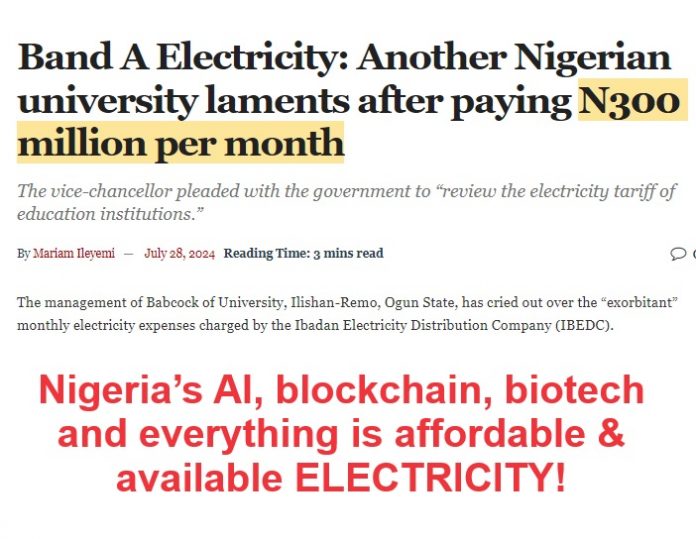
What is going on in Nigeria? Can you imagine a university paying N300 million (about $250,000) in a month? “The management of Babcock of University, Ilishan-Remo, Ogun State, has cried out over the “exorbitant” monthly electricity expenses charged by the Ibadan Electricity Distribution Company (IBEDC). The Vice-Chancellor/President of the university, Ademola Tayo, said the university paid N300 million in May after the increase in tariff of electricity consumers on Band A.” – Premium Times.

Prices of fuel are up; electricity is up. For companies, how do they produce and stay competitive? I challenge our leaders to rethink some of these policies before Nigeria economically folds from within. I cannot see how a small private university (graduated 2,842 students) can afford this type of bill.  If you extrapolate, it means ABU Zaria, UNN, UI and peers may need a state budget to pay electricity bills alone.

Respectfully, it is time to revisit some of these policies. It is indeed time because some are delivering negative results. My position remains that Nigeria must subsidize electricity for these A customers even as residential customers pay full rate. There is no economy where you do not have subsidies. Now that we are not subsidizing forex, maybe electricity should be considered.

I just want to caution the Honourable Minister, you cannot phase out electricity tariff; it would be a bad policy. What you can do is to phase out all for commercial customers, modulate for some residential customers especially in rural areas, but sustain subsidy for industrial customers to make them globally competitive as energy is a huge component of production.

For industrial customers, if a $100m subsidy helps to improve output by $15 billion, when you tax that output and activity associated with it, you can recover that $100m. But if a high tariff makes their products so expensive that the only option is Chinese products, Nigeria loses. Always remember that whenever Nigerian Customs beats annual revenue targets  on import duties, we are de-industrializing Nigeria; reverse that for us.

Electricity is our AI, blockchain, etc; we must focus and fix it in Nigeria before the distractions as no economy can leapfrog energy!

We must work on the root cause why electricity is so expensive in Nigeria. In my office in Owerri, we are not connected to the national grid; we run two generators to escape the insane bills.

Significant Losses in Manufacturing Sector

Many factors are impacting the manufacturing sector, and the government is losing a lot of tax revenue.

The Federal Inland Revenue Service (FIRS) has said all manufacturing companies in the country lost about N1.7 trillion last year as a result of the forex exchange crunch which forced many of them to discontinue operations.

Chairman of the FIRS, Zacch Adedeji, disclosed this on Monday during an interactive session with the Senate Committee on Finance at the National Assembly Complex, Abuja.

“I don’t know anybody that followed in the last one year, all manufacturing entity in Nigeria, they declared a total of N1.7 trillion losses just as a result of forex and we are saying that okay, one sector of the economy had declared N1.7 trillion losses and ask me how does that concerns government.

“It concerns the government because by our law, we will not be able to collect any taxes from them until they recover all those losses, till next 10 years, five years. Even when they make a profit next year, they will tell you they have losses they are carrying forward,” he said.

The 70% Windfall Tax on Banks’ FX-related Profits

Added: Apparently, the government lost tax revenue from the manufacturing sector even as banks were cleaning profits due to the forex adjustments. To balance the indices, it decided to retroactively tax the banks which benefited from the FX changes.

The Future of Contactless Payment Technology

0

In recent years, contactless payment technology has emerged as a transformative force in the financial industry. This technology is currently reshaping the payment landscape, with smartphone-based payments accounting for more than 50% of global revenue.

Driven by technological advancements, contactless payment technology has seen a significant surge in popularity as it is increasingly becoming a preferred choice of payment for consumers across the globe.

A Forbes article “The Future of Contactless Payments: Three Predictions for the next five years”, revealed in one of the predictions that contactless payments will supersede cash and traditional credit cards.

The article further revealed that contactless payments have continued to gain widespread adoption with 48 countries increasing their spending limits on contactless transactions. The average contactless limit increase after COVID-19 was 131%.

Similar increases are expected in the U.S., which currently has a limit of $100. Even countries that prefer cash payments, such as Germany, have become enthusiastic adopters. Before the pandemic, Germany had 35% of transactions being contactless, now more than half of overall purchases are touchless.

These preferences by customers are poised to likely cause contactless payments to overtake cash and traditional credit cards within the next three to five years. At the Zenith Tech fair event held in 2023, Vice President & Head, West Africa Andrew Uaboi, revealed that 74% of business owners expect consumers to prefer contactless payment.

A recent study reports that 27% of small business survey respondents have seen an increase in customers using their mobile phones or contactless cards to pay. Also, according to a March 2020 report, the global contactless payments market size is expected to go from $10.3 billion in 2020 to $18 billion in the next five years, which corresponds to an 11.7% compound annual growth rate (CAGR).

The contactless payment market has continued to skyrocket, and is forecasted to quadruple to $164.15 billion by 2030. Alongside merchants, Central Banks across the globe, are actively pushing out a central bank digital currency (CDC) to capitalize on the contactless trend.

With a growing number of consumers and businesses embracing this technology, a report by Juniper Research revealed that the value of contactless transactions is expected to reach $6 trillion by 2024, up from $2 trillion in 2020. This surge is fueled by the widespread use of contactless cards, and mobile wallets, amongst others.

Here’s a look at how this technology is reshaping the payment landscape

Increased efficiency for businesses

A significant number of merchants say contactless payments have helped shorten checkout lines, reducing wait times for customers. They further reveal that contactless payments have decreased average transaction times, helping to streamline operations. Contactless technology offers a seamless payment experience, which explains why 84% of merchants say an increasing number of customers are using them.

Enhance convenience for consumers

The heightened convenience of contactless payment solutions benefits customers as well. Merchants say contactless payments have improved customer satisfaction. As a hassle-free way to make purchases (and one that eliminates the need for physical currency), 45% of respondents to a global consumer survey said they prefer contactless payments, to traditional cash transactions.

Elevate security for transactions

The security protections of contactless payments- including circuit chips, encryption, and network tokenization, benefit consumers, merchants, and financial institutions. Three in five merchants that accept contactless cards indicate a decrease in fraud rates, particularly reduced card skimming, which benefits consumers and BFS providers alike. With enhanced security in mind, nearly two-thirds of consumers will shop with merchants accepting contactless payment over those not.

Challenges and Considerations

While the future of contactless payments looks promising, there are several challenges to address:

1. Security Concerns: Despite advancements in security measures, concerns about data breaches and fraud persist. Ensuring robust security protocols and educating consumers about safe payment practices are essential to mitigate these risks.

2. Infrastructure Development: The widespread adoption of contactless payments requires robust infrastructure, including POS terminals and digital payment networks. Developing this infrastructure, especially in emerging markets, is crucial for the continued growth of contactless payments.

3. Digital Divide: While contactless payments offer numerous benefits, there is a risk of exacerbating the digital divide. Ensuring that all segments of the population have access to digital payment solutions and the necessary digital literacy is vital for inclusive growth.

Conclusion

The mutual benefits of contactless payment technology are transforming the future of transactions, not just for customers but for merchants and financial institutions alike. From simplified payment processes to amplified security measures for each transaction, contactless payment solutions help power a frictional payment experience that will continue to improve over time.

This mode of payment has no doubt become a catalyst for the next generation of payments, and the gateway for the countless possibilities in the world of connected devices. As the payment landscape evolves, we can expect more secure, convenient, and innovative solutions that cater to the needs of a diverse global population.

Operating System Kernel, Microsoft Weakness and Crowdstrike Massive Outage

0

The massive CrowdStrike outage that took down millions of computers last week will cost Fortune 500 companies more than $5 billion, one insurer now says. Banking and healthcare companies could take the brunt of the hit, as will the major airlines. CrowdStrike said Wednesday that buggy test software was to blame for the outage, which crashed more than 8.5 million Windows systems. The company is vowing to improve testing of those updates, plus stagger the deployments of future updates to limit impact. Insured losses from the incident could range from $540 million to more than $1 billion. (LinkedIn News)

Key things to Note:

  • The creation of the Internet was not fully understood by those in power, including technologists, as evidenced by the openness of operating systems like Windows.
  • Windows allowed access to both kernel space and user space, providing developers with significant power and flexibility.
  • Security companies, like Symantec and McAfee, leveraged kernel access to develop antivirus and malware detection software in the 2000s.
  • Microsoft introduced PatchGuard in the run-up to Windows Vista to restrict third-party access to the kernel, sparking backlash from security companies.
  • Despite initial resistance, Microsoft eventually made concessions to security software makers under pressure from the European Commission.
  • CrowdStrike, a cloud-based security company, recently caused a widespread system crash due to a faulty update that impacted millions of Windows computers.
  • CrowdStrike’s software operates in kernel space, making its bugs capable of crashing entire computers, unlike programs that run in user space.
  • Microsoft’s ability to restrict access to kernel space is limited due to agreements made with regulators following antitrust complaints.
  • The recent system crash highlights the ongoing debate over the appropriate level of access to kernel space for security software and the implications for tech regulation.
  • Cloudflare CEO Matthew Prince warns about the potential consequences of consolidating security under one provider like Microsoft, highlighting the importance of open competition among security vendors.
  • Prince argues against standardizing security solutions on Microsoft, emphasizing the need for diverse security providers to prevent potential catastrophic failures.

In the realm of technology, the debate over access to kernel space in operating systems has taken center stage, sparking discussions on its implications for software development and cybersecurity. Kernel space serves as the protected core of an operating system where critical functions operate, while user space accommodates user applications. Recent events like CrowdStrike’s system crash due to a faulty update have underscored the importance of regulating access to this crucial area for security software. This issue ties into broader themes such as tech regulation and the delicate balance between fostering innovation, ensuring competition, and safeguarding user safety in the rapidly evolving tech landscape.

Moreover, historical contexts like Microsoft’s past antitrust complaints shed light on how regulatory interventions can shape market dynamics and influence technology companies’ trajectories. As cybersecurity threats continue to evolve, there is a growing emphasis on open competition driving technological advancements in antivirus and malware detection software. The future outlook points towards ongoing debates surrounding kernel space access regulation for security software and its potential impact on industry competitiveness. Ultimately, navigating these complex intersections between innovation, regulation, and security will be crucial in shaping the future landscape of technology companies and cybersecurity practices worldwide.

Yet, while acknowledging the complexity of technological advancements and the distributed nature of expertise involved in their development, it is important to critically assess claims regarding the understanding of foundational technologies like the Internet by individuals in power. While it may be true that not all stakeholders fully grasped every aspect of these innovations, attributing the openness of operating systems solely to a lack of comprehension oversimplifies the intricate decisions and trade-offs made during technology development.

Furthermore, highlighting kernel access as a primary driver for security software innovation overlooks the inherent risks associated with unrestricted access to critical system components. While security companies may have leveraged kernel access for antivirus solutions, emphasizing this aspect without considering potential vulnerabilities introduced by such access presents an incomplete picture of cybersecurity challenges.

In discussions surrounding regulatory influence on tech giants and market dynamics, it is essential to approach claims about concessions made under regulatory pressure with caution. While regulators can play a role in shaping industry practices, attributing significant shifts solely to external pressure neglects internal strategic considerations and broader industry trends.

Moreover, arguments against standardizing security solutions on specific providers should consider both the benefits of diversity among security vendors and potential advantages of standardized protocols for enhancing cybersecurity resilience. Balancing competition with interoperability and standardized practices can be crucial for addressing evolving threats effectively while ensuring robust protection for users across diverse technological ecosystems.

The Igbo Women’s August Meeting

0

As August arrives, let me show my admiration to the special people who continue to build a Nation. Yes, every August, married Igbo Women return home, hold meetings and architect roadmaps for their matrimonial communities:

August meeting is an annual congress held by the Igbo women in August, it is a massive homecoming whereby Igbo women in the diaspora and the cities travel back to their matrimonial villages to meet with their local counterparts to discuss matters about the community development, conflict Management, human development, and other socio-economic and cultural initiatives. The meeting is a three days ritual and it is divided into three parts, the first is held at the village level, the second within the community, and the third is held in churches where thanksgivings are held to mark the end of the meeting”.

This meeting happens in every Igbo community in Southeast Nigeria and beyond. They examine  everything, from fixing schools to empowering women in rural areas. Yet, despite what they do, these women rarely ask for accolades. Their husbands stay in the cities while they are doing the strategic works to fix Igbo communities. Why do Igbo Women do all they do without blowing the trumpet? Follow me…

I posit that Igbo Women generally want their husbands to be stars. In other words, Igbo Women derive so much joy when their husbands are successful or as seen as successful. Because of that, they mask their huge impacts, promoting their husbands.

That reverence becomes evident when you see a young lady of the same age as the husband calling the man “Nna-anyi” [our lord]. When a mother tells the daughter “Di bu ugwu nwanyi” [husband is the dignity of a woman], what she is saying is clear: above all, adore and respect that man.

Men respond by anointing wives as “odozi aku” [one who keeps and preserves wealth] and “ori aku’ [one who enjoys wealth]. A man may not have a watch but will thrive to buy a gold-plated watch for the wife! Yes, they acknowledge that until the women have determined to preserve the wealth, building it is all vanity.

But remember: the person who keeps wealth is the one who knows about the wealth. Yes, when the stakes become high, women take over. In 1929, Aba Women made it clear to the British that some of those new unjust taxes would not be accepted, even though men had agreed. It was then the British knew the real accountant generals of every Igbo family.

Mothers of the Nation, as you travel for the August Meeting, I wish all safe travels. 

Ndubuisi Ekekwe

Inaugural President,  Uke-Udo Ugwunta Ovim 

(Peace Age Grade, Ugwunta Ovim, Abia State)