DD
MM
YYYY

PAGES

DD
MM
YYYY

spot_img

PAGES

Home Blog Page 3057

Guinness Nigeria Reports N73.6bn Pre-tax Loss for FY 2024

0

Guinness Nigeria Plc, one of the country’s leading brewery companies, has reported a significant pre-tax loss of N73.6 billion for the financial year ending June 30th, 2024.

This stark loss represents a 233% decline compared to the N22.1 billion pre-tax loss reported in the previous year. The primary factor contributing to this financial downturn was the depreciation of the Nigerian Naira, which adversely affected the company’s bottom line, particularly in relation to its foreign currency loans.

The financial year under review was marked by several challenges for Guinness Nigeria. Despite the company’s revenue increasing by 30.5% to N299.5 billion from N229.4 billion in FY 2023, the overall financial performance was heavily impacted by the rising costs and financial charges associated with foreign currency loans.

The company reported an FX revaluation loss of N112.3 billion, a staggering 129% increase from the N49.1 billion loss incurred in the previous year. This significant foreign exchange loss was a major contributing factor to the overall financial decline.

Key financial highlights from the fiscal year include:

  • Revenue: N299.5 billion, a 30% year-on-year increase
  • Cost of Sales: N208 billion, a 37% year-on-year increase
  • Gross Profit: N91.5 billion, a 17% year-on-year increase
  • Marketing and Distribution Expenses: N49.7 billion, a 20% year-on-year increase
  • Operating Profit: N25.4 billion, a 9% year-on-year increase
  • Net Finance Costs: N99.1 billion, a 118% year-on-year increase
  • Loss Before Income Tax: N73.7 billion, a 233% year-on-year increase
  • Loss for the Year: N54.8 billion, a 201% year-on-year increase
  • Total Assets: N226.1 billion, a 6% year-on-year decrease
  • Cash Generated from Operating Activities: N100.4 billion, a 75% year-on-year increase

The Losses Points

The company’s gross profit margin suffered due to increased raw material costs, which rose to N149 billion, reflecting a 40% increase from N106.6 billion in the previous year. This surge in costs was partly driven by inflationary pressures and the devaluation of the naira, which increased the cost of imported raw materials.

Additionally, Guinness Nigeria’s trade receivables net expected credit loss for the financial year stood at approximately N12.1 billion, a 21% increase from the N10 billion reported in the prior year. This increase indicates a growing challenge in collecting payments from customers, further straining the company’s cash flow and financial stability.

Diageo’s Exit and Tolaram’s Entry

The financial challenges faced by Guinness Nigeria come at a time of significant ownership changes. The company’s parent company, Diageo Plc, recently sold its majority shareholding to Tolaram Plc, marking the end of an era and the beginning of a new chapter in Guinness Nigeria’s history. The relationship with Diageo has been a critical aspect of Guinness Nigeria’s operations, particularly concerning financial arrangements and market strategies.

According to the company’s financial statements, Guinness Nigeria had an outstanding loan of $22.5 million to Diageo Plc. At the end of the financial year on June 30, 2023, this loan had a face value of N17.9 billion, which increased to N39.3 billion by the end of the 2024 financial year.

Moreover, the company’s strategy to manage its foreign exchange exposure included a significant reduction in letters of credit liabilities, which dropped to N814 million from N45.8 billion in the previous year. This reduction aligns with a broader trend among Nigerian subsidiaries of foreign-based companies, which have been relying more on intercompany loans with more favorable terms than traditional bank credits to manage their FX requirements.

However, the brewing industry in Nigeria remains highly competitive, with local and international players vying for market share. While the financial year 2024 was undoubtedly challenging for Guinness Nigeria, the transition in ownership from Diageo to Tolaram may present new opportunities for the company.

Although the immediate focus appears to be on stabilizing the company’s financial performance and addressing the foreign exchange losses, the new ownership could potentially bring fresh perspectives and strategies to rejuvenate the company’s market position and operational efficiency.


Crypto Mining Game-Changer! BlockDAG X1 App Spurs $61M Presale, INJ & Dogecoin Forecasts Unveiled

0

Injective’s fresh approach to decentralized finance is turning heads, promising a bright future with optimistic price projections. Dogecoin, the renowned meme-coin, is navigating ups and downs, yet still holds promise for both immediate and future gains despite recent drops in its value. BlockDAG, meanwhile, stands out as the leading cryptocurrency, transforming mobile mining with its innovative X1 Miner App.

The app’s energy-efficient mining algorithm and enticing referral program have catapulted its presale earnings to $61 million, with a staggering 12.3 billion coins sold. These features position BlockDAG as a dominant force ready to reshape the crypto landscape, presenting an attractive investment opportunity.

INJ Price Projection: Growth and Position in the Market

The Injective Protocol (INJ) is carving out a significant niche in the crypto sphere. Despite market volatility, projections suggest a possible increase to $36, thanks to its unique positioning and appealing staking rewards. INJ is currently trading around $20.45, with a market cap of $1.91 billion and a strong daily trading volume of $375.74 million.

Analysts stress the importance of maintaining support levels between $16.5 and $18 for continued growth. With an Annual Percentage Yield (APY) of about 20%, INJ presents a lucrative investment prospect. The outlook for the Injective’s price remains favorable, anticipating substantial gains ahead.

Dogecoin Forecast: Market Volatility and Outlook

Dogecoin is well-known in the meme coin arena but faces current market instability, with uncertain prospects of either recovery or further decline below $0.1. In recent trading sessions in Europe, DOGE experienced notable declines. However, a spike in trading volume points to ongoing interest in the coin.

Experts suggest that strategic actions could revive Dogecoin, with forecasts indicating opportunities for both short and long-term profitability. Investors are encouraged to keep a close watch on these developments, as the future of Dogecoin continues to unfold.

BlockDAG X1: A Game-Changing Mining App

The BlockDAG X1 Miner App turns smartphones into potent BDAG coin mining devices. Available on the Apple Store, it features an energy-efficient algorithm that conserves battery life and data. Users can mine up to 20 BDAG daily and enhance their earnings through a referral system that boosts mining rates as referred users actively mine.

The app provides a simple and quick onboarding process. To create an account, swipe right on the “Swipe Me” button on the main screen, select “Continue with Phone Number,” choose your country code, and enter your phone number. Click the “Send OTP” button, receive a 4-digit OTP on your registered phone, and enter it to verify your account. If the OTP expires or is incorrect, request a new one. Once verified, click “Activate BlockDAG X1” to access mining functionalities.

The X1 app has created a significant buzz, driving the presale to an impressive $61 million and selling 12.3 billion coins in the current 20th batch at $0.015 each. This excitement has led to a rush of investors securing their spots, enhancing mining opportunities, and providing rewards for active participation.

Concluding Thoughts

While Injective and Dogecoin offer interesting investment opportunities with their dynamic market activities and promising forecasts, BlockDAG claims the spotlight. Its X1 Miner App, featuring an energy-conserving algorithm and a rewarding referral program, has significantly fueled its presale success, establishing it as the most sought-after cryptocurrency. For those exploring cutting-edge and profitable crypto projects, BlockDAG’s revolutionary impact on the market makes it a top contender.

Join BlockDAG Presale Now:

Website: https://blockdag.network

Presale: https://purchase.blockdag.network

Telegram: https://t.me/blockDAGnetworkOfficial

Discord: https://discord.gg/Q7BxghMVyu

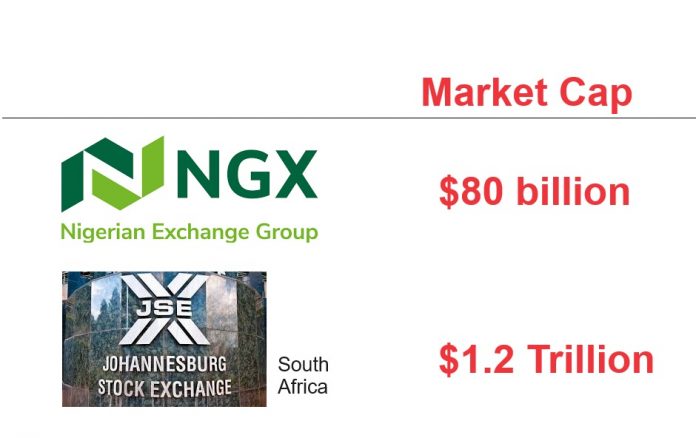
Comparing Nigeria and South Africa’s Stock Exchanges: $80B vs $1.2T

2

Comment: You wroteFor South Africa’s rand,  the Naira has lost a factor of 6 over the same period (1 Rand was about N15 in 2015; today, it can buy N90).“  What other things do I not know about Nigeria and South Africa in the capital market.

My Response: You know everything but let me simply add from the small file here. First, one bank in South Africa can buy all the banks in Nigeria, on current market valuations, and still have a change. Secondly, one company in South Africa across all its subsidiaries needs just 50% of its value to buy every company in the Nigerian stock exchange.

Then, the big one: the total value of the Nigerian stock exchange is about $80 billion using a favourable exchange rate; South Africa’s Johannesburg Stock Exchange is worth about $1.2 TRILLION.

I guess you know these things, and those innuendos from our leaders on how Nigerian banks are making tons of profit and ripping customers off. The fact is this: Nigerian banks underperform when you benchmark their assets because they do not have the field (growing economy and market) to do business. These are small entities lost in a sea of untapped and unlocked opportunities.

That our upward moving hike on interest rate makes them “collect” should not cloud our thinking that our capital market and banking sectors remain largely muted when you consider that we are at least 3.5X the population of South Africa. The high interest rates in our banking halls are due to the prime rate which the Central Bank of Nigeria (CBN) is responsible for. Banks do not set those rates. If CBN picks from Japan and sets the prime rate at 0.25%, we can get interest at about 6% in Nigeria (extra covers insurance, operations, profits, etc).

(Note: that low rate will be disastrous due to inflation I must note)

Of course, this is not to defend the banks for those mindless fees; I am simply saying that Nigeria needs leaders who can think of how to EXPAND opportunities over mere taxing the small piece we have. 

Question: Prof, outside the extractive sector, which sector in Nigeria is comparable to SA in Value?

Startups – Nigeria before May 2023 was outperforming South Africa across many indicators. While they have bigger banks, we built bigger fintechs, creating continental Africa’s largest species in that new sector. But unlike South Africa, 99% of the leading startups in Nigeria are not Nigerians, but Delaware (USA) companies, technically meaning that even though Nigeria created them, the value goes to America. So, in 5-7 years when we are expected to renew our stock market, Nigeria will have none as these firms will likely not list in Nigeria. As I have noted in Harvard, every 10 years, something new happens in Nigeria – 1990s gave the new generation banks; 2000s brought voice telephony; 2010s gave us the mobile internet; we’re moving into application utility era. But unlike those past eras, the new ones may not deliver value at home.

Why Retroactive Taxing of Nigerian Banks Is A Bad Policy

My position is this: Nigeria made a mistake when it taxed our relatively poor banks. The government should have mandated them to lend 70% of the FX-anchored vapour gains, under the central bank supervised apparatus, at half of their typical interest rates. This will boost the economy and help the government’s playbook to grow the economy. But plucking the money out of the banking sector to be spent by bureaucrats negatively impacts the economy.

Traditional Banks Vs Custodial Wallets in Modern Financial Landscape

0

The financial landscape is undergoing a significant transformation with the advent of digital currencies and blockchain technology. This shift has brought to the forefront a debate between the use of traditional banks and custodial wallets for financial management and security. Understanding the nuances of each can help individuals and businesses make informed decisions about managing their assets.

The Pillars of Traditional Finance

Traditional banks have been the cornerstone of financial systems worldwide, operating on the principle of fractional reserve banking. This system allows banks to lend out a portion of customer deposits, thereby stimulating economic growth through increased capital availability for lending. While this model has supported economic activity, it also exposes depositors to risks such as counterparty default and liquidity challenges during bank runs. The digital age has introduced additional threats, including cyberattacks, which necessitate constant vigilance.

The New Frontier in Asset Management

Custodial wallets, integral to the Bitcoin and broader cryptocurrency ecosystem, offer a different approach to asset management. These wallets, often provided by centralized exchanges, entrust private key management to a third party. This arrangement bears a superficial resemblance to traditional bank accounts in terms of fund accessibility. However, the underlying mechanisms differ significantly, with custodial wallets offering potentially faster settlements, lower costs, and a different security paradigm.

One of the most significant advantages of custodial wallets is the speed and efficiency of transactions. Blockchain technology enables faster settlements and potentially lower costs, bypassing the traditional banking system’s layers of processes and fees. Moreover, custodial wallets can contribute to financial inclusion by providing services to those who are unbanked or underbanked, a demographic often overlooked by traditional banks.

Despite these advantages, custodial wallets are not without their challenges. The reliance on a third party to manage private keys introduces a level of trust that may not sit well with all users. Additionally, the regulatory environment for cryptocurrencies is still evolving, which can lead to uncertainty and potential risks for custodial wallet users.

As the crypto industry matures, traditional banks are exploring ways to integrate digital custody services. Institutions like Singapore-based DBS Bank and New York’s BNY Mellon are developing platforms to offer custody services for digital assets, signaling a potential convergence of trust models between traditional banks and the crypto world.

One of the critical differences between traditional banks and custodial wallets lies in their approach to security and fund accessibility. Traditional banks are subject to regulatory protections like the Federal Deposit Insurance Corporation in the United States, which offers a degree of security to depositors. In contrast, custodial wallets rely on the security protocols of the service provider, which can vary widely in robustness and effectiveness.

The debate between traditional banks and custodial wallets is a reflection of the broader evolution of financial services. As we move forward, it is essential to stay informed and adapt to the changing landscape, making choices that align with our financial goals and values. The future of finance is not a zero-sum game; it is an expanding universe of possibilities.

Revolut Secures Banking License from UK Financial Regulator

Meanwhile, in a landmark development for the fintech sector, Revolut has successfully secured a banking license from the UK’s Prudential Regulation Authority (PRA) after a three-year wait. This pivotal moment grants the London-based financial technology firm the ability to expand its product offerings to its UK customers, marking a significant milestone in its growth trajectory.

Revolut, founded in 2015 by Nik Storonsky, has rapidly evolved from a payments service to a financial powerhouse, offering loans, stock trading, and cryptocurrency transactions. With over nine million customers in the UK and forty million globally, Revolut’s journey towards a banking license has been closely watched by industry experts and consumers alike.

The acquisition of the banking license is expected to propel Revolut towards a stock market listing, a goal that the executives have long aspired to achieve. Despite facing regulatory scrutiny over its internal accounting and experiencing delays in the publication of its full-year accounts, Revolut has demonstrated resilience and adaptability. The company has reported a record pre-tax profit of 438 million pounds for 2023, showcasing strong user growth and a surge in interest-related income.

For Revolut, this license is not just a regulatory approval but a gateway to leveling the playing field with traditional banks. It enters the “mobilization” stage, which allows it to finalize its UK banking operations before a full-fledged launch. During this period, Revolut will have the opportunity to secure investments, recruit staff, and enhance its IT systems, although it will operate with a limited deposit acceptance capacity.

The UK banking license also means that Revolut’s customers will now benefit from the Financial Services Compensation Scheme, which offers protection for individual deposits up to £85,000. This is a reassuring factor for customers, providing a safety net that was previously unavailable.

The United Kingdom, known for its robust financial services sector, offers a comprehensive framework for entities seeking to obtain a banking license. The process, overseen by the Financial Conduct Authority (FCA), is meticulous and designed to ensure that only firms that are ready, willing, and organized to comply with regulatory requirements are granted authorization.

To embark on this journey, firms must first understand the specific type of license they require and the regulated activities they wish to undertake. This could range from deposit-taking to investment management or consumer credit services. The FCA provides a detailed list of regulated activities and exemptions, which is crucial for applicants to review.

The FCA emphasizes the importance of being ready to comply with ongoing regulations and any future rules. The application fee varies based on the complexity of the application, and firms must demonstrate their ability to meet the FCA’s threshold conditions at all times.

Revolut’s success in securing the UK banking license is a testament to the evolving landscape of the financial services industry, where technology-driven firms are increasingly challenging traditional banking institutions. It underscores the potential for fintechs to revolutionize the way financial services are delivered, emphasizing convenience, innovation, and customer-centricity.

As Revolut embarks on this new chapter, the fintech community and consumers eagerly anticipate the enhanced products and services that will emerge. With a UK banking license in hand, Revolut is poised to redefine the banking experience for millions, reinforcing its position as a formidable player in the global financial arena.

Ripple Effects of Global Tech Outages on Critical Infrastructures

0

In an unprecedented event, a series of global tech outages have rippled through critical infrastructures worldwide, causing widespread disruptions. The incident, which began with a faulty software update from cybersecurity firm CrowdStrike, has led to approximately 8.5 million Windows operating systems crashing globally. This malfunction has not only affected businesses but also essential services such as airlines, healthcare, public transit, and financial institutions.

The scale of the outage is historic, with the worldwide financial damage estimated to be at least $10 billion. The update, intended to protect systems from cyber threats, ironically became the source of a significant threat itself. The malfunction caused computers to either enter into a boot loop or boot into recovery mode, leaving many services unable to function.

The incident has highlighted the vulnerabilities in our increasingly interconnected digital infrastructure. It underscores the importance of robust testing and backup systems to prevent such widespread failures. As organizations and governments scramble to recover, questions are being raised about the reliance on centralized systems and the need for decentralized alternatives that can offer greater resilience in the face of such challenges.

To prevent such outages in the future, several strategies need to be implemented:

Rigorous Quality Assurance: Ensuring that updates and patches undergo thorough testing before deployment can catch potential issues early. CrowdStrike’s incident was attributed to a bug in their quality control system.

Robust Change Management: IT change management should include structured approaches to system updates, risk mitigation, rigorous testing protocols, release planning, and rollback plans.

Decentralization: Reducing reliance on centralized systems can prevent a single point of failure from causing widespread disruption. Exploring decentralized alternatives could offer greater resilience.

Disaster Recovery Planning: Organizations must have effective disaster recovery plans that can be quickly enacted. This includes having backups and redundancies to ensure continuity of operations.

Transparent Communication: During crises, clear and transparent communication is vital. Keeping stakeholders informed can help manage the situation more effectively.

Education and Training: Regular training for IT staff on the latest technologies and potential threats can prepare them to better handle unexpected issues.

Investment in Cybersecurity: Increasing investment in cybersecurity can protect systems from both internal bugs and external threats.

The tech industry must learn from the CrowdStrike outage and work towards a more secure and reliable digital infrastructure. By implementing these strategies, we can hope to mitigate the risks of such catastrophic events in the future.

The recovery process has been slow, with many systems requiring manual fixes. This has put a spotlight on the need for better disaster recovery planning and the importance of having contingency plans that can be quickly enacted. The incident also serves as a reminder of the cascading effects that failures in technology can have on society, especially when critical systems are involved.

As we move forward, it is crucial for the tech industry to learn from this incident and implement stronger safeguards. This includes more rigorous software testing, transparent communication during crises, and the development of more resilient infrastructure. The global tech outage of 2024 will likely serve as a case study for years to come, influencing how we approach cybersecurity and the management of critical systems.