DD
MM
YYYY

PAGES

DD
MM
YYYY

spot_img

PAGES

Home Blog Page 3128

Mt Gox Impacting Crypto Market Pricing Index

0

The cryptocurrency market is facing a pivotal moment as the long-awaited Mt. Gox repayments commence. This event marks a significant milestone in the history of digital assets, as it not only represents the resolution of one of the most infamous exchange collapses but also poses critical implications for the market’s dynamics.

Mt. Gox, once the largest cryptocurrency exchange, filed for bankruptcy in 2014 after a series of security breaches led to the loss of 850,000 bitcoins. The saga has lingered over the crypto community for a decade, casting a shadow of uncertainty and skepticism. However, recent developments indicate that repayments to creditors have begun, with a substantial amount of bitcoin being moved in preparation for distribution.

The market has reacted with apprehension as the potential influx of a significant volume of bitcoin could exert downward pressure on prices. The fear of a sell-off is palpable, with bitcoin’s value witnessing a notable decline in anticipation of the repayments. This sentiment is echoed by the movements of other large bitcoin caches, including those held by governments, further contributing to market volatility.

One of the primary lessons is the critical importance of robust security measures. The Mt. Gox hack underscored the need for exchanges to implement enhanced authentication methods, conduct regular security audits, and adopt comprehensive security protocols to safeguard users’ assets. The adoption of multi-factor authentication and cold storage for user funds has become more prevalent as a direct consequence of the Mt. Gox breach.

Transparency and accountability have also emerged as pivotal themes in the aftermath of Mt. Gox. The incident highlighted the dangers of opaque operational practices and the necessity for exchanges to maintain open communication channels with their users. This has led to a greater emphasis on the disclosure of security measures, operational procedures, and financial health by exchanges.

Regulatory oversight has gained significant traction as a lesson from Mt. Gox. The lack of regulation at the time of the hack allowed for lax security standards and operational practices that ultimately failed users. In response, many jurisdictions have introduced regulations to ensure compliance, protect investors, and improve customer protection. These measures aim to prevent a recurrence of such catastrophic events in the future.

The Mt. Gox saga has also accentuated the value of decentralized exchanges, which, by design, do not hold their customers’ funds and are less susceptible to hacking attempts. This has spurred innovation in the development of decentralized finance (DeFi) platforms that offer peer-to-peer trading without the need for a centralized intermediary.

In essence, the Mt. Gox incident has been a catalyst for change, driving the evolution of the cryptocurrency industry towards a more secure, transparent, and regulated future. The lessons learned continue to resonate, informing best practices and guiding the development of new technologies to enhance the resilience of the crypto ecosystem.

Despite these concerns, some analysts suggest that the impact of Mt. Gox’s distribution may be less severe than initially feared. The gradual and controlled release of funds, coupled with the strategic management by the trustee, could mitigate the potential for a market upheaval. Moreover, the closure of this long-standing issue may restore faith in the security and stability of cryptocurrency exchanges, fostering a more robust and resilient market environment.

As the crypto community watches closely, the unfolding of the Mt. Gox repayments serves as a reminder of the market’s maturation and the ongoing evolution of digital asset governance. The resolution of this chapter in crypto history may well pave the way for a new era of growth and innovation in the space.

The cryptocurrency market is at a crossroads, and the resolution of the Mt. Gox case will undoubtedly play a crucial role in shaping its future trajectory. As we witness the unfolding of these events, it is clear that the lessons learned from Mt. Gox will inform the development of more secure and transparent practices, ultimately contributing to the maturity of the cryptocurrency ecosystem.

Investment Banking and its Impacts on Development of Fintech in Africa

0

The landscape of financial services in Africa is undergoing a significant transformation, driven by the emergence and growth of fintech. Investment banking, traditionally a sector that deals with large-scale financial transactions and advisory services, is playing a pivotal role in this change. The synergy between investment banking and fintech is not only reshaping the financial sector but also propelling the development of fintech in Africa to new heights.

The impact of investment banking on the development of fintech in Africa can be observed through several lenses. Firstly, investment banks are crucial in providing the necessary capital to fintech startups. With the number of tech startups in Africa tripling to around 5,200 companies between 2020 and 2021, nearly half of which are fintechs, the need for robust funding is more pronounced than ever. Investment banks facilitate this by underwriting deals, providing venture capital, and enabling access to investor networks.

Moreover, the expertise and advisory services offered by investment banks have been instrumental in guiding fintech startups towards sustainable growth and scalability. A report by McKinsey highlights the explosive growth of tech startups in Africa, with Fintech companies making significant inroads into the market, boasting estimated revenues of around $4 billion to $6 billion in 2020. This growth is not just in numbers but also in the quality of financial services being offered.

This is particularly important in a market where fintech solutions are up to 80% cheaper and offer savings returns three times higher than traditional financial services. The strategic guidance from investment banks helps fintech companies navigate complex regulatory environments and scale their operations effectively.

The influx of investment into African fintech is not just about financial growth; it’s also about societal impact. Fintech companies are making financial services more accessible to the general population, many of whom have been historically underserved by traditional banking systems. This is evident in the increased penetration levels of fintech, which, excluding South Africa, stand between 3 and 5 percent, in line with global market leaders.

Furthermore, the COVID-19 pandemic has accelerated the digitalization of financial services, creating a fertile environment for fintech innovation. Investment banks have recognized this shift and are increasingly investing in fintech companies that promise to deliver value in this new digital era.

Investment banks have been quick to recognize the potential of the African Fintech sector, which is evident from the increasing deal sizes and funding proportions dedicated to Fintech. This influx of capital has not only brought jobs and economic growth but has also spurred innovation, leading to more efficient and accessible financial services for the African populace.

The impact of investment banking on Fintech in Africa is also seen in the support for regulatory and governance frameworks. As Fintech companies navigate the complexities of the financial ecosystem, investment banks provide the necessary guidance to ensure compliance and foster trust among consumers and regulators alike.

Furthermore, the intersection of Fintech with sustainable banking and climate finance is an area where investment banking’s influence is profound. Startups focusing on ESG reporting, impact investing, and climate insurance are gaining traction, with investment banks playing a significant role in securing funding and providing strategic direction.

The symbiotic relationship between investment banking and Fintech in Africa is a testament to the dynamic nature of the continent’s financial services industry. With investment banks’ support, African Fintech is not just disrupting but also augmenting traditional financial services, paving the way for a more inclusive and prosperous financial future for Africa.

Implications of ECOWAS’ Single Currency ECO for West Africa

0

The Economic Community of West African States (ECOWAS) has been at the forefront of a significant economic transformation with the proposal of a single currency, the ECO, aimed at enhancing regional integration and economic efficiency among its member states. The introduction of the ECO presents a complex tapestry of implications for the region, both economically and politically.

Economically, the ECO is expected to lower transaction costs, simplify cross-border payments, and potentially boost intra-regional trade among ECOWAS’s 385 million inhabitants. This financial harmonization could spur economic growth, stability, and integration, benefiting the entire West African region. However, the success of such a monetary union hinge on the macroeconomic convergence across the countries and the ability to withstand economic shocks. Lessons from the eurozone suggest that a fiscal pool is crucial for crisis response and for an effective monetary union.

Politically, the move towards a single currency involves the transfer of national political authority to ECOWAS institutions, raising questions about the willingness of member states to subordinate national interests to regional interests. The experience of the eurozone has shown that public opinion can significantly influence the trajectory of a currency union, as seen in the decisions by the Danes, Swedes, and Brits to retain their national currencies largely under public pressure opposed to the euro.

The ECO initiative also brings to light the debate over national sovereignty versus cross-border collaboration. With Nigeria being the region’s biggest economy, there are concerns that it could dominate monetary policy, potentially stalling the projected benefits of the single currency. Moreover, the disparities in economic structure and macroeconomic policies among member states pose a challenge to the creation of an optimal currency area.

One of the critical considerations is the potential relationship between the ECO and major global currencies, particularly the US dollar (USD). The USD is a dominant force in international trade and finance, and its value influences global markets. The introduction of the ECO could alter the dynamics of currency exchange and trade between West Africa and the rest of the world. If the ECO is perceived as stable and reliable, it may reduce the region’s dependency on the USD, allowing for more autonomous monetary policy and potentially shielding the region from external economic shocks.

However, there are challenges to consider. The varying levels of economic development and political stability among ECOWAS member states could pose significant hurdles to the successful implementation of the ECO. Nigeria, as the region’s largest economy, could disproportionately influence the monetary policy, which may lead to tensions within the union. Additionally, lessons from the eurozone crisis suggest that without a fiscal pool and robust governance structures, a monetary union may face severe challenges during economic downturns.

The ECO represents a bold step towards regional economic integration in West Africa. While the potential benefits are considerable, the path to a successful single currency is fraught with complexities that require careful navigation. The ECO’s impact on the USD and the global economy will depend on the execution of this ambitious project and the economic realities that unfold as member states work towards this common goal.

It will require a strong institutional framework, careful policy coordination, and the support of the public to ensure that the ECO becomes a catalyst for economic prosperity in West Africa. The journey towards the ECO is a path filled with both opportunities and obstacles, and its success will depend on the collective resolve of the ECOWAS member states to navigate this complex economic landscape.

Regional Economic, Social differences decreasing in Europe

0

In recent years, Europe has witnessed a significant shift in its regional landscape, with economic and social disparities across various regions showing a marked decrease. This development is a testament to the country’s concerted efforts to foster a more balanced and equitable distribution of resources and opportunities.

In Germany, the Federal Government’s Equivalence Report 2024, approved by the Cabinet, reveals a promising trend towards regional equality. The report indicates that out of 38 equivalence indicators, 27 are converging across regions.  The report highlights a decrease in disparities across a majority of economic, social, and other indicators.

This is a testament to the concerted efforts by the German government to address issues of inequality and promote a more balanced development across its regions. These indicators encompass a wide array of metrics, including municipal tax revenue, unemployment rates, crime rates, birth rates, life expectancy, accessibility to supermarkets, and the proportion of forested areas within the 400 districts and independent towns.

This positive trajectory is not without its challenges, however. Regions with dwindling populations face significant hurdles, highlighting the need for ongoing support and innovative policies to ensure sustainable growth and development. Despite these challenges, the overall trend points to a Germany that is gradually bridging the gap between its wealthiest and most challenged regions.

The report also sheds light on areas where disparities have widened, such as the proportion of skilled labor and experts in the workforce who contribute to social insurance, residential building density, the ratio of children to daycare places, the proportion of single-person households, and the old-age dependency ratio. These findings underscore the complexity of regional development and the necessity for targeted interventions.

Economic integration processes within the EU have also contributed to diminishing regional inequalities. The integration has led to a more homogeneous economic, legal, and political field, promoting social and economic cohesion. This is particularly evident in the gradual economic convergence between Eastern and Western Europe.

Europe has long been a continent of diverse cultures, languages, and economies. The disparities between its regions have been a subject of study and policymaking for decades. However, recent trends suggest a gradual decrease in these regional economic and social differences, signaling a shift towards greater cohesion within the European Union (EU).

The International Monetary Fund (IMF) has highlighted that while productivity gaps largely reflect the level of disparities across regions in advanced European economies, diverging unemployment rates have increased since the Great Recession. The COVID-19 pandemic posed further challenges, as regions with lower teleworkability rates—often poorer regions—faced greater vulnerability. Yet, despite these setbacks, there is evidence of a narrowing gap in regional disparities.

The European Parliament briefing on regional inequalities in the EU supports this optimistic view. The EU Parliament has also noted that while regional disparities have been decreasing across the EU as a whole, they have been increasing within some countries. This paradox highlights the complex nature of regional inequality, which can manifest differently within national borders compared to the broader EU context.

The decreasing regional disparities in Europe signal a move towards a more inclusive and unified continent. This trend presents opportunities for shared prosperity and a stronger collective identity. However, it also calls for continued vigilance and action to ensure that all regions and individuals can benefit from Europe’s growth and progress.

Moreover, studies have shown that the economic differences between East and West Europe are gradually diminishing, fostering a more homogeneous economic, legal, and political field across the EU. This homogenization is crucial for social and economic cohesion, which is a central goal of the EU. The impact of EU integration processes has been profound. Inter-regional inequalities in the EU have strongly declined since 1995 due to the economic, monetary, and political integration of the EU.

Beyond Balance Sheets, The Power of Perception in Markets

1

In the past, the mantra was this: I will just go and execute, and the numbers will do the talking. Interestingly, you can execute, but the numbers will not help you. Simply, how you make money, and where you make money, are more important than the actual numbers on the balance sheet and P&L.

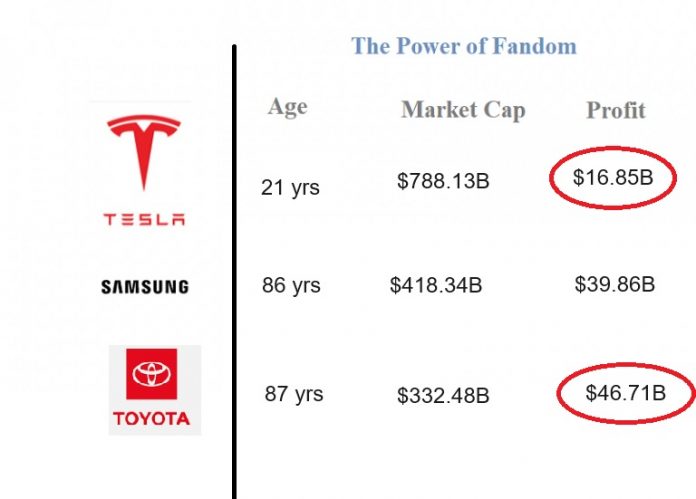
You can generate more $30 billion in profit and still be valued less than 50% of another company in the same industry!

Tesla is a car company which sells “software subscription” and emission credits, and makes all its competitors look lost, even though most are delivering “better automobile numbers”; Toyota sells more than 10 million cars than Tesla, but Tesla is valued at more than 2x.

Remember: Toyota sold around 11.23 million vehicles worldwide in 2023 while Tesla sold 1.8 million vehicles

Look at the profit of Samsung, but see how the market has valued Tesla; it goes beyond absolute $$. Tesla has turned customers into FANS and created a fandom in markets.

Momentum drives the future, and momentum is anchored on Perceptions in markets. But perception is not physics and that means you have to play it.  You can have speed, but companies with velocity win because they have a clear direction.  Markets like companies with clear anchors into the future, and they invest on those growth vistas. Tesla is seen as part of the future and it is rewarded heavily.