
DD
MM
YYYY

PAGES

DD
MM
YYYY

spot_img

PAGES

Home Blog Page 3134

US and German Governments have Traded over $738M Worth of Bitcoin in Two Weeks

0

In a significant move within the cryptocurrency market, recent reports indicate that the US and German governments have transferred a substantial amount of bitcoin, valued at approximately $738 million, to various exchanges over the past two weeks. This action has sparked a flurry of discussions and speculations among investors, analysts, and the general public alike.

The transfers, which were linked to addresses associated with the governments of the United States and Germany, involved large sums of bitcoin being moved to prominent exchanges such as Coinbase, Bitstamp, and Kraken, as well as to over the counter (OTC) desk operator and market maker Flow Traders.

The German government accounted for about three-quarters of the total amount, with its transactions distributed across 30 different transfers, typically occurring around 9 am local time. Although it is not entirely clear whether all the transferred bitcoins were sold, a portion has since been returned to the original addresses, suggesting that not all assets were liquidated.

These transactions represent a notable shift in how governments are handling seized cryptocurrencies. Historically, the US government has auctioned off bitcoin, but the recent activity shows a preference for selling directly on exchanges like Coinbase. On June 26, the US government deposited a single batch of 3,940 BTC to Coinbase Prime, valued at $241.22 million at the time of transfer.

Here are some key considerations:

Market Impact: The sheer volume of these transactions could influence bitcoin’s market price, either through direct selling pressure or by shaping market sentiment. Large transfers can lead to speculation and volatility as traders react to potential selloffs.

Regulatory Signal: These actions might signal a shift in how governments are approaching the regulation and utilization of cryptocurrencies. By choosing to transact on public exchanges, governments are engaging with the crypto economy in a more direct and transparent manner.

Legitimization of Cryptocurrencies: By actively participating in cryptocurrency transactions, governments may inadvertently lend legitimacy to digital assets as a viable component of national financial strategies.

The implications of such large-scale transfers are manifold. For one, they may reflect a growing acceptance and integration of cryptocurrencies within governmental financial operations. Additionally, these moves could potentially influence market dynamics, given the sizeable amounts involved. However, establishing a direct causal link between these government transfers and market prices is challenging.

From an analytical perspective, the data suggests that the US has liquidated or moved to liquidate almost $590 million in bitcoin since November 2020, valued at the time of transfer. This amount is approximately 20% more than what the German government has recently moved. Such activities by state entities could signal various strategic economic decisions, although the exact motivations remain speculative.

The cryptocurrency market is known for its volatility and sensitivity to significant transactions, often referred to as ‘whale’ activities. When governments engage in such large-scale transfers, it inevitably raises questions about their impact on market stability and investor sentiment. While some may interpret these actions as a lack of confidence in the stability of cryptocurrencies, others might see it as a strategic maneuver to capitalize on market conditions.

The recent transfers of bitcoin by the US and German governments are a testament to the evolving landscape of digital currencies and their increasing relevance in global finance. As governments navigate this new terrain, the crypto community will be keenly observing the effects of such moves on the market and what it may signal for the future of cryptocurrency regulations and adoption.
Dior Uses Value-Based Pricing Method, Always Better Than Cost-Based Pricing

0

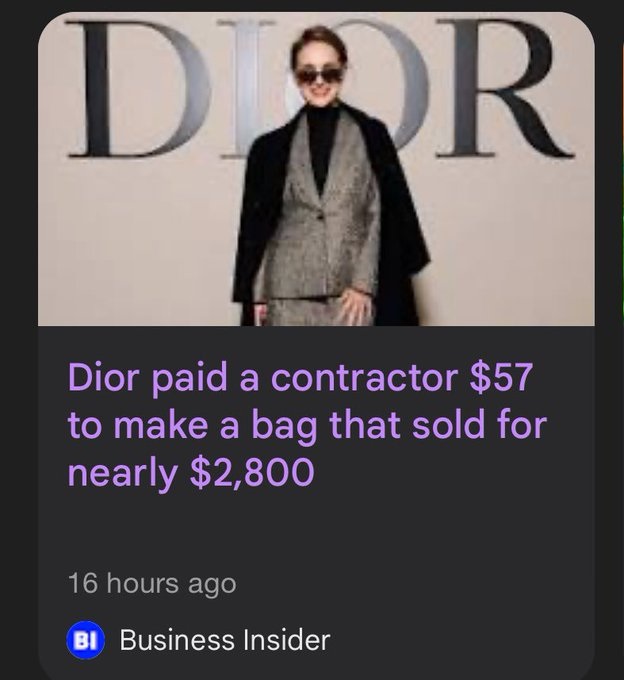
A case study of value-based pricing: “Italian prosecutors have uncovered that luxury fashion brands, including Dior and Armani, have been exploiting migrant workers in Italy to produce their high-end handbags at extremely low costs… The investigation revealed that a Dior handbag, which retails for $2,780, was produced for just $57. ”

Dior and Armani have modeled that their brands deliver so much value that they can put the price tags that high. It is all about understanding pricing psychology and the fact that people buy these products because they are expensive. So, the issue is not the cost of production, but the derivable value, and based on that capture value for the business.

Understand how to price your products.

A business model encapsulates the essence of a firm by providing the compass on how to create value in the company. It is the logic of a business and when you commit to one, you have committed all the factors of production in that business to a destiny. And as you execute that model, creating value in that firm, pricing becomes critical.

At Tekedia Mini-MBA, we have eminent pricing faculty to guide you. Yes, our Faculty members understand the physics of pricing, and how an efficient pricing playbook can unlock growth in a business.

Go here and register for the next edition of Tekedia Mini-MBA and get our early bird discounts with our free books. Do it and let us co-learn in Africa’s largest business school for entrepreneurial capitalism.

Comment

Comment: “Hello prof. I am just thinking, the example of Dior here to my understanding doesn’t fit into the value based pricing strategy. I mean, what is the value derivable from Dior. I think it’s more of a value placing strategy as the price is based on the value the customer placed on the product rather that value been derived from it as I do not see any value derivable from those bag really”

My Response“I think it’s more of a value placing strategy” . It is a luxury product and the value is that only few people can afford it. That is the value! For people to open their wallets to pay for it, they think there is value derivable from it. For Dior to put the price tag, it does think there is value it offers. If not, there would not be an attainment of equilibrium for transactions to take place. So, value is proposed and value is understood!

Yet, do not overthink this. If Dangote writes what you have written, Guardian will make it a leading cover story tomorrow. If what I am writing now is a comment from UN Sec Gen, the New York Times will publish this response. So, what is going on? It is not what is written that matters but the value derivable based on who wrote it.

Make that bag but if it is not Dior, it is not the same thing!

How To Price Your Products

Nigeria’s Signing of $150bn Samoa Deal with Alleged LGBTQ Clauses Ignites Controversy, Allegations of Economic Desperation

0

The recent decision by Nigeria’s federal government to sign the $150 billion Samoa Deal has ignited a firestorm of controversy, primarily due to claims that the agreement includes clauses mandating support for LGBTQ rights.

According to Daily Trust, the deal, signed on November 15, 2023, in Samoa, ostensibly requires underdeveloped and developing nations to uphold LGBTQ rights as a condition for receiving financial aid and other support from advanced countries.

On July 1, Abubakar Atiku Bagudu, Nigeria’s Minister of Budget and Economic Planning, confirmed the ratification of the agreement during a European Union (EU) reception in Abuja. However, the statement quickly sparked backlash. Bagudu’s media assistant, Bolaji Adebiyi, sought to calm the uproar by clarifying that the documents Bagudu referenced pertained strictly to economic development and did not mention LGBTQ or same-sex marriage.

Adebiyi maintained that the minister signed an agreement focused on a $150 billion trade component, not LGBT issues.

Despite these assurances, the agreement has met with fierce resistance from various Nigerian groups. Sonnie Ekwowusi, a Lagos-based lawyer and chairman of the Human and Constitutional Rights Committee of the African Bar Association (AfBA), criticized the signing in a scathing article.

Ekwowusi described the Samoa Agreement as “nauseating” and a significant threat to Nigeria’s sovereignty, alleging that Articles 2.5 and 29.5 of the agreement legalize LGBT rights, transgenderism, abortion, and teen sexual abuse in African countries.

“The signing of the Agreement by Nigeria constitutes a threat to the sovereignty of Nigeria and Africa. It further debases our democracy,” he said.

Ekwowusi further questioned the competence of Nigerian officials, suggesting they may not have fully understood the implications of the agreement.

“I can wager that neither Minister Atiku Bagudu nor the Nigerian officials or diplomats who signed the Samoa Agreement on our behalf, understand the import of the agreement to Nigeria’s sovereignty, let alone the destructive impact of the Agreement in Nigeria,” he said.

“Not infrequently, Nigerian officials in Geneva, New York, and other places sign international agreements or treaties over a cup of coffee or a glass of wine with little or no knowledge of their contents.”

He noted that Nigeria, along with 34 other African, Caribbean, and Pacific countries, had initially refused to sign the agreement on November 15, 2023, frustrating the EU, which subsequently issued a threat on November 24, 2023.

“This explains why many African bodies including the AfBA have condemned the agreement and respectfully urged African countries not to sign it,” he said.

Ekwowusi called for Nigeria to withdraw from the Samoa Agreement immediately and urged the National Assembly to summon the officials who signed it to explain their actions.

Religious and Political Backlash

Following this development, the Nigerian Supreme Council for Islamic Affairs (NSCIA) reiterated its unwavering stance against same-sex marriage and LGBT issues. Abubakar Akande, the administrative secretary of NSCIA, said the council would not welcome any agreement that goes against Islamic teachings and disrespects Nigeria’s sovereignty.

Similarly, Abdulrazaq Ajani, the leader of the Abuja Muslim Forum (AMF), reported that African CSOs, including AMF, had met with top government officials and members of both chambers of the National Assembly to unequivocally reject the proposed agreement.

Rabiu Yusuf, chairman of the House of Representatives Committee on Treaties, Protocols, and Agreements, stated that the Samoa Agreement had not been brought before the National Assembly for consideration.

Economic Desperation Amidst Dwindling Oil Revenue

Critics argue that the Tinubu administration’s decision to sign the Samoa Agreement, despite its controversial LGBTQ connotations, underscores the government’s desperation to secure loans amid dwindling oil revenue.

Many have reminded the present government that former President Goodluck Jonathan, in January 2014, signed a bill criminalizing same-sex relationships, defying Western pressure and provoking criticism from the United States. The law, which bans gay marriage, same-sex “amorous relationships,” and membership in gay rights groups, includes penalties of up to 14 years in prison.

The Peoples Redemption Party (PRP) has also weighed in, describing the ratification of the Samoa Agreement as a betrayal of Nigerian values and trust. The PRP’s acting National Publicity Secretary, Comrade Muhammed Ishaq, expressed shock and outrage, demanding the government withdraw from the agreement immediately.

“This treacherous move is a betrayal of the Nigerian people’s trust and values, and we demand that the government immediately withdraw from this agreement,” he said.

The government’s decision to sign an agreement that is perceived to compromise national values and sovereignty has called into question, its commitment to preserving Nigeria’s cultural and moral fabric.

Tinubu Inaugurates Presidential Economic Coordination Council, Made up of Dangote, Elumelu and Rewane

0

In a move aimed at stabilizing Nigeria’s faltering economy, President Bola Tinubu inaugurated the Presidential Economic Coordination Council (PECC) on Thursday.

Comprising representatives from various sectors, the council aims to spearhead the administration’s efforts to rejuvenate the nation’s economic growth.

The inauguration, held at the State House in Abuja, marked the unveiling of an accelerated stabilization and advancement plan, which envisions injecting N2 trillion into the economy over the next six months.

The Minister of Finance and Coordinating Minister of the Economy, Mr. Wale Edun, alongside others such as Senator Atiku Bagudu, business mogul Alhaji Aliko Dangote, Chairman of Heirs Holdings Limited, Mr. Tony Elumelu, and Chief Executive Officer of the Financial Derivatives Company Limited, Bismarck Rewane, who made up the council, provided a breakdown of the funding allocations to critical sectors including Health, Agriculture, and Energy.

Central to the accelerated stabilization plan is allocating N2 trillion to stimulate growth in key sectors. According to Mr. Edun, significant portions of the funds are earmarked for Health and Social Welfare, Agriculture and Food Security, and the Energy and Power sector, alongside general business support.

  • * 350 billion Naira for Health and Social Welfare
  • * 500 billion Naira for Agriculture and Food Security
  • * 500 billion Naira for the Energy and Power sector
  • * 650 billion Naira for general business support

Additionally, the administration has rolled out a series of policy measures, tax adjustments, and executive orders designed to reduce the cost of doing business and foster a more conducive economic environment.

However, the formation of the PECC has long been expected. Critics have lambasted Tinubu for his perceived sluggishness in establishing the council, a delay they argue has contributed to exacerbating the country’s economic woes.

Despite assurances from the president, concerns persist about the efficacy and integrity of the proposed spending. Many Nigerians worry that a substantial part of the N2 trillion will be funneled into social intervention programs, which critics argue are ripe for exploitation and looting. The fear is that without stringent oversight and transparency, these funds may not reach their intended targets, thereby failing to deliver the promised economic benefits.

Moreover, the timing and scope of the PECC’s initiatives have raised questions about the government’s strategic planning. With the economy on a downward trajectory, there is widespread apprehension about where the government will source the N2 trillion and how it plans to ensure the funds are utilized effectively. Many have argued that social interventions, while necessary, should not overshadow investments in more sustainable economic activities that can drive long-term growth and stability.

President Tinubu has defended his administration’s approach, noting the coordinated effort between the federal government, state governments, and the private sector. The inclusion of high-profile private sector figures like Dangote and Elumelu is intended to signal strong support and collaboration across different economic segments.

Nevertheless, analysts say the success of the PECC and the broader stabilization plan will hinge on transparent and judicious use of the N2 trillion when injected into the economy. Africa’s richest man Dangote assured Nigerians that the PECC would come up with measures that will help the economy bounce back in the shortest possible time.

The coming months will be critical in determining whether Tinubu’s administration can deliver on its promises and set the nation on a path to sustainable economic growth.

How to Accept MATIC Payments in Your Business?

0

Today’s merchants are constantly hunting for modern solutions to stay on trend. One such modern trend is cryptocurrency acceptance. Polygon (MATIC), one particular cryptocurrency, provides businesses an efficient and cost-effective transaction solution. This piece will elaborate on the benefits of Polygon and how businesses can seamlessly accept MATIC payments.

What is Polygon Crypto?

Polygon is an Ethereum-based Layer 2 scaling solution developed to enhance transaction speed and cut expenses. Polygon achieves this by executing transactions on a sidechain and then reverting them back to the main Ethereum network, making transactions faster and more affordable.

MATIC, the network’s proprietary token, facilitates transactions and fee management within Polygon. By resolving Ethereum’s shortfalls, Polygon delivers faster and less expensive transactions, making it an attractive choice for businesses looking to integrate crypto.

Why You Should Accept Polygon Crypto Payments

Choosing Polygon for your business can bring several benefits. Polygon transactions fare speedy and affordable, greatly outpacing traditional Ethereum-based transactions, making them a cost-effective choice for businesses.

When a business accepts MATIC as a mode of payment, it opens its doors to an expanding market of customers who prefer using this cryptocurrency. As Polygon’s popularity grows, so does the pool of potential customers.

Security is a key advantage of using Polygon. Built on Ethereum’s strong security foundation, Polygon leverages advanced methods like ZK-rollups and Plasma to ensure transaction safety. Moreover, the irreversible nature of MATIC payments reduces the likelihood of chargebacks, a recurrent issue in conventional payment modes.

For businesses dealing with international transactions, Polygon is a boon. It allows consumers to make cross-border payments without concerns about exchange rates or limitations imposed by stringent currency rules.

How to Accept MATIC as a Business?

Numerous benefits of MATIC make accepting Polygon transactions a worthy consideration. Here are the steps you can follow to integrate it into your business:

  • Identify a credible payment provider that supports MATIC. Opt for platforms that simplify the integration of crypto payments in your business and offer the necessary functionalities for smooth Polygon payment processing.
  • Next, set up an account using your chosen payment gateway. This step generally involves providing your contact information and business details and undergoing an identification verification process.
  • After registering, establish your merchant account on the payment gateway to accept MATIC. This step involves detailing your wallet, payment preferences, and business information.
  • Once this is done, integrate the gateway with your website or online store. This process is usually made simple through APIs or plugins provided by the gateway.
  • Now, you’re all set to accept MATIC payments. Through the gateway, customers can send MATIC to your wallet as payment. You can convert these tokens into fiat money or retain them based on your business needs.

Conclusion — Does Polygon Crypto Have a Future as a Payment Method?

With benefits like lower transaction costs, faster processing, robust security, and a growing user base, using Polygon as a payment option can give businesses a competitive advantage. By integrating it into their payment methods, businesses can stay ahead in the digitalised economy.