DD
MM
YYYY

PAGES

DD
MM
YYYY

spot_img

PAGES

Home Blog Page 3139

Key Issues in Iran’s Election

0

The recent presidential election in Iran has the potential to significantly alter the geopolitical landscape, particularly in terms of the country’s foreign relations with major powers such as Russia. The election comes at a critical juncture, with the previous administration’s ties with Russia characterized by a “special friendship” that is now subject to scrutiny and potential reevaluation by the incoming leadership.

The untimely demise of President Raisi and his foreign minister in a helicopter crash has left a void in the trajectory of Iran-Russia relations, which were on the cusp of being formalized through a long-term partnership agreement. This development has cast uncertainty over whether the next president will maintain the same level of interest in fostering a relationship with Moscow.

Iran’s strategic orientation is at a crossroads, with presidential candidates signaling a shift in priorities towards alleviating sanctions and reviving the economy, rather than pursuing a special relationship with Russia. This suggests a possible pivot away from the East and potentially towards improving ties with Western nations.

The implications of such a shift are profound. Iran has historically been a significant player in the oil and gas markets and has collaborated with Russia on various international issues, including Iran’s nuclear program, the Syrian conflict, and security in the Persian Gulf. Moreover, post-2022, Iran emerged as a crucial partner for Russia in plans to establish a transport corridor to circumvent sanctions, highlighting the multifaceted nature of their relationship.

The election’s outcome could redefine Iran’s foreign policy, impacting not only its relations with Russia but also with the West. The direction Iran chooses to take will have far-reaching consequences for regional stability, international security interests, and the global balance of power.

 Here are the main issues dominating the election:

Foreign Policy and Diplomatic Relations: The election could reshape Iran’s foreign policy, especially its relations with Western nations and its stance towards Russia and China. The candidates’ differing views on whether to align more closely with the East or to mend ties with the West will be a decisive factor for voters.

Economic Challenges: Sanctions and the persistent economic crisis have been a significant burden on Iran. The next president will need to address these challenges and find ways to alleviate the impact on the Iranian economy and its people.

Nuclear Policy: Iran’s nuclear program remains a contentious issue, both domestically and internationally. The candidates’ approach to the nuclear policy will likely influence Iran’s negotiations and relations with other countries.

Regional Influence and Security: Iran’s role in regional conflicts, including its support for allies in the Syrian conflict and the Yemen Civil War, is another critical issue. The election outcome could affect Iran’s strategy and involvement in these areas.

Domestic Unrest: There has been a backdrop of domestic unrest, with public outrage over suppression of women and minorities and the government’s handling of civil liberties. The next president will have to navigate these internal tensions and address the demands for more freedom and rights.

Succession of the Supreme Leader: With the aging Supreme Leader Ali Khamenei, the election could also influence the anticipated succession and the future power dynamics within Iran’s political structure.

IRGC’s Role: The growing power struggle between the clerical establishment and the Islamic Revolutionary Guard Corps (IRGC) is a matter of concern for many Iranians. The election might impact the balance of power between these two influential groups.

As the world watches closely, the decision of the Iranian electorate will undoubtedly shape the future course of the nation’s diplomacy and strategic alliances. The election’s aftermath may well determine whether Iran continues to align with Russia and China or seeks to mend and strengthen its ties with Western nations, a choice that will resonate beyond its borders and influence the global geopolitical dynamic.
The Nvidia Prediction And The Next Buying Opportunity

0

A bold call: “Hedge fund manager Eric Jackson has made a bold prediction regarding Nvidia’s stock performance, forecasting that it will reach $250 per share by the end of the year. This projection implies a potential upside of over 100% from its current trading levels, positioning Nvidia to achieve a remarkable $6 trillion valuation”.

At a personal level, I am keeping money as I posit that once Donald Trump wins that markets will re-align. Yes, by Q2 2025, I expect a market correction. The US energy sector will recalibrate. Also, the defense sector will pause because the flames of wars will fade. I wrote last month:

“It turns out to be an illusion: the stock market does well when the world seems to be at peace. Check the major stock markets in the world, they’re hitting new highs. Good People, we can make an argument that during crises (not full blown wars), the world goes Keynesian where we spend, spend and spend. And as that happens, companies make tons of money.”

But who knows…they can invent an AI that can help your bank account balance double weekly while you are at a beach playing Double Weekly Alpha! Why not? SoftBank CEO said they will make AI systems that would be smarter by 10,000X than humans. I think such an AI can begin by freeing us from the bondage of work – and money! Indeed, we cannot even imagine the possibilities since it would be 10,000 times smarter than us.

Hedge fund manager Predicts Nvidia will hit $6 trillion Valuation by year end

0

Hedge fund manager Eric Jackson has made a bold prediction regarding Nvidia’s stock performance, forecasting that it will reach $250 per share by the end of the year.

This projection implies a potential upside of over 100% from its current trading levels, positioning Nvidia to achieve a remarkable $6 trillion valuation. Jackson, who utilizes a proprietary AI and machine learning-driven algorithm at EMJ Capital to pick long and short tech equities, believes Nvidia’s historic rally will continue throughout the year.

Nvidia shares have been at the forefront of the market rally this year, soaring over 150% year-to-date. The company executed a 10:1 stock split this month, with shares closing at $123.99 on June 27. This stock rebound follows a significant price correction earlier in the week that saw Nvidia lose over $400 billion in market value due to a 16% drop. Despite this setback, Jackson maintains that Nvidia is trading cheaply based on its valuation metrics.

Jackson highlighted Nvidia’s price-earnings (P/E) multiple trends over the past five years, noting that the average forward P/E multiple has been 40 times. Following the recent correction, the forward P/E was 39 times. Historically, Nvidia’s P/E multiple has exceeded 50 times on three occasions and approached 70 times twice, indicating potential for further growth.

“We just haven’t seen that euphoria yet,” Jackson told CNBC, suggesting that investor excitement could propel Nvidia’s valuation closer to its historical peaks.

Understanding the P/E Ratio

The P/E ratio is a widely used measure to value a company’s stock, calculated by dividing the share price by the earnings per share.

A higher P/E multiple generally indicates that the company is overvalued, meaning investors are paying more for each dollar of earnings. Jackson believes that as investors focus on Nvidia’s future earnings potential, particularly for 2024 and 2026, the stock’s P/E multiple could rise significantly.

“This is a high flyer,” Jackson noted. “Expectations can reset on a bad earnings report, but they can also get equally overhyped on good news. Despite the enormous run the stock has had, the euphoria hasn’t yet caught up in terms of the go-forward multiple.”

This sentiment suggests that Nvidia’s stock could see substantial gains if investor enthusiasm aligns with strong earnings reports.

Nvidia’s Historic Rise

Nvidia recently stunned the world by emerging as the most valuable company in the world, surpassing tech giant Microsoft. This monumental achievement marked a significant milestone for Nvidia, which has been consistently pushing the boundaries of innovation in the tech industry.

On June 2, Nvidia and leading computer manufacturers introduced a new lineup of systems powered by Nvidia’s Blackwell architecture. These systems are designed to build AI factories and data centers to drive generative AI breakthroughs.

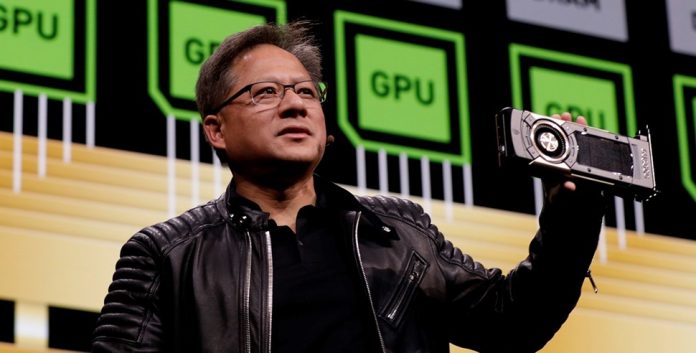
“The next industrial revolution has begun. Companies and countries are partnering with Nvidia to shift the trillion-dollar traditional data centers to accelerated computing and build a new type of data center—AI factories—to produce a new commodity: artificial intelligence,” Nvidia CEO Jensen Huang stated.

Nvidia’s Blackwell products will leverage the Nvidia MGX modular reference design platform to enhance performance for large language model (LLM) inference and data processing. Nvidia MGX aims to meet the faster computing needs of data centers, offering computer manufacturers a reference architecture that enables the quick and cost-effective design of over 100 system configurations.

Jackson believes that as the market recognizes the success of Blackwell chips in the second half of the year, coupled with favorable gross margins and the anticipation of upcoming Rubin chips, investor euphoria will drive Nvidia’s valuation higher.

“I think we’ll start to see that euphoria reflected in a lofty go-forward price-earnings multiple, and if that happens, this thing can go to a $6 trillion market cap,” he asserted.

Nvidia’s Competitive Edge

Jackson noted Nvidia’s significant advantage over its rivals, dismissing comparisons to Cisco during the dot-com bubble as unfounded.

“This is not Cisco in the dot-com era,” Jackson remarked. “Back then, Cisco’s go-forward P/E multiple got to a peak of something like 136 times. Again, we’re below the mean for the last five years. So even though the stock has done so well, it is still relatively cheap compared to where it was trading in the past.”

Despite Wall Street analysts’ bullish long-term outlook on Nvidia, Jackson acknowledges that positive sentiment does not shield the company from share price corrections. The recent 16% drop in Nvidia’s stock price serves as a reminder of the volatility and potential risks in the market.

Nonetheless, Jackson’s confident projections suggest that Nvidia’s journey towards a $6 trillion valuation is far from over, provided that investor enthusiasm and favorable earnings reports align in the coming months.

The Path to a $4 Trillion Valuation

Jackson is not the only one who has expressed this confidence about Nvidia. Numerous analysts and investors have expressed optimism that Nvidia will be the first company to hit the $4 trillion valuation threshold. This ambitious target is driven by Nvidia’s dominant position in the AI and data center markets, where its advanced technologies are becoming increasingly essential.

The company’s ability to innovate and adapt to the evolving tech landscape has solidified its reputation as a market leader.

Nvidia’s commitment to advancing AI technologies is evident in its recent product launches and strategic partnerships. The introduction of Blackwell chips and the development of AI factories represent significant steps toward leading the tech industry. These innovations are expected to drive substantial growth and profitability for Nvidia, further supporting its valuation targets.

Information Security and Digital Forensics; Register for Tekedia Mini-MBA

0

The world of business is going digital, and bytes are absorbing most components of the spheres of atoms, as companies organize and utilize factors of production to create products and services, and in the process fix frictions in markets. In the digital sphere, just as we have physical guards, locks, doors, etc, to secure our assets, the 1s and 0s equivalents are very important.

Join us as we discuss information security and digital forensics within the frame of business management and leadership at Tekedia Institute. This is a very important course in Tekedia Mini-MBA as we understand the importance of digital security in the age of digitization.

Our Faculty, Dr. Francis Nwebonyi, before he moved to the academia world was securing the integrity of autonomous vehicles for BMW Group’s future diving machines. He is an IAM Engineer (Identity and Access Management Engineer) and holds a PhD in Computer Science with focus on Network and Information Security from Universidade do Porto.  An exponential geek and a brilliant educator; only the best teach here.

Tekedia Mini-MBA >> our product is knowledge. Register for the next edition here 

UK Election presents Opportunities to Redefine UK’s Environmental Trajectories

0

As the United Kingdom approaches another pivotal general election, the political discourse has been dominated by a myriad of pressing issues. However, one area that has not garnered the spotlight it deserves is the intersection of climate change and nature loss with the broader electoral concerns.

Despite being ranked eleventh in the Ipsos Issues Index for June 2024, the undercurrents of environmental issues are influencing the most critical concerns of UK voters in profound and multifaceted ways. However, this seemingly modest positioning belies the profound impact these issues have on other top-tier concerns, such as the cost of living, healthcare, and national security.

Moreover, climate change and nature loss directly affect the National Health Service (NHS), the second most important issue for voters. The increase in pollution, the spread of infectious diseases, and the health impacts of heatwaves, which claimed 4,500 lives in 2022 alone, underscore the interconnectedness of environmental and public health policies.

Cost-of-Living Crisis and Environmental Degradation

The UK has witnessed the steepest decline in living standards on record, exacerbated by unprecedented inflation rates driven by soaring food and energy prices. Behind these economic pressures lies the shadow of climate change, which has contributed significantly to food price inflation. In 2023, climate-induced extreme weather events such as droughts and floods impacted agricultural production, inflating food prices by an estimated 5.3 percent.

Energy Security and Climate Policy

The UK’s energy landscape has been volatile, particularly due to its heavy reliance on gas for electricity and heating. The Russian invasion of Ukraine in 2022 triggered a dramatic spike in fossil fuel prices, highlighting the UK’s vulnerability to international market fluctuations. This vulnerability was compounded by the rollback of renewable energy deployment and energy efficiency measures in the early 2010s, which is estimated to have added £19 billion to energy bills post-invasion.

As political parties canvas for votes, their manifestos reveal divergent approaches to addressing these intertwined challenges. The Conservative party emphasizes cost management in achieving net-zero emissions, while the Labour party highlights the benefits of environmental stewardship. The Scottish National Party and the Liberal Democrats also articulate distinct visions, framing climate action as an economic opportunity and an existential necessity, respectively.

The upcoming election presents an opportunity for the UK to redefine its environmental trajectory. With climate change and nature conservation poised to play a central role, the nation stands at a crossroads. The decisions made by voters and the subsequent actions of the elected government will not only shape the UK’s domestic policies but also its contribution to the global fight against environmental degradation. However, this seemingly modest positioning belies the profound impact these issues have on other top-tier concerns, such as the cost of living, healthcare, and national security.

As the world watches, the UK’s general election will serve as a barometer for the prioritization of green issues in the face of competing political agendas. It is a moment for reflection, decision, and action, with the potential to catalyze a shift towards a more sustainable and resilient future. Despite not dominating the headlines to the extent of other pressing issues, the undercurrents of environmental concerns are influencing the electorate in significant and often underappreciated ways.