DD
MM
YYYY

PAGES

DD
MM
YYYY

spot_img

PAGES

Home Blog Page 316

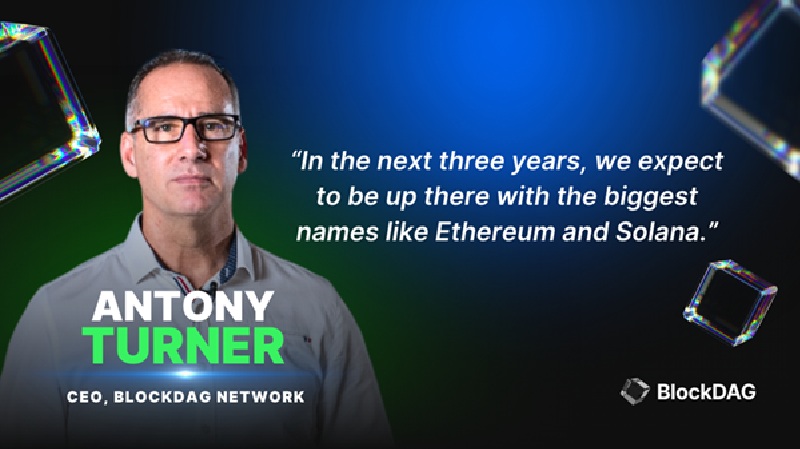
Antony Turner BlockDAG Vision: The Strategy Behind a $425M+ Crypto Powerhouse

0

In a crypto space dominated by anonymous founders and vaporware promises, Antony Turner, BlockDAG, emerges as a rare signal of credibility. His leadership track record spans Spirit Blockchain and SwissOne Capital, two institutions grounded in regulation, not hype. This institutional pedigree now shapes how BlockDAG is being built: infrastructure-first, fully operational, and already trusted by over 3 million users.

With more than $425 million raised and a hybrid architecture combining DAG and Proof-of-Work, BlockDAG (BDAG) isn’t just another speculative Layer 1. It’s the product of real systems thinking, and Turner is the architect behind its growing legitimacy, traction, and long-term delivery roadmap.

From Institutional Roots to System Design

Antony Turner’s background helps explain the structure of BlockDAG. Before founding the project, he held leadership roles at Spirit Blockchain Capital and was involved in building SwissOne Capital, one of the first equally weighted crypto index funds in Switzerland. This history in regulated crypto finance set the tone for how he approached BlockDAG, as a protocol requiring systems, not slogans.

Turner didn’t build BlockDAG around speculative utility or trend-based tokenomics. Instead, his keynote addresses show a commitment to infrastructure-first thinking. BlockDAG’s hybrid Layer 1 chain combines DAG-based architecture with Proof-of-Work, while remaining fully compatible with EVM and WASM smart contract environments. This means it can support high-volume applications and developer ecosystems without requiring a forked future. It’s designed to scale upfront.

During Keynote 4, Turner reinforced this when he said, “We’re not trying to be everything to everyone. We’re building a platform that works from day one, with tools that serve real users.” That philosophy is already playing out.

The Metrics Behind the Vision

Unlike projects that announce ideas before they build anything, BlockDAG has moved quickly from concept to deployment. As of this writing, the ecosystem supports over 3 million X1 app miners, with 20,000 physical miners sold globally. The community has grown to 325,000+ holders across 130+ countries, many of whom actively participate in the platform’s leaderboard system.

These numbers reflect the real-world activity that’s become the backbone of BlockDAG’s Proof-of-Engagement system. Users mine through the mobile app or physical hardware, earn rewards through referrals and daily taps, and increase their rank to secure early access in the upcoming token generation event. Early buyers can access BDAG at $0.0015 using the TGE code, which also grants rank-based airdrops, rewarding those who contributed most to network growth.

That rank-based priority model, introduced during Keynote 4, ties user participation to launch day outcomes. Turner has been clear that the system is designed to reward commitment, not hype. “The people who helped build the network should benefit from its first day,” he said. It’s a simple but powerful shift away from open airdrops or influencer-led coin distribution.

Decentralization Without Delay

A major theme in Turner’s addresses is his long-term view on decentralization. While some Web3 projects rush to deploy DAOs or governance models before their networks function, Turner has taken a more measured approach. BlockDAG currently operates under centralized leadership,  a fact he has acknowledged,  but that structure has enabled fast product delivery and operational clarity.

Turner addressed the issue directly in AMA #3, saying: “Decentralization has to be earned. It can’t be the first thing you do. Execution has to come first.” It’s a sentiment echoed in the project’s roadmap, which includes plans for governance mechanisms once the infrastructure reaches stability.

This practical roadmap mirrors the early growth of other successful chains like Solana and Cardano, both of which leaned on centralized execution in their first years before expanding governance layers. BlockDAG is following a similar arc, but with an added layer of user interaction and reward visibility through its app and leaderboard structure.

Roadmap Execution: From Talk to Tools

Another sign of Turner’s credibility as a founder is the timeline of actual delivery. BlockDAG isn’t relying on speculative timelines or future coin utility. It has already deployed real tools and infrastructure: the BlockDAG Explorer, Stratum miner integration, Smart Account groundwork (EIP-4337), and a highly active testnet.

Each of these components reinforces the system-building mindset Turner brings to the project. Rather than launching a coin and then building backward, BlockDAG is moving into its token generation event with live users, mined rewards, and infrastructure that already works.

This level of delivery is rare for a presale-stage project and highlights why Turner’s leadership is being recognized across the industry. He is not just a spokesperson or symbolic figurehead. He is actively involved in every layer of planning, coordination, and product iteration.

Vision Without Visibility Means Nothing

In crypto, vision often comes cheap. But vision that translates into working systems, verifiable metrics, and long-term execution is far more valuable. Antony Turner BlockDAG isn’t just a founder; project pairing,  it’s a model for how to build in Web3 with credibility and infrastructure in mind.

With more than $425 million raised, over 27 billion coins sold, and a system already supporting millions of users, Turner’s direction is proving that Web3 doesn’t have to choose between scalability and substance. BlockDAG’s public roadmap, leaderboard mechanics, and decentralization roadmap are structured,  not vague promises. And Turner’s leadership style reflects this.

In a sector that too often confuses anonymity with freedom, BlockDAG offers a counterexample: a real founder, a real system, and a protocol that believes delivery comes before decentralization. For those looking for top crypto project leaders who actually build what they claim, Antony Turner is setting the standard.

Presale: https://purchase.blockdag.network

Website: https://blockdag.network

Telegram: https://t.me/blockDAGnetworkOfficial

Discord: https://discord.gg/Q7BxghMVyu

US Government Seizes Record $15 Billion in Bitcoin Linked to LuBian Hack and Global Scam Network

4

The US Department of Justice (DOJ) announced the largest cryptocurrency seizure in history: approximately 127,271 BTC, valued at around $15 billion at current prices.

This action targets funds originally stolen in a massive 2020 hack from LuBian, a prominent Chinese-Iranian Bitcoin mining operation, which were subsequently laundered through a transnational “pig butchering” scam empire run by Cambodia’s Prince Group.

While some reports approximate the value at $12-14 billion due to price fluctuations and partial valuations, the official DOJ figure stands at $15 billion. LuBian, which controlled nearly 6% of global Bitcoin hash rate at the time, suffered a breach exploiting a vulnerability in its 32-bit entropy key generation algorithm.

This allowed a brute-force attack, resulting in the theft of 127,426 BTC worth about $3.5 billion then, now ~$14.5 billion. The hacker moved the funds quietly, and LuBian operators sent over 1,500 micro-transactions totaling 1.4 BTC with embedded OP_RETURN messages pleading for their return—efforts that went unanswered.

The incident flew under the radar until August 2025, when on-chain analytics firm Arkham Intelligence publicly detailed it as potentially the largest crypto theft ever, surpassing the 2016 Bitfinex hack 119,756 BTC. No arrests were made at the time, and the funds remained largely dormant.

The stolen LuBian Bitcoin was funneled into Prince Group’s operations, led by Chinese fugitive Chen Zhi also known as “Mile”. This conglomerate allegedly orchestrated one of the world’s largest investment fraud networks, involving “pig butchering” scams—romance/ investment cons that defrauded victims of billions.

The group operated forced-labor compounds in Cambodia and Myanmar, where trafficked individuals including torture and sexual exploitation were coerced into running scams.

Prince Group used its own mining ventures, including LuBian, to “clean” the illicit BTC by mixing it with legitimate mining output. Proceeds were laundered via shell companies, real estate, and casinos in Southeast Asia. The US Treasury’s indictment describes this as a “multi-billion-dollar criminal enterprise” spanning human trafficking, fraud, and money laundering.

The seizure involved coordination with UK authorities, targeting assets across Cambodia, Thailand, and beyond. It’s part of a broader crackdown on Southeast Asian scam hubs, following similar actions like the 2023 $225 million USDT seizure.

Just one day after the DOJ announcement, a long-dormant LuBian-linked wallet holding 9,757 BTC (~$1.1 billion) activated for the first time in three years, transferring all funds to a new address.

This has sparked speculation: Is it the original hacker evading seizure, or preemptive movement by authorities? On-chain analysts note the remaining ~117,669 BTC is untouched, making the holder the 13th-largest Bitcoin whale.

Some experts, including Arkham’s Emmett Gallic, suggest the US government may have orchestrated the initial 2020 hack or a subsequent “white-hat” recovery, given the timing and custody of vulnerable wallets flagged years ago. However, the DOJ frames it as a standard forfeiture from the scam probe, not admitting any prior involvement.

Priority goes to scam victims pursuing claims. If unclaimed portions remain, the funds could bolster a proposed US Strategic Bitcoin Reserve under President Trump’s administration, potentially reshaping federal crypto holdings.

This seizure eclipses prior records, like the 2022 $3.6 billion Bitfinex recovery. It highlights crypto’s dual role in crime and recovery, while pressuring exchanges and miners to fix legacy security flaws. The case also underscores escalating US-Asia tensions over scam networks, with calls for stronger international tracing tools.

Crypto Markets Downtime Has Triggered FUD on Wintermute and Crypto.com

0

The cryptocurrency market experienced a sharp downturn, triggered by U.S. President Trump’s announcement of 100% tariffs on Chinese imports. This led to over $10 billion in liquidations across the sector within 24 hours, with Bitcoin dropping from around $122,000 to below $110,000 and the total market cap shedding hundreds of billions.

Amid this volatility, unverified rumors began circulating on Telegram channels and X (formerly Twitter) claiming that major market maker Wintermute and exchange Crypto.com had suffered catastrophic losses—often phrased as “blowing up” or facing insolvency/liquidation.

These claims speculated that the firms were dumping assets on exchanges like Binance to cover positions, exacerbating the sell-off. The rumors gained traction quickly on social media, with posts warning users to withdraw funds and speculating on broader contagion.

However, no official downtime, withdrawal halts, or announcements from the firms supported these claims—users reported normal operations throughout.

Official Statements Denying the Rumors

Both companies swiftly addressed the speculation on October 11, 2025, via X posts and statements, emphasizing operational stability and dismissing the rumors as “baseless FUD” fear, uncertainty, and doubt.

The system is operating perfectly and the FUD is unfounded.” Confirmed no disruptions to withdrawals or transactions. “I’m sorry to disappoint you, but Wintermute is perfectly fine, everything is as usual.” Stressed no collapse during the downturn and normal business operations., Kris noted.

BD/Partnerships Exec Arnaud Arn_Wintermute Responded to liquidation rumors with: “I heard Wintermute got liquidated” – followed by clarification that it’s “unfounded FUD” and false. Expressed confusion over the claims.

These responses were echoed across crypto news outlets, with no evidence emerging to substantiate the rumors. Binance founder CZ also weighed in separately, denying any involvement in “hunting Wintermute” and calling related speculation false.

The sell-off was part of a larger $19B+ liquidation wave, but the rumors appear to have amplified panic without basis. Wintermute’s recent OTC volume growth 313% in 2024 and institutional ties suggest resilience, not vulnerability.

The Binance FUD (Fear, Uncertainty, Doubt) episode in late 2022, triggered by the FTX collapse, exemplifies how rumors of exchange insolvency can cascade through crypto markets.

Sparked on November 6 when Binance CEO CZ announced liquidation of $529M in FTT tokens citing risk management post-Terra/LUNA fallout, it escalated with Binance’s brief takeover intent, abandonment on November 8 after due diligence revealed FTX’s $8B shortfall, and subsequent proof-of-reserves scrutiny on Binance.

Largest since FTX; BUSD bled ~9B tokens. Comparable % outflows hit Crypto.com/OKX, but Binance scrutiny was outsized. -32% from Nov; shorts piled in $118M open interest, but no FTT-like crash—BNB’s utility (e.g., fee discounts) buffered it.

Bank run” narrative, with $300M daily outflows and warnings to “get off exchanges.” Reserves fell just 6% vs. FTX’s 90%, but perception ruled—BNB dipped amid shorts, and BTC tested 2-year lows (~$15,650). Temporary USDC withdrawal halts fueled more doubt; Silvergate bank ties rumored severed.

By Jan 2023, inflows resumed; BTC rallied 50%+ into 2023 bull run. Accelerated CEX transparency (e.g., PoR standards) and DeFi migration; Binance consolidated dominance but faced SEC scrutiny (fined $4B in 2023).

FUD exploits sentiment in speculative markets, causing outsized volatility like 10-15% BTC/ETH drops on rumors alone. Yet, facts (e.g., reserves) prevail; it often signals bottoms for HODLers. Parallels recent Wintermute/Crypto.com rumors—verify via on-chain data/official channels to mitigate.

While the statements calmed immediate nerves, crypto’s history via past Wintermute manipulation allegations in early 2025 means skepticism lingers. No further issues have been reported as of October 12, 2025.

The rumors were unfounded FUD amid a volatile market day, and both firms are operating normally.

Gold Hits New All-Time High Above $4,200 per Ounce

0

Gold futures surged to a fresh all-time high (ATH) of $4,218.17 per troy ounce, marking a significant milestone in the precious metal’s price history. This eclipses the previous record of around $4,014.60 set just a week earlier on October 7.

The current spot price as of midday trading stands at approximately $4,184.22, up about 1.4% from the prior close and reflecting a 13.8% gain over the past month alone. This extends a blistering rally that’s seen the precious metal up over 54% year-to-date, outpacing most major assets amid a perfect storm of economic and geopolitical pressures.

Silver, often riding gold’s coattails, also notched a fresh record at $49.57 per ounce earlier this week before pulling back slightly to around $52.38 today.

Why Is Gold Rallying Now?

This latest ATH comes amid heightened global uncertainty, positioning gold as a classic safe-haven asset: Escalating US-China Trade Tensions: Renewed threats from President Trump over tariffs on soybeans, rare earth minerals, and shipbuilding have spooked markets.

China, a major buyer of US agricultural goods, has halted 2025 fall harvest purchases due to retaliatory measures, boosting demand for gold as a hedge. The dollar’s decline—coupled with the Federal Reserve’s recent rate cuts—has made gold more attractive to international buyers.

Gold has now held above $4,000 for three straight days, up 56.3% year-over-year from $2,661.40 in October 2024. Ongoing sanctions on Russia, diversification by central banks like the China’s record purchases, and persistent inflation fears are driving inflows.

Analysts note gold’s role in portfolios during volatility, with retail and institutional investors piling in. Gold’s path to $4,200 is remarkable: Previous ATH: $4,014.60 on October 7, 2025—surpassing the inflation-adjusted 1980 peak of ~$2,500–$3,000 nominal $850 then.

Persistent inflation hedging, coupled with central banks especially in emerging markets diversifying away from the dollar, has fueled massive ETF inflows—$64 billion YTD, including a record $17.3 billion in September alone.

Gold’s Relative Strength Index (RSI) is at 87, signaling “overbought” territory, but the rally shows no signs of fatigue yet. It’s broken key resistance levels like $4,000 hit on October 7-8 with conviction.

Analysts are overwhelmingly bullish, with many eyeing $4,500+ by year-end and $5,000 in 2026. UBS projects gold ETF holdings to top 3,900 metric tons by December, nearing 2020 records. Deutsche Bank sees a full-year return exceeding 50%, potentially making gold 2025’s top performer.

From 2011’s nominal high of ~$2,000, gold endured a decade of consolidation before exploding higher post-2020 amid COVID-19 stimulus and geopolitical shocks. Year-to-date 2025 gains exceed 50%.

The surge is dominating conversations on X (formerly Twitter), with users celebrating (or speculating) in real-time, with a chart showing the spike. “Gold Hit New ATH $4200 … $5000 this year possible?”, pondering further upside.

“People don’t like tariff uncertainty -> Gold hit another ATH at $4200” – @TradfiBaby, linking it to policy risks. @TradfiBaby. Multiple live Spaces and posts from @modernmarket_ and team, drawing hundreds of views: “Gold hits new ATH at $4200.”

Forecasts are bullish but cautious—analysts see potential for $4,500–$5,000 by year-end if tensions persist, though some warn of pullbacks if rates stabilize. Bank of America advises measured exposure near these levels.

A stronger-than-expected U.S. jobs report or de-escalating trade talks could cap gains short-term. If you’re eyeing exposure, consider physical bullion, ETFs like GLD, or mining stocks—but as always, diversify and DYOR. Gold’s not just shining; it’s a spotlight on deeper market cracks.

Brookfield to Take Full Control of Oaktree Capital in $3bn Deal, Strengthening Its Credit Powerhouse

0

Brookfield announced on Monday that it will acquire the remaining 26% stake in U.S.-based Oaktree Capital Management for about $3 billion, cementing full ownership of one of the world’s leading credit and distressed debt investors.

The deal marks a major step in Brookfield’s ongoing effort to expand its footprint in private credit and alternative investments — a space increasingly dominated by global heavyweights like Blackstone and Apollo Global Management.

Under the terms of the agreement, New York-based Brookfield Asset Management (BAM.TO) and its parent company, Brookfield Corporation, will fund roughly $1.6 billion and $1.4 billion of the purchase price, respectively. Once completed, Brookfield will own 100% of Oaktree, which it first acquired a majority stake in for $5 billion in 2019.

The move will make the United States Brookfield Asset Management’s largest market, with $550 billion in assets under management (AUM), employing more than half of its global workforce and generating about 50% of its total revenue. The deal, expected to close in the first quarter of 2026, positions Brookfield as one of the most diversified alternative asset managers in the world — with deep reach across credit, infrastructure, real estate, renewables, and private equity.

Founded in 1995 by Howard Marks and Bruce Karsh, Oaktree Capital has built a global reputation for expertise in distressed debt and opportunistic credit investing. The Los Angeles-based firm manages about $209 billion in assets as of June 30, 2025, making it one of the largest credit managers in the world.

Brookfield’s decision to acquire Oaktree outright is part of its strategic bet on the private credit market, which has surged in popularity as rising interest rates push companies to seek flexible financing outside traditional banks. The acquisition also strengthens Brookfield’s wealth and asset management capabilities, enabling it to offer investors more comprehensive access to public and private credit strategies.

“Oaktree will remain central to Brookfield’s credit strategy, and we see significant opportunities to grow the franchise and expand what we can offer our clients together,” said Oaktree’s co-chairman, Howard Marks, in a statement.

Marks, who is one of the most respected figures in global investing, will continue to serve on Brookfield’s board following the transaction.

Oaktree’s chief investment officer, Bruce Karsh, will also join the board of Brookfield Asset Management, while Oaktree’s co-CEOs, Robert O’Leary and Armen Panossian, will become co-CEOs of Brookfield’s entire credit business.

By consolidating Oaktree’s operations, Brookfield aims to streamline its credit investment platform, which has already been a major profit driver. Including Oaktree’s contribution, Brookfield Asset Management generated about $2.8 billion in fee-related earnings over the last twelve months, the firm said.

When Brookfield first acquired its majority stake in Oaktree in 2019, the deal was seen as a landmark combination between two giants in alternative asset management — marrying Brookfield’s strength in real assets with Oaktree’s expertise in credit and distressed opportunities. Since then, the partnership has allowed both firms to scale their product offerings globally, targeting institutional and high-net-worth investors seeking stable returns amid volatile equity markets.

Brookfield CEO Bruce Flatt has long emphasized the firm’s ambitions to rival Blackstone and Apollo in the alternatives space. With full control of Oaktree, Brookfield is now better positioned to compete directly with those firms in the fast-growing $1.7 trillion private credit market — an area that has become one of Wall Street’s most lucrative profit engines.

For Oaktree, the full buyout by Brookfield is also the culmination of a long-running partnership that has steadily integrated its teams, platforms, and client networks. The firm is expected to retain its brand identity and continue to operate independently under the Brookfield umbrella, much as it has since 2019.

It is believed that the timing of the deal aligns with a broader trend of consolidation among alternative asset managers, as firms seek scale and diversification in an increasingly competitive environment. The combination of Brookfield’s global infrastructure and Oaktree’s credit expertise gives the merged entity an advantage in capturing institutional capital flows at a time when investors are searching for higher yields and downside protection.

With this deal, Brookfield’s credit platform — already one of the largest globally — will gain even greater scope and influence. The company now expects its credit operations to become one of its biggest growth engines over the next decade, helping it attract institutional mandates and further entrench its position among the world’s top-tier asset managers.

The acquisition marks another major consolidation milestone in the financial industry, uniting two of the most respected names in asset management and reshaping the competitive dynamics of the global alternatives market.