Background on China-Africa Relations
Africa’s history has always been linked to that of Asian countries, China in particular. At the height of colonialism and the Cold War back in 1955, African and Asian countries gathered in Indonesia, Bandung to cement their strong bond against Western economic, political, cultural, security and technological dominance. Subsequent to the Bandung conference, the Non-Aligned Movement was formed in 1961, which caught up with the wave of independence of many African countries. Since the Bandung conference, Asian countries have been very active in Africa through bilateral trade, but also through multinational initiatives, such as participating in Africa’s security programs by sending peacekeeping troops to support Africa maintaining security in the continent. China has particularly done well among other Asian countries in their engagements in Africa. China has stepped into the breech where other Asian countries seemed to lose interest or hope by providing investment and taking up or merging up enterprises that have been abandoned. Since the turn of the millennium, China has significantly expanded its activities on the continent, its foreign assistance and investment in Africa has caught the international society’s attention, and China has decentered the West as Africa’s main economic and political partner. In the last few decades, China has increased its trade and economic cooperation with Africa. China’s fast-growing economic ties with Africa are attracting considerable attention globally.
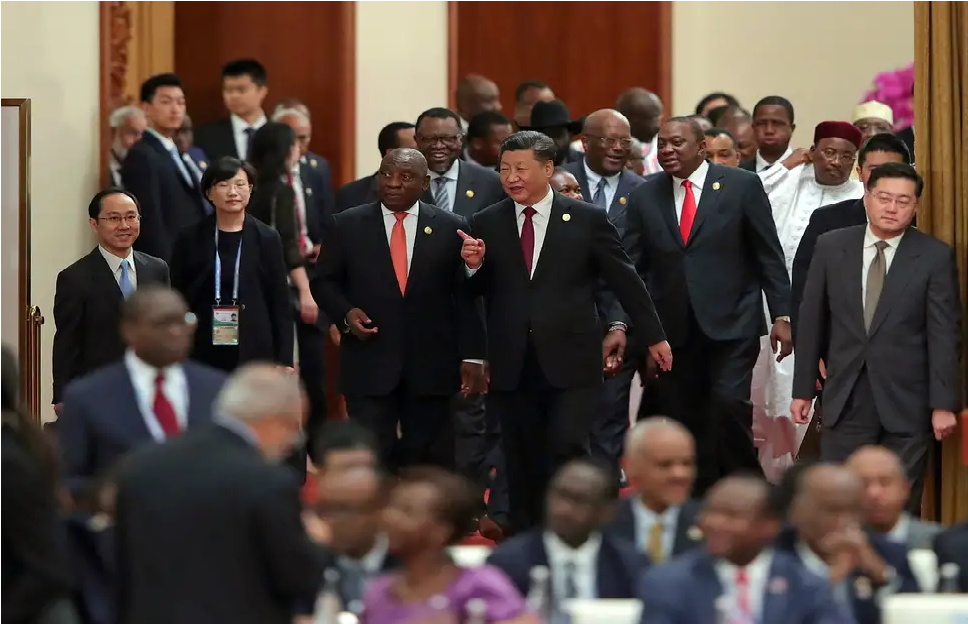
Politically, Sino-Africa relations have experienced quick flight particularly since the turn of the 21st century, especially starting with the establishment of the Forum on China Africa Cooperation (FOCAC) in the year 2000. The relations between the two entities have deepened and broadened on a number of facets covering investments, trade, diplomacy and cultural exchanges. Since its establishment 22 years ago, the Forum on China-Africa Cooperation has remained the essential platform on which Africa’s political, economic and socio-cultural relationship with China has continued to wax stronger. In fact, over the years, China has used the platform to engage with nearly all African countries. Like at every other FOCAC Summit, numerous promises and pledges have been made from China to Africa. For instance, at the 2015 and 2018 FOCAC Summits, China’s President Xi Jinping announced US$ 60 billion package for assistance and loans to Africa. In the 8th FOCAC Summit, China once again delivered over 1 billion vaccines against the Covid-19.
China-Africa cooperation, which mostly involves China offering foreign assistance (non-conditional assistance) or investments in Africa’s key sectors like infrastructure, agriculture and industrial collaboration, offered Africa unprecedented development opportunities, and helped many African countries join the international production chain as a value-added segment. By offering non-conditional aid to many African countries, China has presented a more attractive alternative compared to conditional Western aid, and China gained quite valuable diplomatic support from almost all African countries. With China’s financial support, African countries are transitioning from poor countries to developing countries.
However, China’s support to Africa or China’s engagements in Africa are often labeled in extreme connotations by some western media outlets as either being the best economic “Partner” that Africa has had since the post-colonial era or just the latest “Predator” coming to pillage Africa’s remaining natural resources. Allegations of racism have been as well rife both in China-Guangzhou and Africa-Nigeria. Why do media around the world, especially Western media, criticize China’s engagements in the continent? Is it because China has threatened Western countries’ interests in Africa or is it about the over-hyped debate about African countries’ high “external debt” problem? Some would argue that many of the critics are viewed from the prism of stereotype and willful twisting of allegations while others would say that behind China’s critics, China’s detractors and competitors are simply seized with envy and apprehension. For decades, China has been “crossing the river by feeling the stones” on the African continent and has avoided to follow Western countries development approach. Nevertheless, China is currently seen as a partner of choice as many African leaders reject China’s “Predator behaviors” allegations. Similar criticism has revolved around speculations such as China being “Neo-Colonialist or setting “dept-traps” to African countries.
Economically, in 2009, China displaced the United States as Africa’s largest trading partner; with a total trade topping $200 billion in 2020, and has equally assumed top slots as the most visible constructor and development projects financier in the continent. Since 2000, trade or economic ties has become the largest feature of the China-Africa relationship. Since 2001, the volume of trade between China and Africa has increased by a compound annual growth rate of 21%, reaching US$ 204.19 billion back in 2018, up from US$ 155 billion that was recorded in 2017; more than double the value of trade Africa does with its other major economic partners like India (US$ 59 billion), Japan (US$ 20 billion) etc.; reversing a multiyear slump and reaffirming China’s role as Africa’s most important trading and economic partner. China’s Foreign Direct Investment (FDI) annual flows in Africa increased as well from 2003 US$ 75 million up to 2018 US$ 5.4 billion. From 2018 to 2021, the growth rate of China’s trade with Africa remained high, and China has remained Africa’s largest trading partner. Over the past 20 years, China and Africa have developed close economic ties. Since the turn of the 21st Century, China has increased its economic engagements with almost all African countries. In the last decade alone, China-Africa trade relationship, despite existing trade deficits, looks healthy and full of many promises.
In some ways, since the beginning of the 21st Century, China-Africa relationship has become symbiotic. For centuries, China and Africa have enjoyed a time-honored strong relationship. In fact, China and Africa have been good political, economic and security allies. In 2013, China rolled out the Belt and Road Initiative, a multibillion infrastructure and trade investment initiative aimed at promoting greater integration and connectivity of Africa, Asia and Europe. The Belt and Road Initiative was presented internationally as China’s signature vision for reshaping its global engagements. According to the World Bank, the Belt and Road Initiative aims to strengthen infrastructure, trade, and investment links between China and dozens of other countries that collectively account for over 30% of global GDP, 62% of the world’s population, and 75% of known energy reserves. With China’s “Belt and Road Initiative” initiated by President Xi Jinping back in 2013 as well as China’s policy “Go Out” (???~Zou Chu Qu) overseas investments strategy, China’s economic footprint in Africa is undeniably growing. For instance, under the Belt and Road Initiative, many African countries witnessed unprecedented development in the form of roads, hospitals, stadiums and communication facilities, which made trade and commerce easier to undertake in Africa, improving African people’s well-being. At that, Africa is even being more attractive to other external investors like Russia, India and Brazil, which have seen themselves hosting similar Summits as FOCAC with Africa. In addition, as China has increased its engagements in Africa, its neighboring countries, especially Japan and India, have also responded by seeking new partnership with African countries. For instance, following the launch of the Belt and Road Initiative in 2103, Japan and India launched the Asia-Africa Growth Corridor Economic Cooperation Agreement with multiple African countries.
African countries’ strategic attitude toward the BRI
- Fully be a part of the implementation of China’s Belt and Road Initiative
There are compelling reasons why Africa pivoted towards China in its quest for sustainable development. Economically, the continent remained deprived, despite its huge natural resource endowments. Politically, the continent had been sidelined from global affairs, driven mainly by the past colonial masters. Africa had no voice on international processes and actions that heavily impinged on its socio-economic transformation. Ideologically, Africa identified largely with China, given their unique historical backgrounds characterized by colonialism, and isolation from global economic structures. And this identical history background became one of the reasons why African countries were being even keen to participate in the Belt and Road Initiative, an Initiative that could help African countries generate more resources for economic growth and development in the continent. The Belt and Road Initiative is providing the continent great opportunities to build its infrastructure as well as develop its industrial capacity.
Since the launch of the initiative in 2013, African countries have demonstrated an interest in being part of the Belt and Road Initiative. In fact, in the last couple of years, most of African countries have signed with China the Memorandum of Understanding, which is somehow related to China and Africa’s rise in recent years. In one hand, China’s rise to become the second largest economy in the world after the United States intersected with Africa’s rise between 2002 and 2013, when six of the world’s fastest growing economies were in Africa. In another hand, Africa’s rise is driven by global commodity boom, especially with the high demand from China and other developing countries like India for oil and other commodities. Africa’s rise is also accredited to the signing of the African Continental Free Trade Area agreement by 54 African countries, which has given substance to the last-stated objective and positioned what would be the world’s largest free trade area by number of participating countries when operational. At that, Africa’s rise in recent years is in regard to China’s increased interests in the continent. Africa’s rise has also something to do with China’s development loans to Africa, the role of China in building and rehabilitating African infrastructure in the areas of transport and power, and technology transfer.
- Hard times brought African countries once again stand aside China in pushing forward the BRI
Ironically speaking, the Covid-19 became one of the reasons why African countries consider standing behind China in pushing forward the Belt and Road Initiative. The global health challenge has no doubt drained many countries economically. The global north, which could have provided an alternative financing to Africa was deeply affected economically. After the pandemic, the main concern in the western economies was to turn inside for economic reconstruction. Only China, which has proven its effective response to the pandemic, including a return to industrial activity, extended to Africa the financial assistance to rebuild.
The Covid-19 pandemic provided a strong platform for collaboration between China and Africa. Beijing has been active in sharing its disease control experience with African countries. A total of over 44 African countries have also received infectious disease experts from China, to help with pandemic management. China has equally donated essential commodities including face masks, personal protective clothing, and ventilators to all African countries. As a top trading partner, investor, constructor, and development projects financier for the continent; China-Africa cooperation was not stymied by the pandemic. Instead, it acted as a force multiplier for the cooperative arrangements between Beijing and various African capitals. Before the pandemic, different African countries were already implementing a number of infrastructure projects under the purview of the Belt and Road Initiative. These projects are aimed at catalyzing socio-economic activities and the integration of the continent. As Africa rises from the pandemic, the need to create a functional economy will be overwhelming. Africa will need the industries and businesses to create more jobs, including those lost during the pandemic.
China has been the biggest partner of Kenya in the fight against the Pandemic since the new cases were found on the continent. Having come out of the grip of the virus ahead of other countries, China shared its critical epidemics control experience with Kenya; leading to early steps in containing the virus in the country. China has also been the main source of essential commodities needed in the management of the pandemic – ranging from drugs to face masks, personal protective equipment for the health workers, and the ventilators needed to care for critically ill patients. Much of these came in as donations in three trenches, signaling to the Kenyan public the essential role and commitment that China has demonstrated towards the country at the time of need. Such gestures have opened ground for additional cooperation between the two countries.
- Smooth development and promises brought through the FOCAC
The 7th and 8th Forum on China-Africa Cooperation (FOCAC) held in September 2018 and 2021 in Senegal opened a new chapter for African countries fully participating in the implementation of the Belt and Road Initiative, targeting to boost the development of African participating countries in a targeted manner. The summits adopted the “Beijing Declaration Toward an Even Stronger China-Africa Community with a Shared Future” and “the Beijing Action Plan (2019-2021)”. These two initiatives pointed China and African countries in the right direction for their mutual cooperation. For instance, during the 7th summit in Beijing, China’s President Xi Jinping pledged financial support of US$ 60 billion, adding to the same amount that was pledged in the previous FOCAC summit in South Africa in 2015 to support Africa’s development. Africa’s development has since been linked to the BRI.
East African countries, especially Kenya, have shown a strong interest in moving ahead of other East African countries by fully participating in the Initiative. Kenya became a key partner of China in the actualization of the Belt and Road Initiative given its geographical location advantage. Kenya is currently at different stages of implementing a number of Belt and Road Initiative projects; slated to open up the East and Central Africa region through infrastructure connectivity. Kenya’s former President Uhuru Kenyatta as well as the new President Ruto both have been strong supporters of the Belt and Road Initiative. Through the partnership with China, Kenya has registered a number of infrastructure projects such as the Standard Gauge Railway, running from the port city of Mombasa to the administrative capital, Nairobi. During the 2017 Belt and Road Forum held in Beijing, former President Kenyatta said that the initiative is the best model for Africa’s socio-economic transformation; reflecting the increased ideological affinity between Africa and China, beyond trade and investments. Former President Kenyatta’s sentiments would later manifest among the broader Kenyan population when a 2018 survey, by Ipsos, for the first time, revealed that regarded China as the leading development partner, polling 34%. United States, South Africa, and Britain polled as No.2 (26%), No. 3 (5%), and No.4 (4%) respectively. The favorable public opinion and attitude of the Kenyan public towards China can also be gleaned from the Pew survey of December 2019. From the polls, 68% of Kenyans view Chinese economic growth positively; and 60% welcome Chinese investments in the country.
What can China do to promote a smooth implementation of BRI Projects in Africa?
- China should debunk the debt trap myth by emphasizing the positive socio-economic outcomes of the BRI projects already implemented. In Kenya for example, China should bring more attention to the projects that its implementing, and if necessary, invite western media to come and see the projects themselves.
- Critically ascertain the viability of the proposed BRI projects by different African countries in order to avoid vanity projects.In Kenya, the Mombasa-Nairobi Railway, for example, is by far the most successful project in Kenya and in East Africa. Later, China can use this successful railway example to design more and better development projects.
- Promote diffusion of technologies and industries alongside the BRI projects to spur job creation and economic development.
What African countries can do to promote a smooth implementation of BRI Projects on the continent
- Astute investment policies, especially the ones that are aligned with the continent’s Agenda 2063. In Kenya for instance, the country has its development projects, and the projects in someways are aligned with the Agenda 2063.
- Make sure to maximize the opportunities brought through the BRI to build the infrastructure that the continent desperately needs.
- Africa must hold China to its promise and get the best from it. For instance, China has promised to advance industrial capacity on the continent. As the FOCAC Beijing plan Plan (2019-2021) states, it is imperative that China and Africa make best use of industrial capacity cooperation mechanisms to achieve tangible results from various projects. By inference, the instrumentality of the BRI should help Africa to develop technology.
Like this:
Like Loading...