Dogecoin whales have again made waves by adding a significant 822 million DOGE to their holdings. Simultaneously, the PEPE price has soared, marking its presence among the top meme coins.
Amid these developments, BlockDAG stands out with a $32.8 million presale success, driven by its innovative dashboard enhancements that elevate user engagement and transparency. With a projected surge to $20 by 2027, BlockDAG’s strategic updates position it as a potentially more lucrative and engaging option compared to its counterparts.
In early May 2024, Dogecoin whales demonstrated their influence on the market by adding approximately 822 million DOGE to their holdings, marking a significant transactional period for the cryptocurrency. This uptick in Dogecoin whales’ activity coincided with Dogecoin’s new utility as a payment method for Tesla products, sparking discussions within the community about future expansions, possibly to platforms like X.
By mid-May, the holdings of Dogecoin whales had swelled to 57.9 billion DOGE, a sharp rise reflecting their continued engagement in the market. Despite a minor price correction, Dogecoin’s value has surged past $0.15, encouraged by Dogecoin whales’ optimistic manoeuvres. The coin now tests the resistance at $0.17, navigating through a critical phase that could set the tone for its next big move.
PEPE Price Momentum in the Meme Coin Market
The PEPE price continues its upward trajectory, breaking through the $0.000010 mark after a successful retest of a rounding bottom pattern. This positive movement is part of a broader market recovery, significantly propelling PEPE among the top meme coins with a remarkable 50% surge within 48 hours.
Currently, the PEPE price hovers around $0.0000137, flirting with its all-time high as the market anticipates further gains with the upcoming Ethereum ETF decision. This anticipation suggests sustained interest in PEPE, positioning it as a strong contender in the list of top meme coins without showing signs of slowing down in its bull run.
BlockDAG Dashboard Revamp Powers Up Investor Engagement
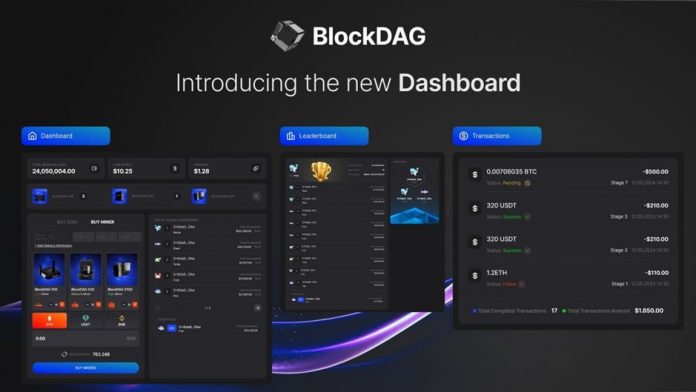
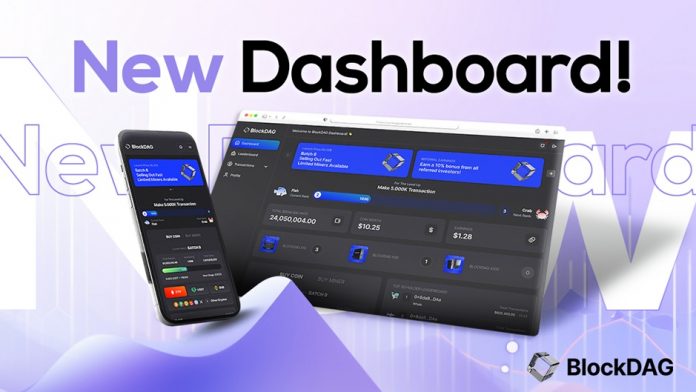
BlockDAG’s recent surge in presale success, accumulating an impressive $32.8 million, is a testament to its strategic enhancements and innovative updates. The project has significantly updated its user dashboard, adding features that enhance transparency and user engagement. These improvements have retained current investors and drawn new interest from the crypto community.
Among the standout new features is the ‘hot news’ section, a dynamic addition that allows users immediate access to the latest announcements as soon as they log in. This ensures that all participants are kept abreast of the latest developments in the BlockDAG project and the broader crypto market, enhancing their engagement and trust in the platform.
Furthermore, the updated dashboard now includes a wallet balance feature, where users can instantly view their current holdings after purchasing miners or coins. This adds a layer of real-time financial clarity and is complemented by a trending ‘leaderboard preview’ that showcases the top 30 investors. This gamification element fosters a competitive spirit and highlights the leading contributors as prominent crypto whales.
These enhancements are setting BlockDAG apart in the competitive crypto landscape. Analysts predict a bullish future for the coin, forecasting a potential price surge to $20 by 2027. With its advanced features and strategic updates, BlockDAG is crafting an appealing narrative for seasoned investors and newcomers eager to engage with a rising star in the cryptocurrency world.
BlockDAG Leads Amid Dogecoin Whales and Top Meme Coins
While Dogecoin whales and PEPE continue to make notable strides in the crypto arena, BlockDAG distinguishes itself with a $32.8 million presale and innovative dashboard enhancements that promise enhanced user engagement and transparency. Positioned to potentially surge to $20 by 2027, BlockDAG presents a compelling opportunity for investors seeking to capitalise on its presale momentum and technological advancements, signalling an opportune moment for entry into a rising star of the cryptocurrency world.
In the fluctuating cryptocurrency market, Lido DAO faces a downturn, while the Internet Computer (ICP) shows modest growth. Amidst these conditions, investors are gravitating towards BlockDAG, acclaimed as the superior crypto platform. With over $32.8 million amassed from its presale and recent enhancements to its dashboard, BlockDAG has improved community interaction and transparency, establishing its prominence over the uncertain trends of Lido DAO prices and ICP predictions.
Analyzing ICP: Market Outlook and Projections
Internet Computer has captured the public’s attention with its vision to decentralize web development, allowing the creation of apps directly on the internet. The analytical channel Upside-Down Data, in their video “A Realistic 2025 Internet Computer (ICP) Price Prediction Using Machine Learning and Simulations,” forecasts an average ICP price around $44, with potential lows and highs ranging from $17 to $73. A more optimistic scenario sets the possible price at $175, ignoring historical downtrends.
These projections underscore the volatile nature of the cryptocurrency market, recommending caution among investors. It’s essential to consider the broader impacts of major cryptocurrencies and market dynamics on ICP’s valuation for strategic investment planning.
Lido DAO (LDO) Endures Market Turbulence
Lido DAO, known for its liquid staking solutions on Ethereum and Polygon, has recently witnessed a 6% drop in price, nearing $1.5. This downturn aligns with Amber Group’s movement of 1 million LDO tokens to Coinbase, part of a larger series of transactions totaling 2 million tokens since May 8, worth about $3.66 million.
An additional 4.5 million tokens remain with Amber Group, suggesting potential future market effects if more sales occur. This situation highlights the ongoing market volatility and the cautious stance investors are taking, watching these developments closely to gauge their impact on broader market and investment strategies.
BlockDAG: Pioneering the Crypto Presale Arena
BlockDAG has successfully secured substantial investor interest, raising over $32.8 million in its latest presale, now in its 15th batch with more than 9.8 billion coins sold at $0.009 each. This impressive presale record reflects strong market confidence and the platform’s growing reputation. The soon-to-be-released X1 mobile miner app is expected to revolutionize crypto mining by enabling efficient mining on smartphones, making the technology accessible to a broader audience.
New features on BlockDAG’s dashboard have significantly enhanced the platform’s transparency and community engagement. These updates include a ‘Hot News’ section, visible user rankings, wallet balance details, a leaderboard preview, and comprehensive transaction histories. The platform categorizes community members from Crab (investing up to $99) to Whale (investing over $50,000), enriching user involvement and providing clear insights into their standings.
Why BlockDAG Leads the Field
While Internet Computer and Lido DAO present valid investment opportunities, BlockDAG clearly stands out as the superior choice for crypto investors. With its robust presale achievements, forthcoming innovations like the X1 mobile miner, and a user-focused, transparent dashboard, BlockDAG is set for significant expansion. These advantages make BlockDAG an appealing option compared to ICP and Lido DAO, offering innovative solutions and substantial growth prospects in the crypto market.
Google is investing nearly $350 million in Flipkart, marking another significant endorsement for the Walmart-owned Indian e-commerce startup. This strategic investment is part of a broader funding round initiated by Flipkart in 2023, aiming to raise close to $1 billion.
Walmart, which has been leading this round, contributed $600 million late last year. Microsoft is also among Flipkart’s investors.
As part of the deal, Google will provide Flipkart with its cloud offerings, enhancing Flipkart’s technological infrastructure and capabilities. This collaboration is expected to boost Flipkart’s operational efficiency and scalability, critical for maintaining its market leadership in India’s rapidly growing e-commerce sector.
Flipkart, now valued at $36 billion following the latest investment, dominates the Indian e-commerce market, serving hundreds of millions of consumers, especially in smaller cities and towns. The company, which also owns the fashion e-commerce platform Myntra, commands approximately 48% of the market share, according to Bernstein.
However, Flipkart faces stiff competition from several formidable players. Reliance Retail, operated by Mukesh Ambani, Asia’s richest man, runs the largest retail chain in India and is making significant strides in the e-commerce space. Valued at $100 billion after a substantial investment by QIA, ADIA, and KKR last year, Reliance Retail is a formidable competitor.
Other notable competitors include Amazon, which has a strong foothold in India, and SoftBank-backed Meesho, which focuses on social commerce and tier 2+ markets. Additionally, quick-commerce apps like Blinkit and vertical commerce platforms such as Nykaa are also gaining traction, creating a dynamic and competitive market environment.
The Growing Indian E-commerce Market
India’s e-commerce market is projected to reach $133 billion by next year, presenting vast opportunities for growth and innovation. Analysts from Bernstein highlight the emergence of niche players and specialized commerce platforms as a significant trend. Unlike the global e-commerce market, which tends to see dominance by large horizontal players, India is witnessing the rise of category-specific leaders such as Blinkit in quick commerce and Nykaa in vertical commerce.
India has rapidly emerged as a huge market and a top destination for tech companies worldwide. With a population exceeding 1.4 billion and a burgeoning middle class, India presents vast opportunities for technology-driven growth. The country’s digital transformation is being propelled by increased internet penetration, affordable smartphones, and supportive government policies.
Tech giants such as Google, Amazon, Facebook, and Microsoft have recognized India’s potential and have been making significant investments in the market. Google’s $10 billion investment plan for Indian businesses, announced in 2020, exemplifies the strategic importance of India to global tech companies. To date, Google has invested $4.5 billion in Jio Platforms, a major telecommunications player, and another $1 billion in Airtel, further solidifying its foothold in the Indian market.
Google’s investment in Flipkart aligns with its broader strategy to strengthen its presence in India. The company, which reaches over half a billion people in the country, views India as a critical market for expanding its ecosystem of services, from search and advertising to cloud computing and digital payments. The partnership with Flipkart is expected to drive innovation and deliver enhanced e-commerce experiences to millions of Indian consumers.
The infusion of capital and technological collaboration with Google is expected to enhance Flipkart’s competitive edge, enabling it to innovate and scale more effectively. This partnership also underlines the growing importance of strategic alliances as the push to grab more market shares in India grows, especially in the e-commerce sector.
However, analysts say Flipkart needs to adapt to changing market demands and leverage advanced technologies to maintain its leadership position.
The Federal Government of Nigeria has announced that home delivery of passports will commence in June 2024, eliminating the need for Nigerians to travel to immigration offices to obtain their passports.
This new service was confirmed by the Minister of Interior, Olubunmi Tunji-Ojo, during an inspection of the electronic gates at the new terminal of the Nnamdi Azikiwe International Airport in Abuja on Friday, May 24, 2024.
Minister Tunji-Ojo explained that the home delivery service will initially be available in Lagos, Port Harcourt, Kano, and Abuja to prevent overloading the system and ensure a smooth implementation. For Nigerians living abroad, the service will first be offered in the United States and the United Kingdom, following preliminary testing to ensure its effectiveness.
The minister acknowledged missing the original plan, which was to start home delivery in February 2024, but disclosed that this was delayed due to challenges related to data center availability. He revealed that the Nigerian Immigration Service (NIS) had been relying on a private company’s data center, which was not a sustainable solution.
“We have completed the whole solution but when we came on board, we realized that the data center was not really there. We were leveraging on a private company’s data center and we appreciate them for that assistance. We think that it is better to create a permanent solution to problems rather than quick fixes,” said Tunji-Ojo.
He stressed the importance of having a dedicated data center for the NIS to maintain the integrity and security of national data.
“It is disgraceful that NIS is 61 years old and NIS is a custodian of biometric data of Nigeria and we believe that NIS should be in charge of the data of Nigeria. It is not acceptable that this data is domiciled in a third party and that is why we have been able to do this,’’ he added.
Minister Tunji-Ojo announced that the construction of the new data center hasbeen completed, resolving the issues that delayed the home delivery service.
“It is about national security and I can assure you that it is comparable with anyone you can find anywhere in the world. We have built the data center, sorted the passport delivery solution, and done the final presentation in terms of technology deliverables and the tracking solution which will all be embedded in the application we have so we do not create multiple lines of failure,’’he stated.
In addition to passport delivery, the minister mentioned that the final presentation of the electronic visa has been completed. This will reduce the processing time for visas from 72 hours to 48 hours, further modernizing the services provided by the Ministry of Interior.
This initiative is part of the Nigerian government’sbroader efforts to modernize administrative processes and enhance service delivery to its citizens. In October 2023, Tunji-Ojo announced a plan to have passports delivered to homes, offices, or any other preferred locations, indicating a significant shift towards automation and improved user experience for passport applicants.
The automation and home delivery of passports aim to streamline the application process, reduce the burden on immigration offices, and improve convenience for Nigerians.
“By January next year, Nigerians will be able to complete this application process online, and by February next year, with collaboration and partnership with other relevant stakeholders, Nigerians will have their passports delivered to their homes, offices, and other locations of their choice,” he said.
As this new service rolls out, it is expected to bring significant relief and convenience to many Nigerians, both within the country and abroad, marking a major milestone in the government’s efforts to enhance administrative efficiency and citizen satisfaction.
In a move that has sparked widespread criticism, the Nigerian House of Representatives on Thursday passed a bill to restore the old national anthem, “Nigeria, We Hail Thee,” replacing the current anthem, “Arise O’ Compatriots.“
Sponsored by House Leader Hon. Julius Ihonvbere (APC, Edo), the bill swiftly advanced through first, second, and third readings.
The bill, officially titled “Bill For An Act to Provide for the National Anthem of Nigeria, and for Matters Related Thereto,” stipulates that upon its commencement, “Nigeria, We Hail Thee” will become the official anthem of the Federal Republic of Nigeria.
Leading the debate, Ihonvbere noted the superior qualities of the old anthem in terms of vigor, resourcefulness, and vision, which he argued are essential for the nation’s progress.
“I have taken time to look at the old anthem and the new, and as a Nigerian who has been involved in the struggle to make Nigeria a better place either as a student to the student union movement including the ‘Ali must go‘ movement or as a university teacher; having been secretary, vice chairman and chairman of ASUU or as a pro-democracy activist who spent twelve and a half years in self-exile, I believe that the old anthem encompasses, contains, and exudes the kind of energy, resourcefulness, and a sense of vision that is good for Nigeria,” Ihonvbere stated.
“The old anthem not only begins by telling us of the pride to serve our nation which is what is required right now when people are ‘Japa-ing‘ left, right, and centre. But it goes on to assert the sovereignty of our motherland,” he added.
However, the bill faced significant opposition from several lawmakers who questioned its relevance amidst Nigeria’s pressing issues. Minority Leader Kingsley Chinda (PDP, Rivers) voiced his disapproval, pointing out that the country has more urgent problems that need legislative attention.
“Today we are taking ourselves back to the old National Anthem. Incidentally, I will ask again, is this bill important at this particular time in our national lives? What value will it add to us as a nation?” Chinda asked. “Nigerians are looking up to us for more fundamental issues that will cause proper change. Prof took us to history days, what is the history we are about to make? So I stand as a Nigerian to say no to this bill. I pray that we look at it critically and urge the sponsor, the House leader, to withdraw this bill.”
Hon. Ahmed Satomi (APC, Borno) also spoke against the bill, arguing that it would not address the urgent challenges of hunger, banditry, and insecurity currently ravaging the country.
“Nigerians are looking up to us regarding this bill because many of us in our early 40s don’t know this national anthem. I don’t know how this bill on the national anthem will affect the common man,” Satomi stated.
“Let’s be realistic about how this will help the government to stop hunger, banditry, or improve security. Let’s do what is beneficial to the common man and this Honourable chamber is the only one standing for the common man of Nigeria.”
Despite the objections, the bill passed after a voice vote, leading to a mild uproar in the House as more lawmakers voted against it. Unperturbed by the dissenting voices, Deputy Speaker Benjamin Kalu listed the bill for consideration at the Committee of the Whole. Following the clause-by-clause consideration, the bill was listed for the third reading and passed when put to vote.
Why the sudden interest in the old national anthem?
Nigerians have been asking the above question ever since the bill was passed on Thursday, especially as it is happening when the country is grappling with severe economic hardship. They echo the sentiment of Chinda and Satomi, noting that Nigeria has more pressing issues to contend with as a nation, which require the time and effort the lawmakers have given the bill.
While it is not clear what resurrected the current interest in the old national anthem, a reference has been made to President Bola Tinubu’s past speeches. Tinubu has previously advocated for the adoption of the old national anthem over the current one.
In 2011, as the leader of one of the main opposition parties, Tinubu called for the adoption of the old anthem, highlighting his longstanding preference for it. This historical context may explain some of the current momentum behind the bill.
“Abandoning the post-independence anthem, which arguably evoked a strong spirit of patriotism and brotherliness, to compose a very drab replacement, is far less inspirational,” Tinubu was quoted as saying during a speech at the Nigerian Institute of Policy and Strategic Studies, NIPSS, Kuru, Jos, Plateau State.
Also, during his presidential campaign, Tinubu expressed hope to return to the old anthem. With his one-year mark in office approaching on Wednesday, some speculate that adopting the old anthem could provide a symbolic win for his administration, despite his decision to order a low-key celebration.
This is not the first time the idea has gained traction. In 2011, while leading one of the main opposition parties, Tinubu called for the old national anthem to replace the existing one. But the call for the return of the old national anthem has not always been Tinubu’s idea only. The 2014 National Conference also recommended adopting the old anthem, viewing it as a better symbol of unity, peace, and prosperity.
Background of Nigeria’s National Anthems
The old national anthem, “Nigeria, We Hail Thee,” written by Lillian Jean Williams and composed by Frances Berda, was Nigeria’s anthem at independence but was replaced in 1978 under General Olusegun Obasanjo’s regime. The current anthem, “Arise O’ Compatriots,” resulted from a national competition that sought to create an anthem reflective of Nigeria’s diverse cultures.
At the time of Nigeria’s independence in 1960, the British colonial masters viewed Nigerians as lacking the creativity to write and compose their own national anthem. Consequently, they commissioned Lillian Jean Williams to write the anthem and contracted Frances Berda to set it to music. This anthem, composed without any input from Nigerians, was imposed on the newly independent nation.
The anthem faced criticism from the start. Some felt it mocked Nigeria, while others believed it exacerbated the country’s ethnic differences rather than fostering unity. For instance, the lines “Though tribe and tongue may differ, in brotherhood we stand” were seen as paying mere lip service to the ideal of national unity. As a result, many Nigerians reportedly sang the anthem without genuine conviction, and some refused to sing it altogether.
The situation worsened with the Nigerian Civil War, which left deep scars on the nation’s psyche. General Obasanjo, who became the head of state after the war, believed that a new, Nigerian-composed anthem, could help the country heal and move away from its colonial past. In 1978, his regime established a committee to create a new national anthem. A national competition was announced, inviting Nigerians from different tribes to contribute their writings in an effort to create a unifying anthem that represented the country’s diverse cultures.
Out of numerous entries, five were selected: P. O. Aderogba, Babatunde Ogunnaike, John Ikechukwu, Eme Etim Akpan, and Sotu Omoigui. Their submissions were combined to form the new national anthem. Benedict Odiase, who was then the Director of Music in the Nigeria Police Band, composed the music for these lyrics.
The new anthem, created by Nigerians for Nigerians, aimed to instill a sense of national pride and unity was born. It’s believed to mark a significant departure from the colonial past, reflecting the country’s aspirations and identity.
However, recent discussions about reverting to the old anthem, seemingly spurred by President Bola Tinubu’s past advocacy and the recommendations of the 2014 National Conference, have reignited debates about national symbols and their role in fostering unity and addressing contemporary challenges.
Many note that the debate over the national anthem is not merely about the lyrics and melody but touches on deeper issues of national identity, patriotism, and historical legacy. Proponents of the old anthem argue that it evokes a stronger sense of pride and unity, essential for nation-building. Ihonvbere’s argument that the old anthem embodies a vision and energy that the new one lacks resonates with people who feel a nostalgic connection to Nigeria’s post-independence era.
Opponents, however, view the debate as a distraction from more pressing national concerns. With Nigeria facing significant socio-economic challenges, some lawmakers and a large section of Nigeria believe that legislative efforts should focus on addressing these issues rather than revisiting historical symbols.
The Role of National Symbols
National symbols like anthems, flags, and emblems play a crucial role in fostering national identity and unity. They are often seen as embodiments of a nation’s values, history, and aspirations. Thus, critics note that changing a national anthem can be a deeply symbolic act, reflecting shifts in national sentiment and priorities.
For many Nigerians, “Arise O’ Compatriots” represent a call to action and collective responsibility, fitting for a country striving to overcome various challenges. The anthem’s message of unity and service to the nation is said to resonate with contemporary efforts to build a more inclusive and resilient Nigeria.
However, critics argue that the focus on changing the national anthem diverts attention from critical issues such as economic recovery, security, and governance reforms. They urge lawmakers to prioritize policies and legislation that directly impact the well-being of the citizens.