DD
MM
YYYY

PAGES

DD
MM
YYYY

spot_img

PAGES

Home Blog Page 3339

Spectranet Maintains Top Position as Nigeria’s Biggest Internet Service Provider in Q4 2023

0

Internet service provider Spectranet, known to be one of the best services when it comes to reliability and internet speed, has maintained its top position as Nigeria’s biggest internet service provider, in the fourth quarter (Q4) of 2023.

Spectranet at the end of Q4 2023, recorded 113,869 subscribers, with a share total of 43.4%. The Internet Service Provider (ISP) has continued to play a pivotal role in providing quality Internet access to Nigerians.

It is worth noting that Spectranet was the first Internet Service Provider (ISP) to launch a 4G LTE-based internet service in Nigeria. The brand is known for providing affordable, faster, and more reliable internet broadband to Nigerian homes and offices.

Its internet service uses various technologies which include; 4G LTE, FTTx (Home Fiber), and WTTx (Fiber on Air) which are currently available across Lagos, Abuja, Ibadan, and Port Harcourt. Its state-of-the-art multi-technology network ensures high-speed internet connectivity for customers.

Spectranet was awarded a License from the Nigerian Communications Commission in 2009 to promote Internet services in Nigeria. Headquartered in Lagos with Management Consultancy and Technical Collaboration with the Infrastructure Development Company Group based in Singapore, the Internet service provider aims to be a leader in the Internet Services space in Nigeria.

In 2023, the company received two awards for the “Best 4G LTE Internet Service Provided”, and Broadband Services Provider of the Year”.

Coming second among the top internet service providers is FiberOne, the largest fiber-to-home (FTTH) premium broadband provider in Nigeria with 27,000 active users and a share total of 10.3% at the end of 2023.

In third position is Elon Musk-owned Starlink, which reached a significant milestone in Nigeria, by becoming the third-largest internet provider, in the fourth quarter (Q4) of 2023.

According to data, Starlink’s active customers in Nigeria increased to 23,897 in Q4 of 2023, from 11,207 in Q3 of 2023, to become one of the leading ISPs in the country. The Q4 figure represented a 113% increase in customers quarter on quarter.

Starlink has gained significant traction in Nigeria due to its ability to provide high-speed internet access in remote and underserved regions, where local internet service providers often struggle to reach. By leveraging a constellation of low Earth Orbit (LEO) satellites, Starlink offers a reliable and efficient internet solution, addressing the digital divide in Nigeria.

Despite Starlink’s price still being on the high side compared with local ISPs, the internet service has sparked high adoption interest among Nigerians who are eager to change their service providers.
Central Bank of Nigeria (CBN) Raises Interest Rate to 26.25% in Continued Fight Against Inflation

0

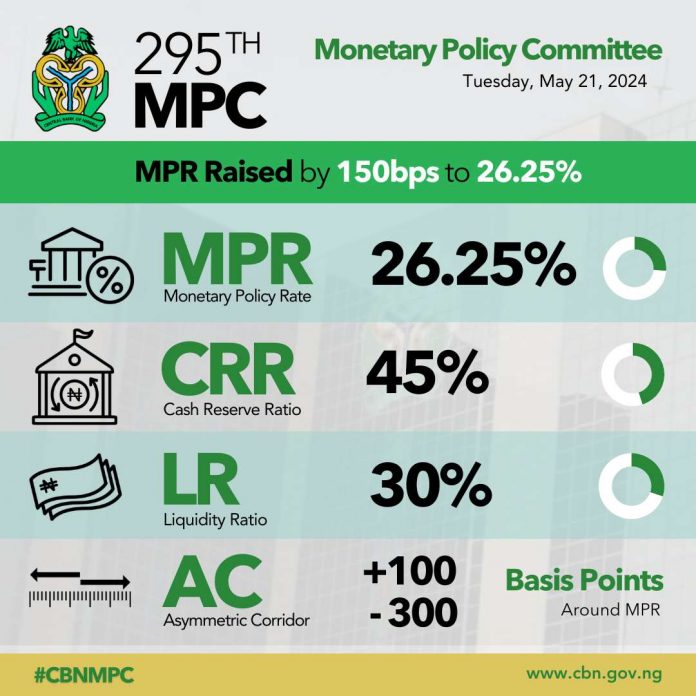
The Central Bank of Nigeria (CBN) has increased the Monetary Policy Rate (MPR) by 150 basis points from 24.75% to 26.25%, marking the third consecutive hike in an effort to combat the nation’s soaring inflation. 

This decision was made during the 295th meeting of the CBN’s Monetary Policy Committee (MPC) held on May 20th and 21st, 2024.

The MPC’s decision to raise the MPR comes against the backdrop of Nigeria’s inflation rate, which surged to 33.69% in April 2024. CBN Governor Yemi Cardoso, who also serves as the chairman of the MPC, announced the committee’s resolutions on Tuesday. Cardoso highlighted the critical need to address inflationary pressures, which are largely driven by escalating food prices, transportation costs, infrastructure challenges, insecurity, and exchange rate volatility.

The Monetary Policy Committee (MPC) of the Central Bank of Nigeria (CBN) held its 295th meeting on the 20th and 21st of May 2024 to review recent economic and financial developments and assess risks to the outlook,” Cardoso stated. “Decisions of the MPC. The committee’s decisions are as follows: 1. Raise the MPR by 150 basis points to 26.25% from 24.75%.”

Despite the significant increase in the interest rate, the MPC decided to retain other key monetary parameters. The Cash Reserve Ratio (CRR) of Deposit Money Banks (DMBs) remains at 45%, while the liquidity ratio is held steady at 30%. The asymmetric corridor around the MPR is maintained at +100 and -300 basis points.

Cardoso stressed that the primary focus of the MPC is to achieve price stability and curb the rising inflation that has heavily burdened Nigerians. He noted that the inflationary pressure is predominantly fueled by food inflation, exacerbated by high transportation costs, infrastructure deficits, security issues, and exchange rate challenges.

The Economic Backdrop

The recent rate hike occurred amid widespread economic difficulties characterized by soaring commodity prices and an increasing cost of living. The economic strain is largely attributed to the removal of fuel subsidies last year and the floating of the naira, which have pushed the cost of goods and services to historic highs. Despite facing protests and pressure from labor unions, President Bola Tinubu has urged for patience, expressing confidence that the government’s reforms will eventually bear fruit.

In recent months, the CBN has also targeted the operations of cryptocurrency exchanges, including Binance, as part of its strategy to combat the falling value of the naira. While these measures initially led to an appreciation of the currency, the gains have stalled recently.

Addressing the volatility in the foreign exchange market, Cardoso attributed the recent depreciation of the naira against the dollar to “seasonal demand” for the greenback. He said that such volatility is common in any functioning foreign exchange market and reflects the dynamics of demand and supply.

“Members further observe the recent volatility in the foreign exchange market attributing this to seasonal demand—a reflection of the interplay between demand and supply in a functioning market system,” Cardoso said. He reiterated the CBN’s commitment to maintaining a transparent FX market through a willing-buyer, willing-seller model.

Skepticism and Criticism

The CBN’s strategy of continuously hiking interest rates has been met with skepticism from some economists and analysts. Kalu Aja, a financial analyst, questioned the efficacy of this approach saying: “So if inflation gets to 35%, CBN will keep hiking to 30%? The strategy must be dynamic.” 

Aja pointed out that the inflation problem is rooted in supply-side and structural issues, which interest rate hikes alone cannot resolve.

Analysts argue that while the CBN’s focus on fighting inflation is understandable, the underlying issues such as insecurity, infrastructure deficits, and economic policies need to be addressed comprehensively.

“CBN has chosen to fight inflation. I can’t fault them; it is in their handbook. Let the Federal government fight bandits to bring down the prices of food,” Aja noted.

Future Outlook

There is a prevailing sentiment among analysts that the CBN might continue to hike rates in the future. However, many believe that without addressing the fundamental issues stoking inflation, these rate hikes will not achieve the desired result. 

The consensus is that Nigeria’s inflation challenge is supply-side and structural, necessitating a multifaceted approach that goes beyond monetary policy adjustments.

‘ICC is built for Africa and for thugs like Putin’ – ICC Prosecutor makes scathing revelation

0

The prosecutor of the International Criminal Court (ICC), which has come under intense scrutiny following its recent decision to seek arrest warrants for Israeli Prime Minister Benjamin Netanyahu, Defense Minister Yoav Gallant, and three leaders of the Palestinian group Hamas, has made a scathing revelation that has put further doubt on the impartiality of the court in prosecuting international crimes.

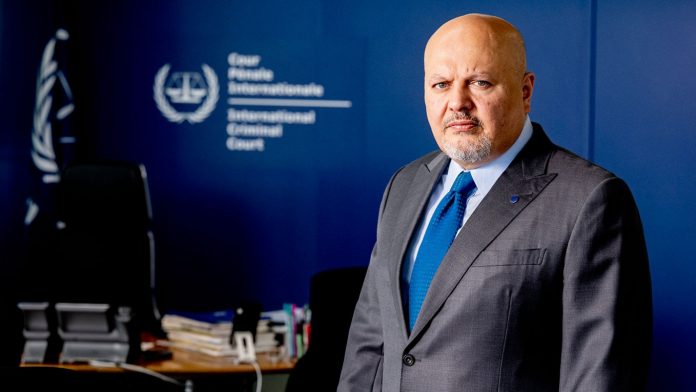
The ICC prosecutor Karim Khan, who announced the decision on Monday, sparked a significant geopolitical debate, with Israel and its key allies led by the United States, crying blue murder.

In an exclusive interview with CNN, Khan defended the ICC’s mandate to prosecute war criminals without bias or discrimination. He however made some shocking revelation that alludes to the growing belief that the ICC is biased.

“Of course, I have heard some elected [ICC] leaders speak to me and be very blunt: ‘This court is built for Africa and for thugs like Putin’, was what a senior leader told me,” Khan disclosed. 

In the wake of the ICC’s move to arrest and prosecute Israeli leaders, this revelation has cast a shadow on the core mission of the court, prompting a clarification from Khan.

“We don’t view it like that. This court is the legacy of Nuremberg. This court is a certain indictment of humanity. This court should be the triumph of law over power and brute force; grab what you can, take what you want, do what you will, and we are not going to be dissuaded by threats,” he said.

The prosecutor’s office announced on Monday its intention to seek arrest warrants for Netanyahu, Gallant, and three Hamas leaders on charges of war crimes and crimes against humanity. Alongside Yahya Sinwar, the Hamas leader in Gaza, the ICC seeks to issue warrants for the military wing’s commander-in-chief Mohammed Deif, and its political leader Ismail Haniyeh. These leaders are accused of orchestrating and committing severe violations during the ongoing conflict in Gaza.

The ICC’s decision has been met with strong opposition from Israel and the United States. President Joe Biden publicly rejected the ICC’s application for arrest warrants, calling the move “outrageous.” Speaking at a Jewish American Heritage Month event, Biden stated, “There is no equivalence between Israel and Hamas,” reinforcing the U.S. stance that the ICC does not have jurisdiction over Israel.

Republican lawmakers in the U.S. have echoed Biden’s condemnation, with Senator Tom Cotton and House Speaker Mike Johnson leading calls for sanctions against the ICC. 

“My colleagues and I look forward to make sure neither Khan, his associates nor their families will ever set foot again in the United States,” Cotton asserted. 

Johnson said, “The ICC has no authority over Israel or the United States, and today’s baseless and illegitimate decision should face global condemnation.”

Khan’s comments to CNN highlighted a persistent critique of the ICC: its perceived focus on prosecuting individuals from the developing world, particularly Africa, while seemingly overlooking alleged war crimes by leaders of wealthier nations or allies of the US. This perception has fueled accusations of hypocrisy and selective justice. Historically, the majority of those indicted by the ICC have been from Africa, leading to claims of a biased approach.

Social media has been abuzz with reactions, with many commentators pointing out the contradiction in the unnamed official’s remarks. The ICC’s mandate, rooted in the legacy of the Nuremberg Trials, aims to uphold international justice impartially, a principle Khan reiterated during his interview.

The ICC’s actions come against the backdrop of a devastating humanitarian crisis in Gaza. Since Israel began military operations on October 7, over 35,000 Palestinians, predominantly women and children, have been killed. Additionally, at least 10,000 people are missing, presumed dead under the rubble, according to Palestinian civil defense officials. The scale of destruction has intensified calls for accountability and justice from the international community.

The arrest warrants sought by Khan will now be reviewed by the judges at the ICC, who will decide whether to grant them. This process marks a critical juncture for the ICC as it navigates the complex legal and diplomatic terrain of the Israeli-Palestinian conflict. The court’s ability to act on these warrants could significantly impact its credibility and the broader landscape of international justice.

Reactions from the international community have been mixed. Switzerland’s UN envoy, Pascale Baeriswyl, expressed full support for the ICC, emphasizing the importance of respecting its independence. 

France and Belgium have also backed the court’s actions, stressing the need to combat impunity for war crimes. 

“France supports the International Criminal Court, its independence, and the fight against impunity in all situations,” stated the French foreign ministry.

The Vicious Circle of Fighting Inflation In Nigeria

1

A big hike:” The Central Bank of Nigeria (CBN) has increased its key interest rate by 150 basis points to 26.25% in an effort to combat persistent inflation and stabilize the nation’s currency…Despite the rate increase, there are concerns about the effectiveness of monetary policy in addressing supply-side and structural issues driving inflation.”

According to government data, more than 95% of Naira in circulation is outside the banking system, meaning that whatever rate policy the apex bank is formulating has minimal impact on consumer demand:  “Nigerians have increased their hoarding of cash, with as much as 94% of the currency in circulation held outside banks by March 2024”.  This is very important, using basic economics: if demand remains the same when supply is reduced, price will go up, ceteris paribus.

By the central bank increasing the rate, the demand side is marginally impacted since consumer  credit  in Nigeria is largely insignificant and cash remains king, outside the influence of the monetary rate policy. But what the apex bank is doing does affect something, and that is SUPPLY.

So, when we increase the rate, we further reduce supply of goods and services since only corporate borrowers are largely affected, and when prime rates go up, bank borrowing interest rates follow, and companies pause expansion since the cost of capital is high. But you need high supply, from companies, to reduce price, and if you process that, you will agree that the apex bank’s trajectory will NEVER stop inflation since it is a clear vicious loop where more rate hikes will lead to reduced supply and more inflation in the economy.

Furthermore, as cash is king in Nigeria and people rarely save since they do not have a lot, the SAVING side benefit of rate hike, typical in most western nations do not apply. So, even if you increase rates, people suddenly will not start saving because they do not have the funds: “As of May 3, 2024, the Nigeria Deposit Insurance Corporation (NDIC) covers 98.98% of depositors in Deposit Money Banks (DMBs) with a maximum deposit insurance coverage of N5 million. This is an increase from the previous coverage of N500,000, which covered 89.20% of depositors.”

As you fight inflation, look at the FX component where the exchange rate is now N1,480/$. That the Naira is losing steam now is an indication that we still have structural challenges, and that whatever improved the Naira (draining the foreign exchange) a few weeks ago was transient. I did note that Nigeria could win any battle including taking the  Naira up to N800/$, but to win the WAR it has to do things differently. Indeed, financializing Nigeria’s economy has a limitation; we need to go back to building things.

Winning the war for Naira begins with 24/7 electricity, security in the land, improved rule of law, a mindset of innovation and making things in Nigeria.

In the first quarter of 2024, Nigeria spent $1.12 billion on foreign debt service payments. In Q1 2023, it spent $801.36 million for the same service. That is another friction in the management of the nation’s scarce resources.

And companies are impacted: “Airtel Africa reported a $1.7 billion loss due to currency devaluations in Nigeria and Malawi for fiscal year 2024, despite a 20.9% growth in service revenues in constant currency.” Cadbury was not spared “Cadbury Nigeria Plc has reported a net foreign exchange loss of N11.5 billion for the first quarter, which plunged it into a loss of N7.3 billion for the quarter.” This has fueled a pessimistic view which can affect investment: from a PwC survey: “51% of CEOs in West Africa expect their local economy to decline compared to global CEOs (37%).” That is a huge problem.

As Trump Struggles with Truth Social Business, We Learn that Activism Rarely Makes Great Business

0

Trump’s social media company is not doing it, and from the data released so far, it does seem this may not be Trump’s thing: “Trump Media and Technology Group (TMTG), the company affiliated with former U.S. President Donald Trump and operator of Truth Social, has disclosed its financial results for the first quarter of 2024. The company reported $770,500 in revenue alongside a staggering net loss of $327.6 million.”

Yes, one of the biggest challenges in business is to be popular and yet be disposable. Yes, Truth Social could be popular to MAGA conservatives but it is also disposable because MAGA conservatives can dispose of it since they want to make more money, by reaching more markets on Facebook, LinkedIn, Twitter and others.

In other words, you cannot tell me that MAGA billionaires are not advertising on the web, and spending $millions, and despite that, Truth Social is getting just $771k in three months. So, it is now business and everyone clears his or her eyes. Indeed, Truth Social must make a compelling business sense for them to drop that money. Otherwise, they will stay at the knowns even though they may not like them.

“Mister, I know we are not friends, but this is business. Let us do business and after the process, we can reactivate the un-friendliness”, he said, and you might have heard such from traders in open markets, where “enemies” do business. Lol . “I am not happy that my money is going to this woman”. Humans become rational when it comes to money, most times.

For Truth Social to find its future, it must shift equilibrium to itself; activism rarely makes a great business. People will shout and support, but when it comes to their wallets, they magically become rational species!

Trump might have mobilized people to Truth Social, but he must do something more which is adding financial value to make Truth Social a great business. The activism alone will not do it, as advertising users are rational and will look for value propositions before they will advertise in the ecosystem.

Trump Media & Technology Group (TMTG) reports $770,500 revenue and $327.6m net loss in Q1 2024