DD
MM
YYYY

PAGES

DD
MM
YYYY

spot_img

PAGES

Home Blog Page 3373

NERC orders cap on electricity supply to cross-border customers to prioritize Nigerian consumers

0

The Nigerian Electricity Regulatory Commission (NERC) has taken decisive steps to prioritize power availability to Nigerian consumers by ordering the capping of power supply to cross-border customers in Benin Republic, Niger, and Togo. 

This move aims to ensure that Nigerians have access to a more reliable and consistent power supply. The directive, outlined in an interim order titled ‘Interim Order on Transmission System Dispatch Operations, Cross-border Supply and Related Matters,‘ is set to last for six months initially.

NERC’s interim order, signed by the commission’s Chairman, Sanusi Garba, and Vice Chairman, Musiliu Oseni, comes into effect from May 1, 2024. It directs the System Operator (SO), a department within the Transmission Company of Nigeria (TCN), to limit power delivery to Nigeria’s neighbors to no more than six percent of total grid electricity at any given time.

The regulatory agency expressed concerns about sub-optimal grid dispatch operations that have compromised Distribution Companies (Discos) ability to meet their service obligations under the Service Based Tariff (SBT). It highlighted the need for a more equitable distribution of power allocation among various off-takers, including Discos, international customers, and eligible customers.

“The commission hereby orders as follows: The system operator shall develop and present to the commission for approval within seven days from the issuance of this order a pro-rata load-shedding scheme that ensures equitable adjustment to load allocation to all off-takers — Discos, international customers, and eligible customers — in the event of a drop in generation and other under-frequency related grid imbalances necessitating critical grid management.

“The system operator shall implement a framework to log and publish hourly readings and enforce necessary sanctions for violation of grid instructions and contracted nominations by off-takers in line with the grid code and market,” it stated.

Moreover, NERC emphasized the importance of transparency and accountability in grid operations, calling for the implementation of Standard Operating Procedures (SOPs) to improve the fairness and efficiency of service delivery. The commission instructed the system operator to develop a pro-rata load-shedding scheme to ensure equitable adjustments to load allocation during grid imbalances.

“The system operator shall ensure that the maximum load allocation to international off-takers in each trading hour shall not be more than six percent of the total available grid generation.

“The aggregate capacity that can be nominated by a generating plant to service international off-takers shall not be more than 10 percent of its available generation capacity unless in exceptional circumstances a derogation is granted by the commission.

“The system operator shall henceforth cease to recognise any capacity addition in bilateral transactions between a generator and an off-taker without the express approval of the commission,” it added.

Additionally, NERC mandated the installation of integrated Internet of Things (IoT) meters at off-take and delivery points to provide real-time visibility of aggregate power consumption. This measure aims to enhance the monitoring and enforcement of grid instructions and contractual obligations.

In a related development, the Minister of Power, Chief Adebayo Adelabu, revealed plans by the federal government and the Nigerian Sovereign Investment Authority (NSIA) to address the country’s significant electricity metering gap. With approximately seven million unmetered consumers, the government plans to inject N750 billion in capital annually, supplemented by N250 billion in debt financing from NSIA, to accelerate meter acquisition initiatives.

He said that out of nearly 13 million registered electricity consumers at present; slightly over five million of them are metered customers.

“The target that we have is that within four to five years, we should close the gap, which means that a minimum of two million meters must be installed under the Presidential Metering Initiatives every year,’’ Adelabu said on Saturday in Lagos during his visit to Femadec Group, a local electricity meter manufacturing company. Earlier that day, he inaugurated the 63MVA, 132/33kV Mobile Substation deployed to Ajah as part of Phase One of the Presidential Power Initiative (PPI).

These moves follow recent developments in Nigeria’s power sector, including increased generation capacity and tariff adjustments, said to have sparked renewed investor interest. The completion of projects like the Zungeru Hydro Electric Power Plant in Niger State has contributed to a rise in power generation, from 4,200MW to 4,800MW, signaling positive momentum for the sector.
Why Nigeria’s Central Bank Struggles To Tame Inflation

0

A big one: “The Central Bank of Nigeria (CBN) has revealed a notable reduction in loans extended to the private sector, with credit dropping to N71.21 trillion in March. This figure reflects a significant month-on-month decline of 11.93 percent or N9.65 trillion compared to February’s record of N80.86 trillion.”

Let me defend banks here: they did not reduce their efforts to give loans to companies. What happened was many companies did not want to take loans due to the high interest rates, anchored on the prime rate which was set by the apex bank.

In our portfolio companies, three of our companies which were approached by a bank to give them credits, rejected the offers, because of the high interest rates (and nonsensical collaterals). The companies could not model how they could pay the rates while advancing their missions.

Good People, our high interest rates are partly driven by the Central Bank of Nigeria. If Nigeria’s prime lending rate is about 15% (see here), the least any bank could offer loans is at about 21% (unless the fund is coming from a development finance institution like AfDB). [A bank will add insurance, operation cost, profits, etc, and when all is done, you have at least a 23% interest rate for customers].

So, with lesser funds going into companies, production will drop, and if that happens, Supply of goods and services will drop to the market. When supply drops, and demand remains the same, ceteris paribus, price goes up. Hence, CBN’s mission to tame inflation will struggle since it is reducing Supply via its monetary policy which has negligible impacts on Demand, especially at the consumer side since few customers get credits in Nigeria. This is why Nigeria has struggled to achieve any positive inflation control for years! We must try new ideas!

One of those ideas could be to offer rebates to companies thereby making sure only companies doing productive things will see their interest rates reduced. That way, you do not reduce rates to scale consumption.

Banks’ loans to the private sector dropped by nearly N10tn in March – Central Bank of Nigeria (CBN)

Zenith Bank’s pre-tax profit in Q1 2014 rises to N320.194 billion

0

Zenith Bank Plc, one of Nigeria’s leading financial institutions, has unveiled its unaudited financial results for the first quarter of 2024, showcasing impressive performance with a pre-tax profit of N320.194 billion. 

This remarkable figure represents a staggering surge of 269.72% compared to the previous year’s performance. Notably, this pre-tax profit accounts for 40.23% of the bank’s pre-tax profit in the entire year of 2023, indicating a strong start to the fiscal year and suggesting a potential to surpass the previous year’s financial achievements if the current growth trajectory is sustained.

Despite persistent macroeconomic challenges such as elevated inflation, interest rates, and exchange rate volatility, Zenith Bank managed to navigate through these complexities, demonstrating resilience and agility in its operations. The challenging economic landscape contributed to higher interest income as well as increased impairment losses. 

However, a closer examination of the financial results reveals a combination of robust growth in interest income, primarily driven by lending activities, and substantial gains from trading income.

The group reported impressive gross earnings of N780.617 billion and a profit after tax of N258.341 billion in the first quarter. The surge in interest income, which reached N488.546 billion, was largely attributed to the expansion in the loan portfolio and the rise in interest rates. 

Notably, interest income from loans and advances to customers accounted for 62% of the total interest income. Additionally, gains from trading activities, particularly gains on other trading books, surged to N186.334 billion, marking a significant increase from the previous year.

Despite the remarkable financial performance, the group also reported an impairment loss of N55.972 billion, with the majority allocated to the allowance for impairment on loans and advances. However, this impairment loss appears to be contained, representing only 18.26% of the bank’s net interest income. 

Consequently, the bank’s net interest income after impairment loss remained robust at N250.478 billion, reflecting an impressive year-on-year increase of 122%.

The strong financial performance and growth trajectory are expected to improve investor sentiment. However, the bank faces the challenging task of meeting the Central Bank of Nigeria’s new capital requirement. With an additional N229 billion needed to meet the requirement, Zenith Bank is exploring various strategies to raise capital, including leveraging its robust and increasing retained earnings standing at N1.407 trillion.

Despite the bank’s strong performance, investors have expressed concerns about the new capital requirement, leading to a decline in the share price of banking stocks, including Zenith Bank. The bank’s share price experienced a year-to-date decrease of 10.48%, contrasting with the significant gains observed in the previous year, according to Nairametrics. 

Nonetheless, Zenith Bank remains well-positioned to navigate through these challenges and capitalize on opportunities for growth in the Nigerian banking sector. The bank announced gross earnings of a staggering N2.13 trillion for the full year 2023.

This outstanding figure represents a remarkable growth of 125.4% year-on-year and stands as the highest gross earnings ever reported in the company’s storied history. In 2023, Zenith Bank’s capital adequacy ratio surged to 22%, up from 20% in the previous year, further cementing its financial strength and stability in the market.

Banks’ loans to the private sector dropped by nearly N10tn in March – Central Bank of Nigeria (CBN)

0

The Central Bank of Nigeria (CBN) has revealed a notable reduction in loans extended to the private sector, with credit dropping to N71.21 trillion in March. 

This figure reflects a significant month-on-month decline of 11.93 percent or N9.65 trillion compared to February’s record of N80.86 trillion. Despite this decrease, credit to the private sector saw a substantial year-on-year increase of 65.57 percent from N43.01 trillion in March 2023.

In contrast, credit to the government also experienced a decline, dropping to N19.59 trillion in March from N33.93 trillion in February, representing a month-on-month decrease of 42 percent. However, on a year-on-year basis, credit to the government rose by 28.8 percent compared to N27.52 trillion recorded in March of the previous year.

These declines in credit to both the private sector and government are attributed to the CBN’s ongoing monetary tightening measures. The CBN has implemented ten consecutive interest rate hikes since May 2022 to curb inflation, with the Monetary Policy Rate (MPR) currently standing at 24.75%, up by 200 basis points from the previous rate of 22.75% set in February.

Furthermore, the CBN’s downward review of the loan-to-deposit ratio (LDR) from 65 percent to 50 percent in April is aligned with its monetary tightening stance. The LDR is a critical metric used to assess a bank’s liquidity by comparing its total loans to its total deposits. While increasing the LDR allows banks to extend more credit to businesses and individuals, a decrease in the ratio limits their ability to loan customers using depositors’ funds.

The Lagos Chamber of Commerce and Industry (LCCI) has voiced concerns over the adverse effects of high interest rates on the economy, particularly on the private sector. Dr. Chinyere Almona, the Director-General of LCCI, highlighted the impact of these rates on diverting funds away from business expansion and development, especially for Small and Medium Enterprises (SMEs). 

“The recent hikes in the MPR have directly translated into higher interest rates, making it more expensive for businesses to access credit for working capital, expansion, and sustainability.

“We have consistently advised that rate hikes alone will not curb inflation without resolving challenges of the real sector of the economy,” she said.

The CBN has been aggressively issuing Treasury bills since the first quarter, with interest rates ranging between 19% and 22%, nearly aligned with the Monetary Policy Rate (MPR) of 24.75%. This move was aimed at mopping up excess liquidity in the economy to curb inflation.

While recognizing the CBN’s efforts in controlling inflation and stabilizing the exchange rate, Dr. Almona emphasized the need to achieve these objectives without stifling private sector growth.

“The real sector has demonstrated the capacity to create more jobs, manufacture products for consumption and export, and sustain the industrial base of the economy.”

“While we understand that high-interest rates attract Foreign Portfolio Investments and local investors to treasury bills and bonds, we lament the drying up of funds away from the private sector to government treasuries,” she said.

The Verdict From The O’Level Economics Teacher

1

I always quote him, and when Nigeria floated the Naira, I relied on his books which I read in secondary school to posit that it would destroy Nigeria’s economy. Magically, it turned out that everything I was saying, the great Economics teacher who wrote a really popular WAEC Economics teacher, was also saying.

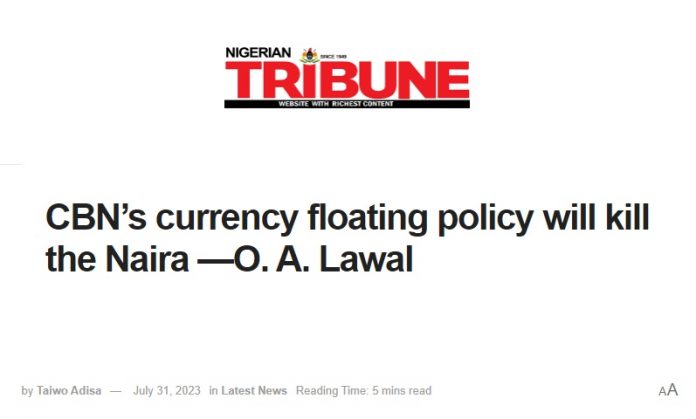
“RENOWNED economist and author, Dr. O.A Lawal has told the Central Bank of Nigeria (CBN) to stop the Naira floating policy it introduced on the advice of the World Bank and the International Monetary Fund (IMF).

“Lawal, who spoke in an interview with the Nigerian Tribune said that the nation’s economy cannot withstand a floated Naira, adding that the World Bank and the IMF would destroy the Naira completely if care is not taken.

“He recommended the adoption of “managed currency” system adding that the country cannot afford to leave its currency at the mercy of certain forces, thereby expanding the frontiers of inflation and instability”, in July 31 2023, Tribune Newspaper 

In a piece on LinkedIn, a member of our community shared a link in the comment section. That link was an interview by Dr. OA Lawal. Dr. Lawal wrote a very popular O’level Economics textbook for secondary school education.

I did not do Economics in secondary school; I did Further Mathematics. Typically, because of the WAEC restrictions to a maximum of 9 subjects which I found strange, I had to find alternative ways to add some additional subjects I could not register for my senior secondary education. So, in SS1, I studied for those subjects and in my first term  in SS2, I took GCE (external WAEC). 

To prepare for those subjects, I bought some books under self-study. For the Economics subject, I used Dr. Lawal’s textbook. I passed with A2 (Distinction).  Reading his book influenced my basic understanding of economics, and he was a distant teacher. I did not attend Economics classes in school as Further Math was scheduled to clash with Economics in the timetable.

So, when Nigeria floated its currency, in a June 2023 article, I wrote that it was a bad policy. I quoted what Dr. Lawal wrote in his  textbook. Magically, yesterday, I just realized that he also spoke out: “CBN’s currency floating policy will kill the Naira —O. A. Lawal”, Tribune published on July 31, 2023. Indeed, floating the Naira without life jackets of production has sent Naira to uncontrollable seas!

That is from the teacher. If you read his book, you would have understood that most things the big experts were saying about Naira were nonsense. It is very refreshing that Dr Lawal found time in his retirement to share these insights.

The Tribune interview is on click; he posits the same thing I have recommended: managed or controlled exchange rate because the Naira does not have production-anchored economic resilience to be under the full influence of market forces.