DD
MM
YYYY

PAGES

DD
MM
YYYY

spot_img

PAGES

Home Blog Page 34

Zcash and Bittensor Face Governance Changes While ZKP Moves Forward With a Bold 3000x ROI Forecast

0

Recent shifts across top crypto coins are being driven less by headlines and more by how projects are structured internally. Changes in governance control, reward emissions, and incentive balance are now translating directly into price movement and sentiment. Zcash and Bittensor offer clear examples of how internal pressure can surface during active market phases.

Meanwhile, Zero Knowledge Proof (ZKP) is approaching the market from a different direction. With its presale auction live, fixed parameters locked from the start, and a clearly defined price path, attention is building around its long-term 3000x ROI potential. This contrast highlights why structure now matters as much as narrative when comparing top crypto coins.

Zcash Governance Tension and Core Team Shifts

Designed to enable private transfers using advanced cryptographic methods, Zcash historically relied on a concentrated development group to maintain trust. Over time, that stability has started to weaken. Public disagreements and notable developer departures have introduced questions around leadership continuity and long-range oversight.

From a market view, governance stress has real impact. When authority becomes fragmented or funding direction loses clarity, confidence often declines. Within the group of top crypto coins, Zcash now reflects a wider challenge faced by mature networks that must repeatedly renegotiate control after launch. Although the network continues to operate, uncertainty around long-term responsibility weighs on sentiment and limits upside expectations.

Bittensor Emission Changes and Market Reaction

Bittensor has gained visibility for its decentralized AI reward design, yet its recent emission reset after halving shows how sensitive pricing can be to economic rule changes. Adjustments to distribution forced participants to rethink reward timing and supply expectations, leading to a broad repricing across the network.

While such changes are often explained as needed upgrades, they also expose a structural weakness. When economic conditions shift after capital has already entered, trust can soften. Among top crypto coins, Bittensor’s experience illustrates how even strong technical ideas can face sharp volatility when incentive systems are altered during live cycles.

Zero Knowledge Proof (ZKP): Locked Structure and Active Presale Auction

Zero Knowledge Proof (ZKP) follows a more defined path. Its governance design and emission schedule are finalized before participation begins, not revised afterward. The network operates on a fixed daily release model, with no halving events, no discretionary supply changes, and no private access tiers influencing distribution.

What sets Zero Knowledge Proof (ZKP) apart is timing. These mechanics are already in motion. The presale auction is live now, infrastructure and network elements are live, and proof pods are delivering and shipping. As demand interacts with a preset supply curve, pricing has already begun to move upward. Early participants are entering a framework where the rules are settled and transparent.

This approach removes future surprises. There are no pending resets, no mid-cycle changes, and no behind-the-scenes adjustments waiting to reshape outcomes. For anyone assessing top crypto coins with asymmetric upside, this clarity matters. With infra complete and funding settled, Zero Knowledge Proof (ZKP) avoids common dilution pressures and internal conflicts. Analysts increasingly associate its long-term 3000x ROI outlook with structure rather than hype, since supply logic, incentives, and governance are fixed from the outset.

Consistency Versus Ongoing Revision

The real distinction between these networks goes beyond technology. It lies in how change is managed. Zcash continues to navigate governance questions well after launch. Bittensor has already revised its economic framework under active market conditions. Zero Knowledge Proof (ZKP) avoids both paths by completing its design before wide participation begins.

Markets tend to respond quickly to uncertainty. Systems that reduce discretionary intervention provide clearer risk profiles than those shaped through ongoing negotiation. For participants reviewing top crypto coins, predictability is becoming just as important as progress.

Final Remarks

Capital flow increasingly favors clarity. Networks that depend on repeated governance fixes or emission adjustments introduce added uncertainty. Zcash and Bittensor each show how internal strain can overshadow core utility. In contrast, Zero Knowledge Proof (ZKP) enters with no inherited complexity, supported by a live presale auction, active network components, and proof pods already shipping.

This does not remove market risk, but it does reduce internal shocks. For those scanning top crypto coins with strong upside profiles, Zero Knowledge Proof (ZKP) stands apart due to its locked structure, active presale momentum, and clearly defined 3000x ROI potential.

Find Out More About Zero Knowledge Proof (ZKP):

Website: https://zkp.com/

Auction: https://auction.zkp.com/

X: https://x.com/ZKPofficial

Telegram: https://t.me/ZKPofficial

When Crypto Meets AI, Market Fragility Grows

0

The growing interest in cryptocurrencies over recent years has increasingly developed in conjunction with the artificial intelligence boom, turning digital assets from a niche financial instrument into an element of the global technological infrastructure. The crypto market is gradually losing its status of a parallel reality for investors and increasingly depends on the same factors as the AI sector. Access to capital, trust in long-term monetization, and the ecosystems’ ability to withstand scaling without losing sustainability. It is at this intersection that new risks form, from cybersecurity to ecology and geopolitics.

Financial markets are becoming increasingly sensitive to these signals. Growing hack reports, rising energy consumption, and possible regulatory pressure are leading to higher volatility in the cryptocurrency market, where investors are increasingly taking profits amid deteriorating news. The same sentiment is spilling over into broader asset classes — for example, pressure on the technology sector is periodically reflected in the dynamics of ES futures. This becomes an indicator of declining risk appetite among institutional players, particularly when narratives about crypto and AI converge.

Thus, in 2025, hackers linked to North Korea stole a record $2 billion worth of cryptocurrency, which is more than 50% higher than the amount stolen the previous year. These funds account for the bulk of the $3.4 billion stolen from crypto companies since the beginning of the year. Cryptocurrency thefts have long become a systemic source of financing for the DPRK, with the largest episode, the Bybit exchange hack, valued at $1.5 billion, becoming the largest digital theft in history and immediately affecting the market. XRP USD showed heightened volatility as investors reassessed counterparty risk and regulatory exposure across major crypto assets. Despite the decrease in the number of attacks, their effectiveness has advanced dramatically. North Korean groups rely on sophisticated money laundering schemes and the insertion of IT specialists directly into crypto services.

At the same time, pressure from the “physical world” is growing. A study by VU Amsterdam indicates that by 2025, the global energy consumption of AI systems could reach 23 GW, and water consumption could exceed 764 billion liters per year, surpassing the total energy consumption of Bitcoin mining in 2024. The ecological footprint of AI infrastructure, according to researchers, could result in carbon dioxide emissions of 50-80 million tons annually, which exceeds those of some developed countries. These figures have already prompted policy initiatives in the United States, from requests for transparency of energy consumption to radical proposals for a temporary moratorium on the construction of new AI data centers.

In this context, the attempts of large electronics manufacturers to bring cryptocurrency closer to the mass consumer appear ambiguous. Xiaomi has announced that, starting next year, it will ship smartphones outside of China and the United States with a pre-installed Sei Wallet and support for the Sei blockchain. By doing this, the company aims to simplify access to Web3 and crypto payments, enabling payments in tens of thousands of Xiaomi retail stores using stablecoins. However, the risks are clearly visible. The imposition of default crypto applications may displease users, as well as enhance regulatory scrutiny in countries where attitudes toward digital assets remain cautious.

Taken together, these events highlight a key shift. The market is gradually shifting from a phase of unconditional optimism to a stage of sober reassessment. Cryptocurrencies and AI are still perceived as the technologies of the future. Still, investors, regulators, and society are increasingly wondering about the cost of this future, whether it is cyber risks, environmental pressures or systemic consequences for global capital markets.

Converge Bio Raises $25m as AI Drug Discovery Race Accelerates

0

Every sector of the global economy is racing to integrate Artificial Intelligence to automate functions, boost productivity, and accelerate growth. Thus, the health sector has been deepening its integration as the results trickle in.

AI is moving decisively from the margins to the core of drug discovery, as pharmaceutical and biotech companies seek to shave years off development timelines, lower soaring research costs, and improve the odds of success in an industry defined by high failure rates.

More than 200 startups are now competing to embed AI directly into research and development workflows, and investor appetite for the sector continues to build. Converge Bio has emerged as the latest beneficiary of that momentum, securing fresh capital as competition in AI-driven drug discovery intensifies.

The Boston- and Tel Aviv–based startup announced a $25 million oversubscribed Series A round led by Bessemer Venture Partners, with participation from TLV Partners and Vintage Investment Partners. The round also included backing from several undisclosed senior executives affiliated with Meta, OpenAI, and Wiz, underscoring the growing convergence between frontier AI talent and life sciences.

According to TechCrunch, the raise comes about 18 months after Converge closed a $5.5 million seed round in 2024, marking a rapid escalation in funding as the company scales its technology and customer base.

Converge Bio focuses on using generative AI trained directly on molecular data — including DNA, RNA, and protein sequences — to help pharmaceutical and biotech companies accelerate drug development. Rather than positioning itself as a standalone research tool, the company integrates its models into existing industry workflows, targeting multiple stages of the drug-development lifecycle, from early discovery through optimization and manufacturing.

“The drug-development lifecycle has defined stages — from target identification and discovery to manufacturing, clinical trials, and beyond — and within each, there are experiments we can support,” CEO and co-founder Dov Gertz said. “Our platform continues to expand across these stages, helping bring new drugs to market faster.”

A key differentiator for Converge is its emphasis on complete, production-ready systems rather than isolated models. The company has already rolled out three customer-facing AI systems: one for antibody design, one for protein yield optimization, and one for biomarker and target discovery. Each system combines multiple layers of AI and physics-based modeling to reduce risk and improve reliability.

Gertz described the antibody design system as a case in point. A generative model first creates novel antibody candidates. Predictive models then screen those candidates based on molecular properties such as stability and binding potential. Finally, a docking system based on physics simulations evaluates three-dimensional interactions between the antibody and its target.

“It’s not a single model,” Gertz said. “The value is in the system as a whole. Our customers don’t have to piece models together themselves — they get ready-to-use systems that plug directly into their workflows.”

Despite being just two years old, Converge has scaled quickly. The company has signed roughly 40 partnerships with pharmaceutical and biotech firms and is currently running about 40 active programs on its platform. Its customers span the U.S., Canada, Europe, and Israel, and the company is now expanding into Asia. Internally, Converge has grown from nine employees in November 2024 to 34 today, reflecting both technical and commercial expansion.

The startup has also begun publishing case studies to demonstrate real-world impact, a critical step in an industry that has long been cautious about AI claims. In one case, Converge helped a partner increase protein yield by four to 4.5 times in a single computational iteration. In another, its platform generated antibodies with extremely high binding affinity, reaching the single-nanomolar range — a benchmark that signals strong therapeutic potential.

The funding round lands amid a broader surge of interest in AI-driven drug discovery. Major pharmaceutical companies are committing significant resources to the space. Last year, Eli Lilly partnered with Nvidia to build what the companies described as the pharma industry’s most powerful supercomputer for drug discovery. In October 2024, the creators of Google DeepMind’s AlphaFold won the Nobel Prize in Chemistry, a watershed moment that cemented AI’s scientific credibility by recognizing its ability to predict protein structures with unprecedented accuracy.

Gertz said the shift in industry sentiment has been swift and striking. “When we founded the company, there was a lot of skepticism,” he said. “That skepticism has vanished remarkably quickly.”

He described the current moment as a fundamental transition away from traditional trial-and-error experimentation toward data-driven molecular design, calling it the largest financial opportunity in the history of life sciences.

But there are challenges. Generative models can hallucinate — a manageable issue in text applications but a costly one in biology, where validating a novel molecule can take weeks or months. Converge addresses this by pairing generative models with predictive filters that narrow down candidates before they reach the lab.

“This filtration isn’t perfect,” Gertz said, “but it significantly reduces risk and delivers better outcomes for our customers.”

The company is also selective about how it uses large language models. While text-based LLMs can assist with tasks like navigating scientific literature, Gertz said they are not suitable as the foundation for biological understanding. He echoed the skepticism of figures such as Yann LeCun, arguing that meaningful progress in biology requires models trained directly on molecular data rather than text alone.

Converge’s platform blends multiple approaches, including LLMs, diffusion models, traditional machine learning, and statistical methods, depending on the problem at hand.

Looking ahead, Converge Bio’s ambition extends beyond individual tools or use cases. Gertz envisions a future where every life-science organization operates a “generative lab” alongside its wet lab, using AI to generate hypotheses and molecular candidates before moving into physical experimentation.

“Wet labs will always exist,” he said. “But they’ll be paired with generative labs that create hypotheses and molecules computationally. We want to be that generative lab for the entire industry.”

As competition intensifies and capital continues to flow into AI-driven drug discovery, Converge Bio’s rapid growth highlights how quickly the field is maturing. The ultimate test, however, will be whether these systems can consistently translate computational promise into approved therapies.

Paystack Steps Into The Nigerian Banking Space With Ladder Microfinance Bank Acquisition

0

Paystack, the African fintech best known for its online and offline payment solutions, has formally entered Nigeria’s banking sector following its acquisition of Ladder Microfinance Bank.

The move marks a strategic shift from being a pure payments infrastructure provider to offering deeper financial services, including deposits, credit, and banking-as-a-service solutions for businesses.

Through the acquisition, Paystack gains greater control over the flow of funds within its ecosystem, enabling it to build more comprehensive financial products beyond payments. This expansion is expected to support lending, savings, yield products, and other core banking services tailored to the needs of African businesses.

Announcing the milestone, the company clarified that Paystack Microfinance Bank will operate independently of Paystack Payments Limited, with its own licence, governance, and roadmap. While both entities will collaborate closely, each will remain focused on its distinct mission. According to the company, the new bank will be guided by the same values that shaped Paystack from its inception: reliability, simplicity, transparency, and trust. The rollout will begin with a small group of users, gradually expanding to more businesses and individuals over time.

Reacting to this development, Paystack’s Chief Operating Officer, Amadine Lobelle, via a LinkedIn post expressed excitement, describing the move as a natural evolution of the company’s vision, while noting that Paystack is now focused on helping businesses access a full financial operating system.

In her words,

“After 10 years of building trusted payments infrastructure, we’re excited to welcome Paystack Microfinance Bank to the family, a sister company to our payments business in Nigeria. Businesses don’t just need to get paid. They need a full financial operating system. One that helps them store money safely, move it easily, understand it clearly, and grow with confidence. Paystack MFB will run as a standalone bank, focused on solving some of these core pain points – from account services to yield and credit – all built on the foundation of what we’ve learned over the last decade. We’re just getting started, and we’re excited about what this unlocks for ambitious businesses.”

Founded in 2015 by Nigerian computer science graduates Shola Akinlade and Ezra Olubi, Paystack began with a simple goal: to make it easier for businesses to get paid. The founders believed modern technology could remove the complexity and frustration associated with payments, and they built infrastructure to support that vision. Over the years, the company has steadily expanded its reach and capabilities.

A decade later, Paystack has evolved into a platform operating across five African countries. In Nigeria alone, it processes trillions of naira in transactions every month, supporting over 300,000 businesses and millions of customers. In March last year, the company further broadened its scope with the launch of Zap, a consumer-focused app designed to simplify and speed up bank transfers.

Instead of relying on card networks or digital wallets, the app focuses exclusively on direct bank transfers, helping to reduce costs and improve transaction speed. This strategy places Paystack in direct competition with major fintech players such as OPay, PalmPay, Moniepoint, and Kuda, all of which have built strong user bases around mobile wallets and digital banking services.

With the acquisition of a microfinance licence, Paystack can now integrate payments, banking, and credit more tightly, offering tailored financial services to the businesses already using its platform. This move strengthens its ability to control the full financial journey of merchants from receiving payments to managing funds and accessing credit.

Outlook

Paystack’s entry into banking signals a broader trend among African fintechs. The convergence of payments, banking, and lending into unified financial ecosystems. By owning both the payments layer and a licensed banking institution, Paystack is well-positioned to build end-to-end financial products that go beyond transactions into long-term business growth.

In the long term, Paystack’s transformation from a payments company into a full-stack financial services provider could redefine its role in Africa’s digital economy, shifting from a facilitator of transactions to a core financial partner for ambitious businesses across the continent.

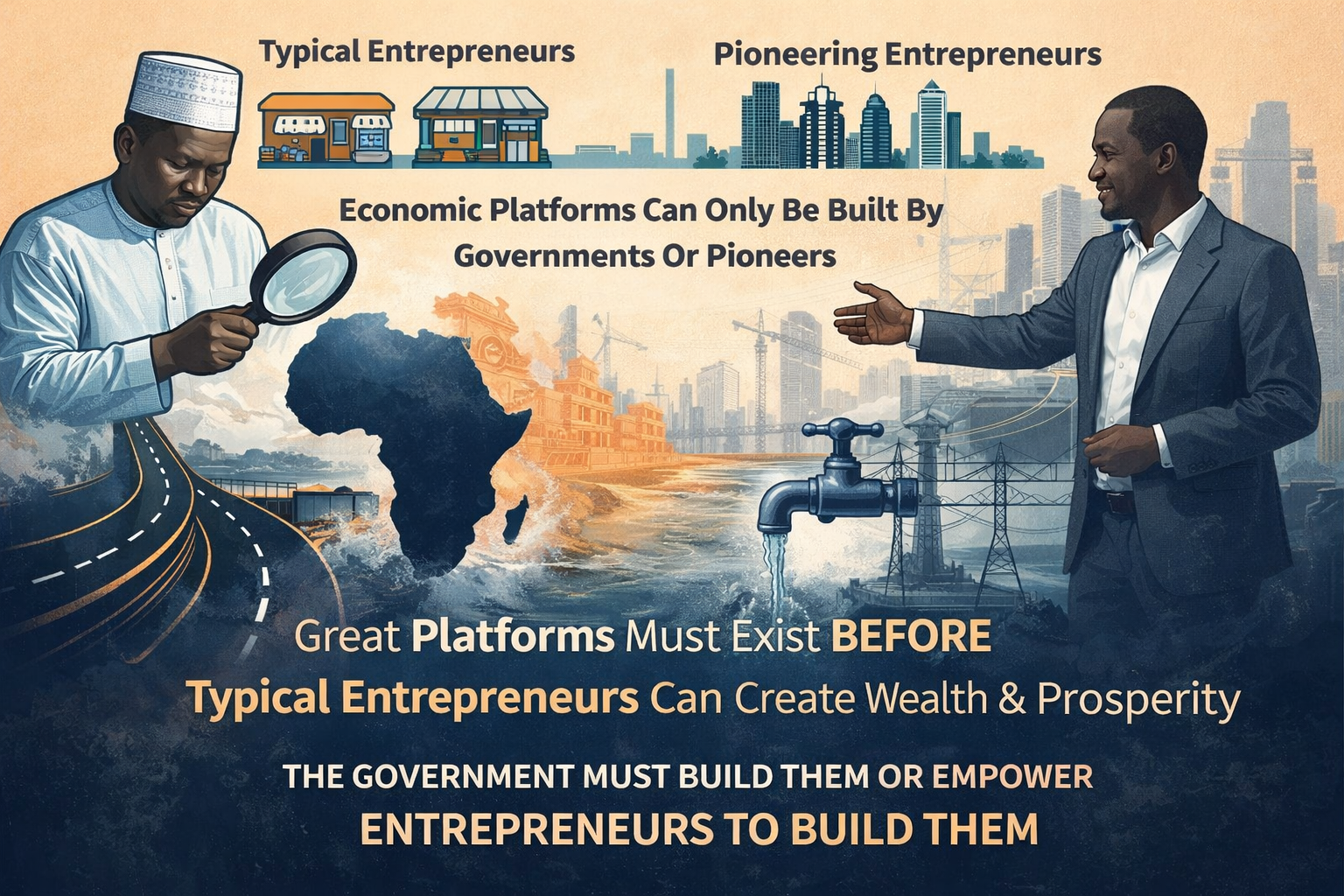
Nations Rise When Platforms Rise: The Missing Link in African Entrepreneurship

1

Comment: “It’s time for African entrepreneurs to start figuring things out and to stop sitting on the fence waiting for governments to provide solutions. Governments can support later, but the momentum and direction must first come from African entrepreneurs.”

My Response: To address this, it is important to classify entrepreneurs into two groups: typical entrepreneurs and pioneering entrepreneurs. Typical entrepreneurs are the everyday businesspeople who populate our markets and there are millions of them. They run restaurants, repair shops, retail stores, logistics services, and tech agencies. They are essential, but they require economic platforms to operate. Those platforms are roads, clean water, electricity, security, postal systems, digital infrastructure, and functional public services. These platforms are the responsibility of governments, because only governments can coordinate and finance them at scale. Once these platforms exist, typical entrepreneurs can thrive.

This is why countries like the United States continue to subsidize their foundational systems. The U.S. Postal Service has not made a profit in two decades. Amtrak has never made a profit since its founding in 1971. Yet these systems are preserved and funded because they serve as economic and social platforms, enabling millions of businesses to function. No modern economy thrives without such base infrastructure.

However, history also shows that governments sometimes lack the capacity to build these platforms on their own. When that happens, states transfer portions of their sovereign rights to pioneering entrepreneurs, men and women who build systems, not just businesses. In the U.S., the eminent domain rules empowered railway pioneers like Vanderbilt to lay the foundations for the national railway grid. Carnegie, Rockefeller, and Mellon built industries that became the scaffolding for America’s economic rise, and government actively supported them because they were building platforms, not just companies.

The same pattern continued into the digital age. When Jeff Bezos launched Amazon, an untested, pioneering ecommerce platform, America gave it a structural advantage: Amazon was not required to collect sales taxes for years. That policy alone made Amazon’s prices significantly cheaper than physical stores and accelerated its dominance. Without such deliberate “goodies,” Amazon would not be Amazon. Tesla revenue was juiced via EV credits financed by America’s taxes!

So, the comment is partially correct, but incomplete. Africa needs pioneering entrepreneurs, yes. But typical entrepreneurs cannot function without platforms, and those platforms must be built first, either by governments or by pioneers empowered by governments.

You may ask: Why must it be that way? Because nation-building follows the laws of economic gravity. What the U.S. Congress did for Amazon would be condemned as cronyism in Nigeria, yet those incentives seeded a trillion-dollar economic platform.

My summary: for development to happen, platforms must be built. Either governments build them, or governments empower pioneering entrepreneurs to build them. But platforms must exist, because without them, no nation has ever unlocked prosperity, and no army of typical entrepreneurs can create sustained growth on a foundation that does not exist.