DD
MM
YYYY

PAGES

DD
MM
YYYY

spot_img

PAGES

Home Blog Page 3406

Stanbic IBTC Holdings Profit Grew by 58% in Q1 2024, as Snap Doubles Digital Growth

0

Stanbic IBTC Holdings PLC, an integral entity within the financial landscape of Nigeria,  has announced its first quarter (Q1) earnings ended March 31, 2024.

The bank posted an increase of 58.13 percent from N28.86 billion reported in the first quarter (Q1) ended March 31, 2023. Also, it reported a pre-tax profit of N62.7 billion, representing a 73% year-on-year growth, compared to the N36.3 billion pre-tax profit posted in Q1 2023.

Stanbic Holdings’ major source of earnings is reported to have come from interest income, which saw the company post a net interest income of N76.8 billion, highlighting a 111.4% YoY growth of the N36.4 billion net interest income posted in Q1 2023. Like other financial institutions in Nigeria, Stanbic enjoyed significant earnings from increased interest rates in the country.

Check Out Stanbic IBTC Holdings Q1 2024 earnings report

– Net interest income: N76.9 billion, +111% YoY

– Non-interest revenue: N61.3 billion, +38% YoY

– Total income: N138.2 billion, +71% YoY

– Net impairment charge on financial assets: N7.1 billion, +117% YoY

– Income after credit impairment charges: N131.1 billion, +69% YoY

– Profit before tax: N62.7 billion, +73% YoY

– Profit for the period: N45.6 billion, +58% YOY

– Earnings per share: N3.45, +59.7% YoY

– Cash and cash equivalent at the end of the period: N1.44 trillion, +133% YoY

– Loans and advances: N2.2 trillion, +9% YTD,

– Total assets: N6.O trillion, +16% YTD

  • Net Cash flows from operating activities N791,606 million
  • Cash flows used in Operations N754,664
  • Increase in assets N197,781 million
  • Increase in deposits and other liabilities N559,748 million
  • Net Cash flows used in investing activities N50,580 million
  • Net Increase in cash and bank balances N983,006 million

Stanbic total assets for 2023 recorded a 70 per cent growth to N5.1 trillion, from the N3.0 trillion posted in FY 2022. This growth in asset was driven to a 69 per cent increase in the group’s loans and advances as well as the 108 percent growth in cash and cash equivalents.

The company showcased a remarkable financial first quarter performance ended March 2024. Through its remarkable growth over the years, the bank stands as a beacon of financial ingenuity and stability. Recall that in 2022, it was awarded the overall best bank in retail and SME segments.

Notably, Stanbic Holdings takes pride in its strategic investment and management of controlling shares across its ten direct subsidiaries.

These includes; Stanbic IBTC Bank Limited, Stanbic IBTC Pension Managers Limited, Stanbic IBTC Asset Management Limited, Stanbic IBTC Capital Limited, Stanbic IBTC Insurance Limited, Stanbic IBTC Stockbrokers Limited, Stanbic IBTC Ventures Limited, Stanbic IBTC Insurance Brokers Limited, Stanbic IBTC Trustees Limited, Zest Payment Limited (formerly Stanbic IBTC Financial Services Limited) and one indirect subsidiary, namely: Stanbic IBTC Nominees Limited.

Snap Q1 2024 Earnings Surpassed Analysts Earnings, Records Double-digit Growth

Meanwhile, American technology company Snap has reported its first quarter (Q1) earnings for 2024, surpassing analysts’ expectations, and also recorded a return to double-digit revenue growth.

The company recorded a first-quarter revenue of $1,195 million, compared to $989 million in the prior year, highlighting a 21% year-over-year increase. Meanwhile, LSEG expected $1.12 billion.

Speaking on the Q1 2024 earnings report, Snap CEO Evan Spiegel said,

“The value we provide our community and advertising partners has translated into improved financial performance. Our large, growing, and hard-to-reach community, brand-safe environment, and full-funnel advertising solutions have made us an increasingly important partner for businesses of all sizes”.

Snap Q1 2024 Financial Summary

•Net loss was $305 million, compared to $329 million in the prior year.

•Adjusted EBITDA was $46 million, compared to $1 million in the prior year.

• Operating cash flow was $88 million, compared to $151 million in the prior year.

• Free Cash Flow was $38 million, compared to $103 million in the prior year.

Snap has been working to rebuild its advertising business after the digital ad market significantly declined in 2022. In a bid to improve ads on the platform, the company implemented several measures.

For instance, it announced two new brand safety solutions for advertisers: a third-party measurement product in partnership with Integral Ad Science, a leading global media measurement and optimization platform, to provide advertisers with increased transparency across their Snapchat campaigns, and a first-party tool that allows advertisers greater control over where their ads appear.

The input on its ads business has begun to yield positive results after the company disclosed that revenue growth was primarily driven by improvements in its advertising platform, as well as demand for its direct-response advertising solutions. The company noted that the number of small and medium-sized advertisers on Snapchat increased 85% year-over-year.

Also, Snap disclosed that the overall time spent watching content globally grew year-over-year, driven primarily by increases in total time spent watching Spotlight and Creator Stories. It added that it has built more advanced ranking models over the past year that are driving improvements in content engagement.

The app’s daily users surged to 422 million in Q1 2024, an increase of 39 million, or 10% year-over-year. Snapchat+ subscribers also more than tripled year-over-year, surpassing 9 million subscribers in the quarter. The company, which laid off 10% of its workforce in February, now says it expects its headcount to “grow modestly as it moves through 2024.”

Notably, Snap plans to continue to invest in generative AI models for the creation of Lenses on the platform, noting that the number of ML and AI Lenses viewed by users increased by more than 50% year-over-year.

As it gears up for Q2, the company announced that it anticipates continued growth of its global community, with a focus on executing against its roadmap to deliver improvements to its DR advertising platform to drive improved results for its advertising partners and accelerate topline growth.

Snap says it expects a Q2 guidance range for revenue from $1,225 million to $1,255 million, implying year-over-year revenue growth of 15% to 18%.

NNPCL and African Refinery Reach Agreement to Strengthen Local Refining Capacity of Port-Harcourt Refinery

0

The Nigerian National Petroleum Company Ltd (NNPCL) has made a fresh move in its quest to bolster Nigeria’s local refining capacity by entering into an agreement with the African Refinery. 

The agreement entails the co-location of a 100,000 barrels per day (bpd) refinery within the Port-Harcourt Refinery complex, heralding a transformative phase in the nation’s petroleum industry.

In a press statement disseminated on the company’s official platform, NNPCL disclosed details of the collaboration, noting its potential to revolutionize Nigeria’s energy sector. 

Once operational, the new refinery is slated to produce an array of essential petroleum products, including Premium Motor Spirit (PMS), Automotive Gas Oil (AGO), Aviation Turbine Kerosene (ATK), and Liquefied Petroleum Gas (LPG), catering to both local and international markets.

“The signing of the agreement is a significant step towards setting in motion the process of building a new refinery which, when fully operational, will supply PMS, AGO, ATK, LPG, and other petroleum products to the local and international markets and provide employment opportunities for Nigerians,” highlighted NNPCL in its press release.

This strategic collaboration is said to underscore Nigeria’s commitment to enhancing local refining capabilities and reducing dependence on imported petroleum products. Over the years, the administration of President Muhammadu Buhari has implemented various initiatives to address this issue, including granting licenses to modular refineries and providing substantial support to the 650,000 bpd Dangote Refinery in Lagos, in which NNPCL holds a 20% stake.

However, despite these efforts, challenges persist in the nation’s refining sector. The long-awaited rehabilitation of the Port Harcourt Oil Refinery, nearing completion according to NNPCL’s announcement last month, has encountered delays in commencing operations. 

While the mechanical completion of the PHRC was declared in December, the refinery has yet to commence operations, prompting scrutiny from the Senate Ad-Hoc Committee to Investigate the Turnaround Maintenance of Nigeria’s Refineries.

The committee said the Port Harcourt Refinery is not ready but will begin operation before the end of December.

In the face of these challenges, Nigeria continues to rely on imported petroleum products, further exacerbating concerns surrounding fuel subsidy removal and currency devaluation. 

Nevertheless, recent developments, such as the supply of diesel and aviation fuel from the Dangote Refinery, offer a glimmer of hope that Nigeria may soon achieve self-sufficiency in petroleum refining.

While the signing of the share subscription agreement between PHRC and African Refinery is remarkable in Nigeria’s journey towards energy independence, the question of ‘how much longer will it take?’ has been echoing – especially as fuel scarcity seems to be resurfacing in many cities across the country.

On Thursday, the president of the Trade Union Congress (TUC), Festus Osifo, said the federal government appears to be reneging on its assurance that the old Port Harcourt Refinery will commence operations by the first week of April.

The union has expressed optimism that the refinery would help curtail the high cost of petrol, by ensuring the availability of the products across the country.

“Although the inspection, both the contractors and those that are employees of company, they told us clearly that the refinery is going to come into fruition on the 1st week of April,” Osifo said.

“Today, we are approaching the first week of April this year. Now, we are approaching the end of April and the refinery production has not resumed in the old Port Harcourt Refinery.

“We wish tohereby, call on the federal government to do everything within its arsenal to ensure that the old Port Harcourt Refinery starts production immediately.

“You could go outside today and you could see queues everywhere in FCT and in some other neighbouring states. But we certainly believe that if our refineries were working optimally, today we would continue to have enough supply”.

Elon Musk’s Vision for Tesla Extends far Beyond the Realm of Automotive Manufacturing

0

In a bold statement, Elon Musk has positioned Tesla as a company whose value lies in its advancements in artificial intelligence (AI) and robotics rather than its car production capabilities. This pivot reflects a strategic foresight into the future of technology and its integration into everyday life.

Tesla’s journey in AI advancements is a testament to its commitment to innovation and technology. The company has made significant strides in various aspects of AI, pushing the boundaries of what’s possible in the automotive industry.

Tesla, traditionally seen as a leader in the electric vehicle market, has been making significant strides in AI and robotics. The company’s Autopilot and Full Self-Driving (FSD) features are prime examples of its AI prowess. These technologies not only enhance the driving experience but also showcase Tesla’s commitment to innovation and safety.

Musk’s emphasis on AI and robotics suggests a future where Tesla’s vehicles are part of a larger ecosystem of smart technology designed to automate and optimize transportation and logistics.

The valuation of Tesla as an AI robotics companies rather than a car manufacturer could have profound implications for investors and the market at large. It signals a shift in focus from traditional car sales to the potential revenue streams from licensing AI technology, data services, and autonomous capabilities. This transition may also reflect the company’s response to the challenges in the automotive sector, such as sales fluctuations and production costs.

Musk’s statement comes at a time when Tesla’s sales have experienced a downturn, prompting a reevaluation of the company’s core business model. By emphasizing the role of AI and robotics, Tesla is positioning itself at the forefront of a technological revolution, one that could redefine the company’s trajectory and market valuation.

Moreover, Musk’s call for a larger share in Tesla to drive its growth in AI and robotics further underscores the importance he places on these technologies for the company’s future. His vision aligns with the broader industry trend where AI and robotics are increasingly becoming critical components of business strategy and competitive advantage.

These advancements reflect Tesla’s dedication to integrating AI into its products and services. The company’s approach to AI and robotics is not just about enhancing the driving experience but also about creating a cohesive ecosystem of smart technology that can automate and optimize various aspects of life.

Tesla’s AI innovations are setting the stage for a future where technology seamlessly integrates with the fabric of society, redefining the relationship between humans and machines. As Tesla continues to innovate, it remains a key player in the evolution of AI and robotics, shaping the future of transportation and beyond.

Elon Musk’s assertion that Tesla should be valued as an AI robotics company reflects a strategic pivot towards technology that could redefine the automotive industry. It underscores the potential of AI and robotics to be the driving force behind Tesla’s future growth and success. As the company continues to innovate and expand its technological capabilities, it may well set a new standard for how companies are valued in the era of AI and automation.

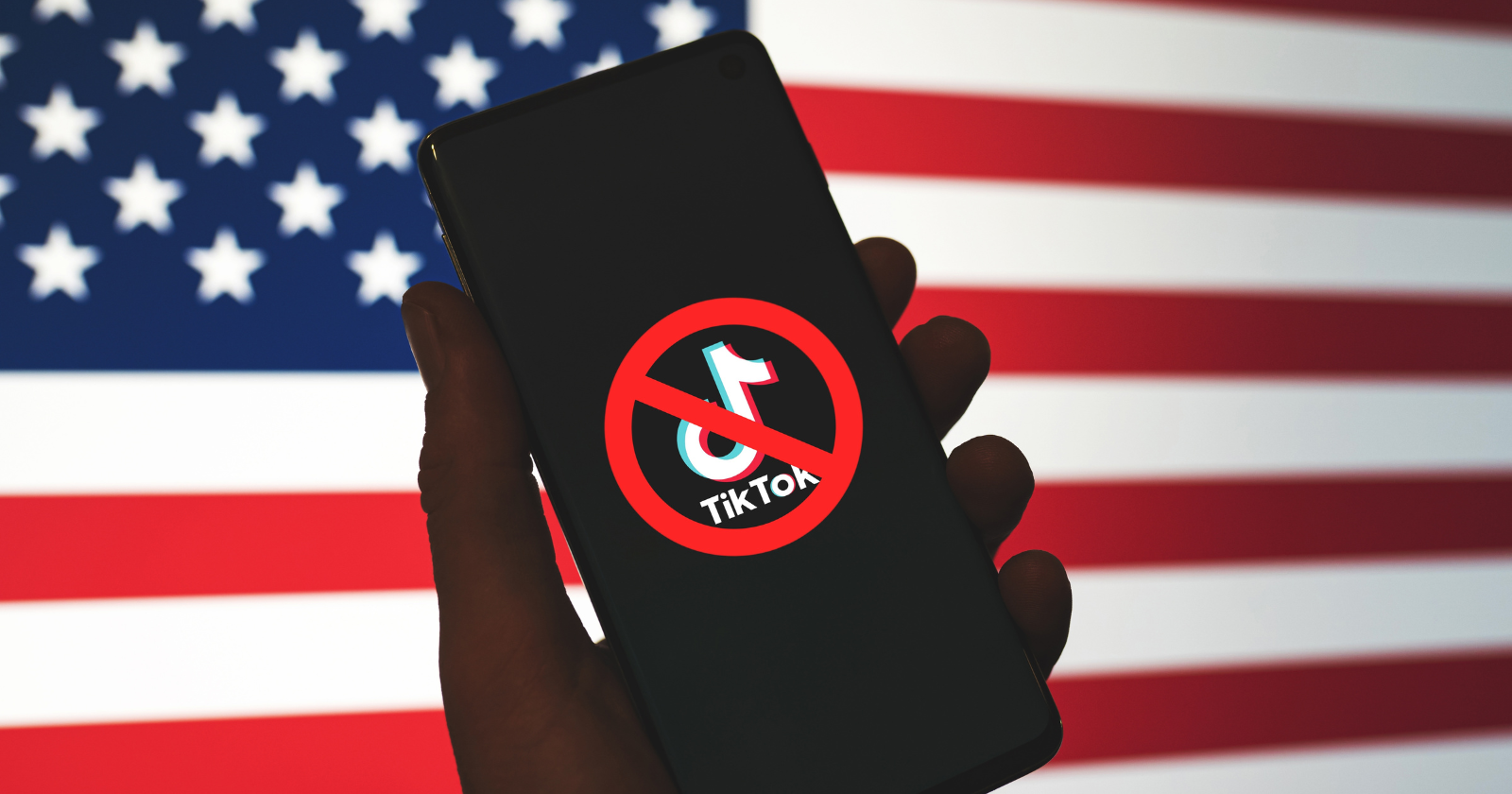
President Biden Signs Bill to ban TikTok Unless its owner, ByteDance, Agrees to sell the Platform

0

In a significant move that could reshape the social media landscape, President Biden has signed a bill that includes provisions for a potential ban on TikTok in the United States. This legislation, part of a broader national security package, sets a timeline for TikTok’s parent company, ByteDance, to divest the app or face a ban.

The bill, which has been the subject of much debate and scrutiny, reflects growing concerns over data privacy and national security. TikTok, a platform with over 170 million American users, has been under the microscope due to its Chinese ownership and the fear that user data could be accessed by the Chinese government.

The new law provides ByteDance with a nine to twelve-month window to negotiate a sale of TikTok. If no sale occurs, the app could be banned in the U.S. However, the timeline ensures that TikTok will remain operational through the upcoming election cycle, a period during which the app is expected to play a significant role in political campaigning and voter engagement.

The decision to sign this bill into law did not come lightly, as it involves a platform that has become deeply integrated into American culture, especially among younger demographics. TikTok has transformed the way people consume and create content, fostering a community of creators and viewers alike.

Critics of the ban point out that TikTok is a platform for creative expression and communication. Banning the app could infringe on First Amendment rights, as postings on TikTok are considered a form of speech.

TikTok has created an ecosystem of creators and businesses that rely on the platform for income. A ban could have negative economic consequences for those who use TikTok for business purposes.

Some argue that banning TikTok won’t solve the broader issues of foreign influence, teen harm, and data privacy problems present in social media. Comprehensive regulation across all platforms would be necessary to address these concerns effectively.

A ban could strain relations with China, as the Chinese government opposes a forced sale of TikTok. This could have wider implications for international diplomacy and trade.

The debate is complex and involves weighing the importance of national security against the rights of individuals to free expression and access to global platforms. As the situation evolves, it will be crucial to monitor the responses from ByteDance, lawmakers, and the public to understand the future of TikTok in the U.S. and potentially, around the world.

The implications of this potential ban are far-reaching. It raises questions about the future of digital platforms and the balance between national security and free expression. It also highlights the challenges of global technology governance in an era where digital platforms can cross national boundaries and influence millions.

As the situation develops, all eyes will be on ByteDance’s next move. Will they agree to sell TikTok, or will they challenge the potential ban? The outcome of this decision could set a precedent for how similar situations are handled in the future.

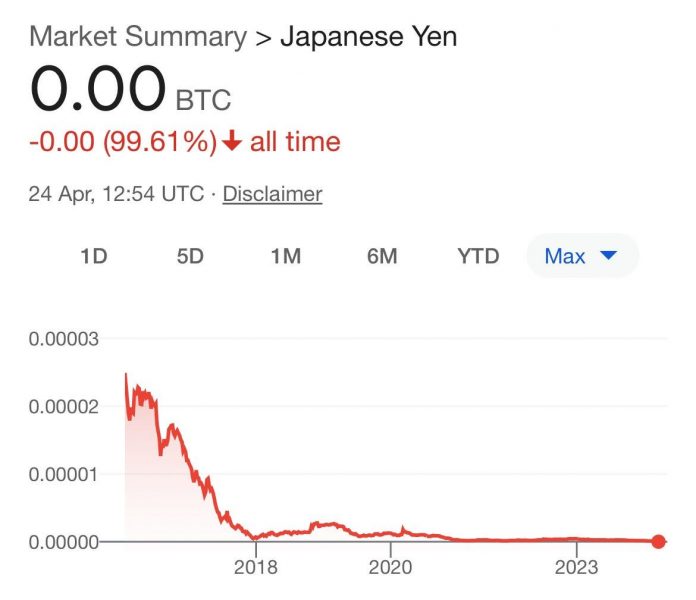
The Japanese Yen and Bitcoin

0

In the dynamic world of currency exchange, the relationship between traditional fiat currencies and cryptocurrencies has been a subject of much interest and speculation. The Japanese Yen (JPY), one of the world’s most traded currencies, and Bitcoin (BTC), the first and most well-known cryptocurrency, are no exception to this trend.

The claim that the Japanese Yen has “gone to zero” against Bitcoin is a hyperbolic statement that does not reflect the actual exchange rates and market dynamics. As of the latest data, 1 Bitcoin is equivalent to approximately ¥10,221,181. This exchange rate is subject to fluctuations due to market forces, including supply and demand, investor sentiment, and broader economic factors.

The valuation of Bitcoin in terms of the Japanese Yen has seen significant changes over time, influenced by various global events, technological advancements, and shifts in regulatory environments. Bitcoin’s decentralized nature and limited supply contrast with the Yen’s status as a legal tender backed by the Japanese government and its monetary policy.

It is important to understand that the value of Bitcoin against the Yen or any other fiat currency is not indicative of the latter’s collapse or failure. Instead, it represents the growing interest and adoption of cryptocurrencies as an asset class and a medium of exchange in certain contexts. The rise in Bitcoin’s value over the years has been remarkable, and it has sparked discussions about the future of money, the role of central banks, and the potential of blockchain technology.

One of the key aspects of Japan’s regulatory framework is the focus on user protection. This includes safeguarding user assets and providing sufficient information to users, ensuring that intermediaries such as custodial service providers maintain proper internal control systems. The FSA mandates that crypto exchanges in Japan be registered and comply with traditional anti-money laundering (AML) and counter-financing of terrorism (CFT) obligations, aligning with international standards set by the Financial Action Task Force (FATF).

The introduction of stablecoins pegged to the yen has also played a significant role in Japan’s cryptocurrency landscape. These digital assets, designed to minimize price volatility by being linked to a conventional asset class like fiat currency, have attracted more individuals and enterprises to the crypto arena. Notably, only banks, fund transfer service providers, and trust companies are entitled to issue digital-money type stablecoins in Japan, with stringent requirements to ensure redemption at par and price stabilization.

Japan’s regulatory approach is not without its challenges. The stability of the yen, for instance, has been a factor in restraining the explosive growth of cryptocurrencies within the country. Moreover, Japan’s shrinking and aging population presents another hurdle, as younger generations are more inclined to adopt crypto assets compared to older demographics.

Despite these challenges, Japan continues to embrace the potential of cryptocurrencies and blockchain technology. The government’s awarding of nonfungible tokens (NFTs) to mayors for their initiatives in 2022 marked a significant milestone, positioning Japan among the first national governments to utilize NFTs as a form of recognition.

Investors and enthusiasts alike are keenly observing the interplay between cryptocurrencies like Bitcoin and traditional currencies such as the Japanese Yen. While some view cryptocurrencies as a hedge against inflation and currency devaluation, others approach them with caution due to their volatility and regulatory uncertainties.

The relationship between the Japanese Yen and Bitcoin is complex and multifaceted. It is shaped by a myriad of factors that go beyond simple comparisons of exchange rates. As the financial landscape continues to evolve, the interaction between fiat currencies and cryptocurrencies will likely remain a topic of keen interest and ongoing analysis.