DD
MM
YYYY

PAGES

DD
MM
YYYY

spot_img

PAGES

Home Blog Page 3410

As Nigeria’s Banking Stocks Crash, Central Bank of Nigeria Must Review Recapitalization Policies

0

I agree – I am a village boy. But I have it on record that I am not a fan of the Central Bank of Nigeria (CBN) recent  policy where banks’ retained earnings are excluded from the recapitalization process. My position was that it would make capital utilization inefficient: “Bank Recapitalization In Nigeria Could Make Capital Inefficient Through Exclusion Of Retained Earnings”.

I have noted that markets become inefficient where capital is designed to have “tiers” based on many factors. Adam Smith in his invisible hands theory cautioned against that. So, if you structure your recapitalization to prefer people in New York, London, etc to invest in Nigerian banks (they export USD to Nigeria, but have to convert to Naira, to buy the equities which are sold in Naira), you are creating a tiered system.  That is bad.

The zenith of any efficient market is when Naira from New York, London, Umuahia, Kano, Ife, Jos, Nairobi, Moscow, etc all have equal weights.  But when fudge factors are introduced to rank capital based on source, you destroy a market. Diamond Bank which funded my doctoral program in banking and finance helped me to understand the dimensions of global finance, international market and currencies.

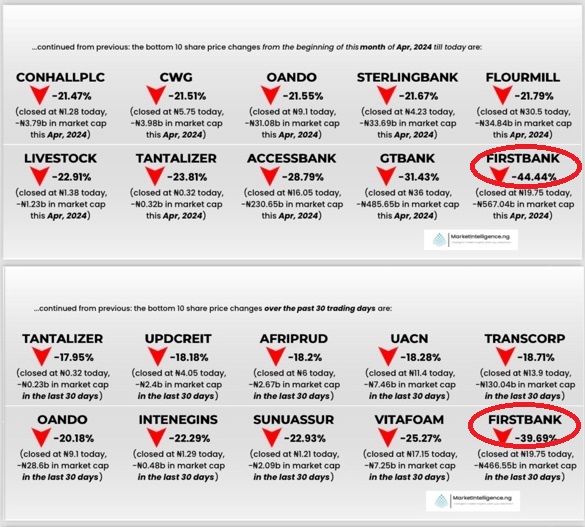
CBN’s policy which is geared to attract USD to our equity market is causing real problems because it has made the market inefficient. FirstBank of Nigeria* is down 44% in April 2024, and 39% in the  last 30 days of trading. Remember, you cannot afford to annoy those currently investing in the Nigerian stock exchange (NGX), even as you hope for the Londoners, New Yorkers, etc to come. I have spoken as a village boy; I yield to the wiser people!

Comment on Feed

Comment 1: Every asset on a banks balance sheet is funded by two broad means:

1. Debt Capital (depositors and lenders)
2. Equity Capital (shareholders)

Most bank regulators around world are primarily saddled with two broad responsibilities:

1. Stability of the financial system
2. Protect capital providers (depositors, lenders and shareholders)

Let’s focus on number #2:

Without capital providers, there’s no financial system, there’s no bank, there’s economy.

However, there’s often a divergence of interest between debt capital providers and equity capital providers.

Hence, the bank regulators needs to use a hierarchy – and in that hierarchy – Debt capital providers rank higher than Equity capital providers. What this means is that a bank regulator will first and foremost protect Debt capital providers before Equity capital providers.

Now, even amongst Debt capital providers there’s also a hierarchy and generally: Depositors rank higher than lenders. Hence, a bank regulator will protect depositors first before lenders.

Amongst lenders, there’s also a hierarchy: secured lenders ranking higher than unsecured lenders.

What is my point?

Capital is tiered in the financial system – all capital are equal but some are more equal than others (animal farm).

Case in point:

Early last year, Credit Suisse collapsed and the Coco bond holders (a capital provider tier within the debt capital tier) was wiped out; their capital was used to absorb the losses the bank had incurred. The decision to do that was taken by the Swiss bank regulator – and they did it to protect other debt capital providers and ensure financial stability.

Now to Nigeria.

Who amongst the different tiers of capital providers stand to benefit the most from the recapitalization of the banks excluding retained earnings and also benefit from the withholding of dividend payments?

The answer is the debt capital provider: raising more equity capital ensures that the banks have adequate equity capital to absorb losses and protect their debt capital providers.

And the losers are the existing Equity capital providers: dividend withheld, dilution coming, stock price tanking.

So, in doing this, the bank regulator, in this case, CBN, is simply following it’s hierarchy of capital providers and at the same time ensuring the stability of the financial system.

Banks are highly leveraged – roughly for every 1 naira of asset you see on a banks balance sheet, more than 80kobo was funded by debt capital providers. If you successfully protect Debt capital providers, you have successfully protected the bank from collapsing.

So, while Equity capital providers are bleeding at the moment (it will be short term), I strongly believe that CBN’s decision will ensure a long term stability of the banks and protect the most important source of capital for the banks.

My Response: The scenario you created is self-evident but is different from my focus. We do know that we preferred shares, ordinary shares, etc. Depositors, debtors, equity holders, etc are not within the issues being debated on bank recapitalization; so, that is totally irrelevant in the debate. Read my piece and my piece is solely focused on the funds used to buy shares, and the need for fairness.  

If I am in Kano and have N10,000 to buy GTCO Plc shares, I must be in the same tier as someone living in New York who wired N10,000 to buy the shares. And if you make policies to entice that person against me, I will not like it. That does not bring classes of shares which we know are never the same, and are tiered. In liquidation, for example, debtors go first before ordinary shareholders, etc.

Here, I am saying N10k from Kano should be respected as N10k from London! If both are not weighted at the same level, you are unfair to one person. I wrote “rank capital based on source”, making it clear where I was focusing on.

Comment 2: Ordinarily, using retained earnings for recapitalization should have been a welcome idea but looking at the banks that have released their financial statements, I see their profits coming from unusual activities which they might not be able to repeat next financial year. If about 90% of your total profit is made from foreign exchange gain, then there is need for caution. Historically, what has been the level of profit of these banks in the last 3 years? Can they sustain same feat next year and beyond?

The recent run on the shares of Nigeria banks, I can say is more as a result of existing shareholders’ perception of dilution. If the existing shareholders perceive that the bank might issue new shares and it will affect the value of their shares, it might lead to sell-off. In First bank, there has been contention about who has the controlling share at the bank so if a large shareholder decides to minimize his risk due to the fact that he is not willing to increase his/her investment in the bank, it will definitely have a huge impact on the market. Access bank just changed its leadership; I think this will likely affect its ownership and share structure and even many of these banks have been dropping shares for the past 3 months.

… the regulator, CBN, has come out to say that retained earnings of banks are not allowed to be part of the capitalization. If it was allowed then the banks can talk about scrip or bonus shares in place of dividend.

For the banks, it means more work and increased capacity to handle big ticket business. For shareholders, it’s an opportunity to scheme and for the economy, it means increased opportunity for the real sector and stronger financial industry.

My Response:  The recapitalization is a good policy. It is necessary. But consider this scenario. A bank makes N20 billion for 100 shareholders (think of units)  and the bank cannot pay dividends. The bank goes to the capital market, raises more funds, and now has 120 shareholders. Later, it pays dividends across 120 shareholders. How would you feel if you are among the 100 shareholders?

Strategically, since there would be dilution, the best thing is to sell high, and rejoin later, post recap. I think that is what is happening because there is no bottom on how far the banks could dilute!

Investors are not charities, and even though they think this is done for the economy, they do not want to carry the “cross”

Crypto Launchpad Creating Sensations: $2.7Mn Raised, Strategic Investments From Gate Labs, and Upcoming A-List VC Onboarding

0

Among hundreds of projects emerging now and then, PenPad has emerged as a formidable force in the decentralized finance landscape, having recently raised an impressive $2.7 million through a successful token presale. The project is empowering developers through innovative approach while presenting a bright future to investors/

PenPad is a decentralized platform, a crypto launchpad specializing in auction services for blockchain-native and real-world assets. It leverages advanced yield aggregation and Scroll Network’s zkEVM technology to maximize asset utilization and ensure scalability, privacy, and compliance in developing adoption-ready decentralized applications (dApps).

This next-gen platform is not just another crypto project; it is steering innovation in auction services for blockchain-native assets and real-world assets (RWAs), coupled with cutting-edge yield aggregation services designed to maximize asset utilization.

Strategic Investments and Noteworthy Collaborations

A strategic investment from Gate Labs, the incubator arm of the renowned Gate.io, has significantly bolstered the project’s growth trajectory. This partnership extends beyond financial support, fostering integration and collaboration to nurture early-stage projects on the Scroll Network.

PenPad’s alignment with Scroll’s Zk solutions equips founders with the necessary tools to develop scalable, adoption-ready decentralized applications, emphasizing privacy and regulatory compliance.

Presale Performance Setting New Standards

PenPad has created a unique staking and distribution system for its native token, $PDD, designed to both reward community participation and promote a fair distribution of tokens. By staking ETH, users earn points that determine the amount of $PDD they receive, with the pricing structured on a gradient scale. This encourages both initial and sustained engagement, offering additional incentives for staking during specific bonus periods.

The number of tokens allocated is based directly on the points gathered, ensuring a decentralized and equitable distribution process. PenPad values community feedback highly, and this is reflected in its allocation approach, which underscores the platform’s commitment to a transparent and fair launch. Leading up to the Initial DEX Offering (IDO), PenPad hosts various seasonal events that provide multiple opportunities for users to engage with the platform and increase their potential token allocation.

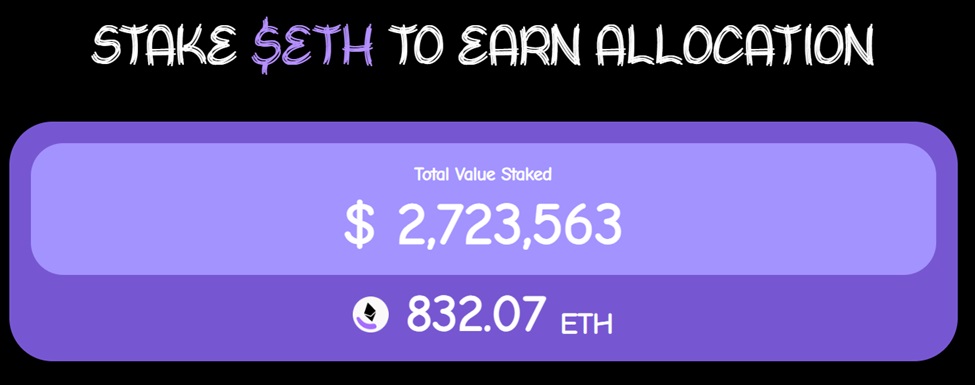
The recent presale of $PDD set a milestone of $2 million in just 15 days and has set the stage for an unprecedented bullish outlook for its $PDD token. ETH staking took place in two seasons, and 60,000 participants participated, accounting for staking more than 820 ETH.

The involvement of heavyweight investors like OKX Ventures and the anticipation of further A-list venture capitalists about to join explain the project’s robust financial backing and market confidence.

Leveraging Layer 2 Innovations for Enhanced Functionality

As the crypto market anticipates another bull run, PenPad stands out with its strategic utilization of Scroll’s zkEVM technology, paving the way for a platform that matches the success of its predecessors and sets new benchmarks in the crypto launchpad sector.

The platform’s introduction of ZK-Protected Logins, Account Abstraction Support, and advanced ZK Circuit Design capabilities mark significant advancements in promoting scalability, privacy, and compliance, particularly for business applications requiring stringent confidentiality.

Community-Centric Token Distribution and Staking Rewards

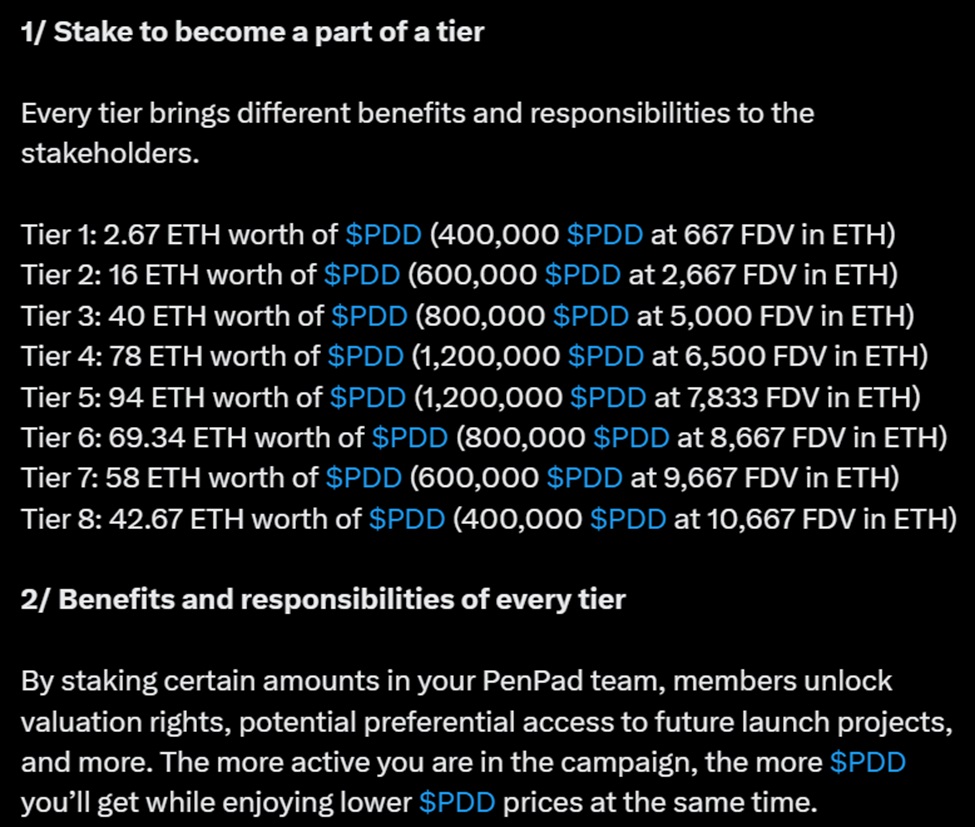
PenPad’s innovative staking and allocation mechanism rewards community involvement with a fair and decentralized token distribution model. By staking ETH, users gain points determining their $PDD token allocation, encouraging early and continuous engagement.

The platform’s tiered system further incentivizes participants by offering varied benefits based on their investment levels, thus fostering a vibrant community-centric ecosystem. In addition, the reward points on staking ETH are increased to a whopping 35% for a limited period to incentivize loyal community members.

PenPad is poised to introduce several new initiatives to solidify its status as a frontrunner in the decentralized finance sector. These include PenPad Staking, which allows users to earn returns by securing assets in a staking vault.

PenPad Launch is a dedicated platform for introducing crypto assets and Real World Assets (RWAs). Other than that, PenPad Vaults offers sophisticated asset management and appreciation solutions, and PenPad Shop is a marketplace for acquiring physical and virtual goods.

What’s Next for PenPad?

With two successful engagement seasons, PenPad is gearing up for the launch of a new yield aggregator that promises to revolutionize Scroll’s ecosystem. This next step aims to make decentralized finance more accessible and facilitate the entry of millions of new users into the crypto space.

PenPad remains at the forefront of the crypto industry, not only by meeting the market’s current demands but also by anticipating and shaping future trends. The project’s focus on innovation, privacy, and community engagement positions it as a pivotal player in the ongoing evolution of decentralized finance.

BlockDAG’s Presale Rockets to $20.3M, Eclipsing Shiba Inu and ICP in the Crypto Landscape By Showcasing Moon Keynote Over The Moon

0

While Shiba Inu’s market signal shows a slowdown, the broader cryptocurrency market is gearing up for significant changes. Meanwhile, the latest developments in ICP’s crypto technology are enhancing its role in decentralized finance (DeFi). Amid these updates, BlockDAG steals the spotlight with its exciting presale and upcoming moonshot keynote, which has already generated a remarkable $20.3 million, positioning it as one of 2024’s most talked-about cryptocurrencies. Market experts foresee an extraordinary potential return on investment (ROI) of 30,000x due to its innovative blend of blockchain and Directed Acyclic Graph (DAG) technologies.

Understanding Shiba Inu’s Market Signals: Momentum and Critical Levels

Recently, Shiba Inu has shown signs of market weakness, with its 21-day Exponential Moving Average (EMA) falling below the 50-day EMA, suggesting a decrease in market momentum. The price of SHIB is at $0.000022, indicating a period of market consolidation as investors wait for upcoming shifts in the broader crypto environment. This Shiba Inu signal, although subtle, plays a crucial role in forecasting short-term market trends.

With a significant halving event on the horizon, another critical Shiba Inu signal to monitor is how the market reacts to improved conditions. If the market favors SHIB, it could aim for a resistance level of $0.0000276. These figures are vital as they will likely affect SHIB’s future market path, underscoring the importance of monitoring these indicators closely.

ICP’s Latest Breakthroughs Bolster DeFi Capabilities

ICP has recently made significant progress in blockchain technology by integrating threshold-Schnorr signatures with Bitcoin. This enables ICP smart contracts to interact with Bitcoin’s BRC-20 tokens more efficiently, enhancing the utility of decentralized applications that leverage Bitcoin’s liquidity and security. ICP has also introduced new functionalities that support basic and advanced transactions on the Bitcoin network, including decentralized exchanges, inscriptions, and Taproot transaction handling. These advancements are set to improve ICP’s functionality and security in the crypto ecosystem.

BlockDAG’s Innovative Approach and Market Impact

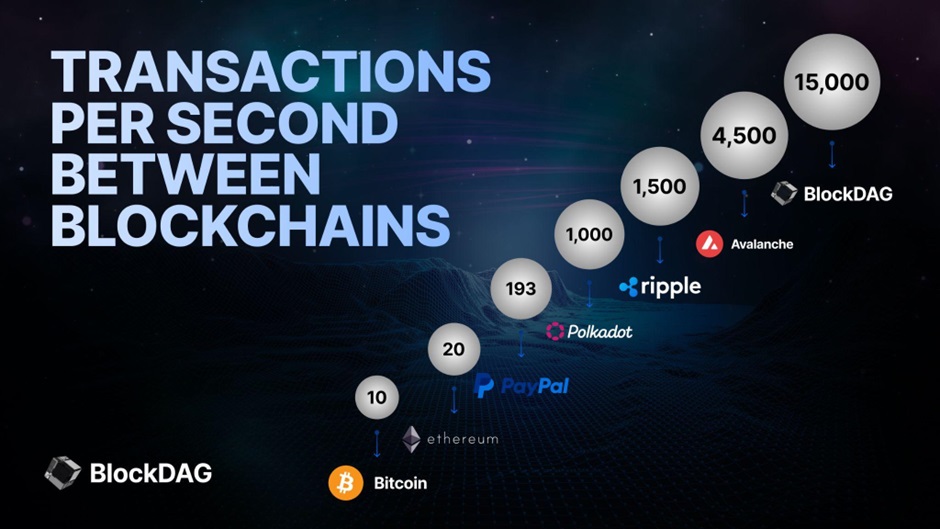
BlockDAG has uniquely positioned itself in the cryptocurrency market by combining the security and decentralization features of blockchains with the scalability and efficiency of the DAG structure, as explained in its keynote video. This approach enables BlockDAG to process transactions up to 15,000 TPS faster and handle greater volumes than traditional blockchain-based systems. Since the start of 2024, BlockDAG has seen significant market growth and investor interest, highlighted by an ambitious plan to present a keynote on the moon. Analysts predict the potential for its price to surge from the current $0.005 to up to $20 by 2027, representing a significant growth opportunity for early investors.

BlockDAG’s presale has successfully raised over $20.3 million and surpassed the goal of selling over 8 billion coins. The demand for the ninth batch of coins has been overwhelming, and it has sold out quickly. The current batch is set to Batch 10 with a price of $0.006. This momentum positions BlockDAG as one of the top-trending crypto assets of 2024.

Concluding Thoughts

With strong community backing and an advanced technological framework, BlockDAG is not merely keeping pace with the crypto wave but is actively shaping it by securing $20.3 million in presale and launching a keynote video teaser over the moon gaining the market’s attention. As it continues to break new ground and redefine industry standards, BlockDAG represents an attractive long-term investment opportunity for those looking to engage with a pioneering digital asset that merges innovative technology with substantial growth potential.


Join BlockDAG Presale Now:

Website: https://blockdag.network

Presale: https://purchase.blockdag.network

Telegram: https://t.me/blockDAGnetworkOfficial

Discord: https://discord.gg/Q7BxghMVyu

Tekedia Capital April 2024 Overview of Startups [video]

0

Good People, join us at Tekedia Capital Demo Day on April 27, 2024 at 4-6pm WAT. Let us fund the next class of potential unicorns. I provide an overview of the 10 startups in this video. Get the Zoom link when you do the needful of becoming a member of Tekedia Capital Syndicate  https://capital.tekedia.com/course/fee/


Multiple US SEC Attorneys resign following false statements and abuse of power on DEBT Box

0

The recent upheaval within the Securities and Exchange Commission (SEC) has sent ripples through the legal and financial sectors. Following a federal judge’s sanctions against the agency for what was deemed a “gross abuse of power,” two SEC lawyers have resigned from their positions. This unprecedented event stems from the SEC’s handling of a case involving DEBT Box, a crypto company based in Utah.

The specific false statement that led to this sanction involved an SEC attorney’s claim during the court proceedings. The attorney alleged that DEBT Box was transferring investor funds abroad, which was later disputed by DEBT Box. Upon further scrutiny, the SEC attorney admitted that there was no direct evidence to support this claim and that it was an inference based partly on a YouTube video by a DEBT Box official.

The case, which initially saw the SEC freeze DEBT Box’s assets and place the firm into receivership, took a dramatic turn when the presiding judge, Robert Shelby, overturned the asset freeze. He cited potential false and misleading representations made by the SEC as the reason for his decision. The judge’s ruling also included an order for the SEC to cover some of DEBT Box’s attorney’s fees, highlighting the severity of the missteps taken by the regulatory body.

The two attorneys, Michael Welsh and Joseph Watkins, faced significant criticism for their roles in the case. Reports indicate that they were informed they would face termination if they remained with the agency. This situation underscores the delicate balance regulators must maintain while enforcing the law. It also serves as a cautionary tale about the consequences of overstepping legal boundaries, especially in the rapidly evolving and often contentious world of cryptocurrency regulation.

The fallout from this case has prompted a broader discussion about the SEC’s approach to crypto regulation. Some argue that the agency’s aggressive tactics may sometimes border on overreach, potentially stifling innovation in the burgeoning crypto industry. Others contend that firm regulatory action is necessary to protect investors and maintain market integrity.

As the dust settles, the SEC’s enforcement chief has issued an apology for the agency’s conduct and mandated training for the enforcement staff. This move suggests a commitment to ensuring that such errors are not repeated in the future. The legal community and crypto industry alike will be watching closely to see how the SEC adapts its strategies moving forward.

This incident highlights the importance of accuracy and integrity in legal proceedings, especially when they have significant implications for the parties involved. The SEC’s misrepresentation in this case not only led to the resignation of two lawyers but also raised questions about the agency’s practices in regulating the crypto industry. The judge’s decision to overturn the asset freeze and order the SEC to pay DEBT Box’s attorney’s fees underscores the serious nature of the SEC’s conduct in this matter.