DD
MM
YYYY

PAGES

DD
MM
YYYY

spot_img

PAGES

Home Blog Page 3628

Impact of Rising Telecom Tariff and Data Plans on Consumers and Nigerian Digital Economy

0

The rising cost of telco tariff and data plans in Nigeria has been a source of concern for many consumers and businesses. The high cost of operating and maintaining telecom infrastructure in Nigeria, especially in rural and remote areas where there is poor power supply, security challenges and multiple taxation. The depreciation of the naira against major foreign currencies, which increases the cost of importing telecom equipment and paying for international bandwidth.

The inflationary pressure on the economy, which erodes the purchasing power of consumers and reduces their demand for telecom services. The need to ensure a fair return on investment for the telecom operators, who have invested billions of naira in building and upgrading their networks. The need to create a level playing field for all telecom operators, especially the smaller ones who are struggling to compete with the dominant players.

What is the impact of rising Telco’s tariff and data plans on consumers and the economy?

Reduced access to affordable and quality telecom services, especially for low-income earners, students, entrepreneurs and rural dwellers who rely on mobile phones and internet for communication, education, business and social activities.

Reduced adoption and usage of digital services and platforms, such as e-commerce, e-government, e-learning, e-health, fintech and social media, which are essential for enhancing productivity, innovation and inclusion in the digital economy. Reduced competitiveness and growth of the telecom sector, which is one of the key drivers of economic diversification, job creation and revenue generation in Nigeria. Reduced contribution of the telecom sector to the national GDP, which stood at 12.45% as of Q2 2023 according to the National Bureau of Statistics.

What are the possible solutions to address the issue of rising telco tariff and data plans in Nigeria?

The issue of rising telco tariff and data plans in Nigeria is a complex one that requires a holistic and collaborative approach from all stakeholders. Some of the possible solutions include: – Reviewing and revising the price floor for data services by the NCC, taking into consideration the interests of both consumers and operators.

Improving the regulatory environment for telecom operators by reducing multiple taxation, streamlining licensing processes, ensuring security of telecom infrastructure and enforcing compliance with quality-of-service standards.

Enhancing the availability and affordability of spectrum for telecom operators by conducting transparent auctions, allocating spectrum efficiently and promoting spectrum sharing among operators. Encouraging infrastructure sharing among telecom operators by providing incentives, guidelines and oversight for co-location, interconnection and roaming agreements.

Promoting competition and innovation in the telecom sector by creating an enabling environment for new entrants, fostering partnerships among operators and supporting local content development. Educating and empowering consumers on their rights and responsibilities as telecom users by providing adequate information, feedback mechanisms and redress options.

Nigerian Telecom Operators Plan Increase in Tariffs, Say Current Rates No Longer Sustainable

The Nigerian telecom industry is facing a major challenge as operators plan to increase their tariffs in the coming months. The operators say that the current rates are no longer sustainable under the administration of President Bola Tinubu, who took office in May 2023.

According to the operators, the cost of providing telecom services has increased significantly due to inflation, foreign exchange volatility, regulatory fees, security threats, and infrastructure vandalism. They also claim that the government has not fulfilled its promises of improving the power supply, reducing multiple taxation, and granting them access to public infrastructure.

The operators say that they have been operating at a loss for several years, and that they need to adjust their tariffs to reflect the current economic realities. They warn that if they do not increase their tariffs, they may be forced to reduce their quality of service, lay off workers, or exit the market altogether.

However, the planned tariff hike has been met with resistance from consumers, civil society groups, and some lawmakers. They argue that the operators are already charging exorbitant prices for poor services, and that increasing the tariffs will further impoverish Nigerians who depend on telecom services for communication, education, health, banking, and entertainment.

They also accuse the operators of being insensitive to the plight of Nigerians who are suffering from high unemployment, poverty, insecurity, and corruption. They urge the government to intervene and stop the operators from exploiting Nigerians.

The government has not yet issued an official statement on the matter, but sources say that it is in talks with the operators to find a mutually acceptable solution. The sources say that the government is aware of the challenges facing the telecom industry, but also mindful of the impact of tariff increase on Nigerians.

The telecom industry is one of the most vibrant and competitive sectors in Nigeria, contributing about 10% to the country’s GDP. It has over 200 million subscribers and employs thousands of Nigerians directly and indirectly. It is also a key enabler of other sectors such as e-commerce, fintech, agriculture, and education.

The rising cost of telco tariff and data plans in Nigeria is a challenge that needs urgent attention from all stakeholders. While it is understandable that telecom operators need to recover their costs and make profits, it is also important that consumers are not overburdened with exorbitant prices that limit their access to essential telecom services. The NCC, as the regulator of the telecom sector, has a critical role to play in balancing the interests of both parties and ensuring that Nigeria achieves its vision of becoming a leading digital economy.
Examining the Middle East Corridor Initiative

0
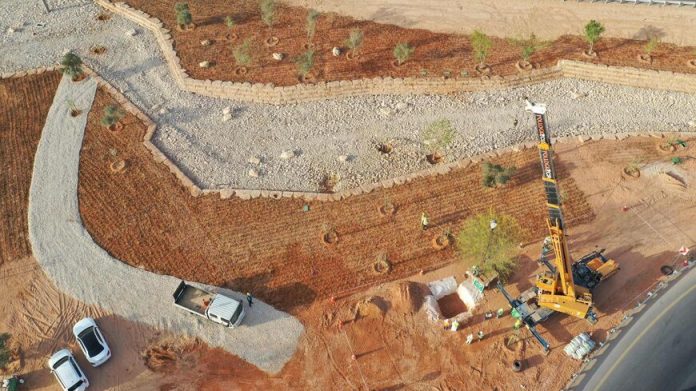
An aerial picture shows workers using a crane to plant trees in a park project by the roadside in the Saudi capital Riyadh, on March 29, 2021. - Although the OPEC kingpin seems an unlikely champion of clean energy, the "Saudi Green Initiative" aims to reduce emissions by generating half of its energy from renewables by 2030. (Photo by - / AFP) (Photo by -/AFP via Getty Images)

The Middle East Corridor Initiative is a strategic plan to enhance the connectivity and cooperation among the countries in the region, especially in the areas of trade, energy, infrastructure, and security. The initiative aims to create a network of corridors that link the major cities and ports of the Middle East, as well as facilitate the movement of people, goods, and services across borders. The initiative also seeks to foster dialogue and trust among the participating countries, as well as address the common challenges and opportunities they face.

The initiative was launched in 2022 by the United Arab Emirates, Saudi Arabia, Egypt, Jordan, and Israel, with the support of the United States and the European Union. The initiative is open to other countries in the region that share its vision and principles.

The initiative is based on the recognition that the Middle East has a huge potential for economic growth and development, as well as a vital role in ensuring global stability and security. The initiative also acknowledges that the region faces many complex and interrelated challenges, such as conflicts, terrorism, climate change, water scarcity, and social unrest.

The initiative has four main pillars: trade, energy, infrastructure, and security. Under the trade pillar, the initiative aims to promote regional integration and diversification of markets, as well as reduce tariff and non-tariff barriers. Under the energy pillar, the initiative aims to enhance energy security and efficiency, as well as develop renewable and clean energy sources.

Under the infrastructure pillar, the initiative aims to improve the quality and accessibility of transport, communication, and digital networks, as well as support urban development and smart cities. Under the security pillar, the initiative aims to strengthen cooperation on counterterrorism, cyber-security, maritime security, and humanitarian assistance.

The initiative has already achieved some notable results since its inception. For example, it has facilitated the signing of several bilateral and multilateral agreements on trade, investment, tourism, aviation, and energy among the participating countries. It has also supported the construction of several infrastructure projects, such as pipelines, railways, bridges, and ports. It has also enhanced the coordination and information-sharing among the security agencies of the participating countries.

However, the initiative also faces many challenges that need to be overcome in order to achieve its goals. Some of these challenges are:

The persistence of political and ideological conflicts among some of the countries in the region, which may undermine the trust and cooperation required for the initiative. The lack of a clear and consistent legal and regulatory framework for regional integration, which may create obstacles and uncertainties for trade and investment.

The uneven distribution of resources and capacities among the participating countries, which may create imbalances and inequalities in the benefits and costs of the initiative. The vulnerability of the region to external shocks and pressures, such as geopolitical tensions, economic crises, and environmental disasters.

The initiative has four main pillars: trade, energy, infrastructure, and security. Under each pillar, the initiative has specific objectives and actions that aim to address these challenges and leverage the opportunities. These are:

Trade: To promote regional integration and diversification of markets, as well as reduce tariff and non-tariff barriers. Some of the actions include, establishing a free trade area among the participating countries; harmonizing standards and regulations; facilitating customs procedures; enhancing trade facilitation and logistics; supporting small and medium enterprises; promoting e-commerce; creating joint chambers of commerce; developing regional value chains; expanding trade with other regions.

Energy: To enhance energy security and efficiency, as well as develop renewable and clean energy sources. Some of the actions include, building interconnections among national grids; diversifying energy sources and suppliers; increasing energy efficiency and conservation; developing solar, wind, hydro, nuclear, and other renewable energy projects; establishing a regional energy market; creating a regional energy agency; cooperating on research and innovation; sharing best practices and technologies.

Infrastructure: To improve the quality and accessibility of transport, communication, and digital networks, as well as support urban development and smart cities. Some of the actions include, constructing pipelines, railways, bridges, ports, airports, roads, tunnels, and other infrastructure projects; upgrading existing infrastructure; improving cross-border connectivity; developing regional transport corridors; enhancing digital infrastructure; promoting broadband access; fostering digital literacy; supporting urban planning and management; developing smart city solutions.

Security: To strengthen cooperation on counterterrorism, cyber-security, maritime security, and humanitarian assistance. Some of the actions include enhancing intelligence-sharing and coordination among security agencies; conducting joint exercises and training; developing common strategies and protocols; combating terrorism financing and radicalization; strengthening cyber-security capabilities and resilience; protecting critical infrastructure; ensuring maritime security and safety; providing humanitarian aid and relief to conflict-affected areas.

The Middle East Corridor Initiative is a visionary and ambitious project that has the potential to transform the region for the better. It is not only beneficial for the participating countries, but also for the wider international community. It is a model of regional cooperation that can inspire other regions in the world. It is a testament to the power of dialogue and diplomacy over violence and confrontation.

When Boards Score Own-Goals and the Lessons from ChatGPT’s OpenAI and Sam Altman

2

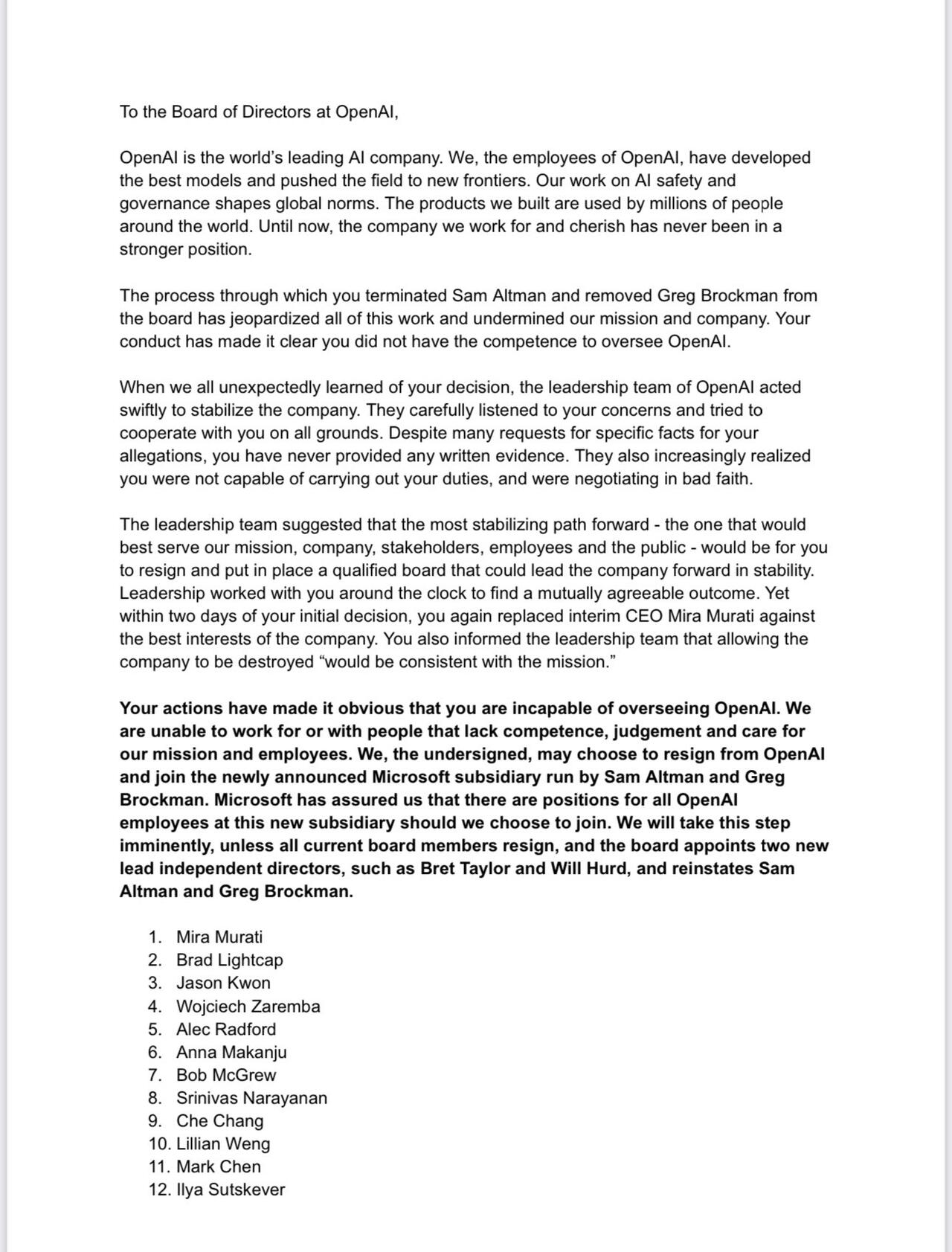
When the Board of OpenAI fired Sam Altman, arguably one of the finest generative AI business visionaries in the world right now, it scored an own-goal. Why did they fire him? Possibly, Sam does not know how to write very long memos since the complaint was on “communication”. Yes, they did not accuse him of not delivering economic value, not creating the right products and not doing the typical things which boards hire CEOs to do.

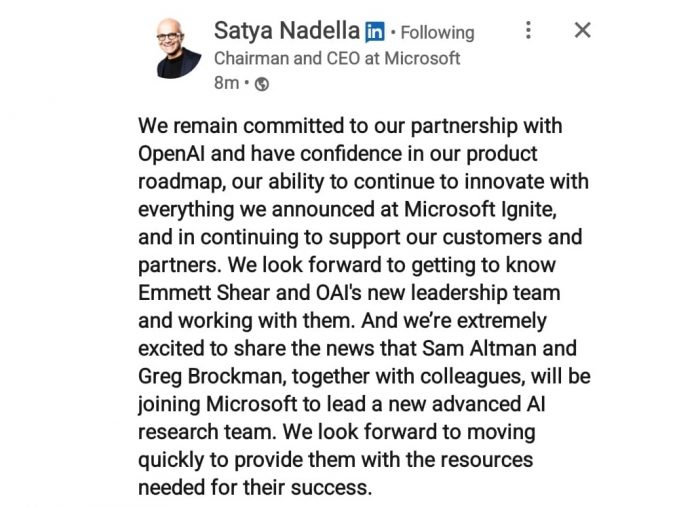
With that own-goal, Microsoft which has funded OpenAI’s ChatGPT jumped for the Sam’s team. Today, the team will be working with Microsoft to extend the mission. As that happens, watch out for the displacement of ChatGPT primarily because if Sam’s team can bake the right products in Microsoft, the tech giant may not see a lot of interest in wasting time with deeper collaborations with OpenAI. 

Why? What made ChatGPT amazing is not just the algorithm and code, but decades of Microsoft data which supported its evolution. If you disconnect the data, ChatGPT will stall. And that is the risk ChatGPT faces right now. The other investors should hope that Microsoft does not follow that path because if you take out the data coming from Bing and other Microsoft sources, ChatGPT will be like another PhD thesis.

The power unused is the most potent power because no one knows the extent of its efficacy, the Igbo axiom posits. But when it is used, people now know how effective it is. OpenAI used its “firing power” and became bare [Igbo sons and daughters, I do not want to use the right translation out of decency here] in the market because we have seen that while it can fire Sam, it is unable to “unfire” him, as they tried unsuccessfully.

Comment: “So I’m thinking that with Microsoft assimilating Sam, they’d still trail behind ChatGPT” . My response: If Microsoft stops providing data to train ChatGPT, it becomes a PhD project. There are better models in the world than ChatGPT but none has the data that Microsoft and Google have as they own search engines with all data. Without the Microsoft data, ChatGPT will fade over time.

Staff asks for the Board to go

The Fintechnolization of Digital Platforms

0

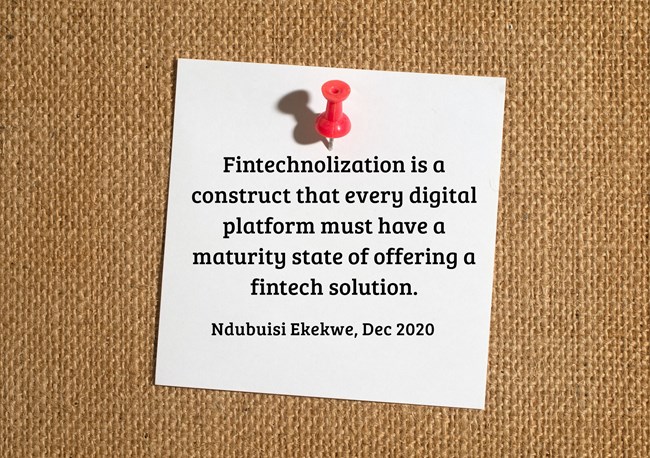
In December 2020, I introduced the concept of fintechnolization: “a construct that every digital platform must have a maturity state of offering a fintech solution. I had watched all great digital platforms on how they ended up providing fintech solutions even when they began in an unrelated sector.”

Other great media organizations have picked that construct. Ladies and Gentlemen, the greatest digital logistics, ecommerce, agtech, etc startups of the future will offer a fintech solution, because financial services is the operating system of commerce and industry. And as that happens, embedded finance will become a critical business category of the 21st century.

How do you plan to make profit on that digital platform?

Fintechnolization of Platforms – Expect This Redesign in Startups

Come and Master the Physics of Pricing at Tekedia Mini-MBA

0

A business model encapsulates the essence of a firm by providing the compass on how to create value in the company. It is the logic of a business and when you commit to one, you have committed all the factors of production in that business to a destiny. And as you execute that model, creating value in that firm, pricing becomes critical.

At Tekedia Mini-MBA, we have eminent pricing faculty to guide you. Yes, our Faculty members understand the physics of pricing, and how an efficient pricing playbook can unlock growth in a business.

Go here and register for the next edition of Tekedia Mini-MBA and get our early bird discounts with our free books. Do it and let us co-learn in Africa’s largest business school for entrepreneurial capitalism.