DD
MM
YYYY

PAGES

DD
MM
YYYY

spot_img

PAGES

Home Blog Page 3637

Notable Provisions of The NMDPRA Anti-Competition, Data Depository Regulations in Nigeria

0

The Nigerian Midstream & Downstream Petroleum Regulatory Authority (NMDPRA) or “The Authority” recently launched its Anti-Competition regulations (“The Regulations”) aimed at checking unethical practices centered around anti-competition in the Midstream & Downstream Petroleum industry.

This article will be looking at the provisions of these regulations, particularly its objectives and the yardsticks for determining anti-competitive activity.

What are the objectives of the regulations?

– To provide guidance for holders of license, permit or authorisation on regulation of market principles and the prevention of anti-competitive behaviour in the Nigerian Midstream & Downstream Petroleum industry.

– To provide a basis for prescribing and applying customer  protection measures in the Nigerian Midstream & Downstream Petroleum industry.

– The procedure for the determination of complaints from customers in the Nigerian Midstream & Downstream Petroleum industry.

– To prescribe sanctions & penalties for the failure to comply with these regulations.

What is the application scope of these regulations?

– These regulations shall apply to the prevention of anti-competitive behaviour and practices and customer protection in the Nigerian Midstream & Downstream Petroleum industry.

What do the regulations say on the authority to administer, monitor and ensure compliance with competition and market principles?

– The Authority shall, subject to the provisions of the Federal Competition and Consumer Protection Act(FCCPA) & any law or regulation in force, have the responsibility to :-

a). Monitor the state of the market regulated by the NMDPRA.

b). Administer, monitor and ensure compliance with the provisions of the Act & any law or regulation issued in respect of competition and market regulation.

c). Monitor market behaviour including the development and maintenance of competitive markets.

d). Prevent or stop situations of abuse of dominant power and restrictive business practices.

What are the provisions of the regulations regarding the determination of anti-competitive activity?

– The NMDPRA shall –

a) determine whether there is any anti-competitive activity being carried on and exercise its powers under these regulations to prevent continuance of the activity;

b) determine and issue, by notice, any pre-conditions and any transitional arrangements required for any services to be offered competitively by licencees.

What is the extent of the powers of the NMDPRA to prevent anti-competitive behaviour under these regulations?

– Subject to the provisions of the FCCPA in force, the authority shall have the power to prevent anti-competitive behaviour and may take any or a combination of the following actions :-

a). Monitor and determine whether any conduct by a licensee or any other person operating or intending to operate in Midstream & Downstream operations :-

(i). has the purpose or effect of substantially lessening competition in any segment of Midstream & Downstream Petroleum operations;

(ii). may likely result in anti-competitive or discriminatory conduct, including an unlawful exercise of market power that may prevent customers from obtaining the benefits of a properly functioning and competitive market;

(iii). may amount to practices which reflect an apparent or probable effect of crippling, excluding or deterring the entry of another person into Midstream and Downstream Petroleum operations;

(iv). may likely be indicative of an abuse of dominant position in respect of the provision of any service.

b). Consider how best to prevent or mitigate abuse of market power in its decisions and determinations regarding matters including license, permit or authorisation applications, grants, terms and conditions and the regulation of prices for services in competitive markets. 

What are the provisions of the regulations regarding national interest?

– Notwithstanding the regulations mentioned above directly where the authority deems it to be in the national interest or necessary to preserve or promote the benefits of a functional and effective competitive market, the Authority may, on the application by a licensee or other person with the ability to influence the price of petroleum products –

a). Give written approval to the application upon such terms and conditions and impose other requirements as it may deem appropriate.

b). The NMDPRA may at any time, withdraw an approval granted under this regulation upon such terms and conditions as it may deem appropriate.

Notable Provisions Of The NMDPRA Data Depository Regulations Of Nigeria

The Nigerian Midstream & Downstream Petroleum Regulatory Authority (NMDPRA) or “The Authority” recently issued its Data Depository Regulations creating the Midstream Downstream Petroleum Data repository (or “The Repository”).

This article will be looking at the notable provisions of these regulations as well as the organizational structure of the repository.

What are the objectives of the NMDPRA regulations?

– To establish the Midstream Downstream Petroleum Data repository in the authority.

– To provide the procedure for the submission, collection and management of technical data in the repository.

– To provide sanctions and penalties for failure to comply with these regulations.

What is the application scope of these regulations?

– These regulations shall apply to the submission, collection and management of technical and commercial data in the Midstream & Downstream Oil and Gas industry in Nigeria.

What are the provisions of the regulations concerning the repository?

– There is established in the authority the Midstream & Downstream Petroleum Data Repository.

– The repository shall be located in Abuja, Nigeria or any other location as the NMDPRA chief executive may direct.

What are the functions of the Repository?

– To serve as the technical data centre for the Midstream & Downstream Petroleum industry in Nigeria.

– To provide a platform for the timely and holistic submission of data by holders of Midstream & Downstream Petroleum licenses or permits.

– To carry out storage, management, transfer, quality control and validation of all data and materials submitted to it.

– Ensure data preservation, value maximization and compliance with these regulations, standards and procedures as may be prescribed from time to time.

What is the organizational structure of the repository?

– The organizational structure of the repository shall be as set out in the first schedule to the regulations.

What constitutes the revenue of the repository under these regulations?

– Transaction & Service fees.

– Fees or levies imposed by the NMDPRA on the Midstream & Downstream Petroleum industry in the support of the repository.

– Funds and grants accruing from multilateral agencies, bilateral institutions and related sources dedicated partly or wholly for the development of data repositories.

– Any other sum freely donated or accruing to the repository for the development of the repository.

– Fees, charges and revenue accruable to the repository under these regulations shall be used for the operations, maintenance and development of the repository.

– The repository may grant discounts or waivers on transaction or service fees to subscribers based on published and clear criteria.

What are the provisions of the regulations concerning data submission?

– All records including but not limited to reports, data samples, fluid samples, plans, maps, charts, crude oil assay, accounts, materials and information which are required to be provided to the NMDPRA under the Petroleum Industry Act, regulations or any other law shall be submitted by the holder of a Midstream & Downstream license or permit to the repository in a standard and format specified by the Authority.

– The Repository shall charge fees for the storage and handling of fluid samples at designated storage facilities.

What are the provisions of these regulations on offences and penalties?

– A violation of these regulations can lead to :-

a). Exclusion from the services of the repository.

b). A civil action for the recovery of unpaid fees and accrued interest.

Google Updates Search Engine, Users Can Now Get Help With Math And Science Problems

0

Tech giant Google has updated its search engine after it announced that search now provides users with more help on complex subjects like trigonometry and calculus.

Announcing this upgrade, Google wrote,

Whether you’re delving into a math textbook or turning to Search to get more context on a complicated physics problem, it can sometimes be hard to describe exactly what you’re looking for. Take that intricate biology concept or pesky geometry problem, for example. With new features across Search and Lens, you can now visualize STEM-related concepts and figure out which equation to use by browsing for them in a more natural and intuitive way”.

After an equation or integral is typed in the search bar, it will be followed with a step-by-step explanation and solution to help students visualize and solve tricky problems.

Meanwhile, for Geometry, the tech giant disclosed that Google Lens can now interpret both the visual and the text components of triangle problems. As users won’t be able to draw shapes into the search bar, uploading a photo of the equation is the best way to go.

Google’s upgraded feature will help users identify the known and unknown values, as well as understand which formulas to use and when so that they can better solve these problems going forward.

Additionally, for physics questions, Google search will highlight the known and unknown values and then show the correct formula to use for that particular equation.

The maths update is currently live on the desktop and the mobile app. Google states that users can type the phrase “math solver” in the search bar, to try out their new experience on the desktop.

Google wrote,

“It can feel frustrating when you are trying to solve a math problem and aren’t quite sure what the next step should be. Now, when you look up the problem on Search, you will be able to get even more help in subjects like trigonometry and calculus.

“Simply type your equation or integral into the Search bar, or take a picture with Lens, to see a step-by-step explanation and solution. You can also type “math solver” to give the experience a try on desktop and coming soon, on mobile”.

Alongside the mathematics help, Google is rolling out interactive 3D models for certain fields of science such as physics, biology, and chemistry. The diagrams will enable users to zoom into an object as well as provide definitions of what they are looking at.

With 3D models on search, users will be able to explore interactive diagrams containing definitions and overviews for almost 1,000 Biology, Chemistry, Physics, Astronomy, and Related topics.

Google is also leveraging large language models (LLMs) to let search better answer word problems, starting with many fundamental topics related to high school physics.

Recall that in March this year, the tech giant incorporated the Pathways Language Model (PaLM) into Bard for improved math and logic capabilities. This made possible answers to multi-step word and math problems.

As AI technology becomes the most in-demand technology with tech giants incorporating it into their systems, Google in response to the heated search space, is racing to build an all-new search engine powered by AI technology to stay ahead.

Tinubu Requests Approval of Fresh $7.8bn, €100m Loan from Senate Amid Criticism Over Extravagant Spending

0

President Bola Tinubu has requested the approval of the Senate for an additional $7.8 billion and €100 million borrowing plan, a mere 24 hours after seeking approval for the N2.18 trillion Supplementary budget.

This move comes amid economic challenges exacerbated by low revenue and what has been described as imprudent government spending.

The President’s request was conveyed in a letter read during a plenary session by Senate President, GodsWill Akpabio, on Wednesday. Just a day prior, President Tinubu had presented the N2.18 trillion supplementary budget to the National Assembly.

A few months ago, the National Assembly approved a total of N819.5 billion presented by the President. This allocation included a N500 billion palliative package to mitigate the impact of recent economic policies.

The President’s letter stated, “The Senate may wish to note that the past administration approved the 2022 – 2024 borrowing plan at the Federal Executive Council which was held on the 15th day of May 2023.”

The borrowing plan encompasses a range of sectors, with a specific focus on infrastructure, agriculture, health, education, water supply, security, employment, and financial management reforms, among others. The total facility for the projects and programs under the borrowing plan amounts to $7,864,508,559 and €100 million.

President Tinubu highlighted that the removal of fuel subsidy and its impact on the economy prompted interest from the African Development Bank and the World Bank Group to assist the country, offering sums of $1 billion and $2 billion respectively.

“The Senate is invited to note that following the removal of fuel subsidy and its impact on the economy in the country, the African Development Bank and the World Bank Group have indicated interest to assist the country in mitigating the economic shores and recent reforms with a sum of $1 billion and $2 billion respectively.

“In addition to the Federal Executive Council approved 2022-2024 external borrowing plan. Consequently, the required approval is 7,864,508,559 dollars, and in terms of euros, 1000 million euros.

“I would like to underscore the fact that the projects and programmes borrowing plans were selected based on positive technical economic evaluations as well as the expected contribution to the social economic development of the country, including employment generation, skills acquisitions, supporting the emergence of more entrepreneurs, poverty reduction and food security to improve the livelihood of an average Nigerian,” he said in the letter.

The president emphasized that the projects were selected based on positive technical economic evaluations and their expected contributions to the socio-economic development of the country, including employment generation, skill acquisition, support for entrepreneurship, poverty reduction, and food security.

He assured that the projects and programs would be implemented across all 36 states of the federation and the Federal Capital Territory, focusing on critical infrastructure projects such as power, railway, and health, among others.

Given the current economic realities facing the country, President Tinubu emphasized the urgency of the Senate’s consideration and approval of the 2022-2024 external borrowing plans to enable the government to fulfill its responsibilities to Nigerians through prompt disbursement and efficient project implementation.

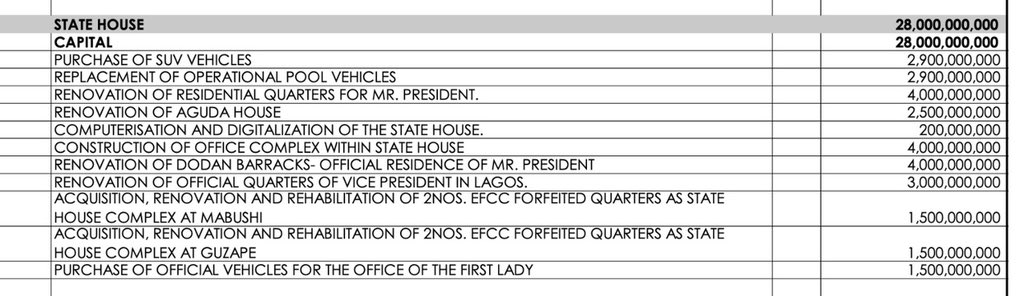
However, the fresh loan request is coming at a time when the federal government’s use of public funds is under serious scrutiny. On Tuesday, it was revealed that the supplementary budget of N2.17 trillion the federal government requested from the National Assembly includes billions of naira budgeted for vehicles.

In the budget allocation, there is an allocation of N2.9 billion for Sport Utility Vehicles (SUVs) for the Presidential Villa. Additionally, another N2.9 billion is set aside for the replacement of operational vehicles for the presidency. Renovation projects for the presidential and vice-presidential residences are also included, with N4 billion allocated for the president’s residence and N2.5 billion for the vice president’s residence.

The State House, which encompasses various aspects of the presidency, is proposed to receive a total of N28 billion, and the Presidential Air Fleet is allocated N12.5 billion for its operations and maintenance.

The budget has faced additional criticism due to the allocation of N5.5 billion for an education loan fund and N5.095 billion for the Nigerian Navy, specifically for the acquisition of a presidential yacht.

These allocations have sparked controversy and raised questions about their prioritization in the budget, especially as the government needs to borrow to fund them.

The Nigerian Police Must Work Professionally and Follow The Constitution

1

Two things:

#1: Firing water cannons to the Governor of Rivers State: “Some civilians, apparently the governor’s political supporters, also walked along with Mr Fubara as the police continued to fire teargas and water cannons towards the governor”

#2: Arresting the President of the Nigerian Labour Congress: “President of the Nigeria Labour Congress, Joe Ajaero, was picked up a few minutes ago from NLC state council secretariat by heavily armed policemen in Owerri and taken to an unknown destination,”

To the Nigerian Police, these stories are not just right. What is really wrong with Nigeria? How do we lose our souls because of allegiances to powers? Many things are not defensible including firing teargas to a Governor who ideally is the Chief Security Officer of the state. Then, the leader of the Labour Union, being picked up in a secretariat.  This is simply painful for Nigeria!

Nigeria needs a professional police force which takes orders from the Constitution and not big men. We must do better!

Treat Every Gunshot Wound Without Police Clearance in Nigeria

0

About three weeks ago, I heard and read the story of a young girl in her mid-20s who died as a result of the negligence and nonchalant attitude of some hospitals in Abuja. From what I heard, they said that the lady entered a “one chance” vehicle, the “one chancers” did not just rob her of all her belongings, they also stabbed her multiple times and threw her off of the moving vehicle when they were done with her. 

Some good Samaritans saw her and rushed her to the hospital since she was still alive although in critical condition with the hope that she would get urgent medical help and get stabilized.

I was told that about three hospitals turned down treating her on the grounds that they did not come with a police report and those hospitals demanded police clearance before she could be attended to. Since it was already late in the night and there was no way in hell they could have gotten a police report from any police station; from taking her from one hospital to another hoping that she could be attended to, she gave up the ghost. 

This happened in Abuja, barely three weeks ago and I’m certain you must have heard of a similar story of a robbery victim or an accident victim or someone who was shot being refused Medicare by hospitals on the grounds that the victim might be an armed robber who got shot by the police hence why the hospitals always insist on the victim providing a police report or police clearance before he or she can be attended to. These encounters have led to the loss of numerous lives and it keeps happening. 

The truth is some of these hospitals are just being negligent. By the implication of the Hippocratic Oath health workers swore to, their first job is to save lives whether the patient is a criminal or not or whether there is a police report or not, that is what is expected but reverse has been the case. 

In 2017 a bill was passed called Compulsory Treatment and Care for the Victims of Gunshot Wound Act 2017. By the provisions of Section One of this act, hospitals, clinics, pharmacies and other health outlets are mandated to treat and render every required and necessary medical assistance to any victim of a gunshot wound without requesting or demanding a police report or police clearance. 

This section one provides thus; “As from the commencement of this Act, every hospital in Nigeria whether public or private shall accept or receive, for immediate and adequate treatment with or without police clearance, any person with a gunshot wound”. 

Section two went on to place a duty of care and legal obligations on both hospitals and law enforcement agents to render every help necessary for the survival and recovery of a victim of a gunshot. In fact, hospitals are asked to treat every victim without first demanding a monetary deposit. 

Here is the provision of Section 2 

2(1) Every person, including security agents, shall render every possible assistance to any person with gunshot wounds and ensure that the person is taken to the nearest hospital for immediate treatment.

(2) Accordingly-

(a) a person with a gunshot wound shall be received for immediate and adequate treatment by any hospital in Nigeria with or without initial monetary deposit.

By reason of this act, any hospital that refuses to treat a person with a gunshot wound faces both civil liabilities from the victim and criminal liabilities from the government for their negligence. 

The icing on the cake is that the Inspector General of police recently ordered the full enforcement of this act, so whenever any hospital insists on seeing a police clearance before they can attend to a gunshot victim please draw their attention to this act and also draw their attention to the current directive of the IG of police for the full enforcement of this act with no exceptions.