DD
MM
YYYY

PAGES

DD
MM
YYYY

spot_img

PAGES

Home Blog Page 3660

DO Kwon TerraForm’s founder to be Extradited to the United States

0

Terraform Labs co-founder Do Kwon has been in custody in Montenegro since his arrest in March 2023. Both South Korea and the United States have requested his extradition.

Recently, the High Court of Podgorica in Montenegro ruled that Do Kwon should be extradited to the United States to face fraud charges rather than to his native South Korea.

This decision followed an appeal by Kwon’s legal team, arguing that Montenegro’s Justice Minister had the final authority to decide on the Terraform co-founder’s extradition—a claim the high court rejected.

Kwon, known as “the cryptocurrency king,” was charged with fraud by federal prosecutors in New York. South Korean prosecutors have also sought his extradition. He was arrested at Montenegro’s Podgorica Airport on March 23 last year while trying to depart for Dubai using fake Costa Rican passports.

Kwon and five others connected to Terraform were wanted because of allegations of fraud and financial crimes related to the implosion of its digital currencies in May 2022.

Kwon will now be able to stand prosecution for the alleged financial crimes connected to the collapse of the Terra ecosystem as a result of his extradition to the US. He might have to serve an extended prison term and pay fines if found guilty. It also begs more concerns regarding Terraform Labs’s future and the potential for legal action against other project participants.

TerraUSD, designed as a “stablecoin,” saw around $40 billion in market value erased from its holders after it plunged far below its $1 peg. Despite initially winning an appeal against extradition, the High Court of Podgorica later reversed that decision and ordered Kwon’s extradition to the United States. His current prison sentence in Montenegro is for using a fake passport.

Satoshi Nakamoto has left behind a legacy that changed the world of finance and technology.

Satoshi Nakamoto is the pseudonym of the mysterious creator of Bitcoin, the first and most popular cryptocurrency. Bitcoin was launched in 2009, after Nakamoto published a white paper describing the protocol and the vision behind it.

Nakamoto’s identity remains unknown, but his or her legacy is undeniable. Bitcoin has revolutionized the way people transact value online, without intermediaries or central authorities. It has also inspired thousands of other cryptocurrencies and blockchain projects, some of which aim to improve or challenge Bitcoin’s dominance.

Nakamoto’s innovation has opened up new possibilities for finance and technology, as well as social and political implications. In this blog post, we will explore some of the aspects of Nakamoto’s legacy and how they have shaped the world we live in today.

While many associate Bitcoin with Satoshi Nakamoto’s white paper published in 2008, there’s a vibrant pre-history that shaped its inception. This techno-social phenomenon was decades in the making, influenced by various currents.

Bitcoin’s initial support base consisted mainly of tech-savvy individuals, libertarians, and crypto-anarchists. These early adopters defined its values, virtues, and fundamental design. Satoshi Nakamoto introduced Bitcoin as a “peer-to-peer electronic cash system,” emphasizing that “participants can be anonymous.” However, this seemingly untraceable digital cash would later reveal its true nature.

In late 2013, a revelation shook the crypto world: Bitcoin was not truly untraceable. Its blockchain allowed researchers, tech companies, and law enforcement to trace and identify users with even more transparency than the existing financial system. This discovery upended cybercrime dynamics.

Enter Sarah Meiklejohn, a young mathematician who meticulously analyzed Bitcoin’s blockchain. She discovered traceable patterns within what initially seemed like noise. Her work marked the beginning of a new era in crypto criminal justice.

Implications for the Cryptocurrency Industry

The Do Kwon narrative and the legal dispute surrounding his extradition have a big impact on the bitcoin market. It draws attention to the difficulties facing global collaboration in the regulation and implementation of legislation related to digital assets. It also calls into question the responsibility of those working on cryptocurrency initiatives, particularly in the face of charges of fraud and financial misbehavior.

Nvidia posts positive Q4 financial reports for 2023 fiscal year amid Challenges in its China’s Operation

0

NVIDIA, a leading technology company, has recently announced its financial results for the fourth quarter of fiscal year 2023. The numbers are nothing short of impressive.

In Q4 2023, NVIDIA’s revenue surged to a staggering $22.1 billion, marking a remarkable 265% increase compared to the same period a year earlier. This substantial growth far exceeded Wall Street’s expectations, which had estimated revenue at $20.6 billion. The company’s net income also experienced a significant boost, rising from $1.41 billion to an impressive $12.29 billion during this quarter.

Diluted earnings per share (EPS) for Q4 2024 came in at $4.93, a substantial leap from the 57 cents reported a year earlier. This robust performance underscores NVIDIA’s continued dominance in the tech industry, particularly in areas like artificial intelligence (AI), gaming, and data centers.

Jensen Huang, founder and CEO of NVIDIA, expressed optimism about the future: “AI is at an inflection point, setting up for broad adoption reaching into every industry. From startups to major enterprises, we are seeing accelerated interest in the versatility and capabilities of generative AI.” He highlighted breakthroughs in generative AI and large language models as key drivers for NVIDIA’s success.

Furthermore, NVIDIA is actively partnering with leading cloud service providers to offer AI-as-a-service, providing enterprises access to its world-leading AI platform. Customers can engage with various layers of NVIDIA AI – from AI supercomputers to pretrained generative AI models – as cloud services. The company’s commitment to innovation extends beyond hardware; it aims to empower businesses across industries with cutting-edge AI solutions.

As NVIDIA continues to push boundaries and redefine what’s possible in technology, its impressive financial results demonstrate that it remains at the forefront of innovation and growth.

Nvidia $NVDA CEO says data center sales to China declined significantly.

Nvidia, the renowned chipmaker, has been at the forefront of technological advancements, particularly in artificial intelligence (AI), high-performance computing (HPC), and gaming. However, recent developments have highlighted both successes and challenges for the company, particularly concerning its data center sales in China.

In a recent earnings call, Nvidia CEO Jensen Huang revealed that the company’s data center sales to China have experienced a significant decline. Despite this setback, Nvidia remains committed to its Chinese customers and continues to ship chips to the country.

During the fiscal fourth quarter, which ended on January 28, 2024, Nvidia’s business in China saw a notable decline. Huang stated, “This last quarter, our business significantly declined as we…stopped shipping in the marketplace (for China).” The company recorded sales of $1.9 billion during this period.

Although data center sales to China dropped, Nvidia recognizes the importance of its Chinese customer base. In fiscal year 2023, approximately 19% of Nvidia’s data center revenue came from China. However, in fiscal year 2024, this share decreased to 14%. Despite the decline, China continues to be a significant market for Nvidia. Sales to Chinese companies are expected to account for 14% in Q1 FY2025.

The decline in sales can be attributed partly to U.S. government licensing requirements that impacted high-performance AI and HPC GPU sales to China. These restrictions affected Nvidia’s data center revenue but did not deter the company from serving its Chinese clientele.

Nigerian Government Suspends LPG Exports to Tackle Soaring Cooking Gas Prices

0

The Federal Government of Nigeria has taken decisive action to address the mounting challenges faced by consumers grappling with soaring cooking gas prices.

In an announcement made by Ekperikpe Ekpo, the Minister of State for Petroleum Resources, during an “Internal Stakeholders’ Workshop” convened in Abuja, the government revealed its immediate suspension of Liquefied Petroleum Gas (LPG) exports.

This strategic move aims to bolster the availability of LPG within the domestic market and mitigate the financial strain on consumers.

Ekpo noted the significance of halting the exportation of locally produced LPG, emphasizing the need to retain the entire production within the country. He stated that the suspension of LPG exportation is a crucial step in addressing the challenges faced by consumers and ensuring a more stable and affordable cooking gas market.

Additionally, he disclosed ongoing discussions with key stakeholders, including the Nigerian Midstream and Downstream Petroleum Regulatory Authority, as well as major operators like Mobil, Chevron, and Shell, aimed at collaboratively devising strategies to enhance market stability and affordability.

The initiative comes amidst reports of escalating cooking gas prices, with prices soaring to N1,300 per kilogram earlier this month, a significant increase from less than N500 in 2018. This surge has compounded financial pressures on households across Nigeria, exacerbating existing economic strains.

While the government’s intervention has been welcomed by some, skepticism remains among experts regarding its efficacy in addressing the underlying causes of the price surge.

“The issues with the rising cost of LPG from butane (C4) that is imported is mostly because of the FX rate. Fix exchange rate and the prices of LPG will come down,” Kelvin Emmanuel, an energy expert, said, adding that “Banning NLNG from exporting propane is only going to reduce the dividend that they generate for shareholders.”

Emmanuel elucidated the complexities of the LPG market, noting that NLNG exports 700k metric tonnes of Propane (C3) gas due to two main reasons:

Unsuitability for Tropical Weather: The pressure and boiling point of Propane (C3) are not conducive to the tropical climate in Nigeria.

Low Composition in Local LPG: Propane (C3) constitutes only 15% of the composition of the LPG consumed in Nigeria.

Furthermore, Emmanuel raised concerns about potential ramifications stemming from the export suspension, including penalties arising from existing forward sales agreements with international off-takers.

“I didn’t mention that they already have forward sales agreement (FSA) with international off-takers and banning export of propane (C3) means they have to pay penalties,” he said.

He questioned the decision-making process within the government, querying, “Is it that the President doesn’t have actual Oil & Gas people explaining these things to him?”

While the government’s suspension of LPG exports represents a proactive step towards alleviating cooking gas price pressures, experts caution that it may not fully address the root causes of the issue.

Galaxy Digital Receives Favorable Buy Rating from Canaccord as ZKSYNC Transactions Surge

0

In the dynamic realm of cryptocurrency investments, Galaxy Digital is now under the spotlight, courtesy of a bullish appraisal from Canaccord Genuity. As of February 20, 2024, Canaccord has initiated research coverage on Galaxy Digital (BRPHF), assigning it a Buy rating alongside a one-year price target of C$17, marking a potential upside of over 28% from its recent closing price.

Galaxy Digital stands out as one of the most diversified avenues for investors keen on navigating the digital asset landscape. Known for its comprehensive exposure to the cryptocurrency ecosystem across its balance sheet and operations, Galaxy Digital represents an attractive investment opportunity. Analysts at Canaccord laud the company’s strategic positioning and foresee a promising trajectory amid the evolving dynamics of the cryptocurrency market.

The rationale behind Canaccord’s optimistic outlook stems from Galaxy’s institutional trading business, which is poised to capitalize on multiple favorable catalysts. Notably, the anticipated launch of Galaxy One, the company’s innovative crypto prime brokerage platform, is expected to catalyze growth.

Moreover, the approval of various spot Bitcoin ETFs in the United States and the impending Bitcoin halving are anticipated to drive spot prices upward, thereby enhancing trading volumes and volatility—a scenario conducive to Galaxy’s trading operations.

The analysts at Canaccord expressed their confidence in Galaxy Digital’s positioning, stating, “Overall, we view Galaxy as well positioned against what we believe should be an improving landscape for digital assets in 2024.”

Galaxy Digital, known for its comprehensive exposure to the cryptocurrency ecosystem across its balance sheet and operations, stands out as one of the most diversified avenues for investors keen on navigating the digital asset landscape. The rationale behind Canaccord’s optimistic outlook stems from Galaxy’s institutional trading business, which is poised to capitalize on multiple favorable catalysts.

Notably, the anticipated launch of Galaxy One, the company’s innovative crypto prime brokerage platform, is expected to catalyze growth. Moreover, the approval of various spot Bitcoin ETFs in the United States and the impending Bitcoin halving are anticipated to drive spot prices upward, thereby enhancing trading volumes and volatility—a scenario conducive to Galaxy’s trading operations.

Galaxy Digitalis now under the spotlight, courtesy of a bullish appraisal from Canaccord Genuity. As of February 20, 2024, Canaccord has initiated research coverage on Galaxy Digital (BRPHF), assigning it a Buy rating alongside a one-year price target of C$17, marking a potential upside of over 28% from its recent closing price.

Fairshake has raised almost $5 million.

Winklevoss twins Cameron and Tyler who cofounded Gemini have given $4.9 million to Fairshake, the crypto-focused super political action committee, according to a Bloomberg report citing federal filings. Fairshake has also raised millions of dollars from Coinbase, Ripple, and Kraken, as well as from venture capitalists Marc Andreessen and Ben Horowitz.

The filings show the super PAC raised $6.3 million in January of 2024, including the funds from the billionaire Winklevoss brothers, who cofounded the crypto trading platform Gemini and are prominent bitcoin investors.

The development comes following a December announcement from Fairshake that said they raised $78 million in the fourth quarter of 2023 “to support leaders who support American crypto and blockchain innovation and responsible regulation in the forthcoming 2024 elections.”

The group aims to support pro-crypto politicians who are intent on advancing blockchain technology and the digital asset sector.

ZKSYNC transactions, and addresses deploying contracts are Surging

In the world of blockchain and decentralized applications (dApps), gas fees have been a persistent challenge. Users often need to pay these fees in Ether (ETH), which can be inconvenient and limiting.

ZKSync has emerged as a powerful solution for scaling Ethereum. With its innovative zero-knowledge rollup approach, zkSync achieves high throughput and low fees while maintaining security.

However, zkSync, a layer-2 scaling solution for Ethereum, introduces an innovative feature called Paymasters, which offers a powerful solution to this problem.

Paymasters are smart contracts that act as intermediaries between users and the zkSync network. They handle gas fees on behalf of users, allowing for more flexibility and convenience. Whether enabling gasless transactions or facilitating fee payment in specific ERC20 tokens, paymasters bring unparalleled flexibility to dApps.

The Power of Paymasters

Gasless Transactions: With Paymasters, users no longer need to hold ETH to pay for transaction fees. Instead, they can use other tokens (such as stablecoins or utility tokens) to cover the costs. This opens up new possibilities for seamless user experiences.

Custom Fee Payment: Paymasters allow developers to define custom fee payment logic. For example, an application could allow users to pay fees using their favorite ERC20 token or even a specific NFT. This customization enhances user engagement and simplifies fee management.

Web2 Developers’ Perspective: While zkSync is a Web3 technology, Paymasters are particularly relevant for Web2 developers. They bridge the gap between traditional web applications and blockchain networks, making it easier for developers familiar with Web2 tools and practices to integrate zkSync into their projects.

To demonstrate how Paymasters work, let’s consider a scenario where an application wants to allow users to pay transaction fees using an ERC20 token instead of ETH.

Creating a Custom Paymaster: Developers can create their own custom Paymaster contracts that handle fee payments. These contracts define the logic for accepting tokens and executing transactions on behalf of users.

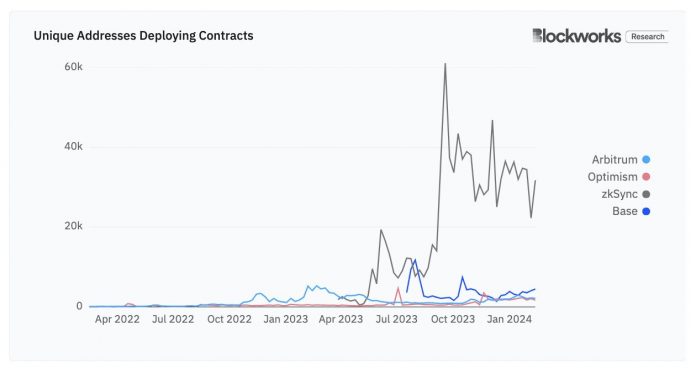
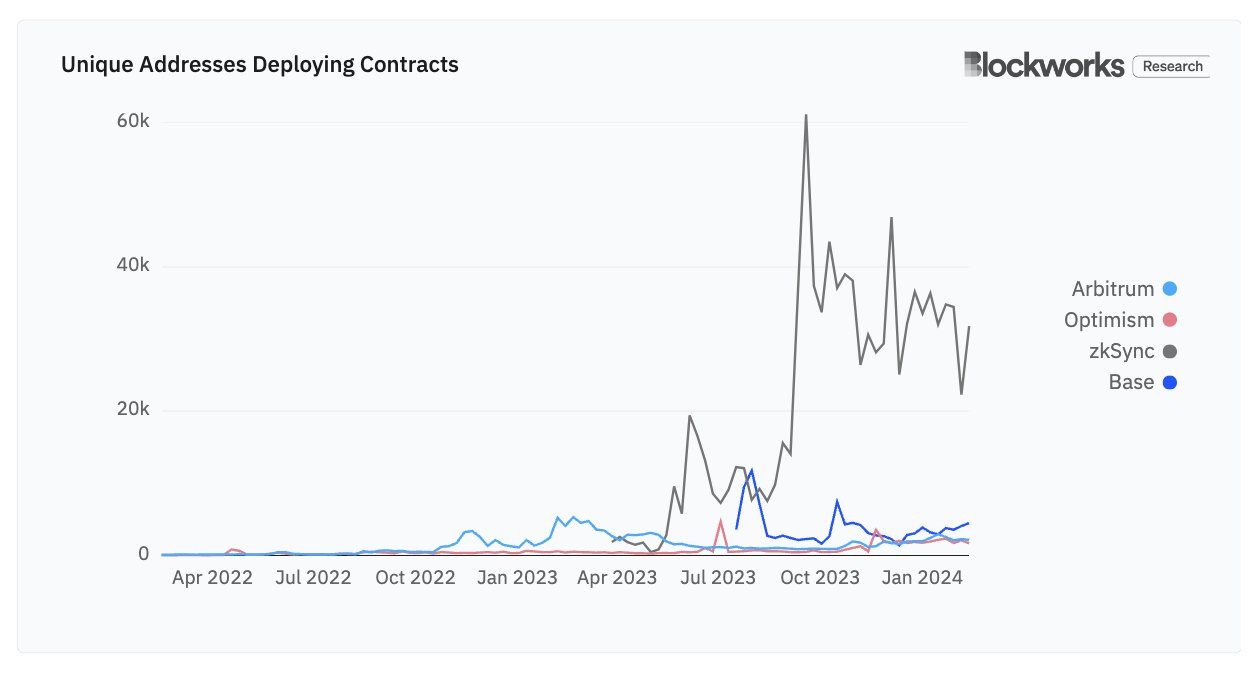
ZKsync transactions, active addresses, and addresses deploying contracts are all skyrocketing in February 2024 as the FOMO towards its mainnet and Airdrop approaches which is evident in the below graph according to Blockworks.

On Ethereum, deploying a smart contract involves sending a transaction to the zero address (0x000…000) with the data field containing the contract bytecode concatenated with constructor parameters. This process ensures that the contract is correctly initialized.

In contrast, zkSync introduces a novel approach to contract deployment. To deploy a contract on zkSync Era, a user calls the create function of the ContractDeployer system contract. This function requires the hash of the contract to be published and the constructor arguments. The actual bytecode of the contract is supplied in the factory_deps field of the transaction (as it’s an EIP712 transaction).

If the contract is a factory (capable of deploying other contracts), these contracts’ bytecodes should also be included in factory_deps. We recommend using tools like the hardhat-zksync-deploy plugin to simplify deployment. This plugin handles bytecode hashing and other deployment requirements.

Senate Rejects Plans to Increase Electricity Tariff and Remove Subsidy Amid Economic Hardship

0
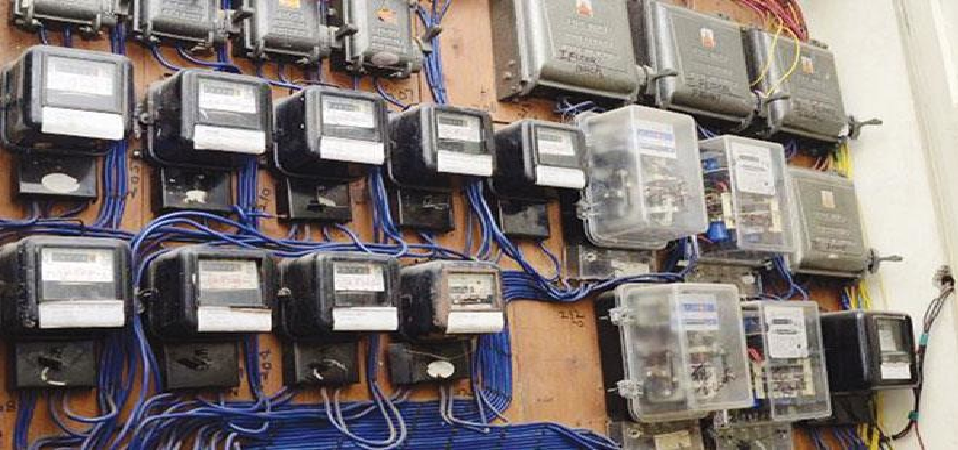
electricity companies nigeria

The Nigerian Senate has taken a firm stand against the Ministry of Power’s proposal to increase electricity tariffs and remove subsidies, citing the prevailing economic challenges gripping the nation.

During a plenary session on Wednesday, the Senate unanimously rebuffed these plans, highlighting the need to alleviate the burdens already weighing heavily on Nigerians.

The upper chamber also directed its Committee on Power to investigate the N2 trillion subsidy requirement, as stated by the Minister of Power, Adebayo Adelabu, along with other outstanding debts within the sector. Additionally, they were tasked with examining the state of metering across the country.

Senator Aminu Abbas (PDP, Adamawa Central), who moved the motion, urging the retention of electricity subsidies, voiced the Senate’s collective concern.

Speaking on the alarming indebtedness of DisCos to power generating companies and gas companies, which currently stands at a staggering sum exceeding N3 trillion, Abbas said: “[the] Senate notes with greatest dismay the plan to increase electricity tariff by the relevant statutory authority in gross disregard of increased economic challenges with attendant widespread poverty and high cost of living.”

He added, “The Senate may note that the Minister of Power was reported as saying that the nation must begin to move towards a cost-effective tariff model, as the country is currently indebted to the tune of N1.3tn to generating companies (GenCos) and $1.3bn owed gas companies.

“According to him, out of over N2tn needed for the subsidy, only N450 billion was budgeted this year.

“The same electricity businesses are collecting money from customers for services not rendered when they have not added anything to the equipment, they inherited it from PHCN.

“Communities buy transformers to replace damaged ones in addition to overburden bills and arbitrary estimates for unmetered customers.”

“The prospect of higher electricity bills is untenable in a country where a significant portion of the population lives below the poverty line,” Abbas asserted.

He noted the dire consequences the situation has put individuals and small businesses in, especially amidst stagnant wages and skyrocketing inflation rates.

The Senate’s resistance to the proposed tariff hike was partly buoyed by the outcry of consumers over exorbitant charges levied on unmetered customers by Distribution Companies (DisCos). Senator Abbas condemned the DisCos for their unjust billing practices, which further compounds the financial strain on vulnerable segments of society.

Echoing Abbas’s sentiments, Senator Aminu Tambuwal (PDP, Sokoto South) denounced the notion of raising electricity tariffs during times of economic hardship, labeling it counterproductive and insensitive to the plight of the populace.

Senator Orji Kalu (APC, Abia North) echoed similar sentiments, emphasizing the urgent need to prioritize improvements in transmission and distribution infrastructure overburdening consumers with additional costs.

The Senate’s resolution underscores the need for a comprehensive inquiry into the financial health of the power sector, encompassing outstanding debts and the state of metering nationwide. The Committee on Power has been tasked with conducting a thorough investigation into the N2 trillion subsidy requirement and other outstanding sectoral debts, to formulate actionable recommendations to tackle the underlying challenges.

Nigeria’s electricity sector continues to grapple with inadequate generation capacity, hovering around 4,137.60MW as of February 2024. This shortfall has resulted in heavy reliance on alternative power sources, further straining household budgets, particularly in the wake of skyrocketing fuel prices following the removal of petrol subsidies last June.

The prevalence of estimated billing due to insufficient metering also exacerbates the financial burden on consumers, impeding efforts to justify any proposed tariff adjustments. Consequently, Nigerian lawmakers said the DisCos must be held accountable for their billing practices and be compelled to prioritize metering initiatives to ensure transparency and fairness in electricity billing.

The Senate’s rejection of the proposed electricity tariff hike and subsidy removal, while it protects consumers from further exploitation, exposes once again the voids in the power sector. Experts have called for concerted efforts to address systemic challenges within the power sector and enhance service delivery.

Moreover, the implications of poor electricity supply on the economy cannot be overstated. Inconsistent power provision stifles industrial productivity, inhibits business growth, and undermines investor confidence. The manufacturing sector, in particular, bears the brunt of erratic power supply, resulting in increased production costs and diminished competitiveness in the global market.

Furthermore, unreliable electricity access hampers technological advancements and innovation, hindering the transition to a knowledge-based economy. Small and medium-sized enterprises (SMEs), which form the backbone of Nigeria’s economy, are disproportionately affected, grappling with operational challenges and constrained growth opportunities.

The cumulative effect of epileptic power supply translates into reduced employment opportunities, heightened poverty levels, and constrained economic growth. Addressing the systemic deficiencies within the power sector is thus imperative for unlocking Nigeria’s full economic potential and fostering sustainable development.