DD
MM
YYYY

PAGES

DD
MM
YYYY

spot_img

PAGES

Home Blog Page 3721

Part of Africa’s Intra-Trade Challenges Include Inadequate Payment and Supply Chain Infrastructures

0

Africa is a vast and diverse continent with many opportunities and challenges for e-commerce. However, one of the main barriers that hinder the growth of online shopping in Africa is the lack of reliable and affordable payment and logistics solutions.

Payment systems in Africa are often fragmented, costly, and insecure. Many African consumers do not have access to formal banking services, credit cards, or mobile money platforms. Those who do may face high fees, fraud risks, or limited interoperability with other payment methods. As a result, cash on delivery (COD) remains the dominant mode of payment for online purchases in Africa, accounting for up to 80% of transactions in some countries.

However, COD poses its own challenges for e-commerce platforms and merchants. COD increases the risk of order cancellations, returns, and theft. It also adds to the operational costs and complexity of delivering goods to customers. Moreover, COD limits the ability of e-commerce platforms to offer value-added services such as financing, insurance, or loyalty programs.

Logistics systems in Africa are also underdeveloped, inefficient, and expensive. The continent suffers from poor infrastructure, such as roads, ports, airports, and railways. It also faces regulatory hurdles, such as customs delays, tariffs, and taxes. These factors increase the time and cost of shipping goods across borders or within countries. Furthermore, logistics providers in Africa often lack the technology, data, and skills to optimize their operations and ensure quality service.

These challenges create a vicious cycle that hampers the growth of e-commerce in Africa. Without reliable and affordable payment and logistics solutions, e-commerce platforms struggle to attract and retain customers, merchants, and investors. Without a vibrant e-commerce ecosystem, payment and logistics providers lack the incentives and resources to innovate and improve their services.

To break this cycle, Africa needs a holistic approach that addresses both the demand and supply sides of payment and logistics solutions. On the demand side, e-commerce platforms need to understand the needs and preferences of their target customers and offer them convenient and secure payment options that suit their context. They also need to partner with local logistics providers that can deliver goods quickly and reliably to their customers.

Some examples of e-commerce platforms in Africa that are trying to solve the payment and logistics problem are:

Jumia: Jumia is the largest online marketplace in Africa, operating in 14 countries. Jumia offers a variety of products and services, such as electronics, fashion, groceries, food delivery, travel booking, and classifieds. Jumia has its own payment platform called JumiaPay that allows customers to pay online or offline using various methods such as mobile money, bank cards, or cash. Jumia also has its own logistics network called Jumia Logistics that leverages local partners to deliver goods to customers across urban and rural areas.

Flutterwave: Flutterwave is a fintech company that provides payment solutions for businesses and individuals in Africa and beyond. Flutterwave enables merchants to accept payments from customers using multiple channels such as bank transfers, cards, mobile money, USSD codes, QR codes, or cash. Flutterwave also integrates with global payment platforms such as PayPal, Stripe, Alipay, or M-Pesa to facilitate cross-border transactions. Flutterwave has partnered with several e-commerce platforms in Africa such as Jumia, Konga, Paystack, or Uber to provide seamless payment experiences for their customers.

Kobo360: Kobo360 is a digital logistics platform that connects cargo owners with truck drivers in Africa. Kobo360 uses technology to match supply and demand for trucking services, optimize routes and prices, track shipments in real-time, and provide insurance and financing options. Kobo360 aims to reduce the cost and time of moving goods across Africa by leveraging data and analytics to improve efficiency and transparency in the logistics sector.

On the supply side, payment and logistics providers need to invest in technology, data, and skills that can enhance their efficiency and quality. They also need to collaborate with each other and with e-commerce platforms to create integrated and interoperable solutions that can reduce costs and friction for all parties involved.

By solving the payment and logistics problem in Africa, e-commerce can unleash its full potential as a driver of economic growth, social inclusion, and innovation in the continent.
Are All Paid VPNs the Same?

0

With so many VPN services on the market, one common question is – are all paid VPNs the same? The short answer is no. While paid VPNs generally provide better security, speeds, and features compared to free VPNs, there can still be major differences between providers. Here are the key factors to consider when evaluating paid VPN services.

Privacy and Security

For most of us, VPN meaning equals to privacy and security are the main motives for using a VPN. So, to deliver true privacy protection, a VPN should have a strict no-logs policy, meaning it does not track or store any user activity data that could potentially identify individuals. VPNs that do log data are inherently less private. VPN providers use different encryption protocols to secure connections.

The strongest protocols, like AES-256, SHA-256, and RSA-4096, provide robust encryption that is extremely difficult for hackers to crack. Weaker protocols may be faster but are less secure. Some VPNs offer advanced security features like a kill switch, split tunneling, and ad blocking. A kill switch disconnects your internet if the VPN connection drops to prevent data leaks. Split tunneling allows you to route only some of your traffic through the VPN. And ad blocking prevents ads from tracking you.

Server Network

The number and location of a VPN’s servers impact both speed and ability to bypass geographic restrictions. More servers in diverse locations increase your chances of getting a fast, nearby connection. Wide server coverage also lets you access more geo-restricted content.

Top VPNs have 1,000+ servers in 50+ countries. Budget VPNs tend to have smaller server networks concentrated in a few regions. Limited server selection can result in slower speeds, congestion, and the inability to stream content or websites from certain countries.

Speed and Reliability

VPN encryption has some impact on internet speeds. The extent of the speed reduction depends on factors like the protocol, encryption strength, server load, and your distance to the server. The fastest VPNs can maintain nearly full speeds while connected. Slower VPNs may struggle with activities like HD streaming and gaming.

Speed and reliability also vary based on the server you connect to. Look for VPNs that offer ultra-fast protocols like WireGuard or proprietary protocols optimized for speed. Features like Speed Test servers and connection load balancing also improve speeds.

Streaming Capabilities

Many people use a VPN to access streaming platforms like Netflix, Hulu, ESPN, and BBC iPlayer, that block users from other countries. The best VPNs for streaming can reliably bypass geographic blocks on major streaming services.

VPNs that don’t work with popular streaming sites are less useful for cord-cutters. Having dedicated streaming servers optimized to unblock platforms is also beneficial. Streaming capability should be a key consideration if you plan to use a VPN to watch shows or live sports.

Features

VPN providers include different features to enhance the user experience. For example, top services allow connecting 5+ devices simultaneously under one account. Limiting connections requires setting up multiple accounts. Some VPNs also offer split tunneling, which is useful for excluding specific apps and websites from the VPN tunnel. This prevents speed reduction on services that don’t need a VPN.

Other handy features include a kill switch to prevent data leaks if the VPN drops, DNS and IPv6 leak protection, port forwarding for P2P traffic, and ad blocking for privacy. The more features a VPN provides, the more customizable the experience.

Customer Support

Even the best VPNs encounter technical issues now and then. Good customer support can help you quickly resolve problems. Look for VPNs that offer 24/7 live chat and email support. Phone support is also preferable for urgent issues.

Slow response times or lack of communication will leave you frustrated. VPNs with poor or limited support should be avoided in favor of those that offer timely, knowledgeable assistance.

Pricing and Plans

Paid VPNs range in price from a few dollars to over $10 per month for an annual plan. More expensive VPNs may offer benefits like faster speeds, more features, and extra simultaneous connections. But a higher price doesn’t always equal better service.

Consider the length of subscription plans as well. Monthly billing is the most expensive overall. Opting for 6-month, 1-year, or 2-year plans decreases the monthly cost significantly. But also look for a money-back guarantee in case you want to cancel.

Bottom Line

While paid VPNs are generally better than free ones, there are still major differences between providers in terms of privacy protections, server networks, speeds, streaming capabilities, features, support, and pricing. Taking the time to thoroughly research VPNs can help you select the best one for your specific needs and budget.

Bitcoin is often seen as Hedge against Inflation and Currency Devaluation

0

One of the main reasons why many investors are interested in Bitcoin is its ability to serve as a protection against the loss of purchasing power of fiat currencies. In this blog post, we will explore how Bitcoin can act as a hedge against inflation and currency devaluation, and what are the advantages and challenges of this strategy.

Inflation is the general increase in the prices of goods and services over time, which reduces the value of money. Currency devaluation is the deliberate reduction of the value of a currency relative to another currency or a basket of currencies, usually to boost exports and stimulate economic growth. Both inflation and currency devaluation erode the purchasing power of money and can have negative impacts on savers, investors, and consumers.

Bitcoin, on the other hand, has a limited supply of 21 million coins that will ever be created, and a predictable issuance schedule that decreases over time. This means that Bitcoin is not subject to the whims of central banks or governments that can manipulate the money supply and cause inflation or devaluation. Bitcoin is also decentralized and global, which means that it is not affected by the economic or political conditions of any single country or region.

Therefore, Bitcoin can offer a hedge against inflation and currency devaluation by preserving or increasing its value relative to fiat currencies. Bitcoin can also provide diversification benefits for investors who want to reduce their exposure to traditional assets such as stocks, bonds, and commodities, which may suffer from inflation or devaluation. Moreover, Bitcoin can enable access to financial services and opportunities for people who live in countries with high inflation or devaluation rates, or who face capital controls or sanctions.

However, investing in Bitcoin as a hedge against inflation and currency devaluation is not without risks or challenges. Bitcoin is still a volatile and speculative asset that can experience significant price fluctuations due to various factors such as supply and demand, regulation, innovation, competition, security breaches, hacks, frauds, etc. Bitcoin is also subject to taxation and legal uncertainties in different jurisdictions, which may affect its profitability and usability. Furthermore, Bitcoin requires technical knowledge and skills to use it safely and effectively, as well as reliable access to the internet and electricity.

According to CoinDesk, Bitcoin’s price dropped by about 5% on February 1, 2021, the day of the coup, from $33,445 to $31,817. However, it quickly recovered and reached a new all-time high of $48,635 on February 9, after Tesla announced that it had bought $1.5 billion worth of Bitcoin and would accept it as a payment method but later resented the apeldoorn.

Another event that has affected Bitcoin is the ongoing trade war between the US and China, which has escalated under the Biden administration. The US has imposed tariffs and sanctions on Chinese goods and companies, accusing them of unfair trade practices and human rights violations. China has retaliated with its own measures, such as banning imports of certain US products and restricting access to its market.

The trade war has created uncertainty and volatility in the global economy, as well as increased tensions between the two superpowers. This has also affected the cryptocurrency market, as China is one of the largest markets for Bitcoin mining and trading. According to Coin Metrics, Bitcoin’s price fell by about 10% on May 19, 2021, from $43,165 to $38,787, after China announced that it would crack down on cryptocurrency mining and trading activities.

However, Bitcoin also bounced back and reached $40,000 on May 26, after reports that some Chinese miners were relocating to other countries with more favorable regulations and lower electricity costs. Additionally, some analysts believe that the trade war could benefit Bitcoin in the long run, as it could increase its appeal as a store of value and an alternative to fiat currencies.

As we can see, Bitcoin is not immune to geopolitical events, but it also has the ability to adapt and recover from them. Bitcoin’s price is determined by a complex interplay of factors that are constantly changing and evolving. Therefore, investors should be prepared for fresh volatility amidst geopolitical uncertainty, but also for new opportunities and challenges.

Bitcoin is often seen as a hedge against inflation and currency devaluation because of its limited supply, predictable issuance, decentralization, and global nature. However, investing in Bitcoin also involves risks and challenges that need to be carefully considered and managed. Therefore, investors should do their own research and due diligence before investing in Bitcoin or any other cryptocurrency.

Blur, YugaLabs, Improbable, FTX, Pfizer, Solana, and other Crypto News

0

One of the most controversial decisions in the NFT space was Blur’s announcement to lower its royalty fee from 10% to 2.5% in September 2022. This move was intended to attract more artists and collectors to the platform, but it also had a devastating impact on Yuga Labs, the company behind Bored Ape Yacht Club, one of the most popular NFT collections on Blur.

Yuga Labs relied heavily on the royalty fee as a source of income, since it did not sell any new apes after the initial launch in April 2021. The fee reduction meant that Yuga Labs lost 75% of its potential revenue from secondary sales, which amounted to millions of dollars. Some analysts speculated that this was a deliberate attempt by Blur to undermine Yuga Labs’ success and dominance in the NFT market, while others argued that it was a necessary step to foster a more competitive and diverse ecosystem.

Improbable, the company behind the SpatialOS platform for creating massive online worlds, has shifted its focus from gaming to metaverse applications in recent years. According to CEO Herman Narula, this move has been rewarding for the company, as it has attracted new clients and partners from various industries. Narula believes that the metaverse is not just a buzzword, but a real opportunity to create immersive and interactive experiences that transcend the boundaries of physical reality.

FTX, a cryptocurrency exchange platform, has revealed that it does not have a fixed amount for its insurance fund, but rather uses a random number generator to determine its size. The company claims that this method allows it to adjust the fund according to market conditions and avoid over- or under-funding. However, some critics have raised concerns about the transparency and reliability of this approach, as well as the potential risks for traders and investors who rely on the insurance fund to cover losses in case of liquidations or hacks.

The legal team of the SBF has filed a motion to exclude any reference to Anthropic, a rival AI research company, from the trial. The motion argues that Anthropic is irrelevant to the case and that mentioning it would prejudice the jury against SBF. SBF is accused of violating several safety and ethical regulations in its pursuit of artificial superintelligence.

The hacker who stole 2.8 million HTX tokens from the Hotbit exchange has returned the funds, according to a tweet by Justin Sun, the founder of TRON. Sun also confirmed that the hacker will receive a 250 ETH reward for acting as a “whitehat” and helping to improve the security of the exchange. Sun praised the hacker for their “high moral standards” and said that the incident was a “win-win situation” for both Hotbit and the hacker.

According to a report by The Block, Bitmain, the world’s largest producer of cryptocurrency mining hardware, has paid its employees the wages that were delayed due to its financial troubles. The report cites unnamed sources who claim that Bitmain has resolved its cash flow issues and is now able to pay its staff on time.

Bitmain has been facing a series of challenges in the past year, including a leadership dispute, a failed IPO attempt, and a decline in demand for its products amid the crypto market downturn. The company reportedly laid off a significant portion of its workforce and closed some of its overseas offices in an effort to cut costs and survive the crisis.

Pfizer-backed DAO launches community-funded biotech firm Science crowdfunding project VitaDAO has launched Matrix Biosciences, seeded with $300,000 and future funding via IP-NFT fractionalization. The DAO, called VitaDAO, aims to fund and support innovative biotech projects that can benefit humanity and the environment.

VitaDAO is a community-driven platform that allows anyone to propose, vote, and fund biotech initiatives using blockchain technology and smart contracts. VitaDAO leverages Pfizer’s expertise and network in the biotech industry, as well as its commitment to social responsibility and sustainability.

Solana Investment products see largest week of Inflows

Solana, the blockchain platform that claims to offer fast, scalable and low-cost transactions, has seen a surge in demand from investors in the past week. According to data from CoinShares, Solana investment products attracted $49.4 million in inflows in the week ending October 6, 2023, the highest amount since March 2022. This represents a 28% increase from the previous week and brings the total assets under management (AUM) of Solana products to $314.7 million.

The inflows into Solana products reflect the strong performance of the SOL token, which has risen by more than 300% since the start of September 2023. SOL reached an all-time high of $214.76 on October 4, 2022, making it the fifth-largest cryptocurrency by market capitalization. The rally was driven by several factors, including the launch of Wormhole, a bridge that connects Solana with other blockchains such as Ethereum and Binance Smart Chain, the growth of decentralized applications (DApps) and decentralized exchanges (DEXs) on Solana, and the anticipation of more institutional adoption.

One of the most notable DApps on Solana is Audius, a music streaming platform that has over 6 million monthly active users and hosts artists such as Skrillex, deadmau5 and Diplo. Audius uses Solana to store and verify the ownership of music tracks, as well as to reward users and creators with its native token, AUDIO. Audius recently announced a partnership with TikTok, allowing users to share their songs directly to the popular social media app.

Solana investment products returned their largest inflows since March 2022, adding $24 million, according to CoinShares’ latest report. Solana is “continuing to assert itself as the altcoin of choice,” Head of Research James Butterfill wrote, particularly considering the recent launch of ether futures ETF products. Solana funds have recorded inflows in 28 weeks this year, with just four weeks of outflows in 2023. Bitcoin dominated the overall inflows, adding $43 million. However, some investors capitalizing on recent price strength began adding to short-bitcoin product positions — resulting in inflows of $1.2 million during the same period.

Another DApp that has gained traction on Solana is Serum, a DEX that leverages Solana’s high speed and low fees to offer fast and cheap trading of crypto assets. Serum claims to process over 50,000 transactions per second, with an average fee of less than $0.0001 per transaction. Serum also supports cross-chain swaps, allowing users to trade assets from different blockchains without intermediaries.

Solana’s popularity among investors and developers is also evident in the number of projects that have raised funds through its ecosystem. According to data from Messari, Solana projects have raised over $1.2 billion in funding in 2023 so far, surpassing Ethereum’s $1.1 billion. Some of the notable fundraises include Star Atlas, a metaverse game that raised $40 million in a public sale, Mango Markets, a DEX that raised $70 million in a token sale, and Pyth Network, a decentralized oracle that raised $31.5 million in a private sale.

Solana’s impressive growth has attracted the attention of institutional investors as well. In September 2023, Osprey Funds launched the Osprey Solana Trust, the first investment product in the U.S. that offers exposure to SOL. The trust has a management fee of 2.5% and requires a minimum investment of $10,000. Osprey Funds CEO Greg King said that Solana is “one of the most exciting projects in crypto” and that the trust will provide investors with “a secure and cost-effective way to access it”.

CoinShares, the digital asset manager that tracks the inflows and outflows of crypto investment products, said that Solana’s inflows indicate that investors are diversifying their portfolios beyond Bitcoin and Ethereum. CoinShares also noted that Solana’s inflows accounted for 86.6% of the total inflows into crypto products in the past week, which amounted to $57 million. The remaining inflows went to Bitcoin ($5.2 million), Ethereum ($1.8 million), Cardano ($0.9 million) and Polkadot ($0.8 million).

Solana’s strong momentum shows no signs of slowing down, as more projects, users and investors flock to its platform. With its innovative technology, vibrant ecosystem and growing adoption, Solana may soon challenge the dominance of Ethereum as the leading smart contract platform in crypto.

Implications of Innovation Information Availability and Innovation Seeking Behaviour in Nigeria

0

Whether for personal growth or societal advancement, performing certain tasks without the prerequisite information can prove challenging for individuals or groups responsible for these tasks. This analogy underscores the importance of having the right information on how to innovate and foster greater innovation. It serves as the cornerstone for ensuring a sustainable innovative society. In our experience, access to information, whether through media or non-media sources, plays a vital role in helping individuals take on innovation challenges and avoid what we refer to as the “information-deficient innovation trap” in nearly all sectors and industries in Nigeria. However, our analysis reveals that over the years, innovation-focused information on the Internet for the Nigerian market has been quite diverse and, in many cases, follows both backward and forward-looking trends.

Available Innovation Information

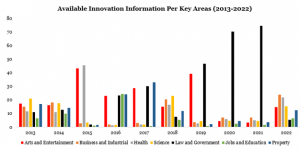
Utilizing the Google Search Engine, Nigeria’s and the world’s most widely used search platform, we discovered that there were 7.5 billion pieces of information related to innovation available for Nigeria between 2013 and 2022. Our analysis reveals that almost half (31.4%) of this information pertained to innovation within the field of law and government. Following closely at 25.3% of the total were arts and entertainment. Property accounted for 14.8%, and health comprised 10.5% of the information available. Jobs and education represented 7.9%, while science accounted for 4.8%, both totalling less than 10% of the overall information.

Our year-by-year analysis indicates that the volume of information available to the Nigerian public varied significantly during this period. Information availability exceeded one billion between 2015 and 2017 [2015 (1.1 billion), 2016 (1.9 billion), 2017 (1.3 billion)], only to drop to 222 million in 2018. This decrease was followed by a return to previous levels, with results recorded in 2013 (194.4 million) and 2014 (199.8 million). Subsequently, there was a significant increase in 2019, surpassing one billion, before reverting to previous levels in 2020 (632.7 million), 2021 (648.9 million), and 2022 (179.8 million).

As depicted in the figure below, the law and government sector held a higher percentage of the total available information between 2019 and 2021. Arts and entertainment also demonstrated relatively consistent performance between 2015 and 2019. Surprisingly, the percentage of information available for business and industrial, health, science, jobs, and education exhibited irregular patterns, indicating lower contributions from stakeholders in these sectors and industries related to the information categories.

Source: Google Trends, 2023; Opolo Global Innovation, 2023

Innovation Information Seeking Behaviour

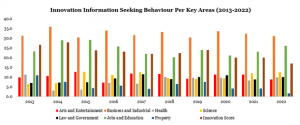
The Nigerian public consistently expresses a keen interest in the annual Global Innovation Index, prompting us to conduct an analysis of the country’s innovation scores from 2013 to 2022 along with their innovation information seeking behaviour. When it comes to seeking information on innovation, particularly with the goal of understanding innovation and potentially fostering innovative practices, the majority of inquiries were directed towards the business and industrial category throughout the entire analysis period with the different volume of searches [2013 (n=2679), 2014 (n=2416), 2015 (n=2621), 2016 (n=2494), 2017 (n=2366), 2018 (n=2119), 2019 (n=2645), 2020 (n=1833), 2021 (n=2280), and 2022 (n=2729)]. Following closely behind was the jobs and education category, which initially had a lower percentage of available information. Despite a substantial amount of information being accessible for arts and entertainment throughout the period, it emerged that people sought information in this category less frequently.

People in Nigeria have become increasingly curious about the meaning of innovation in the realm of arts and entertainment. They are eager to explore how innovation manifests in the arts and entertainment industry, including product innovation and the role of institutes like the Prime Innovation Institute of Technology. In the world of business and industry, innovation has become a buzzword. Nigerians have shown a keen interest in understanding what innovation means in a business context. Entrepreneurship, as a driving force behind innovation, has also garnered attention. People sought information about sources of innovation with the intention of grasping the concept of disruptive innovation. The dynamic nature of innovation and its relationship with change were the topics that piqued curiosity in this field. Within the realm of health, the focus was on the meaning of innovation. People were eager to understand how innovation can lead to advancements in healthcare, whether in medical treatments, technology, or healthcare delivery systems. In the fast-evolving domain of science and technology, innovation remains a central theme. Nigerians were interested in how innovation drives technological advancements. This interest related to emerging technologies, scientific discoveries, and their practical applications in various sectors.

In the context of law and government, innovation was a topic that captured attention. Citizens wanted to comprehend how innovation can be harnessed to improve governance, public services, and legal systems. Curriculum innovation was also a matter of interest, potentially indicating a desire for educational reform within this sector. When it comes to jobs and education, innovation was a recurring theme. People were keen to explore the meaning of innovation in the context of curriculum development and implementation. Institutions like the Innovation Institute of Technology in Akure may be contributing to this heightened interest. Additionally, agencies of curriculum planning and innovation are being sought after, suggesting a desire for educational reforms and advancements.

Throughout this decade, the search for the meaning of innovation was constant, reflecting a nation’s quest for progress and development. Whether in arts and entertainment, business and industry, health, science and technology, law and government, or jobs and education, Nigerians have shown a clear appetite for innovation and its transformative potential. The steady increase in information-seeking behaviour indicates a society eager to embrace change and stay at the forefront of innovation in the global landscape.

Source: Google Trends, 2023; Opolo Global Innovation, 2023

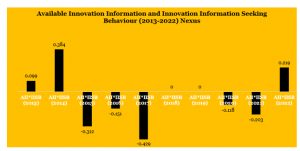
To increase our understanding of how the Nigerian public sought information between 2013 and 2022 in the context of the categories listed earlier, we further analysed the link between the availability of innovation information and innovation information-seeking behaviour. Our analysis reveals a -28% linkage. In this case, as the availability of innovation information increases, the level of innovation information-seeking behaviour decreases. On an individual level, this insight resonates with available innovation information and seeking behaviour from 2015 to 2021.

It’s possible that the available information does not always align with what individuals are seeking. Even though there might be a vast amount of information, its relevance and quality might not meet the needs of those seeking it, leading to a disconnect between availability and behaviour. For those involved in disseminating innovation-related information, this finding suggests the importance of understanding the ebbs and flows of public interest. It’s essential to tailor communication strategies to match the shifting dynamics of information-seeking behaviour. It also emphasizes the importance of adapting communication and information dissemination strategies to match the evolving interests and needs of the audience.

Source: Google Trends, 2023; Opolo Global Innovation, 2023

In speaking to this data, it is important to call the attention of government to the need for appropriate dissemination of innovation information to quench the thirst of Nigerians seeking to know more about the concept. In recent times, especially between 2015 to 2019, there is heightened discussion of innovation as a result of attention it is getting from the government in terms of policies and activities. However, as the new government is taking the focus higher and seeing how the digital economy could be harnessed for skills development and job creation, we advise that the information on innovation should be more contextualized. There should be a deliberate plan on communicating innovation in the local languages.  It is established that information couched in indigenous languages not only pique the interest of the receiving audience but also boosts comprehension.

This also does not leave out the private sector as making people understand innovation in their local languages has the potential to birth more innovative solutions to local problems. The media should also play more prominent roles in democratizing and decolonizing the language of discussing innovation. The Nigerian media landscape is rich and robust enough to take care of this charge if the actors are ready.