DD
MM
YYYY

PAGES

DD
MM
YYYY

spot_img

PAGES

Home Blog Page 3777

Rejuvenating Institutions for Sustainable Innovation Ecosystem in Nigeria

0

In any country, creating new products and services, as well as ensuring the sustainability of existing ones by restoring their prior level of functionality when issues have prevented them from delivering the expected value, is crucial for economic growth. This is also expected to lead to direct or indirect personal growth for individuals, regardless of their socioeconomic status or political class. At the heart of initiating and executing plans for developing and revamping existing offerings—products and services—lies innovation, a concept that has been theorized and researched worldwide over the years. From political leaders to captains of industries and professionals who execute various ideas into the commercialization stage, innovation serves as the bedrock for ensuring the hyper-commercialization of ideas, benefiting everyone and the country at large.

This has been one of the reasons for measuring the innovation ecosystem by different organizations and individuals at global, regional, national, and local levels. Nigeria is not an exception in this regard. The country has been among those studied by various organizations and researched by academics with the intention of understanding what works and what doesn’t work in its innovation ecosystem over the years. Leveraging the research conducted by the World Intellectual Property Organization and others that have studied the country’s innovation ecosystem, the outcomes have consistently been mixed, with a significant focus on the poor status of institutions – including political, regulatory, and business environments – in ensuring good innovation ecosystem performance.

Primarily, World Intellectual Property Organisation and others assess various factors, including institutions, human capital and research, infrastructure, market sophistication, and business sophistication. These factors serve as inputs for gauging the knowledge, technology, and creative outputs in any given country. The “institution” pillar encompasses political, economic, and business environments. Sub-indicators for the “human capital and research” pillar include the presence of high schools and higher education institutions teaching innovation, as well as active engagement in research and development. Under the “infrastructure” pillar, WIPO and others evaluate the strength of information and communication facilities, general infrastructure quality, and ecological sustainability in countries. The “market sophistication” pillar considers financial support, diversification, and the ability to scale products and services in markets as relevant sub-indicators.

Similarly, “business sophistication” aims to gauge the ability of workers to absorb innovation knowledge and skills. However, this alone is insufficient. They must also possess the capability to connect various innovations to develop sustained innovation outputs. In this regard, they should be able to create and disseminate impactful knowledge without neglecting the capacity to generate intangible assets, creative products, and services, whether online or in physical stores.

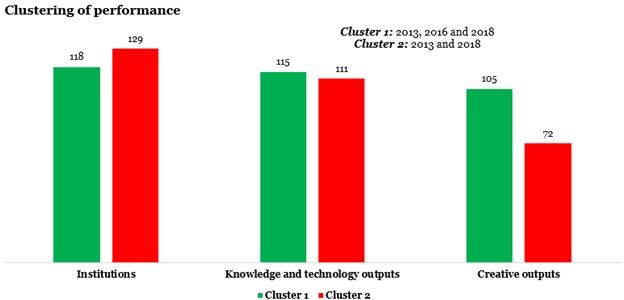
Unfortunately, considering these pillars, Nigeria did not perform well within the institution pillar between 2013 and 2022. The average ranking during this period was 120, while innovation stood at 117, reflecting suboptimal results over the course of a decade. An analysis during this timeframe reveals that the strength of institutions contributed only 11.2% towards creating a more favourable innovation ecosystem. However, when examining the impact on specific aspects, institutions had a significant influence on knowledge and technology outputs, accounting for 42.8%, and also affected creative outputs by 23.4%. These findings suggest that institutions showed relatively good performance, helping the country achieve nearly half of the expected 100% outcome of institutions in fostering a better innovation ecosystem. This also indicates that businesses, non-profit organizations, and individuals were able to overcome some obstacles related to the political, regulatory, and business environment while pursuing creativity and disseminating impactful knowledge across various sectors and industries.

When we break down the years, it becomes apparent that institutions performed better in 2018 compared to other years between 2013 and 2022, particularly in contrast to 2013 and 2014. Although 2013 wasn’t a favourable year for the country in terms of institutional ranking, it was relatively successful in terms of innovation outputs, especially in the realm of creativity. On the other hand, 2014 exhibited slight improvements, particularly in knowledge and technology output.
What the future holds if the status remains?

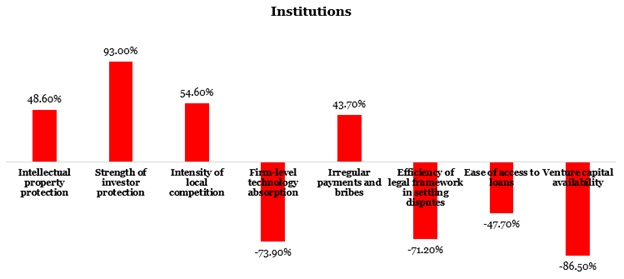
In the future, the current status of institutions will be bleak on attaining innovation outputs, at least between 2023 and 2025. During this period, Nigeria is expected to feel the significant effects of political, regulatory, and business environments on knowledge, technology, and creative outputs. However, there is optimism for more positive outcomes from 2026 to 2030. To mitigate the adverse effects of these institutions on innovation outputs and to enhance future results from 2026 to 2030, political and business leaders must address inherent challenges within the political, regulatory, and business environments. Political leaders at all levels, from federal to state and local, should create a conducive environment that facilitates the effectiveness of legal frameworks aimed at resolving various disputes related to intellectual property.

Moreover, access to loans that do not hinder innovation should be made available by avoiding stringent requirements that might deter innovators from exploring the potential of launching new products and services. Venture capitalists should recognize the importance of innovation financing as a key driver of the country’s economy and should actively support innovators. Additionally, businesses and their employees should strive to adopt existing innovative products or services more effectively, thus enhancing efficiency and productivity.
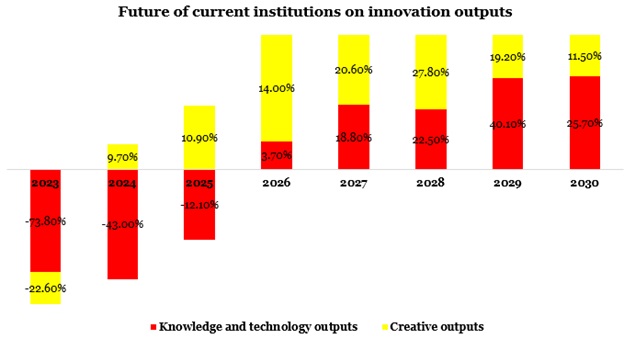
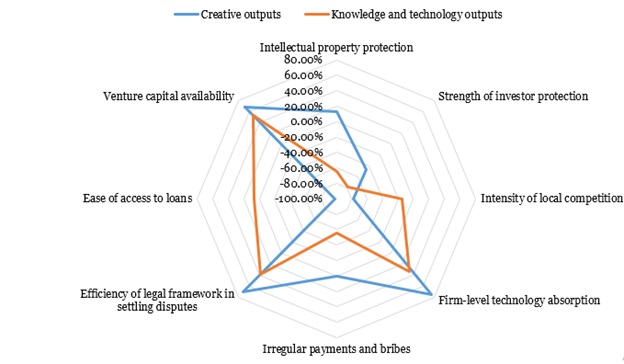


Source: Global Innovation Index, 2013-2022; World Economic Forum, 2013-2022

In order to hone the different institutional framework for rejuvenating the ecosystem, steps must be taken to improve the health of the political, regulatory and business environment. Based on the data, we suggest the following remedies.

Improved policy implementation and environment

From observations, it was noticed that the innovation and digital ecosystem in Nigeria started receiving serious governmental attention perhaps from 2015 or thereabout when the ministry of communication was reconfigured to also include digital economy. From then till the new administration of President Ahmed Bola Tinubu came on board, there was a flurry of policies upon policies probably to give shape to enhanced prosperity through the digital economy. There is a need to accelerate the provisions of the policies and find a place of convergence and divergence between them. It is then new policies could be put in place if there is a need for such. In driving a mechanism for accelerated growth in the innovation ecosystem, it is important to avoid policy glut and improve the policy environment. 

Activate the National Startup Act

In order to address the issue of funding inadequacy for innovation ecosystem, the National Startup Act has extensively addressed access to funding by the ecosystem players. The Act has provisions that cater to the financial needs of startups in Nigeria through the Startup Investment Seed Fund. It is our advice to the Minister of Communication and Digital Economy to fast track the establishment of the National Council for Digital Innovation and Entrepreneurship for the current administration. We also advise a strong coordination with the state governments through the Nigeria Governors Forum (NGF).  Efforts such as these would assist the drive for the growth of innovation and entrepreneurship in the country. 

Increased and Enhanced Public-Private Partnership

To grow the digital and innovation ecosystem in the country, it is critical to increase and enhance public-private partnership. This is to address the issue of sustainability of programmes put in place by government. From observation, governments at state levels are also seriously considering growing innovation and digital prosperity in their various states. However, the capacity of the state civil service bureaucracy to successfully run some of the needed programmes to bring this to a reality is in doubt. This is where the need for private operators in the ecosystem comes in. With their established processes, programmes and experience, the private sector working hand in hand with public institutions would bring far reaching impact to the drive for innovation and digital economy. A good example of this is what Opolo is doing across higher institutions where it has presence. We help in talent management of the ecosystem through offering programmes that plug the gaps in curriculum especially in entrepreneurship and and student work experience programmes. In Osun State University, Opolo partnered the Faculty of Engineering to provide facilitation in Data Science for 200 Level Engineering students in the university. In the same vein, the hub at the Rivers State University of Science and Technology had an engagement with the startup ecosystem on campus addressing issues such as ideation, incubation, acceleration and funding for their ideas. Improved and enhanced partnership would go a long way to accelerate innovation in the country.

Time for Innovation to Flourish but more needs to be done 

It is a good time for digital economy to boom in Nigeria. This is not farfetched from the fact that the personality and professionalism of the new driver of the national vehicle of digital economy has been a strong and established player in the terrain before his appointment. Still, there is a need to pay attention to factors that could make the job well-coordinated, easier and more impactful. Addressing improved policy implementation and environment, fostering partnership with established private players and putting up a structure to implement the provision of the National Startup Act would show the needed result.
Tether still shows strength of Solvency

0

Tether, the most widely used stablecoin in the crypto market, has been under scrutiny for its lack of transparency and its alleged role in manipulating the price of Bitcoin. Tether was launched in 2014 by a company called Tether Limited, which is closely affiliated with Bitfinex, one of the largest crypto exchanges in the world. However, despite the controversies and the legal challenges, Tether still maintains its dominance and its peg to the US dollar.

Tether is a cryptocurrency that is backed by an equivalent amount of fiat currency, such as the US dollar, the euro, or the yen. Tether claims that for every unit of Tether issued, there is a corresponding unit of fiat currency held in reserve by Tether Limited, the company behind the stablecoin. This means that Tether should always be redeemable for its face value, regardless of the fluctuations in the crypto market.

Tether operates on several blockchains, such as Bitcoin, Ethereum, Tron, and Solana, and can be transferred between them using a service called Tether Bridge. Tether can also be exchanged for other cryptocurrencies on various platforms, such as exchanges, wallets, and decentralized applications. Tether is often used as a medium of exchange, a store of value, and a hedge against volatility in the crypto market.

Tether’s solvency depends on two factors: its reserves and its demand. Tether’s reserves are the assets that back up the value of Tether. According to Tether’s website, these assets include cash, cash equivalents, short-term deposits, commercial paper, secured loans, corporate bonds, precious metals, and other cryptocurrencies. However, Tether does not provide a detailed breakdown of its reserves or a regular audit by an independent third party. This has raised doubts about whether Tether actually enough assets has to back up all the Tethers in circulation.

Tether’s demand is the amount of Tether that people want to hold or use. As long as there is enough demand for Tether, Tether can maintain its peg to the US dollar by issuing or redeeming Tethers as needed. For example, if there is more demand for Tether than supply, Tether can issue more Tethers and sell them for fiat currency or other assets to increase its reserves. Conversely, if there is less demand for Tether than supply, Tether can redeem some Tethers and buy back fiat currency or other assets to decrease its reserves.

However, if there is a sudden loss of confidence in Tether or a regulatory crackdown on Tether, there could be a run-on Tether, where people try to sell their Tethers for fiat currency or other cryptocurrencies. This could cause a liquidity crisis for Tether, where it does not have enough reserves to meet all the redemption requests. This could lead to a loss of peg or a collapse of Tether.

Using Tether involves both risks and benefits. Some of the risks are:

Lack of transparency: As mentioned above, Tether does not provide a clear and verifiable account of its reserves or its operations. This makes it hard to assess its solvency and trustworthiness.

Legal uncertainty: Tether is subject to various legal and regulatory challenges around the world. For example, in February 2021, Tether reached a settlement with the New York Attorney General’s office over allegations that it misrepresented its reserves and concealed losses from customers. As part of the settlement, Tether agreed to pay $18.5 million in fines and to provide quarterly reports on its reserves. However, other jurisdictions may impose different or stricter rules on Tether or ban it altogether.

Technical issues: As with any cryptocurrency, using Tether involves relying on technology that may malfunction or be hacked. For example, in November 2017, a hacker stole $31 million worth of Tethers from a wallet belonging to Tether Limited. Although the hacker was unable to redeem the stolen funds due to a freeze imposed by Tether Limited, this incident exposed the vulnerability of Tethers to theft or manipulation.

Some of the benefits are:

Stability: As long as Tether maintains its peg to the US dollar, it offers a stable and predictable value that can be used for transactions or savings in the crypto market.

Liquidity: As one of the most widely used cryptocurrencies, with a market capitalization of over $70 billion as of September 2023, Tether offers high liquidity and low transaction costs compared to other cryptocurrencies or fiat currencies.

Interoperability: As mentioned above, Tether operates on multiple blockchains and can be transferred between them using a service called Tether Bridge. This allows users to access different platforms and services in the crypto ecosystem without having to convert their funds into different currencies.

Tether’s popularity and influence are undeniable. According to CoinMarketCap, Tether is the third-largest cryptocurrency by market capitalization, with over $70 billion worth of USDT in circulation. Tether also accounts for more than half of the total trading volume of all cryptocurrencies, surpassing even Bitcoin. Tether’s dominance is especially evident in Asia, where many traders prefer to use USDT instead of fiat currencies or other cryptocurrencies.

Tether is a controversial but influential stablecoin that has a significant impact on the crypto market. Despite the lack of transparency and the legal uncertainty, Tether still shows strength of solvency and maintains its peg to the US dollar. However, using Tether also involves risks that users should be aware of and prepared for. Ultimately, the future of Tether depends on its ability to prove its legitimacy and reliability to its users and regulators.

Riot Blockchain in Texas computes 10,500,000,000,000,000,000 mathematical algorithm

0

One of the leading companies in the cryptocurrency mining industry is Riot Blockchain, based in Texas. The company operates a massive facility that houses thousands of high-powered computers that are constantly solving complex mathematical problems. These problems are part of the process of verifying transactions on the blockchain, the distributed ledger that underpins cryptocurrencies like Bitcoin. By solving these problems, Riot Blockchain and other miners compete to earn rewards in the form of new coins and fees.

Bitcoin mining is a process that involves solving complex mathematical problems to validate transactions and create new bitcoins. The difficulty of these problems increases over time, making it harder and more expensive to mine bitcoins. This poses a challenge for miners who want to earn rewards and secure the network.

Riot Blockchain, a Nasdaq-listed company that operates one of the largest bitcoin mining facilities in North America, has developed a new algorithm that aims to optimize the mining process and increase profitability. The algorithm, called RiotX, is based on artificial intelligence and machine learning, and it dynamically adjusts the mining parameters according to the network conditions and the available resources.

RiotX works by analyzing various factors, such as the difficulty level, the hash rate, the electricity cost, the temperature, the hardware performance, and the market price of bitcoin. It then determines the optimal configuration for each mining machine, such as the power consumption, the fan speed, and the clock frequency. By doing so, it maximizes the efficiency and the output of each machine, while minimizing the operational costs and the environmental impact.

The scale of this operation is staggering. According to Riot Blockchain’s website, the company’s current hash rate, or computing power, is 10.5 exahashes per second (EH/s). That means that the company’s computers are performing 10.5 quintillion calculations every second, or 10,500,000,000,000,000,000 calculations per second. To put that in perspective, that is more than a thousand times faster than the world’s most powerful supercomputer, Fugaku, which has a peak performance of 9.4 petaflops, or 9.4 quadrillion calculations per second.

Why does Riot Blockchain need such a colossal amount of computing power? The answer lies in the nature of the blockchain and the competition among miners. The blockchain is a series of blocks that contain records of transactions. Each block is linked to the previous one by a cryptographic hash, a unique code that is derived from the data in the block. To create a new block, miners have to find a hash that meets certain criteria, such as having a certain number of leading zeros. This is called proof-of-work, and it ensures that the blockchain is secure and immutable.

However, finding such a hash is not easy. It requires trial and error, and the difficulty of the problem adjusts every 2016 blocks to keep the average time between blocks at 10 minutes. As more miners join the network and increase the hash rate, the difficulty increases as well. Therefore, miners have to constantly upgrade their hardware and software to keep up with the competition and increase their chances of finding the next block.

Riot Blockchain is one of the most successful miners in this global race. The company has invested heavily in expanding its capacity and improving its efficiency. In 2021, Riot Blockchain acquired Whinstone US, Inc., which operates the largest Bitcoin mining facility in North America, with a total power capacity of 750 megawatts. The company also announced plans to acquire 43,500 Antminers from Bitmain Technologies Limited, one of the leading manufacturers of mining equipment. With these acquisitions, Riot Blockchain expects to reach a hash rate of 25 EH/s by the end of 2023.

Riot Blockchain’s impressive growth and performance have attracted attention from investors and analysts. The company’s stock price has soared from $1.22 per share at the end of 2019 to $28.60 per share as of September 29, 2023, an increase of more than 2,200%. The company’s market capitalization is currently over $2.8 billion, making it one of the largest publicly traded Bitcoin mining companies in the world.

Riot Blockchain’s vision is to become a leader in advancing blockchain technology and creating value for its shareholders and stakeholders. The company believes that Bitcoin and other cryptocurrencies have the potential to transform the global financial system and create a more inclusive and decentralized economy. By providing security and trust to the blockchain network, Riot Blockchain aims to contribute to this transformation and benefit from its growth.

The family at centre of racism row in Irish sport [video]

0

A recent incident involving a family of mixed-race origin has sparked a heated debate about racism and discrimination in Irish sport. The family, who wish to remain anonymous, claim that they were subjected to racist abuse and threats by some members of their local rugby club, after their son was selected to play for the national under-18 team.

The family say that they have been living in Ireland for over a decade, and that their son, who was born and raised in the country, is proud to represent Ireland on the international stage. However, they allege that some of their fellow club members do not share this sentiment and have been harassing them with derogatory remarks and insults, questioning their son’s eligibility and loyalty to the Irish team.

The family have reported the matter to the club’s management, as well as to the Irish Rugby Football Union (IRFU) but say that they have not received any satisfactory response or action. They say that they feel isolated and unwelcome in the club, and that their son’s mental health and performance have been affected by the ordeal.

The family, who wish to remain anonymous for fear of further reprisals, have faced racist slurs, threats, vandalism and physical attacks. They have reported the incidents to the authorities but claim that they have received little support or protection from the sporting bodies they are affiliated with.

The family’s ordeal began when their eldest son, a talented rugby player, was selected for a regional team. He soon became a target of abuse from some of his teammates and opponents, who called him derogatory names and mocked his appearance. His parents tried to intervene but were met with hostility and indifference from the coaches and officials.

The situation escalated when their daughter, a promising gymnast, was also selected for a national competition. She faced similar abuse from her rivals and spectators, who accused her of cheating and questioned her eligibility. Her parents again tried to seek help from the governing body of the sport but were told that they were overreacting and that they should ignore the comments.

The family’s youngest son, who plays soccer and basketball, has also been affected by the racism. He has been excluded from some of his teams and clubs and has been bullied at school. He has become withdrawn and depressed and has lost interest in sports.

The family say that they are devastated by the racism they have experienced, and that they feel betrayed by the sporting community that they have been part of for so long. They say that they love Ireland and consider it their home, but that they no longer feel welcome or safe here.

They are calling for more action and awareness from the sporting authorities and the public, to combat racism and discrimination in all forms of sport. They say that they want to see more diversity and inclusion in Irish sport, and that they hope that their story will inspire others to speak out against racism and support those who are affected by it.

The incident has sparked outrage among many people in the Irish sporting community, who have condemned the alleged racism and expressed solidarity with the family. Several prominent figures, such as former Ireland captain Brian O’Driscoll and current Ireland coach Andy Farrell, have spoken out against any form of discrimination in rugby, and have praised the diversity and inclusiveness of the sport.

However, some others have defended the club’s actions, arguing that they were merely expressing their opinions and concerns about the selection process and criteria for the national team. They claim that they have nothing against the family or their son personally, but that they are worried about the integrity and identity of Irish rugby, which they believe should be reserved for players who are fully Irish by birth and ancestry.

The IRFU has issued a statement saying that it is aware of the incident and that it is investigating the matter. It has also reiterated its commitment to promoting equality and respect for all people involved in rugby, regardless of their race, ethnicity, nationality, religion, gender, sexual orientation or any other factor. It has urged anyone who experiences or witnesses any form of discrimination or abuse in rugby to report it immediately and seek support.

Futures Kline, Terra Blockchain, UpBit, FTX and Other Crypto News

0

The Futures Kline feature allows users to view the historical and current prices of BTCUSDT in different time intervals, such as 1 minute, 5 minutes, 15 minutes, etc. The Kline is composed of four elements: open, high, low and close prices. The open price is the first price of the interval, the high price is the highest price of the interval, the low price is the lowest price of the interval, and the close price is the last price of the interval. The Kline also shows the volume of trades in each interval.

The problem of Futures Kline (chart) display issue on BTCUSDT on Binance. This is a serious issue that affects the accuracy and usability of the Futures Kline feature, which is one of the most popular tools for traders who want to analyze the price movements of Bitcoin and USDT. The problem is that the UI aggregated Kline has issue, meaning that the Kline displayed on the web or mobile interface does not match the actual prices of BTCUSDT. For example, if you look at the 15-minute Kline on September 29, 2023, at 12:00 GMT+00:00, you will see that the open price is 42,000 USDT, the high price is 43,000 USDT, the low price is 41,000 USDT and the close price is 42,500 USDT.

The Terra Classic community has decided to halt the issuance of Terra Classic USD (USTC), the stablecoin that was pegged to the US dollar on the Terra Classic blockchain. The decision was made after a governance proposal was submitted by a group of validators and delegators who argued that USTC was no longer sustainable or necessary, given the low demand and high maintenance costs. The proposal received overwhelming support from the community, with 98.7% of the votes in favor of stopping the minting of USTC.

The proposal also outlined a plan to redeem the existing USTC holders with Terra USD (UST), the stablecoin on the main Terra blockchain, at a 1:1 ratio. The redemption process will start on October 1, 2023, and will last for six months, after which USTC will cease to exist. The community hopes that this move will simplify the Terra ecosystem and focus the resources on developing the main Terra blockchain and its applications.

Arrington, the founder of TechCrunch and Arrington XRP Capital, has stepped down from the board of Celsius successor, a decentralized lending platform that aims to disrupt the traditional banking system. Arrington announced his decision on Twitter, citing a conflict of interest with his new role as a board observer at BlockFi, another crypto lending platform. He said he will remain a supporter and investor of Celsius successor but will no longer be involved in its governance or operations.

UpBit, one of the leading crypto exchanges in South Korea, has announced that it will temporarily halt the withdrawals of Aptos, a new token that was recently listed on its platform. The reason for this decision is a bug in the Aptos smart contract that allows scammers to mint unlimited tokens and sell them on the exchange, causing a massive price drop and affecting the liquidity of the token.

UpBit said that it is working with the Aptos team to resolve the issue and restore normal operations as soon as possible. It also assured its users that their funds are safe and that they will be able to withdraw their Aptos tokens once the bug is fixed. UpBit apologized for any inconvenience caused by this incident and urged its users to be careful when trading new tokens with low market capitalization and high volatility.

FTX, a cryptocurrency exchange platform, is facing multiple lawsuits from investors who claim they lost money due to its misleading marketing and unfair practices. FTX’s former law firm, Davis Polk & Wardwell LLP, and several celebrity endorsers, including Tom Brady and Kevin O’Leary, have filed motions to dismiss the lawsuits, arguing that they are not liable for FTX’s actions and that the plaintiffs have failed to state a valid claim.

The defendants contend that they were not involved in FTX’s operations or decision-making, and that they merely provided legal advice or promotional services to FTX. They also assert that the plaintiffs have not shown any causal link between their alleged losses and the defendants’ conduct.