DD
MM
YYYY

PAGES

DD
MM
YYYY

spot_img

PAGES

Home Blog Page 3902

BlackRock is Planning to Seed its Spot Bitcoin ETF with $10 million

0

BlackRock, the world’s largest asset manager, has filed an application with the U.S. Securities and Exchange Commission (SEC) to launch a spot Bitcoin ETF. The proposed fund, named BlackRock Bitcoin Trust, will track the performance of Bitcoin based on the CME CF Bitcoin Reference Rate.
Unlike futures-based Bitcoin ETFs, which invest in Bitcoin derivatives contracts, the spot Bitcoin ETF will hold actual Bitcoin in custody and allow investors to gain direct exposure to the cryptocurrency.

The CME CF Bitcoin Reference Rate is a daily benchmark price that reflects the value of one Bitcoin in U.S. dollars, based on data from several major cryptocurrency exchanges. Unlike futures-based Bitcoin ETFs, which invest in Bitcoin derivatives contracts, the spot Bitcoin ETF will hold actual Bitcoin in custody and allow investors to gain direct exposure to the cryptocurrency.

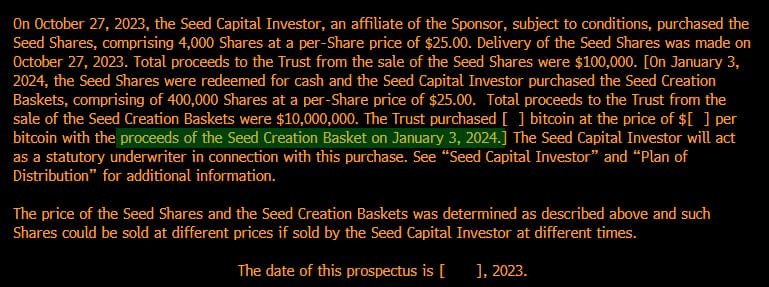
According to the filing, BlackRock plans to seed the fund with $10 million of its own capital, which will be used to purchase Bitcoin from various sources. The fund will charge a 0.95% annual fee, which is lower than the 1% fee charged by most futures-based Bitcoin ETFs.

The fund will also use third-party service providers to ensure the security and integrity of the Bitcoin holdings, such as Fidelity Digital Assets Services, LLC as the custodian and Coin Metrics, Inc. as the index provider.

BlackRock’s move to launch a spot Bitcoin ETF is a significant development for the cryptocurrency industry, as it signals the growing interest and acceptance of institutional investors in Bitcoin. BlackRock is not only the largest asset manager in the world, with over $9 trillion in assets under management, but also a leader and innovator in the ETF space, with over $3 trillion in ETF assets.

By offering a spot Bitcoin ETF, BlackRock could potentially attract more investors who prefer to invest in Bitcoin directly rather than through futures contracts, which entail additional costs and risks.

Moreover, BlackRock could also pave the way for other asset managers and financial institutions to follow suit and launch their own spot Bitcoin ETFs, creating more competition and diversity in the market.

The approval of a spot Bitcoin ETF by the SEC is still uncertain, as the regulator has repeatedly rejected or delayed such applications in the past, citing concerns over market manipulation, fraud, and lack of regulation.

Some other Bitcoin ETFs that are currently available or pending approval are:

ProShares Bitcoin Strategy ETF (BITO); The first U.S.-listed Bitcoin ETF that invests in CME Group’s monthly bitcoin futures contracts. VanEck Bitcoin Strategy ETF (XBTF): Another futures-based Bitcoin ETF that invests in CME Group’s monthly bitcoin futures contracts.

Valkyrie Bitcoin Strategy ETF (BTF): A futures-based Bitcoin ETF that invests in CME Group’s monthly bitcoin futures contracts as well as cash-settled options on those contracts. Simplify Bitcoin Strategy PLUS Inc ETF (MAXI): A hybrid fund that invests 15% of its assets in CME Group’s monthly bitcoin futures contracts and 85% in equity securities of companies that are involved in or benefit from blockchain technology.

Global X Blockchain & Bitcoin Strategy ETF (BITS): A hybrid fund that invests 80% of its assets in equity securities of companies that are involved in or benefit from blockchain technology and 20% in CME Group’s monthly bitcoin futures contracts.

Grayscale Bitcoin Trust (GBTC): A private placement trust that holds actual bitcoin and issues shares to accredited investors. It is not an ETF, but it trades on OTC markets like an ETF.

WisdomTree Physically Backed Bitcoin ETP (BTCW): A physically backed bitcoin exchange-traded product (ETP) that is listed on SIX Swiss Exchange and holds actual bitcoin in cold storage. It is not an ETF, but it is similar to one.

However, some analysts believe that the chances of approval have increased recently, as the SEC has approved several futures-based Bitcoin ETFs in October and November, indicating a more favorable stance towards Bitcoin-related products. Additionally, some SEC commissioners, such as Hester Peirce and Elad Roisman, have expressed support for a spot Bitcoin ETF, arguing that it would provide more choice and transparency for investors.

BlackRock’s spot Bitcoin ETF is expected to launch in early 2024, subject to regulatory approval and other conditions. If approved, it will be the first of its kind in the U.S., and potentially a game-changer for the Bitcoin market.
Quest for the holy grail of Nuclear Fusion has been a long and arduous one

0

The quest for the holy grail of nuclear fusion has been a long and arduous one, with many setbacks and challenges along the way. For decades, scientists and engineers have been working tirelessly to create a device that can harness the power of the stars and produce clean, abundant and sustainable energy for humanity. But despite the enormous efforts and investments, the goal of achieving a net energy gain from fusion has always seemed perpetually 30 years away.

However, recent breakthroughs and innovations have changed the landscape of fusion research and brought us closer than ever to realizing this dream. We will explore some of the most promising developments and projects that are pushing the boundaries of fusion science and technology, and why we can now confidently say that the holy grail of nuclear fusion is no more than ten years away.

The dream of harnessing the power of the stars to produce clean, abundant and sustainable energy has been pursued by scientists for decades. Nuclear fusion, the process that fuels the Sun and other stars, could potentially provide a solution to the world’s energy problems.

However, achieving fusion on Earth is not easy. It requires creating and controlling plasma, a state of matter where atoms are stripped of their electrons and form a hot, ionized gas. Plasma must be heated to temperatures of over 100 million degrees Celsius and confined under immense pressure for long enough to allow fusion reactions to occur.

One of the most promising ways to achieve this is by using a device called a tokamak, a doughnut-shaped chamber that uses powerful magnets to confine and shape the plasma. Tokamaks have been around since the 1950s, but they have faced many technical challenges and limitations.

The largest and most advanced tokamak in the world is the ITER project, an international collaboration involving 35 countries that aims to demonstrate the feasibility of fusion as a large-scale and carbon-free source of energy. ITER is currently under construction in France and is expected to start operations in 2025.

However, while ITER is a crucial step towards fusion energy, it is not the only one. In recent years, several other fusion projects have emerged around the world, driven by advances in technology, materials and computing. Some of these projects are led by private companies, such as General Fusion, Commonwealth Fusion Systems and TAE Technologies, that hope to commercialize fusion energy in the near future.

Others are led by research institutions, such as the Korea Superconducting Tokamak Advanced Research (KSTAR) facility, that aim to push the boundaries of fusion science and engineering.

These projects have made remarkable progress and achieved impressive results in their respective fields. For example, KSTAR recently set a new world record by sustaining a 100-million-degree plasma for 30 seconds, a milestone that demonstrates the stability and reliability of its superconducting magnets.

General Fusion has successfully tested its novel approach of using pistons to compress plasma inside a metal sphere, which could potentially reduce the size and cost of fusion reactors. Commonwealth Fusion Systems has developed a new type of high-temperature superconductor that could enable more powerful and efficient magnets for tokamaks.

TAE Technologies has achieved stable plasma confinement for over 10 milliseconds using its unique design of a linear reactor that uses beams of neutral particles to heat and control the plasma.

These achievements have transformed the landscape of fusion research and brought us closer than ever to realizing this dream. However, there is still a long way to go before fusion energy becomes a reality. Each project faces its own challenges and uncertainties, and there is no guarantee that any of them will succeed.

Moreover, there are many other aspects of fusion energy that need to be addressed, such as safety, economics, environmental impact and social acceptance. Therefore, it is important to support and collaborate with all the fusion efforts around the world, as they all contribute to the common goal of creating a better future for humanity.

The More People Use Crypto The More Crypto Becomes Part of the Global Financial System

0

The more people use crypto the more crypto becomes part of the global financial system. This is a simple but powerful statement that reflects the growing importance and influence of cryptocurrencies in the world economy. I will explain why crypto a niche, or a fad is not just, but a fundamental and transformative force that is reshaping the way we exchange value, store wealth, and access financial services.

Crypto is not just a new type of money, but a new type of network. Unlike traditional money, which is issued and controlled by central authorities, crypto is decentralized and distributed. This means that anyone can participate in the network, without intermediaries or gatekeepers.

Crypto is also programmable and transparent, which enables new forms of innovation and accountability. Crypto is not bound by geography or jurisdiction, but by cryptography and consensus. This means that crypto can transcend borders and barriers and create a more inclusive and efficient global financial system.

Crypto is not just a speculative asset, but a productive asset. Unlike traditional assets, which are subject to inflation and manipulation, crypto is scarce and immutable. This means that crypto can preserve and increase its value over time, without being diluted or devalued. Crypto is also divisible and fungible, which enables new forms of liquidity and exchange.

Crypto is not dependent on intermediaries or platforms, but on protocols and standards. This means that crypto can enable peer-to-peer transactions and markets, without fees or friction.

Crypto is not just a trend, but a movement. Unlike traditional systems, which are rigid and hierarchical, crypto is flexible and democratic. This means that crypto can adapt and evolve according to the needs and preferences of its users, without being constrained or corrupted. Crypto is also open and participatory, which empowers new forms of collaboration and governance.

Crypto is not driven by profit or power, but by purpose and vision. This means that crypto can create positive social and environmental impact, without compromising on performance or security.

Crypto will become more accessible and user-friendly. One of the main barriers to crypto adoption is the complexity and difficulty of using it. Crypto requires technical knowledge, digital skills, and personal responsibility.

Crypto also faces regulatory uncertainty, security risks, and scalability challenges. However, these issues are being addressed by various innovations and initiatives in the crypto space.

Crypto will become more user-friendly, with better interfaces, education, and support. Crypto will also become more accessible, with more options, platforms, and services. Crypto will lower the entry barriers and increase the adoption rates for both individuals and businesses.

Crypto will become more diverse and interoperable. Another key feature of crypto is its diversity and interoperability. Crypto is not a monolithic or homogeneous entity, but a heterogeneous and dynamic ecosystem. Crypto consists of different types of assets, such as cryptocurrencies, stablecoins, tokens, NFTs, etc.

Crypto also consists of different types of networks, such as public, private, permissioned, permissionless, etc. Crypto also consists of different types of protocols, such as layer 1, layer 2, sidechains, bridges, etc. Crypto will become more diverse, with more innovation and experimentation in the crypto space. Crypto will also become more interoperable, with more integration and collaboration among the crypto players.

The more people use crypto the more crypto becomes part of the global financial system. This is not a threat or a challenge, but an opportunity and a solution. Crypto is not an alternative or a competitor, but a complement and a catalyst. Crypto is not a zero-sum game, but a positive-sum game. Crypto is not the end, but the beginning.

Create-to-earn is the future of Metaverse Gaming

0

The hype around play-to-earn games has faded quickly. Many players realized that the rewards were not worth the time and effort they invested in these games. Moreover, the environmental impact of blockchain-based games was too high to ignore. Play-to-earn was a bust — we need to create-to-earn.

What is create-to-earn?  Instead of playing predefined games, players can use tools and platforms to design, build, and share their own games. They can also earn tokens or cryptocurrencies by selling their creations, or by getting tips or donations from other players.

Create-to-earn is not only more fun and rewarding, but also more sustainable and inclusive. It reduces the carbon footprint of gaming by using more efficient technologies and protocols. It also democratizes gaming by giving everyone the opportunity to express their creativity and earn income from it.

Some examples of create-to-earn platforms are:

Decentraland: A virtual world where players can create and explore 3D scenes, games, and experiences. Players can also buy and sell land, items, and services using the MANA token.

Roblox: A platform that allows players to create and play millions of user-generated games. Players can also earn Robux, the in-game currency, by creating popular games or selling items.

Axie Infinity: A game where players can collect, breed, and battle cute creatures called Axies. Players can also earn AXS and SLP tokens by playing the game or selling their Axies on the marketplace.

Create-to-earn is the future of gaming. It is not only a way to have fun, but also a way to unleash your potential and make a difference in the world.

Create-to-earn is a new paradigm of online content creation that rewards creators for their work. Unlike traditional platforms that rely on advertising or subscription models, create-to-earn platforms use blockchain technology and cryptocurrencies to enable direct and transparent value exchange between creators and consumers.

Create-to-earn platforms allow creators to monetize their content in various ways, such as:

Selling digital assets or collectibles (such as NFTs) that represent their unique creations or intellectual property. Earning tokens or coins that reflect their contribution to a network or community (such as social tokens or governance tokens). Receiving tips or donations from fans or supporters (such as through micropayments or smart contracts).

Participating in decentralized autonomous organizations (DAOs) that empower creators to collaborate and govern their own platforms. Create-to-earn platforms also benefit consumers by giving them more choice, control and ownership over the content they consume. Consumers can:

Access a wider range of content that is not limited by the algorithms or policies of centralized platforms. Support their favorite creators directly and transparently, without intermediaries or fees. Own or collect digital assets or collectibles that have intrinsic or sentimental value and can appreciate over time. Join or create communities that share their interests and values and have a voice in how they are run.

Create-to-earn is more than just a business model. It is a movement that aims to democratize the online content creation industry and empower creators and consumers alike. By leveraging the power of blockchain technology and cryptocurrencies, create-to-earn platforms offer a new way of creating, sharing and enjoying online content that is fair, sustainable and rewarding.

HODL Bitcoin, Ordinals, and BRC-20 tokens Against 2024 Investment

0

If you are looking for a long-term investment strategy that can withstand the volatility of the crypto market, you might want to consider HODLing Bitcoin, Ordinals, and BRC-20 tokens. These three assets have different characteristics and advantages that make them suitable for different investors and goals. We will explain what they are, how they work, and why you should HODL them.

Bitcoin is the first and most popular cryptocurrency, created by Satoshi Nakamoto in 2009. It is a decentralized digital currency that operates on a peer-to-peer network, without the need for intermediaries or central authorities. Bitcoin has a limited supply of 21 million coins, which makes it scarce and valuable. Bitcoin is also the most widely accepted and traded cryptocurrency, with a market capitalization of over $1 trillion as of December 2023.

Ordinals are a new type of cryptocurrency that are based on ordinal numbers, which are used to rank objects in a sequence. For example, the first, second, and third place in a race are ordinal numbers. Ordinals are created by a smart contract on the Ethereum blockchain, which assigns a unique ordinal number to each token. The ordinal number determines the value of the token, as well as its voting power and governance rights in the Ordinals DAO (decentralized autonomous organization).

The lower the ordinal number, the higher the value and power of the token. For example, the first Ordinal token is worth more than the second Ordinal token, and so on. There are only 10,000 Ordinals in existence, which makes them extremely rare and exclusive.

BRC-20 tokens are a standard for creating tokens on the Binance Smart Chain (BSC), which is a blockchain platform that is compatible with Ethereum but offers faster transactions and lower fees. BRC-20 tokens can represent anything from utility tokens to governance tokens to non-fungible tokens (NFTs). Some of the most popular BRC-20 tokens include PancakeSwap (CAKE), BakerySwap (BAKE), and CryptoBlades (SKILL). BRC-20 tokens offer a lot of opportunities for innovation and experimentation in the crypto space.

So why should you HODL these three assets? Here are some reasons.

Bitcoin is the king of crypto and has proven to be a reliable store of value and a hedge against inflation. It is also expected to grow in adoption and demand as more institutions and countries embrace it as a legal tender or an asset class.

Ordinals are a novel and scarce asset that have a lot of potential for appreciation and influence. They are also a way to participate in the governance and development of the Ordinals project, which aims to create a fair and transparent ranking system for the crypto world.

BRC-20 tokens are diverse and dynamic assets that can offer high returns and rewards for various activities on the BSC platform. They are also compatible with Ethereum, which means they can benefit from the network effects and innovations of both ecosystems.

HODLing these three assets can give you exposure to different aspects and trends of the crypto market, as well as diversify your portfolio and reduce your risk. Of course, you should always do your own research and due diligence before investing in any cryptocurrency, and only invest what you can afford to lose. Crypto is a volatile and unpredictable market, but also an exciting and rewarding one. HODLing Bitcoin, Ordinals, and BRC-20 tokens can be a smart and profitable strategy for next year investment.