DD
MM
YYYY

PAGES

DD
MM
YYYY

spot_img

PAGES

Home Blog Page 3904

Pathway to Revitalization of the Education System: The Role of the New Student Loan Act 2023 in Nigeria

0

In a bid for an inclusive education for all, in particular at the tertiary level, the Nigerian government heralds the Student Loan Act 2023. With a widespread consensus that education represents a critical component in the human capital development process, this initiative is a welcome development. However, advancement in the digital landscape is reshaping the educational space, which calls for a synergy of purpose for the successful delivery of mandates in this sector.

Productivity and economic prosperity of any nation are in tune with its level of technological development vis-à-vis the inherent innovation capability of its citizens, who, of course, reside across all tiers of educational level. However, this pathway to the supposed delivery has been hampered by poor funding, which is essential for equitable enrolment and learning in academic institutions. As a result, the new Student Loan Act is a positive step forward. The Student Loan (Access to Higher Education) Act, 2023, promises easy access to higher education for indigent Nigerians through interest-free loans from the Nigerian Education Loan Fund. A promise waiting for fulfilment in the minds of our tertiary students.

The Key Highlights from the Act

The Nigeria Education Bank Fund promises inclusive access to education at any public institution of higher learning in Nigeria with an equal right to access to qualified students without any discrimination arising from gender, religion, tribe, position, or disability of any kind. This minimizes the cost of tertiary education as the financial assistance will increase the enrolment of indigent students constrained by funds to pursue their higher education. Critical to the application procedure are certain terms and conditions inherent in a loan portfolio.

The eligibility criteria are that the applicant’s income or family income must be less than N500,000 per annum, while the guarantor system to access the funds includes civil servants of at least level 12 in the service, experienced lawyers, judicial officers, or justices of peace. Although inclusive literacy and advocacy with financial advice on educational matters for stakeholders (institutions of higher education, parents, and educational investors) are stated, a common platform to initiate this remains a question. The disbursement window period of within 30 days’ dictates a timely use of funds; provision for accountability in the terms of appropriation of applicants rules for disqualification (exam malpractice, fraud, criminal convictions, drug offenses, and the like) is established.

The student loan scheme offers proper monitoring of the academic records of grantees of the loans to obtain information on their year of graduation, national service, and employment and to ensure that grantees of the loans commence repayment of the loans as soon as they are due. The informed repayment process starts two years after the completion of the National Youth Service Corps program with a direct deduction of 10% of
the beneficiaries’ salary at source by the employer and credited to the Fund. Provisional defaulters are liable on conviction to a fine of N500,000, imprisonment for a term of two years, or both.

Appropriating the Act 2023 for long-term, sustainable delivery

Key aspect of this game-changing policy on higher education will increase the enrolment rate and foster inclusive learning. This provision encourages more individuals to pursue higher education, leading to an increase in the number of educated professionals across fields of study. Increased literacy in the nation through the tertiary educational system will also drive human capital development geared towards social and economic growth. Improved skilled professionals will deliver impact initiatives to drive sustainable economic growth and, subsequently, increase returns on quality education. The scheme promotes diversity and inclusivity within educational institutions, fostering a vibrant and enriched learning environment through sustainable access to funding.

However, a number of critical questions come to mind from the New Student Loan Act. Firstly, is there a chance of being gainfully employed afterwards for repayment purposes, and is there a specific limit to years of loan taking, even with students having extra years of study due to uncertainties? In another way, is the student loan fund a means to an end or an end in itself in the education ecosystem? What role will digital technology play in the application process for seamless operation within the fund management space? Although the disbursement process is underway, answers to these questions on the New Student Loan Act might be tailored into the amendment process for long-term delivery. Meanwhile, as a way of thinking, considering the high unemployment rate in the country, are there any prospects for innovation and entrepreneurship to scale startups and spinouts in tertiary institutions towards meeting loan repayment periods?

I suggest revitalization of the educational system for long-term human capital development should focus on innovation-centered interventions. A cursory look at digital advancement shows that technology and innovation play a pivotal role in transforming the educational landscape. For instance, support for edTech initiatives presents innovative digital tools and platforms, enhancing teaching methods and enriching the out-of-classroom learning experience.

This support can also incorporate interactive multimedia, robotics, and artificial intelligence (AI) into the educational curriculum, fostering engagement, critical thinking, and creativity among students. Investment in science, technology, engineering, and mathematics (STEM) has enormous opportunities and closely connects all fields of study across all tiers of education (primary, secondary, and tertiary). Aside from this fact, the addition of another acronym, I-innovation, (STEMI) thus suggests the strategic position of innovation as a propelling force towards an inclusive educational sector. The perception should complement the ultimate goals of the new Student Loan Act.

In conclusion, the Student Loan Act of 2023 presents a catalyst for an inclusive tertiary education ecosystem. There is a need to factor in technological and innovation enhancement strategies needed for sustained growth, which are critical to the loan scheme’s long-term viability. Appropriating the identified gaps will enable students from all backgrounds to leverage technology for research, collaboration, and skill development, bridging the digital divide and promoting the human capital and economic development that the educational sector upholds.
Telecom Operators in Nigeria Generated A Total of N53.6 Billion From SMS in 2022

0

Data from the Nigerian Communications Commission (NCC), revealed that telecommunications operators in Nigeria, comprising MTN, Airtel, Glo, 9Mobile, and Smile Communications, generated a total of N53.6 billion from SMS in 2022.

The NCC disclosed that a total of 14.08 billion text messages were sent by subscribers on all the networks in 2022. At a fixed rate of N4.00 per SMS, this amounts to approximately N56.3 billion for the operators.

NCC data also reveals a significant 48.8% surge in the number of text messages exchanged by subscribers last year. This surge saw an increase from 9.46 billion SMS in 2021, to an impressive 14.08 billion in 2022.

Correspondingly, the volume of text messages received experienced an 11.06% boost to reach 11.8 billion, ultimately culminating in a combined tally of 25.9 billion SMS sent and received during the year.

Check Out NCC Data Insights on How Each Telecommunications Company Performed

MTN stood as the leader, recording the largest number of SMS sent and received locally within the year. The number of SMS sent and received on the telco’s network stood at 8.3 billion and 8.7 billion respectively. The company raked in N33.3 billion from the messages sent.

Globacom occupied the second position with 3.6 billion SMS sent over its network, amounting to N14.5 billion and 777.2 million received in 2022.

The third largest operator by subscriber number, Airtel, recorded 1.8 billion sent messages at N7.5 billion and 2 billion messages received.

On 9 Mobile, the total SMS sent on the network in 2022 stood at 234.8 million (N93.9 million) while a total of 235 million messages were

received.

Smile Communications recorded the least SMS count, as 173,607 (N694,428) messages were sent and 766,588 received on the network in the year under review.

As regards international SMS, all the operators recorded a total of 518.9 million in international SMS in 2022. This comprised 59.5 million sent messages and 459.3 million received SMS.

With the proliferation of Over The Top (OTT) services such as WhatsApp, Facebook Messenger, Telegram and other messaging platforms, telecom operators in Nigeria have expressed concern over the decline in revenue from calls and SMS.

The rise of these social media platforms and messaging apps, has indeed changed the way people communicate, and this shift has had an impact on traditional SMS usage and pricing.

As people have increasingly turned to these platforms, the demand for SMS has declined. This change in communication habits has led to some adjustments in SMS pricing and plans by telecommunications providers in some regions.

However, industry analysts noted that while the rate at which telecom subscribers use SMS might have reduced due to the embrace of OTTs, its use cannot be completely taken over by the free messaging platforms.

Despite the rise of messaging apps, SMS remains relevant for various purposes, such as sending messages to individuals without internet access, and sending and receiving verification codes, amongst other uses.

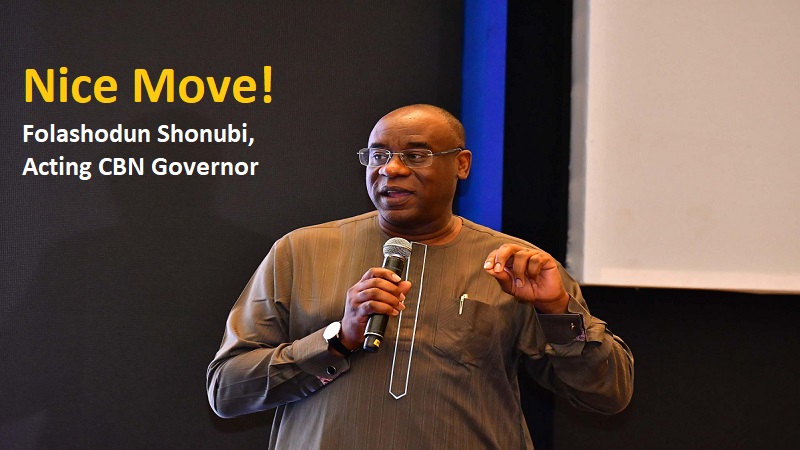
Well Done Folashodun Shonubi, Acting CBN Governor; Truly Brilliant Move

2

Good People, join me to commend this gentleman: Folashodun Shonubi, acting governor of Nigeria’s central bank. He impressed me today. Yes, since 2016 when they froze the publication of the Central Bank of Nigeria financial statements, I have written and challenged the government to obey the CBN Act: publish those documents for We The People. Today,  the documents have been published, and Shonubi is bringing Nigeria to the old order, at least in one area.

Read this: “The Group entered into a securities lending agreement with Goldman Sachs and J. P. Morgan and as part of the agreement, the Group pledged its holdings on foreign securities in return for cash. The cash received from Goldman Sachs is N0.23tn ($500m), 2021: N0.22tn ($500m), and JP Morgan N3.23tn ($7bn), 2021: N3.05tn ($7bn) is recognised in other foreign securities.”

So, when they told you that we had no money to pay doctors, nurses, lecturers, etc, even as they raked $billions in debts from American banks, it was all vapour lies. Without going political: Buhari took Nigeria backward by miles. He just held the “President” as a title!

That a general would allow that kind of rascality was simply unfortunate. In my village of Ovim, we have many military  generals, and we respect these men because even in their Isi-agu native dresses, you know they’re men of steel. What did they do with this money is the question we need to ask Buhari and his government because nothing was largely achieved?

And you know the unfortunate? More revelations are coming… Shonubi, go ahead and publish more. Of course, we also need the books to be audited.

Comment on Feed

Comment from user: I do appreciate your various posts and regular contributions. On the last one regarding the CBN’s books and loans, aren’t we missing part of the equation? You’re saying that the debt the CBN took was “rascality”. Wouldn’t it depend on whether the loans were taken for valid reasons? Were the funds used to grant loans for capex projects (in which case they’re not necessarily bad IF these projects are executed) OR were they squandered for subsidy and landed in the pocket of the few (which would be mayhem like you suggest). I think it’d be fair to add this point to your argument to drive the reasoning even further !

My Response: They were not disclosed until now. That is the rascality. It was hidden from Nigerians. This is not the sovereign debt.

Comment 1R: Ah OK. The fact they weren’t disclosed. Agreed. CBN were cowboys for sure. I really wonder how we’re going to get out of the mess we’re in. Subsidies destroy value as we’re totally incapable of managing properly. Lack therefore is the naira going into a tailspin.

My Response: I agree with you. But note that the subsidy is not really that bad. What is bad is the corruption in subsidy.

Why NFTs Market Has Plummeted in 2023

1
A woman looks at a NFT by Mad Dog Jones titled "SHIFT//" during a media preview on June 4, 2021, at Sotheby's for the Natively Digital: A Curated NFT Sale Online Auction to take place June 10, 2021. - They are technology enthusiasts on the hunt for opportunities in the Wild West market surrounding NFTs: the popular certified digital objects that have spawned a new generation of collectors convinced of their huge potential. (Photo by TIMOTHY A. CLARY / AFP) / RESTRICTED TO EDITORIAL USE - MANDATORY MENTION OF THE ARTIST UPON PUBLICATION - TO ILLUSTRATE THE EVENT AS SPECIFIED IN THE CAPTION

NFTs, or non-fungible tokens, are digital assets that represent unique and scarce items such as art, music, collectibles, and even virtual land. They have been one of the hottest trends in the crypto space since 2021, when they exploded in popularity and value. However, in 2023, the NFT market has seen a sharp decline in both volume and price, with some analysts predicting that it may never recover. What are the reasons behind this collapse, and what does it mean for the future of NFTs?

One of the main factors that contributed to the downfall of NFTs was the environmental impact of their creation and transaction. NFTs are mostly built on the Ethereum blockchain, which uses a proof-of-work (PoW) consensus mechanism that requires a lot of computing power and energy to validate transactions and mint new tokens. According to some estimates, a single NFT transaction can consume as much electricity as an average American household in a month. This has raised concerns among environmentalists, regulators, and even some artists and collectors, who have questioned the sustainability and ethics of NFTs.

Another reason why NFTs have lost their appeal is the oversaturation and dilution of the market. As more and more people jumped on the NFT bandwagon, the supply of NFTs increased exponentially, while the demand decreased. This resulted in a lower quality and originality of NFTs, as well as a loss of exclusivity and rarity. Many NFTs were simply copies or derivatives of existing works, or even outright scams or frauds. Moreover, some platforms and creators inflated the prices of their NFTs artificially, creating a bubble that eventually burst.

A third factor that affected the NFT market was the legal and regulatory uncertainty surrounding them. NFTs are still a relatively new phenomenon, and there is no clear or consistent framework for their governance, taxation, ownership, and protection. This poses a number of challenges and risks for both buyers and sellers of NFTs, such as disputes over intellectual property rights, copyright infringement, counterfeit detection, taxation compliance, and consumer protection. Furthermore, some governments and authorities have expressed their skepticism or hostility towards NFTs, citing their potential for money laundering, tax evasion, and illicit activities.

According to a recent study by the University of Cambridge, the annual electricity consumption of the Ethereum network, which hosts most of the NFTs, is equivalent to that of the entire country of Argentina. This is because every transaction on the network requires a complex mathematical computation, known as proof-of-work, that consumes a lot of computing power and electricity. Moreover, most of the electricity used by the network comes from fossil fuels, which emit greenhouse gases and worsen climate change.

So, how can we make NFT more sustainable and reduce their environmental impact? Here are some possible solutions:

Switch to a more energy-efficient consensus mechanism. Proof-of-work is not the only way to secure a blockchain network. There are alternative methods, such as proof-of-stake, proof-of-authority, or proof-of-burn, that require less computing power and energy. Some projects, such as Tezos, Flow, or Polygon, already use these methods to create more eco-friendly NFT platforms.

Use renewable energy sources. Another way to make NFT more sustainable is to use clean and renewable energy sources, such as solar, wind, or hydro power, to run the blockchain network. This would reduce the carbon footprint and emissions of the network and make it more environmentally friendly. Some initiatives, such as Crypto Climate Accord or Green NFTs, are working to promote the use of renewable energy in the crypto space and to offset the carbon impact of NFTs.

Create less but better NFTs. Finally, a simple but effective way to make NFT more sustainable is to create less but better NFTs. Instead of minting thousands of low-quality and generic NFTs that have no artistic or cultural value, we should focus on creating high-quality and meaningful NFTs that have a lasting impact and appeal. This would not only reduce the energy consumption and waste of the network, but also increase the value and reputation of the NFT market.

The NFT market has plummeted in 2023 due to a combination of environmental, economic, and legal factors that have eroded its value proposition and attractiveness. While some enthusiasts and optimists believe that NFTs still have a future and will bounce back once these issues are resolved or overcome, others are more pessimistic and think that NFTs were just a fad or a bubble that has burst. Either way, it is clear that NFTs need to undergo some major changes and innovations if they want to survive and thrive in the long term.

NFTs are an exciting and innovative technology that can revolutionize the digital economy and culture. However, they also pose a serious threat to the environment and sustainability. Therefore, we should take action to make NFT more sustainable and responsible, and to balance their benefits and costs.

Cool Cats Introduces New NFT Character Sidechick to Cooltopia Game Ecosystem

Meanwhile, Cool Cats, one of the most popular NFT collections on the Ethereum blockchain, has announced the launch of a new character named Sidechick, who will join the Cooltopia game ecosystem as a playable avatar. Sidechick is a female cat with a sassy attitude and a stylish outfit, who can interact with other Cool Cats and explore the virtual world of Cooltopia.

Cooltopia is a game platform that allows Cool Cats owners to use their NFTs as digital identities and participate in various activities such as socializing, gaming, and earning rewards. Cooltopia is powered by Immutable X, a layer-2 scaling solution that enables fast and gas-free transactions on the Ethereum network. Cooltopia aims to create a fun and immersive experience for NFT enthusiasts and gamers alike.

Cooltopia offers a variety of activities and features for its users. You can create your own avatar and customize it with different outfits, accessories, and hairstyles. You can chat with other users in public or private rooms, or join groups based on your interests. You can play games with other users or by yourself, such as puzzles, quizzes, racing, or trivia. You can also create your own games using the easy-to-use game editor. You can explore different worlds created by other users or by the Cooltopia team, such as forests, beaches, cities, or space stations. You can also create your own worlds using the world editor and share them with others.

Sidechick is the first new character to be introduced to the Cool Cats collection since its launch in July 2021. The collection consists of 9,999 unique and randomly generated Cool Cats, each with its own traits and personality. The collection sold out in less than an hour and has since become one of the most sought-after NFTs on the secondary market, with an average price of over 8 ETH.

To celebrate the arrival of Sidechick, Cool Cats is hosting a special giveaway event, where 100 lucky winners will receive a free Sidechick NFT. To enter the giveaway, participants need to follow the official Cool Cats Twitter account, retweet the announcement tweet, and tag three friends. The winners will be randomly selected and announced on September 1st.

Cool Cats is also planning to release more new characters and features for the Cooltopia game ecosystem in the near future. According to the team, they are working on developing more mini-games, quests, items, and customization options for the players. They are also collaborating with other NFT projects and artists to create cross-over events and partnerships.

Cool Cats is more than just an NFT collection; it is a vibrant community of passionate and creative people who share a love for cats and gaming. By introducing Sidechick and expanding the Cooltopia game ecosystem, Cool Cats hopes to attract more users and fans to join their Meowtastic adventure.

Cool Cats Meowtastic Adventure is not only a game, but also a learning experience. As you play, you will discover fascinating facts and trivia about cats, such as their origins, evolution, behavior, and symbolism. You will also learn about the different types of cats that exist in the world, from domesticated to wild, and how they adapt to their environments. You will also encounter some famous cats from history, literature, art, and pop culture, and see how they have influenced human society and culture.

Nigeria Opens the Central Bank of Nigeria (CBN) Books And Bad Things Are There!

2

For years, including just last week, I have been demanding that the Central Bank of Nigeria (CBN) opens its books for the public to see what we have there. Amazingly, they have done that, after seven years,  and there are many bad things there: “Also, the CBN owes JP Morgan and Goldman Sachs a combined sum of $7.5bn as of the financial year ended December 2022. Included as part of its liabilities is another $6.3bn owned in foreign currency forwards.”

The Central Bank of Nigeria has released the Consolidated Financial Statements for the last seven years, making it the first time since 2015 that the apex bank will be making its book available for public scrutiny.

The Consolidated Financial Statements, which were released by the CBN, are for 2016, 2017, 2018, 2019, 2020, 2021 and 2022 financial periods.

The CBN declared a profit after tax of N103.8bn in 2022, up from N75.13bn reported a year earlier.

Also, the CBN owes JP Morgan and Goldman Sachs a combined sum of $7.5bn as of the financial year ended December 2022.

Included as part of its liabilities is another $6.3bn owned in foreign currency forwards.

The apex bank, however, stated it owes Goldman Sachs $500 million and JP Morgan $7 billion in what it classified as securities lending.

The 2022 financial statement read, “The Group entered into a securities lending agreement with Goldman Sachs and J. P. Morgan and as part of the agreement, the Group pledged its holdings on foreign securities in return for cash. The cash received from Goldman Sachs is N0.23tn ($500m), 2021: N0.22tn ($500m), and JP Morgan N3.23tn ($7bn), 2021: N3.05tn ($7bn) is recognised in other foreign securities.”

Securities lending forms part of the CBN’s total external reserves of about N14.3tn or $29bn using the official exchange rate of N494/$1 as of 2022.

However, the apex bank also owes another N3.15tn ($6.3bn) in foreign currency forward which are forex obligations it needs to make to foreign investors.

The financial statements uploaded on the CBN website is an indication that the apex bank, under the leadership of acting Governor Folashodun Shonubi, is ready to open its book to public scrutiny.

Comment on Feed

Comment 1: As Buhari became president, the CBN stopped publishing its report. What we witnessed in the past 8 years was a unique combination of ineptitude and impunity, it’s both unbelievable and unbeatable.

We are yet to know the true debt we are owing and the people we are owing. Everything that could go wrong went wrong, and up till now many are still in denial as to whether Nigeria is progressing or regressing. NNPC did its own magic.

You cannot wake up people who are pretending to be asleep.

Comment 2: It’s truly eye-opening to see the Central Bank of Nigeria’s finances being made public after seven long years. The startling revelation that the Central Bank of Nigeria owes JP Morgan and Goldman Sachs a whopping $7.5 billion raises important questions about financial management.

Let’s hope this is a game-changer for Nigeria’s accountability and economic progress.

The financial kinetics and mathematics continue.

But my simple questions include: is this figure complete? Or we should still be expectant? Why is it taking 7 years to show what is in there? Are they mutilating the data like the election results?