DD
MM
YYYY

PAGES

DD
MM
YYYY

spot_img

PAGES

Home Blog Page 3958

CAC Issues New Directive to Nigerian Startups With Foreign Investors, to Have A Minimum Paid-up Capital of N100 Million

0
CAC

Nigeria’s Corporate Affairs Commission (CAC), has issued a new directive to Nigerian startups with foreign participation, to have a minimum paid-up capital of N100 million.

The commission via a public notice, announced that existing companies with foreign participation that have less than N100,000 paid-up capital are advised to comply within six months from the date of the notice, failure to do so will force the compulsory winding-up of companies.

The notice reads,

“The Commission wishes to notify the General Public that it has in line with the Revised Handbook on Expatriate Quota Administration (2022), commenced the implementation of the requirement of N100,000,000 (One Hundred Million Naira) MINIMUM PAID-UP CAPITAL for Companies with foreign participation.

“Accordingly, any application for incorporation of a company having foreign participation shall not be processed unless it complies with the above requirement. Existing Companies with foreign participation that have less than N100,000,000 paid-up capital are hereby advised to ensure compliance with the above requirement not later than six (6) months from the date of this notice, failing which the Commission shall commence proceedings for the compulsory winding-up of the Companies under Section 571 (e) of the Companies and Allied Matters Act 2020.”

This new directive by the CAC is likely implemented to ensure financial robustness and stability, potentially reflecting regulatory efforts to fortify the economic resilience of startups with international investment involvement. Prior to this time, the minimum share capital requirement was 10 million naira.

While this new requirement may be intended to protect the interest of stakeholders, enhance corporate governance, and contribute to the overall economic stability of the country, it has however sparked mixed reactions from Netizens.

Check out some reactions from Netizens on X,

@Ashley Smith wrote,

“This requirement is hugely prohibitive. A startup with foreign co-founders are better off registering abroad, opening a bank account abroad, and paying local talent as contractors. Meanwhile, NG will lose out on the tax rev. What’s the purpose here??”

@Malachy Odo wrote,

“Foreign companies are shutting down and fleeing from the company but CAC is asking the few companies with foreign participation to up their share capital by N100M!!! Tone deaf”.

@Good_citizins wrote,

“It’s concerning to see Nigeria’s Corporate Affairs Commission set a high minimum paid-up capital of N100m for foreign-involved companies. In a time when Nigeria desperately needs foreign investments, this policy can deter potential investors. More flexible strategies are needed.”

@Arome Abu wrote,

“I hear that by January 2024, already existing companies with foreign participation may be given a deadline to increase their share capital from 10 million naira to 100 million Naira or risk penalties. The only solution in the event of inability to increase share capital might be to remove the foreigner(s) as Directors and appoint Nigerians”.

The CAC’s move signifies a significant shift in the regulatory framework, aiming to balance foreign participation with financial stability within Nigeria’s startup ecosystem.


Four Types of Casino Entertainment That Will Always Take Your Money

0

While the thrill of casino gaming is undeniable, it is always wise to understand the inherent risks that come along with the craft. Mind you, the stakes are the same irrespective of where you play – it could be at a brick-and-mortar New Zealand gambling house such as the Christchurch Casino or an NZ-facing iGaming site like mrbet online platform.

Based on casino revenue statistics, some games have been known to consistently make the house more money than others; they are pokies, roulette, craps, and blackjack. As a result, the said games are thought to ‘always take away your money’ whenever players participate in them. So, does this assumption carry any weight? Well, in today’s post, we’ll unravel the mysteries of the various games that are considered to take all your money.

The Pokies Illusion of Easy Wins

When we talk about gambling in New Zealand or other parts of the world, slots or pokies, as Kiwis popularly call them, usually take centre stage. With their colourful themes, enticing mechanics, exciting sounds, and bonuses, these are the most ubiquitous games in any casino, brick-and-mortar or online.

While pokies present players with the illusion of choice, they are carefully crafted with mechanics set in place to ensure that wins are produced at random. Here’s a breakdown of how slots calculate wins:

  • Random Number Generators – Each slot machine uses RNG software that generates thousands of numbers per second. The numbers correspond to varying sequences of symbols on the slot reels;
  • Mapping Symbols to Numbers – The RNG allocates each symbol to a specific number;
  • Player Spin – When you spin the reel, the RNG will generate a new arbitrary number right away, and the RNG outcome produced in each spin is different;
  • Outcome Determination – The random number produced will correspond to a specific sequence of in-game symbols, and if the symbols land on a payline, you win.

So, as you can see, the outcomes of pokies are purely based on luck; there is no way for you to predict the next win, which is why they are thought to take your money. However, if you enjoy playing pokies, you can increase your odds of bagging wins by only taking on high RTP slots, preferably 96% or higher.

Roulette

Like pokies, roulette is primarily a game of chance. The wheel determines your fate, and you are presented with a one in thirty-seven chance of winning every time you play. The probability of this stat does not raise the required confidence that this game has commanded over the years.

All in all, the deceptively simple gameplay of the roulette game conceals mathematics that typically gives the house an edge for specific types of wagers, especially for American variants of the game. To try evening the odds, if this is a game you enjoy, you should employ different roulette strategies like the Martingale or D’Alembert systems.

Craps

Often left to the upper echelons of the gambling realm, the entertainment of craps is a somewhat complicated game that novice gamers often shy away from. That said, beneath the intimidating outward look, it is a game that is pretty easy to understand once you get the gist of things. In craps, players place wagers on the outcome of two rolled dice, with the various combos determining wins, losses, and continued rolls.

The house edge in craps will vary depending on the type of wager you place. Here’s an example of some of the common bets associated with craps and their respective house edge rate:

Bet Type House Edge
Field Bets ( 3, 4, 9, 10, or 11) 5.56%
Place Bets (6 or 8) 1.52%
Place Bets (4 or 10) 6.67%
Place Bets (5 or 9) 4%
Don’t Come 1.36%
Come 1.41%

From the table above, you already know that you should avoid the wagers with the higher house advantage to reduce the chances of the house taking your money.

Blackjack

Blackjack, often known as 21, is often associated with players who can employ strategic decisions to win the game. That said, there is more than meets the eye regarding the entire game makeup. For you to rake in some attractive rewards, you must be skilled enough in the game; otherwise, you’ll end up with the short end of the stick. So, as popular as the game is in casinos, don’t be tempted to play it unless you have confidence in your gameplay skills.

Measure Twice, Bet Once

Beneath the flashing glitz and the glam of casinos lies the uncomfortable truth that gambling games, by nature, are designed to ensure that the house wins or at least turns a profit. Otherwise, the casino wouldn’t be a viable business. This does not mean that playing the games isn’t a good idea; instead, just make sure you have a plan before risking your hard-earned money in the lobby.

Have you registered for the next Tekedia Mini-MBA?

0

Have you registered for the next Tekedia Mini-MBA? It will begin on Feb 4 to end May 2,  2024. More people attend Tekedia programs in a year than any business school in Africa. With more than 350 eminent faculty members from companies you admire, we have demonstrated capabilities to educate at the least cost possible, on the fundamental mechanics of business management and leadership.

I invite you to join us, by registering, before the early bird discounts end.  This is the #best school; register today for the free ebooks, free cybersecurity course, and other goodies which come with early registrations. Go here now.

Cost remains N90,000 or $170 and we have many payment options.

N3tn Revenue Loss: Nigerian Senate Asks Federal Govt. to Stop Tax Waivers

0

The Nigerian Senate has urged the Federal Government to cease providing tax waivers and concessions to corporate organizations, expressing concerns over substantial revenue losses attributed to these incentives.

The call comes on the back of efforts by the federal government to mitigate dwindling revenue generation.

The Senate Committee on Appropriations proposed an alternative approach during an interactive session on the 2024 budget with Wale Edun, Minister of Finance, and Atiku Bagudu, Minister of Budget and Economic Planning.

The committee, chaired by Adeola Olamilekan, underscored the need for companies to fulfill their tax obligations entirely and suggested that they pay their taxes upfront, with the option to apply for rebates if deemed necessary.

During the session on Wednesday, concerns were raised about the abuse of economic policies, leading to significant revenue loss. Minister Wale Edun informed the panel that Nigeria had lost approximately N3 trillion to tax waivers this year alone.

In response to these concerns, Senator Mohammed Sani Musa proposed adopting a system similar to withholding taxes for tax waivers, suggesting that companies must prove tax compliance before receiving rebates.

Ali Ndume echoed the sentiment, urging the government to follow the bold decision on fuel subsidies and put an end to tax credits and waivers. He emphasized the importance of addressing revenue collection loopholes that benefit a few at the nation’s expense.

Committee Chairman Adeola Olamilekan proposed a transitional approach by reducing the provision for waivers by 50 percent. Edun assured the committee that the federal government’s fiscal policy and tax reform committee would carefully consider the lawmakers’ advice.

While appreciating the need for reform, Edun stressed the importance of practicality in implementing such policies, acknowledging that the details require careful consideration. He highlighted the agreement to move towards a rebate system rather than the upfront granting of waivers and incentives, including interest incentives.

“In trying to implement such a laudable policy, it is important to look at the practicality and decide how it can be done, whether it can be done in one fell swoop, or whether there are some obvious exceptions. But I think we are all agreeing that we should try as much as possible to move to a rebate system rather than upfront granting of waivers and other incentives, even including interest incentives.

“The fiscal policy and tax reform committee is very careful about that, and what you have advised today will be taken as important input into our work,” said Edun.

The Senate’s call for the discontinuation of tax waivers and concessions reflects a broader effort to enhance revenue collection and address fiscal challenges, aligning with the government’s commitment to expanding tax nets as part of President Bola Tinubu’s tax reforms.

However, should the call be heeded, it would present a new hurdle considering that the government has relied on tax waivers as a tool to incentivize businesses, particularly during a period when the nation’s economy is facing a downturn.

Why Naira Has Not Stabilized with US Dollars in Nigeria Despite the Floating Policy

0

The experts praised it, from Lagos to London to New York. But yours truly did not buy it. Yes, I was possibly the only person who challenged the core thesis of floating the Naira. As the banks, traders, etc trumpeted the consequential policy, I cautioned that Naira could struggle to attain a stable state.

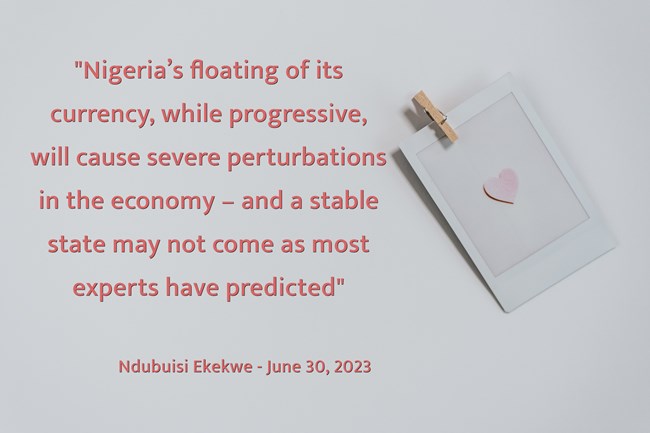
Nothing big, I only used what I learnt from AO Lawal’s textbook in secondary school (I did not do Economics in SSCE, rather, I bought the book, read and took external GCE while in secondary school, since those days, it was either Further Maths or Econs; I chose Further Maths for SSCE). I wrote on June 30 2023 thus.

‘In his O’ Level textbook on economics, AO Lawal explained demand and supply and the movement of price on the demand-supply curve. If I apply what he explained in that book, floating naira with no capacity to earn USD dollars will kill Naira, because there is an asymmetric imbalance on demand and supply of USD in the Willing Buyer, Willing Seller nexus. In other words, two people may each have $100 to sell while twenty people want to buy each $100. If you do not close that number to near parity, the equilibrium point will keep shifting and I do not see how Naira will stabilize because demand outweighs supply here.’

‘I have read many theses on how Naira will stabilize to N680. Good luck. But if you visit Marina Street in Lagos, and climb one of those tall buildings (I have friends who give me access whenever in Lagos), look at the far habour, count the number of ships coming into and leaving Nigeria – and then examine their capacities. Most come loaded, most depart empty! What does it say? We spend more US Dollars than we can “create”.’

Can someone hear me now? I think we make sense on this feed and should be a required Follow for Nigerian leaders. Hahahaha. Lol