DD
MM
YYYY

PAGES

DD
MM
YYYY

spot_img

PAGES

Home Blog Page 4

Why Your Value at Work Matters More in the Age of AI

0

Artificial intelligence has introduced a powerful new currency into the workplace: time. A task that once consumed an afternoon can now take minutes. Reports can be summarized, emails drafted, spreadsheets analyzed, presentations structured and research organized with unprecedented speed.

But there is a principle that should accompany every productivity gain: do not use AI to save yourself time by wasting someone else’s. The temptation is understandable.

When an AI system can produce an answer instantly, it becomes easy to forward that answer without checking it, send a poorly constructed draft for someone else to repair, or generate hundreds of words when five would have been enough.

The person using AI technically saves time. Everyone around them, however, inherits the cost. This is where AI exposes an important truth about work: productivity is not simply about how quickly an individual completes a task. It is about how efficiently value moves through an organization.

Consider an employee asked to prepare a market briefing. Instead of researching the subject, understanding the audience and verifying the relevant information, they ask an AI model to produce a generic report and send it directly to their manager.

The employee may have saved two hours. But if the manager spends another hour correcting factual errors, removing irrelevant material and asking for the analysis that should have been there in the first place, the organization has not gained an hour. It has merely transferred the work.

The same principle applies to communication. AI can make people prolific without making them useful. A five-line question can become a 700-word message. A straightforward meeting can generate pages of artificial notes.

A simple decision can become an elaborate presentation. When every person uses AI to increase their own output without considering the recipient, organizations risk creating an economy of information overload.

That is why the most valuable AI users will not necessarily be those who generate the most content. They will be those who understand where human judgment ends and automation begins.

The second principle is equally uncomfortable: if your boss does not understand the value you bring, you may have a problem—and the problem may not be your boss.

AI is forcing workers to confront the difference between performing tasks and creating value. If your contribution can only be described as completing repetitive assignments, automation will inevitably raise questions about how much of that work actually requires a human being.

But if your contribution involves judgment, relationships, strategic thinking, creativity, institutional knowledge or the ability to turn ambiguous problems into useful decisions, AI can amplify that value.

This does not mean every misunderstanding between an employee and manager is the employee’s fault. Managers can fail to communicate expectations, recognize contributions or understand specialized work. But professionals also have a responsibility to make their value visible.

The AI era therefore demands a different definition of productivity. The goal is not simply to work faster. It is to create more value with less unnecessary effort while reducing the burden placed on everyone else.

AI should eliminate friction, not redistribute it. The best use of the technology is not to make one person look extraordinarily productive. It is to make the entire system work better. That may become the real golden rule of AI: use machines to save time, but never forget that everyone else’s time is valuable too.

Trump Extends $100,000 H-1B Visa Fee Order for Another Year

0

President Donald Trump has extended an executive order imposing a $100,000 fee on new H-1B non-immigrant visas for another year, prolonging a policy that has become a major source of uncertainty for U.S. employers that rely on highly skilled foreign workers.

The White House said Friday that the extension keeps the fee increase in place after the original order, issued in September 2025, was due to expire this month.

The H-1B program allows U.S. companies to employ skilled foreign workers, particularly in fields such as technology and engineering. Before Trump’s increase, employers generally paid fees ranging from about $2,000 to $5,000, depending on the circumstances of the petition.

Trump has argued for a much higher cost for the program as part of his broader immigration policy. His administration has sought to make the $100,000 charge permanent, but the policy has faced legal challenges from employers and business groups.

The extension comes as courts continue to consider whether the administration has the authority to impose the fee.

A Boston-based appeals court is reviewing a June ruling by a federal judge who found the higher fee illegal and blocked the government from collecting it. Another court is considering a separate challenge brought by the U.S. Chamber of Commerce, the country’s largest business lobbying group. That means the extension does not necessarily settle the fate of the fee. Its continuation remains tied to litigation that could determine whether the administration can impose such a substantial charge through executive action.

The policy has also created a divide between the administration’s effort to tighten immigration and the technology industry’s continued demand for specialized workers.

Business groups and technology companies have noted that H-1B visas allow employers to recruit highly skilled professionals when qualified U.S. workers are unavailable. The program is considered a lifeline to the technology industry, which has historically relied heavily on workers from India and China.

Critics of the program, meanwhile, have said that some companies use H-1B workers to fill positions at lower wages rather than hire American workers.

The $100,000 fee significantly changes the economics of hiring through the program. For companies making large numbers of H-1B applications, the additional cost can run into millions of dollars, potentially affecting decisions about where to recruit, where to establish engineering operations, and whether to expand in the United States.

The impact is expected to weigh heavily on technology companies, which have been among the largest users of the visa program while simultaneously expanding their international operations.

The order does not apply to foreign workers who are already in the United States on student visas, a group that represents a significant share of new H-1B recipients. It also does not apply to renewals of existing H-1B visas. That limits the immediate effect on some companies’ existing employees, but it leaves employers facing higher costs when bringing in new workers from abroad who do not qualify for the exemptions.

The uncertainty has already influenced corporate planning. Changes to the scrutiny and processing of H-1B applications have affected hiring and expansion decisions, with some major users of the program, including Alphabet, increasing operations in India.

The situation has resulted in a broader concern for the U.S. technology sector, bordering on whether tighter immigration rules will encourage companies to invest more heavily in domestic talent or accelerate the relocation of certain functions to countries where skilled workers can be hired without the same immigration barriers.

The issue is growing as the technology industry competes for workers in artificial intelligence, semiconductors, cloud computing, and other specialized fields. Many of those businesses operate across borders and can move engineering, research, and other functions when the cost of maintaining operations in one market rises.

The H-1B program itself was established by Congress in 1990, meaning the current dispute is taking place against a long-standing system that has become deeply integrated into the U.S. technology labor market.

For companies, the extension preserves a high level of uncertainty rather than providing a final resolution. Employers must continue to account for the $100,000 fee while the courts determine whether the administration can legally enforce it.

Extending the order keeps pressure on companies that depend on foreign skilled labor while Trump’s administration pursues a broader immigration crackdown. For technology companies, however, the policy adds another cost and planning variable at a time when demand for specialized technical workers remains high.

The eventual outcome of the court challenges will therefore matter beyond the fee itself, with business leaders warning that it could determine how much discretion a U.S. president has to alter the economics of a major employment-based immigration program without new legislation from Congress.

8 Keyword Research Tools an SEO Team Can Actually Build On (2026)

0

Mid-market SEO teams still run keyword research by hand more often than they’d admit: export volumes from one tool, paste them into a spreadsheet, reconcile against a second because the first looked off, then repeat every content sprint. Priced in hours per quarter, that adds up fast. The keyword research tools on the market either plug into that workflow or quietly keep burning those hours, one export at a time. If a task repeats weekly, it’s a pipeline, and seo keyword research is exactly the kind of task that repeats.

Volume alone stopped being the whole story. About 30% of US keywords now trigger an AI Overview, so a term with solid volume can still be a bad bet when an AI summary sits above the results eating the clicks. Intent and SERP-feature data now decide which keywords are worth chasing, not volume sorted high to low.

The math first: here’s what separates a tool you can build a workflow around from one that just fills spreadsheets.

  • Database size and refresh cadence: how many keywords it covers and how stale the data gets between updates.
  • Intent and SERP-feature data returned with the keyword, including whether AI Overviews show up as a flag.
  • Bulk vetting at scale: hundreds of keywords checked in one call, not one at a time.
  • API and MCP access plus export freedom: whether the data can leave the interface for a script, dashboard, or agent.
  • Pricing honesty: whether that access sits inside the plan you pay for or gets metered separately.

Each tool below was checked against its API and MCP documentation, bulk-request limits, export behavior, and current public pricing.

Rank Tool Best for Data + automation reach Pricing
1 SE Ranking Consolidating research, tracking and audit in one platform 5.5B kw DB, intent tags, bulk 100/call, API + MCP every plan Core $129/mo, Growth $279/mo
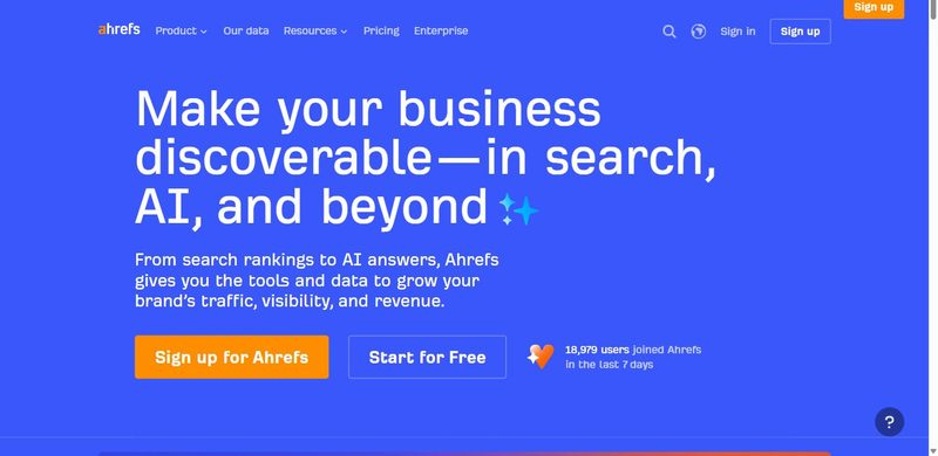
2 Ahrefs Deep keyword and backlink discovery Large clickstream index; API on higher tiers Lite $129/mo, Standard $249/mo
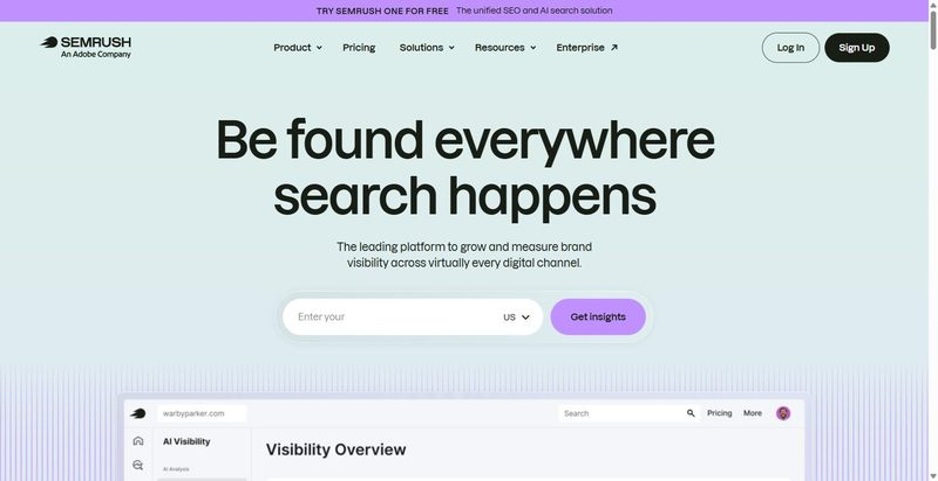
3 Semrush Teams already standardized on it Keyword Magic breadth; API is a paid add-on From $139/mo
4 Moz Pro One clear prioritization metric Priority Score; smaller index; Links API separate Standard $99/mo
5 Serpstat Research, rank and audit in one lower tier Clustering plus API in-plan From $69/mo
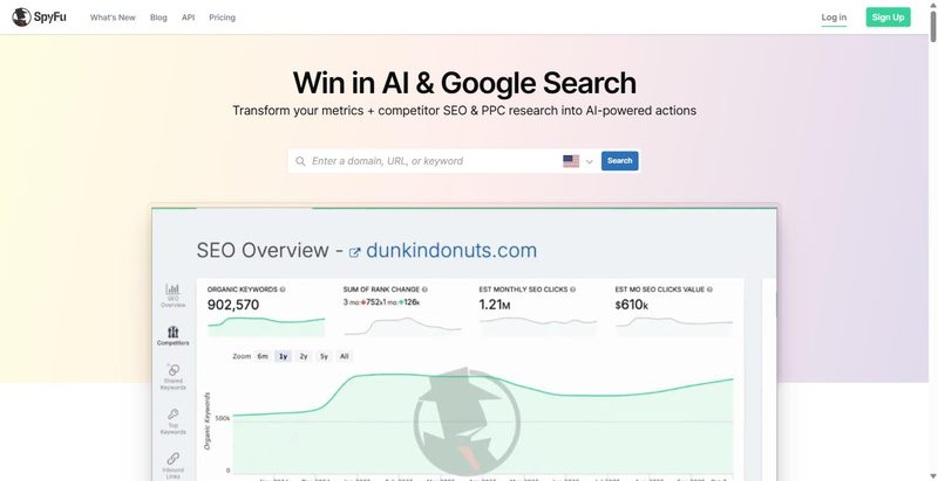
6 SpyFu Competitor keyword and PPC history Competitor/PPC history; API higher tiers Basic $39/mo
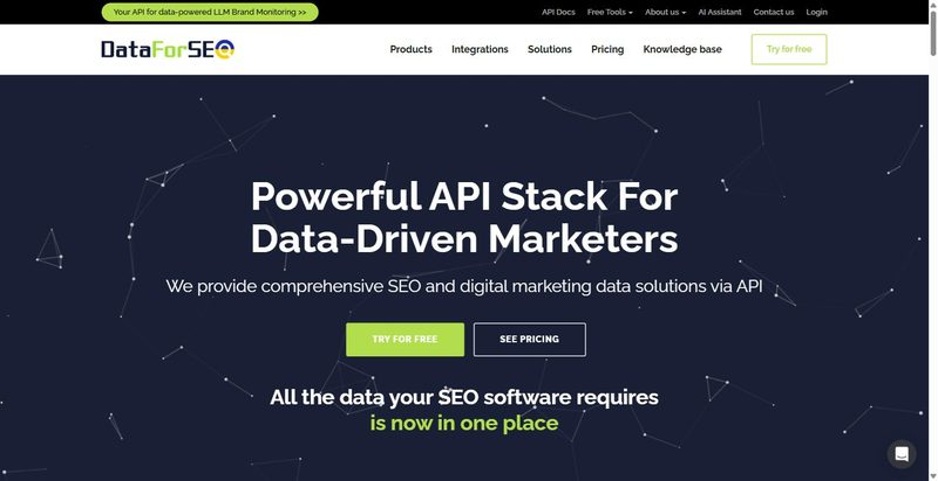
7 DataForSEO Building your own keyword pipeline Raw Keywords/SERP/Labs via API only Pay as you go, $50 minimum
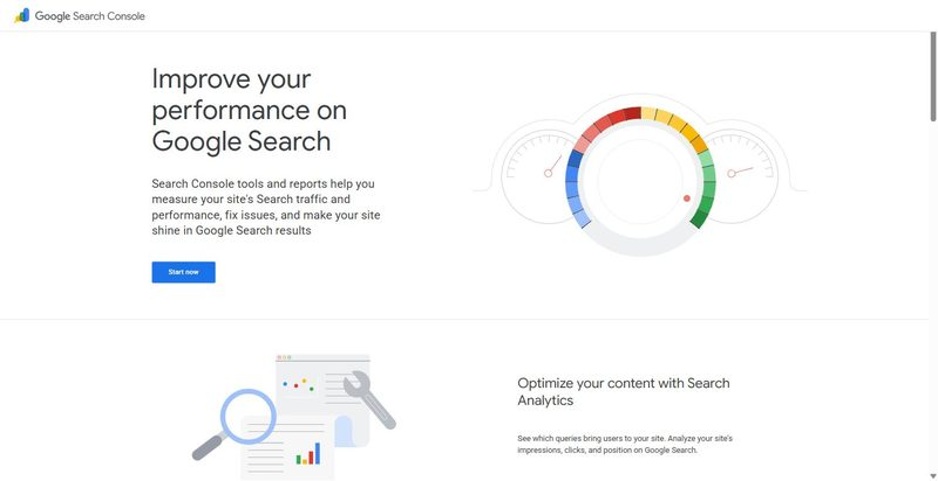
8 Google Search Console Mining your own query data First-party queries; Search Analytics API Free

What Makes a Keyword Tool Worth Wiring Into a Workflow

A keyword tool is a dashboard you log into and read. A keyword workflow is the same data flowing into briefs, dashboards and alerts on its own, with no re-key in between. A keyword research tool earns its seat in that workflow only when its data is bulk-accessible, intent-tagged at ingest, and exportable through an API or MCP connection.

Anything you run every week deserves to be a pipeline, not a Monday-morning favor to the content team. Three things separate a workflow from a dashboard: bulk export that doesn’t cap out at a few hundred rows, intent labels attached at the source instead of guessed later in a spreadsheet, and a programmatic interface an agent or script can call on a schedule. Most teams still re-key the same volume numbers into the same brief template every month, because the keyword research software they picked was built for screenshots, not pipelines.

The 8 Tools, Ranked by Research Depth and What You Can Automate

1. SE Ranking

SE Ranking treats keyword research as the start of a pipeline, not a report to screenshot, and pushes the data into tracking and content work.

Best for: mid-market in-house SEO teams and agencies consolidating keyword research, rank tracking and site audit in one platform, with API and MCP in every plan.

Standout feature: SE Ranking’s Keyword Research runs on a 5.5 billion keyword database across 188 country databases, tags every keyword by intent at ingest, and vets up to 100 keywords in one bulk pass. That data ships out through an API and MCP included on every plan, wired into n8n, Make and Zapier, with a handoff into Content Editor.

Pros:

  • Pulls volume, keyword difficulty, CPC and intent for a term in a single call, no stitching together separate lookups
  • API and MCP access ship on every plan tier, so there is no separate automation SKU to negotiate
  • Vets up to 100 keywords in one bulk pass, useful for clearing a backlog fast
  • Sends selected keywords straight into Content Editor without retyping them

Cons:

  • Keyword data is limited to Google: no Bing, Yahoo or Amazon coverage
  • Historical keyword data is limited by plan: Core gets 6 months of history
  • Data API rate cap sits at 10 requests per second by default; a higher limit needs a call with their team

Pricing: Core $129/mo ($103.20/mo billed annually); Growth $279/mo ($223.20/mo billed annually). API and MCP are included in every plan.

Bottom line: I’d build the keyword research layer on SE Ranking when the goal is data that leaves the dashboard: the API and MCP save real integration hours across a stack. One limit to know going in: coverage stops at Google, so if Amazon or Bing volume matters to your team, plan for a second source alongside it.

2. Ahrefs

Ahrefs pairs a large clickstream-backed keyword index with mature backlink data, giving research and link teams one place to work.

Best for: teams that want deep keyword and backlink discovery in one place.

Standout feature: the keyword index draws on clickstream data at real scale, and Keywords Explorer digs into it with parent-topic clustering and durable SERP history. The catch in automation terms: the API sits on higher tiers with its own credit budget, so a pipeline costs more than opening the dashboard.

Pros:

  • Broad, clickstream-backed keyword database
  • Strong parent-topic clustering
  • Solid SERP and position history

Cons:

  • API gated to pricier tiers
  • Exports capped on the entry plan
  • No MCP-native access

Pricing: Lite $129/mo; Standard $249/mo (verify current tiers).

Bottom line: the keyword depth is real, and if you only need the dashboard for research, Ahrefs earns its spot. Price the automation before you commit, though. Once you’re pulling data into a pipeline instead of clicking through the UI, the credit budget adds up fast.

3. Semrush

A broad SEO suite with a very large keyword index, best suited to teams already standardized on it rather than those shopping fresh.

Best for: teams already standardized on Semrush who want Keyword Magic breadth.

Standout feature: the keyword database is one of the largest on the market, and Keyword Magic Tool clusters terms by topic and flags intent automatically. The catch for automation: the API is a paid add-on outside the plan, so pulling Semrush data into a pipeline means a second invoice, not something bundled in.

Pros:

  • Very large keyword database across markets
  • Intent and clustering built into Keyword Magic
  • Wide toolset beyond keyword research

Cons:

  • API is billed separately from the plan
  • Price climbs quickly across higher tiers
  • Automation is not included by default

Pricing: from $139/mo (plans restructured in 2026; verify current tiers).

Bottom line: fine if your team already lives inside Semrush and just needs the keyword layer. If you are evaluating it for a keyword pipeline, price out the API add-on separately before you compare it on sticker price alone.

4. Moz Pro

A leaner keyword research tool built around one clear prioritization metric, aimed at teams who want a fast decision signal without adopting a full platform.

Best for: a leaner team that wants one clear prioritization metric, not a sprawling suite.

Standout feature: Keyword Explorer pairs volume, difficulty and CTR into a single Priority Score, so a long keyword list turns into a ranked shortlist in one pass, useful when triaging fast under a deadline. The index runs smaller than the two market leaders, and the Links API is a separate product.

Pros:

  • Priority Score gives one clear triage number
  • Clean SERP analysis
  • Approachable data model

Cons:

  • Smaller keyword index
  • Automation options are limited
  • Scale needs add-ons

Pricing: Standard $99/mo ($79/mo billed annually); Starter $49/mo.

Bottom line: a good call when the job is a fast prioritization signal on a keyword list and not another platform to maintain. If the requirement is market-wide keyword depth or heavy automation, this is not the widest net on this list.

5. Serpstat

Serpstat bundles keyword research, rank tracking, site audit and clustering into one lower-priced tier, aimed at teams that would otherwise stitch together separate tools.

Best for: teams that want research, rank tracking, audit and clustering bundled in one lower tier.

Standout feature: Serpstat bundles keyword research, clustering and an API into a single plan, so a small team gets breadth without buying three products. The trade is depth: its keyword data does not go as deep as the leaders on any one discipline, so heavy research may hit limits.

Pros:

  • Keyword clustering built in
  • API included on plans
  • Broad bundle for the price

Cons:

  • Data depth trails the leaders
  • UI feels dated in places
  • Confirm current pricing before you commit

Pricing: from around $69/mo (verify live pricing).

Bottom line: a sensible pick when coverage across tasks matters more than depth in any one discipline. Trial it against your real list sizes, and confirm the API call limits fit your pull volume before you build automation on top of it.

6. SpyFu

SpyFu specializes in competitor keyword research and paid search history, letting you see what a rival has bid on and ranked for over time.

Best for: competitor keyword research and pulling a rival’s paid and organic history.

Standout feature: SpyFu’s edge is historical competitor data: the keywords a domain has bid on and ranked for across years, not a single snapshot. That suits competitor keyword research when you are unpacking a rival’s strategy or spotting keywords they dropped, rather than sizing a fresh market.

Pros:

  • Deep competitor keyword and PPC history spanning years
  • Low entry price for the feature set
  • Bulk domain pulls for agency-scale competitor lists

Cons:

  • Leans PPC over organic keyword depth
  • Organic index is thinner than the category leaders
  • API access only on higher tiers

Pricing: Basic $39/mo ($33/mo billed annually); Professional $79/mo.

Bottom line: keep it as the competitor-intel tool, not the primary research database. Feed it a rival’s domain and it surfaces years of paid and organic keyword moves. Pair it with a broader platform for volume and intent.

7. DataForSEO

Raw keyword and SERP data delivered via API, priced per request, built for teams assembling their own pipeline rather than logging into a dashboard.

Best for: teams building their own keyword research pipeline, with no dashboard involved.

Standout feature: DataForSEO sells the data, not an interface: Keywords, SERP and Labs endpoints on pay-as-you-go credits, no seat, no report builder. It is the buy-the-data, build-the-interface option. The honest build cost: you own the reporting and the maintenance, and that only pays off past a certain query volume.

Pros:

  • Flat per-request pricing
  • Credits do not expire
  • Broad endpoint coverage

Cons:

  • No UI: engineering hours required
  • You build and maintain the reporting
  • Support is developer-grade, not hand-holding

Pricing: pay-as-you-go, from a $50 minimum deposit.

Bottom line: worth it when your requirements are unusual, your volume is high, and you have engineering hours to spend. If your needs match the standard 80 percent, buy a tool with the interface already built and skip the maintenance bill.

8. Google Search Console

Not a keyword tool by design, but the free first-party source of the exact queries your own site already ranks for.

Best for: mining your own site’s real query data, free.

Standout feature: Search Console reports the actual queries, impressions, clicks and average position for properties you own, and its Search Analytics API pulls that into a pipeline on a schedule. It is not an ideation database: no competitor visibility, no whole-market volume, and a 16-month trailing window.

Pros:

  • Real impressions, clicks and position for queries you already rank for
  • Free for any verified property
  • Search Analytics API supports scripted, recurring pulls

Cons:

  • Covers only properties you have verified
  • No market-wide or competitor search volume
  • Trailing 16-month history limit

Pricing: Free.

Bottom line: it will not replace a research database, since it only shows what you already rank for. Wire the Search Analytics API into your keyword pipeline anyway: matching real impressions against a tool’s estimated volume catches gaps no estimate alone will show.

The Build-Vs-Buy Verdict: What I’d Wire In, What I’d Skip

For most mid-market teams, SE Ranking is the research-plus-automation core: the API and MCP ship on every plan, so volume, difficulty and SERP data pull straight into whatever pipeline you already run, with no separate integration tier to negotiate. Pair it with Google Search Console for the free, first-party query layer, and you cover discovery and validation without stitching together three vendor contracts. That combination is why it lands near the top of most lists of the best keyword research tools built for teams that automate rather than click through dashboards, and it is one of the more workable keyword research tools for seo teams that want API access included rather than gated behind an enterprise tier.

Skip DataForSEO unless you have engineering hours budgeted to build and maintain the interface yourself. Skip wiring Semrush into an automated pipeline if you are not prepared to carry a separate automation bill alongside the seat cost.

My rule stays simple: buy the standard 80 percent, build only the unusual 20. Start with one bulk pull of your top 100 terms with an intent filter and see what your current process was missing.

FAQ

Can you automate keyword research end to end?

Not the judgment call, but the repeatable work, yes. Pulling volume and intent, vetting a long list down to targets, refreshing a brief when rankings shift: that is scriptable through an API or MCP connection. Deciding which terms are worth targeting stays human. A tool that ships the API or MCP access included costs less to automate than one that sells it as an add-on.

What breaks when you pull keyword data on a schedule?

Rate limits and credit budgets first: a scheduled job that fans out too many requests burns a month’s allotment in a week. Schema drift is the quieter failure, an endpoint renames a field and your pipeline writes silent zeroes instead of erroring. Set a hard credit ceiling on the API side, and add a sanity check that flags a column suddenly reading all zero.

Can one keyword tool cover both SEO and PPC research?

Yes, for sizing. The broader platforms return CPC and competition alongside volume, difficulty and intent, so one pull gives a rough read on both paid and organic opportunity for a term. If the job is reverse-engineering a competitor’s bid history and ad rotation, a dedicated PPC-intelligence tool goes deeper than a keyword platform’s CPC column will.

How do you keep keyword research consistent across a team?

Pick one source for volume and intent, agree a difficulty threshold in writing, and template the query so every analyst runs the identical pull: same location, same device, same date range. Letting each person eyeball a different dashboard produces different numbers for the same term. An API pull or a shared export removes that variance, because the query decides the output, not the analyst.

How Non-Custodial Crypto Services Are Changing Cross-Border Payments in Emerging Markets

0

Sending money across borders remains one of the most frustrating financial experiences for millions of people in emerging markets. A worker in Lagos sending money to family in Nairobi, or a small business in Manila paying a supplier in Buenos Aires, often faces a maze of intermediary banks, opaque fees, and multi-day settlement delays. Traditional cross-border payment rails were built decades ago for a world of slower trade and fewer, larger transactions, not for the millions of small, frequent transfers that define today’s global economy.

At the same time, financial infrastructure across much of Africa, Latin America, and Southeast Asia remains fragmented. Banking penetration is uneven, currency controls are common, and local financial systems are often disconnected from the global correspondent banking network that underpins international transfers.

Into this gap has stepped a new generation of tools: stablecoins, blockchain-based settlement rails, and non-custodial crypto exchanges. These technologies are not simply speculative assets anymore; they are increasingly functioning as practical infrastructure for moving value across borders faster, cheaper, and with fewer intermediaries than the legacy system allows.

Why Cross-Border Payments Remain a Challenge in Emerging Markets

To understand why crypto is gaining traction, it helps to look at what’s broken in the traditional system.

Most international transfers still rely on correspondent banking, a network of banks holding accounts with one another to facilitate transactions between countries that don’t have direct banking relationships. Every additional correspondent in the chain adds cost, delay, and a point of potential failure. For countries with smaller or less-connected banking sectors, this often means transfers route through two, three, or more intermediary banks before reaching their destination.

FX restrictions compound the problem. Many emerging-market currencies are subject to capital controls, official exchange rate mismatches with parallel markets, or outright shortages of foreign currency liquidity. Businesses and individuals in countries like Nigeria, Argentina, or Egypt have grown accustomed to navigating official and unofficial exchange rates that can diverge significantly.

Fees remain stubbornly high. According to World Bank data, the global average cost of sending remittances hovers around 6%, and in some African corridors it can exceed 8–10%, far above the UN’s Sustainable Development Goal target of 3%. For a migrant worker sending a few hundred dollars home each month, that’s a meaningful tax on already limited income.

Settlement times add another layer of friction. While some remittance services offer near-instant delivery, many bank-to-bank transfers still take two to five business days, particularly when multiple currencies and jurisdictions are involved.

Finally, all of this feeds into a broader financial inclusion gap. An estimated 1.4 billion adults globally remain unbanked, according to the World Bank’s Global Findex database, many of them concentrated in the same regions most dependent on remittance inflows. When the formal banking system doesn’t reach people, alternative rails become not just convenient but necessary.

From Bank Accounts to Digital Wallets

One of the quieter but more significant shifts of the past several years has been the move from bank accounts to crypto wallets as a store and transmission mechanism for value.

A crypto wallet, whether a mobile app, browser extension, or hardware device, allows a user to hold and control digital assets without needing a bank account at all. This is the essence of self-custody: the user, not a financial institution, holds the private keys that control access to their funds. There’s no waiting for account approval, no minimum balance requirement, and no dependency on a local bank having correspondent relationships abroad.

This matters enormously in markets where opening a bank account can be slow, costly, or simply inaccessible for large segments of the population. A smartphone and an internet connection are often sufficient to participate in a wallet-based financial system, bypassing the traditional intermediary layer entirely.

Self-custody also shifts the trust model. Instead of relying on a bank to safeguard and move funds, users interact directly with blockchain networks. This doesn’t eliminate all risk; losing a private key means losing access to funds, but it removes dependency on institutions that may be slow, expensive, or in some cases politically constrained in how they can move money internationally.

The Rise of Non-Custodial Crypto Services

As self-custody has grown, so has demand for tools that let users convert between different crypto assets, or between crypto and stablecoins, without surrendering control of their funds to a centralized platform.

This is where non-custodial crypto exchanges come in. Unlike traditional custodial exchanges, which require users to deposit funds into an account controlled by the platform, non-custodial exchanges facilitate direct wallet-to-wallet swaps. The user sends funds from their own wallet, the platform executes the swap through liquidity partners, and the converted asset is sent straight back to a wallet address the user controls, often without requiring registration, KYC for smaller amounts, or an account at all.

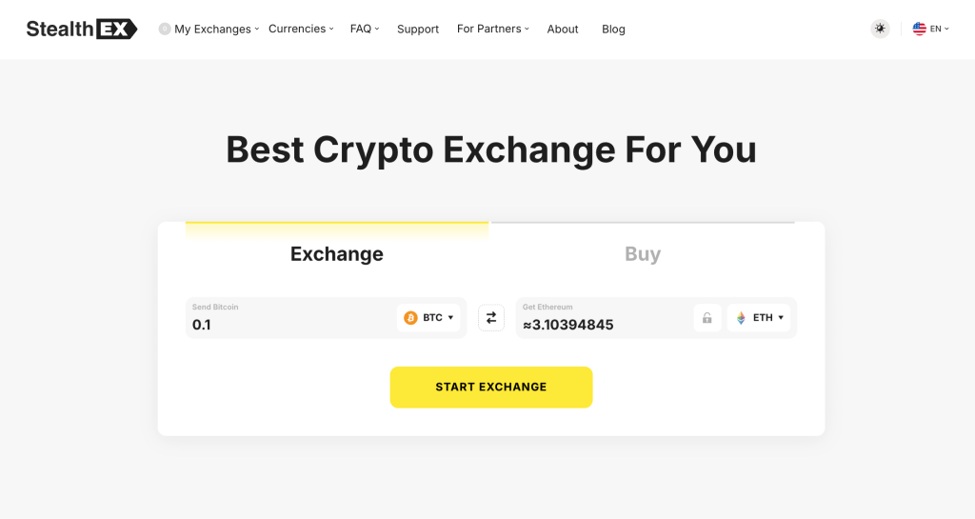
StealthEX is one example of a service built around this model. The platform allows users to exchange crypto assets without holding those funds on the platform itself; swaps happen directly between wallets, with StealthEX acting as a routing and price-discovery layer rather than a custodian.

According to StealthEX’s own website, the service supports more than 2,000 coins and tokens and explicitly states that user funds are never stored on the platform, with transactions instead passing through the system only for the duration of the swap before being forwarded to the recipient’s address.

For someone in an emerging market who has received stablecoins as payment or remittance and needs to convert them into another asset, or into a locally liquid cryptocurrency, a non-custodial swap service like this removes a step that would otherwise require a centralized exchange account, identity verification, and a waiting period. It’s a small piece of plumbing, but multiplied across millions of transactions, it becomes meaningful infrastructure.

Stablecoins, Crypto Swaps, and African Markets

Nowhere is this dynamic more visible than in Africa, where USDT and USDC have become de facto dollar substitutes in several economies grappling with currency instability.

In Nigeria, Ghana, and parts of East Africa, stablecoins are increasingly used for remittances, allowing families to receive dollar-denominated value that can be held or converted locally, often at rates more favorable than official bank channels. Business payments have followed a similar pattern; importers and cross-border traders use stablecoins to settle invoices with suppliers in Asia or Europe without navigating local FX bottlenecks or waiting for central bank dollar allocations.

The appeal is straightforward: currency volatility in many African markets makes holding local currency risky for anyone trying to preserve value or transact internationally. A dollar-pegged stablecoin offers a hedge without requiring a foreign bank account.

But stablecoins alone don’t solve everything; users still need to move between different blockchain assets, convert stablecoins into local crypto liquidity, or swap between chains (Tron-based USDT versus Ethereum-based USDC, for example). This is where liquidity between different blockchain assets becomes critical, and where non-custodial swap platforms provide practical utility, letting users convert between stablecoin variants and other crypto assets without funneling funds through a centralized custodian first.

What Needs to Improve Before Crypto Becomes Mainstream Payment Infrastructure

Despite this momentum, crypto-based cross-border payments are far from a finished product.

Regulation remains the biggest variable. Many emerging-market regulators are still defining their stance on stablecoins and crypto exchanges, and inconsistent rules across jurisdictions create uncertainty for businesses trying to build on top of these rails.

Wallet UX is still a barrier for mainstream users. Managing private keys, understanding gas fees, and navigating different blockchain networks remains intimidating for people used to simple banking apps.

Security concerns, from phishing to wallet compromises, highlight that self-custody shifts responsibility onto the user, which is empowering but also risky without better safeguards and education.

Liquidity across smaller markets and less-traded assets can still be thin, leading to price slippage on swaps. Consumer protection mechanisms common in traditional finance, like chargebacks or deposit insurance, largely don’t exist in crypto. And interoperability between different blockchains, wallets, and payment providers still needs significant work to feel as seamless as tapping a card.

Conclusion

Crypto is unlikely to fully replace banks in emerging markets anytime soon, and it may not need to. What’s emerging instead is an additional layer of financial infrastructure that runs alongside traditional banking: stablecoins for value transfer, self-custodied wallets for control, and non-custodial exchanges for conversion between assets. Together, these tools are giving people in underserved markets more options for moving money across borders, not a wholesale replacement of the existing system, but a meaningful complement to it.

From Chatbots to Risk Engines: Where AI Fits Into Modern iGaming

0

Artificial Intelligence (AI) is becoming embedded in more parts of the iGaming technology stack. What started with relatively simple customer-service chatbots is expanding into fraud detection, compliance, personalization, player analytics, and real-time risk management.

Modern Online Casinos, Sportsbooks, Sports Betting platforms, Online Poker sites, and Live Dealer Games generate enormous volumes of transactional and behavioral data. Machine Learning (ML), Predictive Analytics, Natural Language Processing (NLP), and Real-Time Data Processing can turn some of that data into automated decisions and operational insights.

The result is an industry where AI increasingly works behind the scenes. Chatbots may be the most visible application, but Risk Engines, compliance systems, recommendation platforms, and player-protection tools could have a much larger operational role.

From Chatbots to Conversational AI

Customer support remains one of the easiest areas for iGaming companies to apply AI. For players researching the best online casinos, the quality and responsiveness of customer support can be an important part of the overall digital experience, particularly when dealing with payments, account verification, or technical issues.

Traditional support systems generally depend on predefined answers and decision trees. AI Chatbots and Conversational AI can go further by using NLP and Large Language Models (LLMs) to understand the intent behind a player’s question and generate a contextual response.

For an online casino, this could mean handling common questions about deposits, withdrawals, account verification, game rules, promotions, or account access without requiring a human agent for every interaction.

Intent Recognition can help classify incoming requests, while Sentiment Analysis can identify conversations that may require additional attention. Automated Onboarding can also use conversational interfaces to guide customers through account setup and verification processes.

The technology can extend across Omnichannel Support, including websites, mobile applications, messaging platforms, and Interactive Voice Response (IVR) systems. However, automation does not mean every interaction should remain with an AI system. Clear Escalation Protocols can route complex, sensitive, or unresolved issues to human agents.

For operators, the business case is therefore less about replacing customer-service teams and more about automating repetitive Tier-1 Ticket Automation while allowing human employees to focus on cases requiring judgment.

Risk Engines Are Taking AI Beyond the Chat Window

The more consequential applications of AI can sit much deeper inside an iGaming platform.

A Risk Engine can evaluate account activity, transactions, betting patterns, and other signals to identify potentially unusual behavior. Instead of relying exclusively on static rules, operators can combine those rules with Machine Learning models and Real-Time Risk Scoring.

For example, a Fraud Detection System may evaluate multiple signals associated with an account or transaction before assigning a risk score. Similar systems can be used for Bonus Abuse Detection, Multi-Accounting Prevention, and Syndicate Betting Detection.

Deep Learning and other statistical techniques can help identify relationships across large datasets that may be difficult to capture through individual rules. Real-Time Data Processing is particularly important when operators need to evaluate activity as it happens rather than relying entirely on retrospective analysis.

This does not make AI infallible. Models can produce false positives, incomplete classifications, or unexpected results. Human review, predefined thresholds, and escalation processes therefore remain important components of a broader risk-management architecture.

AI Meets KYC, AML and RegTech

Compliance is another area where AI can support increasingly complex workflows.

Know Your Customer (KYC) processes can involve identity-document analysis, biometric checks, identity matching, and other verification steps. Computer Vision can assist with extracting and comparing information from documents, while automated systems can flag inconsistencies for further review.

AI can also support Anti-Money Laundering (AML) processes through Transaction Monitoring. Rather than examining every transaction manually, automated systems can look for unusual patterns and prioritize activity that warrants investigation.

This is part of the wider development of Regulatory Technology (RegTech), where software is used to make compliance processes more automated and scalable.

The regulatory environment makes this particularly important for operators working across jurisdictions. Organizations such as the UK Gambling Commission (UKGC), Malta Gaming Authority (MGA), Nevada Gaming Control Board, and New Jersey Division of Gaming Enforcement (NJDGE) operate within different regulatory frameworks.

AI does not remove those obligations. Instead, it can become part of the technical infrastructure used to support them. Operators still need appropriate governance, documentation, monitoring, and human oversight around automated compliance systems.

Can AI Support Responsible Gambling?

AI’s role in iGaming also extends beyond commercial and security applications.

Responsible Gambling systems can use Player Behavior Analysis to identify changes in activity that may warrant closer attention. Early Detection Algorithms can examine patterns involving session frequency, wagering activity, deposits, or changes in normal account behavior.

Other applications include Problem Gambling Detection, Self-Exclusion Tracking, and Deposit Limit Automation.

The potential value comes from analyzing multiple signals rather than relying on a single event. A sudden change in behavior, for example, may be more meaningful when viewed against a customer’s previous activity.

However, unusual behavior does not automatically indicate problem gambling. AI systems can make probabilistic assessments, but they should not be treated as infallible judgments about an individual’s circumstances.

This makes responsible deployment particularly important. AI-based player-protection systems need carefully designed intervention mechanisms, appropriate escalation procedures, privacy controls, and human oversight.

The objective is not simply to create another automated scoring system. It is to use technology to support player protection while avoiding unnecessary or inappropriate interventions.

Personalization, Retention, and the Player Experience

AI can also influence what users see when they open an iGaming platform.

A Personalization Engine can combine Player Segmentation, Behavioral Analytics, and Recommendation Systems to determine which content is presented to different users. An Online Casino might use these systems to organize game recommendations, while a sportsbook could use them to tailor markets or interface elements.

Dynamic Front-End systems can adapt aspects of the user experience based on available data. Other applications include Custom Bet Builders, Dynamic Bonusing, and Real-Time In-Game Messaging.

Predictive models can also be used for Churn Prediction. By identifying behavioral patterns associated with declining engagement, operators can determine which users may be becoming less active.

These applications connect directly to commercial metrics such as Player Retention and Customer Lifetime Value (CLV), while Gross Gaming Revenue (GGR) remains an important industry-level business measure.

Yet personalization creates an important balancing problem. A system optimized purely for engagement may not align with responsible-gambling objectives. AI therefore needs to operate within commercial, regulatory, privacy, and player-protection boundaries rather than treating engagement as the only optimization target.

Dynamic Odds and Real-Time Decision Making

AI’s role is not limited to casino games or customer-facing tools.

Sportsbooks and Sports Betting platforms process constantly changing information, creating an environment where Real-Time Data Processing is particularly valuable. Machine Learning and predictive models can contribute to Dynamic Odds and Automated Price Discovery by processing large quantities of market and event data.

Similar technologies can support products involving Betting Exchange markets and live betting.

These systems also demonstrate why it is important to distinguish between different forms of AI. Not every AI application in iGaming requires a Generative AI model or an LLM. Many operational systems are better suited to statistical models, Machine Learning, predictive algorithms, and specialized real-time infrastructure.

In other words, the most useful AI system for a particular iGaming problem may not be the most visible one.

AI Needs Strong Governance and Security

The expansion of AI introduces another technology challenge: governance.

iGaming companies may process sensitive identity, financial, behavioral, and account information. AI systems operating on this data therefore need appropriate controls around data access, security, model monitoring, and privacy.

The General Data Protection Regulation (GDPR), where applicable, creates additional requirements around the handling of personal data. Information-security frameworks such as ISO/IEC 27001 can also provide a broader framework for managing information-security risks.

Operators need to understand how models are trained, what information they use, how decisions are generated, and what happens when a model produces an unexpected result.

This is particularly important for systems involved in financial risk, identity verification, compliance, or responsible gambling. In these areas, explainability and human oversight can be just as important as automation.

AI’s Bigger Role in the iGaming Technology Stack

The evolution from chatbots to Risk Engines illustrates how AI is becoming a broader infrastructure layer for iGaming.

Conversational AI can automate customer interactions. Machine Learning can identify patterns in player and transaction data. Predictive Analytics can support retention and risk management. Computer Vision can assist identity verification. Real-Time Data Processing can enable rapid decisions across payments, betting, and security systems.

For technology companies and startups, this creates opportunities beyond operating an Online Casino or Sportsbook themselves. There is potential across fraud prevention, KYC and AML technology, RegTech, customer-support automation, data infrastructure, personalization, and responsible-gambling systems.

The most significant AI applications in iGaming may therefore not be the ones players see first. Behind the chatbot interface is an increasingly sophisticated collection of systems designed to process information, detect patterns, automate routine tasks, and support decisions in real time.

As iGaming becomes more data-intensive, the competitive role of AI is likely to depend less on simply having an AI feature and more on how effectively that technology is integrated into the wider platform, operational workflow, compliance framework, and player-protection architecture.