DD
MM
YYYY

PAGES

DD
MM
YYYY

spot_img

PAGES

Home Blog Page 4026

Tesla Announces Plans to Launch First Cybertruck Ahead of Q2 Earnings Call

0

Electric Vehicle automaker Tesla has announced plans to launch its first cybertruck, ahead of the second quarter (Q2) earnings call.

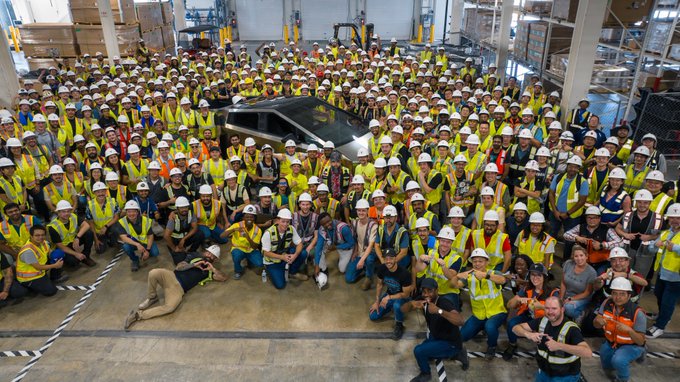
In a recent Tweet on Twitter, Tesla posted the newly manufactured cybertruck, which was surrounded by the company workers, with the caption “First Cybertruck built at Giga Texas!”.

Tesla hasn’t launched a new consumer vehicle since 2020, and it’s widely seen as falling behind other automakers, who have stepped up their EV development to meet surging demand, until the recent roll out of the Cybertruck.

The cybertruck launch was however delayed after the company’s CEO Elon Musk first introduced it in 2019. The truck was initially scheduled for production and delivery in 2021, but the company had to hold back the launch, citing a shortage of sourcing components.

While Tesla attributed the Cybertruck delayed launch to standard supply chain issues, leaked documents however revealed other fundamental flaws in the vehicle’s basic design and engineering.

In January 2022, a whistleblower leaked 100GB of files to German outlet Handelsblatt that showed pre-production prototypes had serious braking, powertrain, suspension, sealing, and structural issues.

The report, which detailed unfulfilled promises from Tesla, showed that the pre-production alpha version of the Cybertruck was still struggling with some basic problems with its suspension, body sealing, noise levels, handling, and braking.

While it is known that Tesla cars have a history of technical issues, the report hints that the Cybertruck’s unusual design may have complicated engineers attempts to properly seal it.

Musk had also stated that the Cybertruck is a hard vehicle to make. “You can’t just use conventional methods of manufacturing,” he said on an earnings call in May. “We had to invent a whole new set of manufacturing techniques in order to build an exoskeleton car rather than an endoskeleton car, so it is clearly not trivial.

However, the content of the report does not deal a fatal blow to the Cybertruck, as a veteran automotive engineer who spoke on condition of anonymity to prevent backlash from Tesla fans, said the company has enormous financial resources which will allow it to address the issues detailed in the report.

Experts suggest that addressing all of these manufacturing and engineering issues is likely to have substantially pushed up the price of the Cybertruck.

Musk initially said the pickup’s price would start below $40,000. However, by 2021 those attractive price estimates had already been removed from Tesla’s website. Musk told shareholders last year that the vehicle’s specifications and pricing had changed since its introduction in 2019.

Experts predict that Tesla’s pickup truck launch will bring the automaker into another profitable EV segment in the U.S. The Cybertruck will have to compete with electric pickups like Ford’s F-150 Lightning, which is available now with a starting price of around $60,000.

Musk believes that Tesla could eventually sell between 250,000 and 500,000 Cybertrucks per year. 

Meanwhile, experts have noted that the odd shape of the vehicle, and particularly its sharp edges, will make it hard for the Cybertruck to meet pedestrian protection rules in Europe, and possibly in other markets.


Sankofa Innovation: How Companies Continue to Drive the Economy Through Cultural Retention

0

Sankofa is a word in the Twi language of Ghana meaning ‘’to reach back and get it done’’. The concept is depicted by a bird that has its head turned backward with a precious egg in its mouth. Sankofa denotes an inquiry into the past for what is good and bringing it into the present to influence a positive change. Sankofa innovation therefore entails the progress recorded based on critical reflections, regeneration and improvement of historical facts.

Observation has revealed that several ideas that have developed in the modern economies, especially in the startup ecosystem of Africa have not been particularly new ideas but are modernized adaptation of the ancient ingenuity. From Fintech to Agritech, old and almost forgotten values and practices are now being recalled and rekindled to extend economic prosperity.

For instance, esusu is a word that dates back to the Yoruba traditional economic system which has found its way into modern finance and financial services. Esusu is a traditional form of cooperation whereby individuals contribute to informal savings and develop a robust credit system for their mutual benefits. Leveraging on the force of numbers combined into a unit, esusu helped the individuals to meet their financial needs which they could have failed to meet individually.

Nigerian-American Fintech unicorn, Esusu financial, is leveraging data solutions to help its clients have access to any property of their choice through credit building and rent reporting to the credit bureau. In 2022, Esusu financial was reported to have reached a valuation of $1billion in less than six years the company was founded. Another company, Esusu Africa, a Nigerian based microfinance, leverages digital technology to deliver financial management solutions to financial service providers and their customers while ensuring ease of contribution and collection of thrift and access to microcredit facilities.

In the agricultural sector, ideas such as crowdfunding and crowd-sourcing saw the emergence of many startups. Crowdfunding and crowd-sourcing for projects within the agritech ecosystem also have their root in the traditional Yoruba economic system. In the traditional African societies, agriculture was the mainstay of the economy.

Among the Yoruba people of south-western Nigeria, the practice of Aro and Owe was adopted by farmers to embark on a large agricultural project that may be impossible for an individual to handle alone. Aro and Owe were a corporative farming arrangement where kinsmen formed a consolidated work-force to work a large farmland. These systems not only awakened a sense of collective ownership among the farmers, it made work easier and faster for them and foods were available to the community.

Both Esusu and Owe and Aro represent historical evidence of collaborative work for common good and the need to preserve this work ethic for sustainable development.

Embracing and Practicing Clever Failure in the Quest for Innovation Success

0

Innovation simply entails the discovery and deployment of new things which have market or economic value. Innovation is often differentiated from invention due to the former’s ability to generate economic profits and bring about a change or disturbance in the market. The idea of innovation can be expressed as Invention + Commercialization. The need to innovate can be inspired internally such as having a goal to lead a change in the market or externally such as having to adapt to changes in the market.

Profits and technology are words that appear frequently in the discourse of innovation. However, beyond profit-making, and deployment of new technology, attention to other factors such as the social values and emotions of the target audience determine how sustainable an innovation is in the market. Thus, matching value propositions with customers’ actual needs is often noted as a pre-condition for a business to continue to be relevant in the market.

While technology is inevitably an enabler and driver of innovation, the idea that innovation must always centre on technology is trite. There have been instances where technology has failed in the design process. Therefore, designing the right business model to complement the right technology is very critical to innovation success.

It is also important to note that profiting from innovation is not a rule cast in stone. At least one is required to brace for temporary defeat or loss in the short-term. Studies have shown that most innovations launched to the market fall short of revenue expectations. For instance, a 2018 study by data analytics firm, Nielsen, reveals about 80-85 percent of all fast-moving-consumer-good launches fail. Therefore, founders are often nudged to understand and embrace failure and loss as essential parts of innovation. Embracing innovation failure as a requisite experience for innovation success implies awareness of the risk-reward rule of innovation and this can have a positive outcome on one’s risk appetite.

The lessons and narratives of successful innovation are the same across industries and cultures or geographies:

”There is rarely successful innovation without a fair share of failure along the way. Every successful innovator deals with the frustration, pain, and anxiety associated with numerous setbacks’’ analysts revealed.

It is also observed that since innovations are oriented to challenge the status quo, much of the “tensions” around innovation develop from hidden feelings of insecurity or fear of crossing the line, not necessarily from the “potential benefits” or “pitfalls” of the innovation.

Thus, rather than avoiding failure outright, founders and business leaders are advised to embrace the idea of “clever failure”, which involves accepting to fail as often, cheaply, and early as possible in the innovation process, and also help their employees to brace for the same.

Resources:

The Innovation Revolution in Agriculture: A Road Map to Value Creation. Hugo Campo Editors

Egypt-Based Fintech, Flash Secures $6 Million in Seed Round to Boost Expansion And Develop The Cashless Ecosystem

0

Egypt-based fintech startup that offers cashless transactions to businesses via QR codes, Flash, has secured $6 million in a seed round to boost product expansion and develop the cashless ecosystem.

The funding round was led by Addition, a Venture Capital firm, with participation from Flourish Ventures and other strategic angel investors.

Flash allows customers to purchase with their phones by adding any existing bank card or digital wallet to the app and scanning a QR code that is presented by a business, in-store or non-delivery.

The startup is eyeing opportunities in the package delivery market with ‘Flash on Delivery’, offering businesses the opportunity to take payments upon receipt of goods at the doorstep.

Speaking on the seed raised, Flash co-founder and CEO Erik Gordon said,

“As a team, we are excited and proud to be launching a new contactless payment method in Egypt. Our mobile application removes transactional challenges for businesses looking for an easier solution than the POS. Our goal is to make payments easier, safer, and faster for everyone. We are also excited to be releasing new features to help consumers make better spending decisions.

“We’re eliminating the need for cash or carrying cards for our consumers and the POS machine on the merchant side. With QR codes, businesses don’t have to worry about integration, setup, and maintenance fees and it’s low-tech, so anyone with a camera on their phone can pay that way”.

Also speaking on the seed round, Andrew Miskiewicz from Addition said,

“Flash is transforming the payments landscape in Egypt, simplifying the complex transactional process for consumers and businesses with a safe and easy-to-use application. We look forward to supporting Flash and its leadership team as they continue to accelerate product development, expand customer bases and help promote financial inclusion.”

Founded in 2021, Flash has built a robust network of key ecosystem participants, stakeholders, and renowned global investors. As part of its growth strategy, Flash is seeking to expand strategic roles in its Engineering and Product teams.

Flash, off the back of obtaining approval from the Central Bank of Egypt to operate as a technical payment aggregator, allows customers to purchase with their phones by adding any existing bank card or digital wallet to the app and scanning a QR code that is presented by a business, in-store or on-delivery. This way, businesses can accept payments without needing the tasking technical integration typically encountered with expensive NFC-enabled point-of-sale (POS) systems.

In alignment with the Central Bank of Egypt’s financial inclusion strategy (2022-2025), Flash empowers the country’s population to seamlessly conduct transactions by transitioning from cash to digital.

While e-wallets and cards dominate the digital payments landscape, Egypt’s apex bank is keen to promote another method: contactless payments, after recently issuing regulations governing payment card tokenization on mobile apps.

An Undemocratic Administration has Stolen a Country’s Economic Progress

0

The history of money is not synonymous with the history of the economy and its nature. Man is one of two creations of God, and man made his own to make life easier and to order human lives. In conclusion, the historical summary of this nation’s knowledge from primary and secondary sources recounted by many elite and trained historians demonstrates that the table will undoubtedly be excrement from the other side, potentially leading to the undergrowth of her economy. The new president was elected, and the main focus of his public speech to the nation was to improve the economy.

Do you know that the previous administration constantly addressed the issue and even drafted a remedy for the country’s economic growth? The point is, why are all of these speeches that have been made into laws ineffective in improving the country’s economy? Is it a political manifesto from politicians to win the hearts of the people, even if the people come with the rationale of “We are not voting by party, we are voting in person who is capable of representing”? Still, the chosen one abandons the objective for which he or she was voted by the people, which is known as democracy.

The Nigerian election political campaign is always a smoke screen that is not worth embracing or discussing. The country’s democracy has been jeopardized by inept rulers from various geopolitical zones, including indigenous representatives from each of the 36 states (Governors). Is my country’s economy worth discussing?

I sincerely appreciate those who accept democracy in their government, especially those who view things from the opposite side and have benefited from it. Good day, Nigerians. Democracy in the country has been hijacked.

What exactly is democracy?

Yes, even in today’s modern educational system, basic or elementary school students are taught briefly and simply about the nature of democracy. This improves and enables the youngster to articulate and defend himself/herself in public, as is common in poor countries. At senior secondary level 1, I learn about the nature of democracy, which prepares me to exercise my first franchise in the country’s presidential, senatorial, and governorship elections in 2015. During this time, all Nigerians actively and purposefully vote out His Excellency’s government. Good luck, Jonathan, as the political system is changing. I voted for the APC government, and the candidate is His Excellency Mohammad Buhari, because I wanted to reform the country.

Nigerians joyously applauded the new administration in 2015, after purely democratic elections were held. This is when I began to believe in the nature of democracy. It is the government of the people, by the people, and for the people, according to Abraham Lincoln. Lincoln was the man who ended African slavery in the world today. Democracy, on the other hand, is defined as a form of governance in which citizens vote for their representatives from their constituencies during the election process.

Democracy means rule by the people. There are different ways this can be done: People meet to decide about new laws and changes to existing ones. This is usually called direct democracy. The practice of exercising your franchise alters the government structure to return what the citizens desire.

The character of the Nigerian economy from 2019 to 2023 is not worth discussing in public or in international forums. The mechanism adopted by the government for the growth of the country’s economy has a significant negative impact on economic growth. This caused her citizens to endure in misery, unable to glimpse the light of salvation. This is where the saying “Our vote doesn’t count” comes in. There is no need to vote because democracy has been hijacked by an unknown elite aiming to test political power without comprehending its roots and origins. As a result, I did not vote in the general election in 2023.

What is the relationship between democracy and the economy?


When an effective mentor (leader) guides the apprentice through the trading process, the financial standing of each apprentice varies by the learner by about 70%. Good administration elevates a nation’s economic standing to the highest degree, creating a wealth of employment opportunities for its citizens. Currently, you automatically become a public servant when you represent the people. A representative to develop and liberate the area and bring back good news. Money cannot alter a country’s standard of living; rather, a nation’s progress is fueled by the leader’s positive outlook. For the benefit of her people, this is the process where pragmatism, meritocracy, and governance are voted in to modify the system and promote fresh growth. The government and electoral processes serve the interests of the people. How many times has the Nigerian government actually listened to what you had to say or shown concern for the welfare of its citizens?

Democracy has a significant positive impact on a nation’s economic development since it causes the outside world to start paying attention to it, which may draw in international investors. Economic democracy growth statistics show that businesses in the nation don’t actually do well because there isn’t any genuine economic growth. The lack of democracy in the system of government causes the government to suffer, which has a negative impact on the expansion of the economy. The greedy rulers who don’t understand the history and purposes of democracy seized control of both democracy and economic development.

To win over its citizens’ hearts and minds, the new government proposes to alter and remain unchanged while adopting new laws, yet, to be honest, the Nigerian economy cannot be freed from the control of the current administration because those in charge and those in charge are made up of consumers. The percentages of consumers that steal and loot are entirely in the hands of the authorities. How do you want them to determine, in the end, what will spur the expansion of the national economy?

In conclusion, the Nigerian government is sympathetic to the plight of the populace.