DD
MM
YYYY

PAGES

DD
MM
YYYY

spot_img

PAGES

Home Blog Page 408

Nothing Launches Playground, An AI Tool That Lets Users Build Simple Applications Through Text Prompts

0

Nothing on Tuesday launched Playground, an AI tool that lets users build simple applications through text prompts, TechCrunch reports.

The tool deploys creations onto a companion hub called Essential Apps, signaling the smartphone maker’s ambition to infuse consumer software with AI-driven personalization.

At present, Playground is limited to generating lightweight widgets — such as flight trackers, next-meeting briefs, or even virtual pets — either from scratch using natural language or by customizing existing apps on the Essential Apps platform. More technically inclined users can dive into the generated code to fine-tune functions.

The company said developers will not yet be able to build full-screen apps, noting that the underlying technology is not mature enough to support that level of complexity.

The launch follows Nothing’s $200 million funding round led by Tiger Global earlier this month, with CEO Carl Pei emphasizing that the company’s long-term bet is on building an operating system with AI at its core, alongside AI-centric hardware devices.

In an interview with TechCrunch last week, Pei criticized the industry’s reluctance to reinvent mobile software.

“Something that has always bothered me is why we aren’t improving software? A lot of people look at what big companies like Apple do, and follow that because that is the safer path. I think software iteration is very slow,” he said.

“With breakthroughs in AI, we believe that operating systems will change and become more personal. Our devices have so much context on us, but that is not being leveraged right now,” he added.

Still, Nothing’s current AI footprint is modest. To date, it has launched only one AI-enabled application, Essential Space, which allows users to share screenshots, record voice notes, and transcribe meetings. Most of these functions are already available through existing smartphone operating systems or third-party apps, highlighting the challenge of differentiating in a crowded app ecosystem.

Founded in 2020, Nothing has positioned itself as a design-forward challenger brand in smartphones, but its global market share remains below 1%, according to data from IDC. That leaves it far behind entrenched rivals like Apple, Samsung, Google, Huawei, Xiaomi, Oppo, and OnePlus.

Pei, however, sees its underdog position as an advantage. He has repeatedly argued that Nothing can build hardware tailored specifically for AI use cases — starting with smartphones and extending to other categories.

“If we can get it right on smartphones, building hardware with specific use cases would be easier,” he has said.

The idea of “vibe coding”, as Nothing calls it, is compelling on paper, but history suggests hurdles ahead. Data from AppFigures shows that similar attempts at text-to-app functionality on smartphones have struggled to gain traction, largely due to security and maintenance concerns. Pei acknowledged the risks, stressing that Nothing must keep its platform safe without stifling creativity.

“We have millions of users on our devices. So whatever we ship should be easy to use and hard to make a mistake on. That is why, for us, maintaining a level of security with these apps will be important,” he said.

For now, Nothing is not charging for Playground or its Essential Apps tools. A premium tier is not in development either, with Pei saying the company is focused on cultivating a community of contributors and highlighting top creators.

The comparative picture shows both the promise and pressure facing Nothing. Apple has so far taken a measured approach, weaving AI tools into iOS incrementally — from personalized Siri updates to rumored generative AI functions in iOS 19. Google, meanwhile, has accelerated its Gemini AI integration across Android, linking AI to search, Gmail, Maps, and now Pixel-exclusive features. Samsung has leaned on partnerships with Google to market “Galaxy AI” across its premium devices, folding in translation, summarization, and productivity tools.

Against this backdrop, Nothing’s Playground stands out for its bold attempt to hand AI-powered app creation directly to users. But it also highlights the gap: Apple and Google can afford to roll out AI cautiously, confident their user bases will adopt new tools gradually, while Nothing must take risks to differentiate itself in a market where it controls less than 1% of global share.

Financial markets may see this divergence as both a risk and a potential opportunity. For investors, Nothing’s $200 million funding round suggests confidence in its ability to carve out a niche. Yet unless Playground evolves into a sticky differentiator, the company could be squeezed by giants who can outspend and out-integrate AI into their ecosystems. For enterprise buyers and developers, the launch may serve as an early test case: can a smaller player move fast enough to shape AI-driven consumer software before the dominant platforms shut the window?

The Physics of Business and Transduction from Ideas to Revenue

0

The concept of Business Transduction defines the critical, high-friction journey of a nascent idea from its initial energetic state (the invention) to its final, revenue-generating state (the commercialization). In the physics of business, this phase change is non-negotiable. An idea, no matter how elegant or technologically advanced, remains a mere thought artifact—an invention—until it is exposed to and validated by the market.

We must discard the notion that innovation is simply ideation; per Tekedia Institute, Innovation =: Invention + Commercialization. The market, therefore, acts as the ultimate arbitrator of value, demanding that the idea resolve tangible frictions in the consumer value chain. The failure to engineer this complex transition is the leading cause of mortality among ventures, transforming brilliant intellectual property into forgotten footnotes in entrepreneurial history.

The successful transduction of innovation is fundamentally dependent on two pillars: Great Products and Superior Execution. The former ensures market fit by solving a customer’s pain point uniquely; the latter ensures operational excellence, efficient combination of resources, and market penetration velocity.

A founder must adopt an unrelenting founder’s mindset, recognizing that the process is not a linear sprint but a complex, iterative cycle—a grand playbook that may require repeated refinement of the original idea based on hard data from customer behavior analysis. Execution is the kinetic energy that sustains this process, transforming strategic thinking and design principles into actual market momentum. Without superior operating teams to manage the combination and recombination of factors of production, even the most disruptive product becomes stranded in the competitive landscape.

Ultimately, transduction culminates in the establishment of a robust revenue engine, enabling Scalable Growth—the only trajectory that heals and cures corporate maladies. For emerging markets in Africa, this journey carries an added dimension: the necessity of “hacking trust” and often building the requisite infrastructure concurrently.

As we witness the current Cambrian moment of entrepreneurial capitalism, the ventures that secure greatness are those that not only convert ideas into functional products but also engineer momentous efficiency where the rate of revenue growth significantly outpaces expense growth. This outcome is not accidental; it is the deliberate application of business physics, ensuring that the initial energy of the idea is efficiently converted into realized commercial potential, thereby serving as the architecture for the continent’s new economic future. QED.

Tekedia Institute >> helping learners understand the physics of markets.

With a BWT Alpine Formula 1® Partnership & $415M Onboard, BlockDAG Surges Ahead of DOGE & XRP

0

The race for dominance among digital assets is heating up, with each candidate offering unique catalysts. Dogecoin (DOGE) has remained popular thanks to community-driven hype, while XRP price outlook suggests a potential breakout fueled by liquidity clusters and institutional demand. Yet, it is BlockDAG (BDAG) that has stolen the spotlight.

With a nearly $415M presale raise, an exclusive BWT Alpine Formula 1® Team sponsorship, and upcoming ecosystem milestones, the project is making a serious case for being the best performing crypto today. From cultural relevance to technical execution, BlockDAG combines sports partnerships, investor incentives, and cutting-edge blockchain infrastructure to secure a place at the front of the crypto grid.

XRP Price Outlook Builds Momentum

XRP (XRP) price outlook has turned bullish after months of consolidation. Analysts point to a breakout above $3.50 as the key trigger, with liquidation clusters suggesting a possible short squeeze that could rapidly drive the asset toward $5 and potentially $6. Institutional interest adds weight to the bullish case, with funds increasing exposure to XRP as regulatory clarity improves following Ripple’s courtroom victories.

The coin has spent nearly a year building momentum within a rectangular continuation pattern, a setup that often precedes significant rallies. Traders now view $3.00 as the critical support zone, while $3.50 marks the breakout threshold. Should buyers clear this resistance, XRP could reestablish itself as one of the best performing crypto today, driven by both technical strength and adoption in cross-border payments.

Dogecoin Breakout Setup Gains Attention

Dogecoin (DOGE) breakout setup is another storyline traders are watching closely. DOGE has held firm at key support levels, consolidating after recent ETF approval news sparked fresh institutional interest. Analysts note that the memecoin is coiling around long-term moving averages, preparing for a potential breakout if bullish momentum resurfaces.

The community’s role in sustaining demand remains crucial. DOGE thrives on cultural relevance and speculative energy, which, when paired with growing market infrastructure, positions it for sudden explosive moves. A clean break above resistance near $0.30 could push Dogecoin back into the spotlight, reigniting its reputation as one of the best performing crypto today.

However, its reliance on external hype contrasts with projects like BlockDAG, which are building concrete partnerships and technology foundations.

BlockDAG BWT Alpine Formula 1® Team Sponsorship & $415M Growth

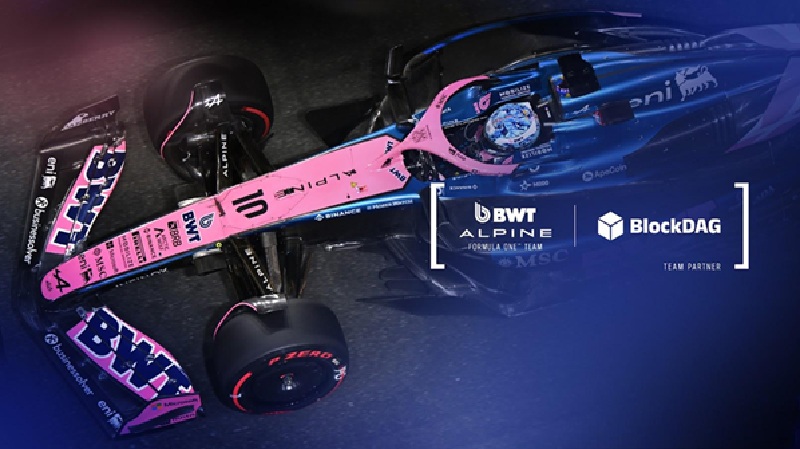
No project has captured both market momentum and cultural resonance like BlockDAG. Its landmark multi-year deal with the BWT Alpine Formula 1® Team has positioned it as the exclusive Layer 1 blockchain partner, aligning the brand with Formula 1®’s global image of speed, precision, and performance. The partnership made its debut at Singapore’s iconic Raffles Hotel ahead of Token2049 and the Grand Prix, featuring Alpine’s race car, team drivers, and official branding. This move pushes BlockDAG beyond traditional crypto marketing, embedding it in a sport watched by billions worldwide.

Financially, BlockDAG continues to shine. The project has nearly raised $415M in its presale, with coins priced at $0.0013 in the current batch and a confirmed launch price of $0.05. Such traction signals strong investor trust. Beyond fundraising, the project is rolling out advanced features like Buyer Battles, rewarding top daily buyers from a 50M BDAG pool. Referrals add another growth layer, with a 25% commission for referrers and a 5% bonus for referees, making community-led expansion a core driver.

On the tech side, BlockDAG’s Awakening Testnet is live, and being stress-tested its. This live simulation showcases scalability and transparency, while Dashboard V4 enhances investor faith through exchange-style charts, order books, and real-time participation metrics. Combined with rigorous audits from CertiK and Halborn, BlockDAG is solidifying its reputation for both innovation and security.

For those seeking the best performing crypto today, BlockDAG’s blend of cultural sponsorships, gamified presale tools, and secure blockchain infrastructure sets it apart from rivals like DOGE and XRP.

Wrapping Up

The competition for dominance among altcoins has never been more intense. XRP (XRP) price outlook highlights a possible short squeeze to $5, while Dogecoin (DOGE) breakout setup reflects its enduring community-driven appeal. Nonetheless, it is BlockDAG that is racing ahead of the pack. With a $415M presale raise, coins at $0.0013, an estimated $0.05 launch, and its multi-year BWT Alpine Formula 1® Team sponsorship, BlockDAG is redefining how crypto enters mainstream culture.

When paired with referrals, testnet readiness, and a secure DAG-based design, it becomes clear why many see it as the best performing crypto today, and perhaps the frontrunner for 2025.

Presale: https://purchase.blockdag.network

Website: https://blockdag.network

Telegram: https://t.me/blockDAGnetworkOfficial

Discord: https://discord.gg/Q7BxghMVyu


Wisconsin Lawmakers Introduce Assembly Bill 471 Aimed At Reducing Barriers For Crypto Activities

0

Wisconsin lawmakers introduced Assembly Bill 471 (AB 471), a bipartisan measure aimed at reducing regulatory barriers for cryptocurrency activities in the state.

The bill proposes explicit exemptions from the state’s money transmitter licensing requirements, administered by the Department of Financial Institutions (DFI), for a wide range of digital asset operations. This could position Wisconsin as a more attractive hub for blockchain innovation, similar to states like Wyoming and Texas, by lowering compliance costs for non-fiat crypto transactions.

If passed, the exemptions would apply immediately upon enactment, potentially encouraging rapid business relocations and investments in crypto infrastructure. The bill has been referred to the Assembly Committee on Financial Institutions for review and is currently about 25% through the legislative process, according to tracking data.

The legislation targets activities that do not involve converting digital assets to legal tender (e.g., USD) or bank deposits. Operating mining rigs or hardware to validate blockchain transactions. Removes licensing hurdles for energy-intensive operations, potentially boosting local data centers.

Participating in proof-of-stake networks to secure blockchains and earn rewards. Includes a securities exemption for third-party technical staking services, as long as rewards are solely network-generated.

Building or maintaining software for blockchain protocols. Fosters developer ecosystems without DFI oversight. Trading one cryptocurrency for another like BTC for ETH without fiat involvement.

Simplifies peer-to-peer and decentralized exchanges. Running full nodes to support blockchain networks. Protects decentralized infrastructure from state restrictions.

Accepting crypto as payment for goods/services or using self-hosted/hardware wallets for custody. Prohibits state agencies from banning or restricting these uses. Sending digital assets directly to another person or wallet. Enables seamless P2P transactions without licensing.

The bill explicitly states: “Neither a state agency nor a political subdivision may prohibit or restrict a person in accepting digital assets as a method of payment for legal goods and services or in taking custody of digital assets using a self-hosted wallet or hardware

Two Republican Senators and one Democrat (Rep. Tip McGuire), making it modestly bipartisan. This aligns with a pro-crypto shift under the Trump administration, amid federal uncertainty from the SEC and CFTC. Wisconsin currently has three other crypto bills under review, including ones on ATM regulations and data center tax exemptions.

Custodial services like MoonPay, which handle fiat conversions, would still require licenses and are not covered by these exemptions. Reduced barriers could attract Bitcoin mining firms, DeFi protocols, and wallet providers, spurring job growth in tech hubs like Madison.

Everyday activities like staking or paying with crypto become less risky, promoting adoption. Some worry it could invite illicit activity without federal safeguards, though proponents argue it clarifies rules in a patchwork regulatory environment.

Committee hearings could begin soon; passage isn’t guaranteed but reflects growing state-level momentum for crypto-friendly policies. This bill represents a significant step toward regulatory clarity, but it doesn’t override federal laws.

By exempting activities like crypto mining, staking, node operation, and non-fiat exchanges from licensing requirements, the bill lowers compliance costs. This could make Wisconsin an attractive destination for blockchain startups, DeFi platforms, and mining operations, especially compared to states with stricter regulations.

The immediate effect upon passage could draw crypto firms to Wisconsin, boosting local economies in tech hubs like Madison or Milwaukee. Data centers for mining or node operations may see increased investment.

Developers of blockchain software and decentralized protocols can operate without fear of licensing violations, fostering innovation in areas like smart contracts, NFTs, or layer-2 solutions.

Wisconsin could compete with crypto-friendly states like Wyoming, Texas, or Florida, positioning itself as a blockchain hub in the Midwest. Exemptions for accepting crypto payments and using self-hosted or hardware wallets protect everyday use cases.

This could encourage more merchants and individuals to adopt cryptocurrencies for transactions without legal uncertainty. Individuals engaging in staking or direct wallet-to-wallet transfers won’t face regulatory hurdles, making these activities more accessible and less legally ambiguous.

Without licensing requirements, there’s a risk of insufficient oversight for non-custodial services, potentially exposing users to scams or unreliable platforms, though the bill doesn’t affect custodial services requiring licenses.

Attracting crypto businesses could lead to job growth in tech, energy, and financial sectors, particularly in mining operations and blockchain development. Increased business activity could boost tax revenues, though the bill’s exemptions may limit direct licensing fees.

Related legislation on data center tax exemptions could further amplify economic impacts. Crypto mining, if expanded, could strain Wisconsin’s energy grid, raising concerns about sustainability and electricity costs, especially in rural areas.

The bill aligns with a pro-crypto trend under the current federal administration but may conflict with stricter SEC or CFTC regulations. It could set a precedent for other states to adopt similar exemptions, fragmenting the U.S. regulatory landscape.

Critics may argue that reduced oversight could attract money laundering or fraud, though the bill’s focus on non-fiat activities mitigates some risks. Federal laws like AML/KYC still apply to fiat-related crypto businesses.

Wisconsin could emerge as a Midwest leader in blockchain technology, attracting talent and capital. This aligns with national trends toward decentralized finance and Web3 development.

The bill’s immediate enactment could lead to rapid changes, but without federal clarity, businesses may still face legal risks. The 25% progress in the legislative process suggests uncertainty, as committee reviews and potential amendments could alter its scope.

Bit Digital Proposes $100M on Convertible Senior Notes as OpenSea Integrates Token Strategy

0

Bit Digital, Inc, a publicly traded digital asset platform specializing in Ethereum-native treasury and staking strategies, announced a proposed registered underwritten public offering of $100 million in aggregate principal amount of convertible senior notes due 2030.

The offering includes a 30-day option for underwriters to purchase up to an additional $15 million to cover over-allotments. The notes are senior unsecured obligations maturing on October 1, 2030, with holders able to convert them into cash, shares of common stock, or a combination prior to maturity.

Net proceeds will primarily fund Ethereum (ETH) purchases, with the remainder allocated to general corporate purposes, including potential investments, acquisitions, and other digital asset-related opportunities.

This move aligns with Bit Digital’s pivot to a “pure-play” Ethereum staking and treasury company, which began accumulating and staking ETH in 2022. In July 2025, the company raised $172 million via a public equity offering, sold ~280 BTC, and converted its treasury to acquire over 100,603 ETH, making it one of the largest public corporate ETH holders globally.

The offering is led by Barclays, Cantor Fitzgerald, and B. Riley Securities as joint book-running managers, conducted under an effective shelf registration on Form S-3. BTBT shares closed up 8.4% on September 29 but fell ~10% in after-hours trading amid the announcement.

CEO Sam Tabar has emphasized ETH as a “discount to the future,” citing its role in institutional finance and AI scalability. This reflects a broader trend of digital asset treasury (DAT) strategies, with firms like BitMine Immersion and SharpLink Gaming also building ETH positions.

OpenSea Integrates NFT Strategy Tokens; Punk Strategy Hits 18th CryptoPunk Acquisition

OpenSea, the leading NFT marketplace, launched support for all NFT Strategy tokens, enabling seamless trading and integration of these innovative ERC-20 tokens tied to ERC-721 NFT collections.

Developed by TokenWorks, NFT Strategy tokens deploy a “flywheel” mechanism: trading fees typically 10% accumulate in a smart contract until sufficient ETH is gathered to buy a floor-priced NFT from the linked collection. The NFT is then automatically relisted at a 1.2x markup 20% premium.

Sale proceeds are used to buy back and burn the corresponding strategy tokens, creating deflationary pressure and aligning token value with the underlying NFT floor price. The rollout includes a 20 ETH rewards pool for select tokens like PUNKSTR (CryptoPunks), PUDGYSTR (Pudgy Penguins), APESTR (Bored Ape Yacht Club), TOADSTR (Toadz), and BIRBSTR (Good Vibes Birds), incentivizing early liquidity and adoption.

PUNKSTR, the flagship token for CryptoPunks, has surged 392% since its September 15 launch, boasting an $87.2 million market cap, $1.5 million daily volume, and a price of ~$0.087 down 1.9% in the last 24 hours.

It has generated ~700 ETH in fees and burned ~2.8% of its supply through 12 full Punk buy-sell cycles. Coinciding with the launch, Punk Strategy via PUNKSTR acquired its 18th CryptoPunk, pushing the protocol’s treasury deeper into the iconic 10,000-piece collection (floor price ~59.71 ETH, or $176,649 average over the past year).

This automated protocol, exclusive to CryptoPunks acquired by Yuga Labs in 2022, transforms the collection into a “living burn engine” by linking token trades to NFT arbitrage, with dynamic taxes up to 90% post-sale, decaying over time to deter MEV exploits.

The integration blends DeFi yield with NFT trading, potentially revitalizing on-chain activity amid a $109.8 million weekly NFT sales jump CryptoPunks up 136%. TokenWorks plans to enable any ERC-721 collection owner to deploy custom strategy tokens, expanding the model.

On X, discussions buzz about OpenSea’s potential $2 million token buy-in, fueling speculation on broader adoption.