DD
MM
YYYY

PAGES

DD
MM
YYYY

spot_img

PAGES

Home Blog Page 41

Musk to Take SpaceX’s Terafab chip moonshot pitch to Europe’s biggest tech company, ASML

0

As SpaceX prepares for what could become one of the largest public offerings in history, Elon Musk is personally stepping in to sell one of the company’s most ambitious long-term bets: building a semiconductor manufacturing ecosystem capable of supporting its sprawling artificial intelligence ambitions.

According to internal communications seen by Business Insider, Musk will participate in a virtual fireside chat with ASML Chief Executive Officer Christophe Fouquet during the Dutch chip-equipment giant’s annual technology conference next week. The event will take place just days before SpaceX is expected to make its public market debut.

While investors have traditionally viewed SpaceX through the lens of rockets, satellites, and space transportation, the company’s IPO narrative is centered on artificial intelligence infrastructure and the enormous computing requirements that Musk believes will define the next technological era.

Internal event materials indicate Musk will discuss his vision for AI, robotics, space technology, and semiconductor manufacturing, including the company’s highly publicized Terafab initiative. The project has emerged as one of the most closely watched components of SpaceX’s long-term growth strategy and is expected to feature prominently in investor discussions ahead of the offering.

Terafab is described as a collaboration involving SpaceX, Tesla, and Intel aimed at building a network of giant semiconductor manufacturing facilities capable of producing advanced AI chips at an unprecedented scale. The project is strategically important because much of SpaceX’s future revenue projections are tied not to launch services or satellite broadband, but to artificial intelligence.

According to recent IPO disclosures, the company is pursuing plans that envision the deployment of vast AI computing infrastructure, including orbital data centers that would require enormous quantities of advanced semiconductors.

That vision creates a challenge familiar to every major AI player today: securing enough chips.

As demand for AI accelerators continues to outpace supply globally, companies from OpenAI and Anthropic to Microsoft, Google, and Meta are spending hundreds of billions of dollars securing compute resources. For Musk, controlling semiconductor production could become a competitive advantage that reduces reliance on external suppliers and shields SpaceX from future chip shortages.

What Makes ASML Thick

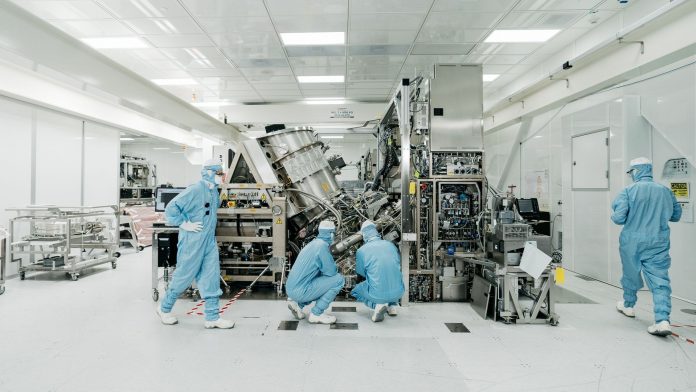
The involvement of ASML is particularly notable because the company occupies a unique position in the global chip industry. ASML is the world’s sole manufacturer of extreme ultraviolet (EUV) lithography systems, the highly sophisticated machines required to produce the most advanced semiconductors used in AI training and inference.

Without ASML’s technology, it is effectively impossible to manufacture leading-edge chips at scale.

That makes the Dutch company a critical bottleneck in the global semiconductor supply chain and an essential partner for any organization seeking to build advanced chip manufacturing capacity.

Fouquet recently acknowledged that he had discussed the Terafab concept with Musk, though he did not provide details. He also warned that the scale of AI infrastructure being proposed by companies such as SpaceX could place significant strain on semiconductor production capacity over the coming years.

The discussion comes as a growing number of technology companies race to secure every layer of the AI stack. Over the past year, major firms have moved aggressively beyond software and AI models into chips, power generation, networking equipment, and data center infrastructure.

Nvidia has invested billions of dollars in photonics companies to improve data-transfer efficiency. Anthropic recently secured one of the largest private credit transactions ever assembled to finance AI infrastructure. SoftBank has announced tens of billions of dollars in AI data center investments across Europe. Meanwhile, governments from the United States to China are increasingly treating computing capacity as a strategic national asset.

Against that backdrop, SpaceX’s Terafab initiative represents an attempt to vertically integrate AI infrastructure on a scale few companies have contemplated.

However, building semiconductor fabrication facilities is among the most capital-intensive industrial undertakings in the world. Leading-edge fabs routinely cost tens of billions of dollars and require years of construction, specialized talent, and highly complex supply chains.

Even established industry leaders such as Intel, Taiwan Semiconductor Manufacturing Company, and Samsung Electronics have struggled with escalating costs and manufacturing challenges.

For SpaceX, investors will likely want answers about funding requirements, production timelines, technology partnerships, and whether projected demand for AI compute can justify such enormous investments.

Those questions have become relevant as some analysts warn that today’s AI infrastructure boom could eventually lead to overcapacity if enterprise adoption fails to keep pace with investment.

Jensen Huang Tips Robotics to Be South Korea’s Next Big Sector as Nvidia Deepens AI Alliance With Manufacturing Powerhouse

0

Nvidia CEO Jensen Huang arrived in South Korea on Friday bearing a message that the next major chapter of the artificial intelligence revolution may be written in robotics, and South Korea is uniquely positioned to lead it.

Making his second visit to the country in seven months, Huang used the trip to underscore the strategic role South Korea plays in Nvidia’s global AI ecosystem. While the country has become indispensable to Nvidia’s supply chain through its dominance in advanced memory chips, Huang is indicating that the relationship is evolving into something broader, encompassing robotics, AI factories, industrial automation, and physical AI systems.

“Because Korea is a manufacturing center of the world, we can apply the robotics technology, the physical AI technology that we invent here for the industry,” Huang told reporters after arriving at Gimpo International Airport from Taiwan.

“So we have a great opportunity to partner with the semiconductor companies here as well.”

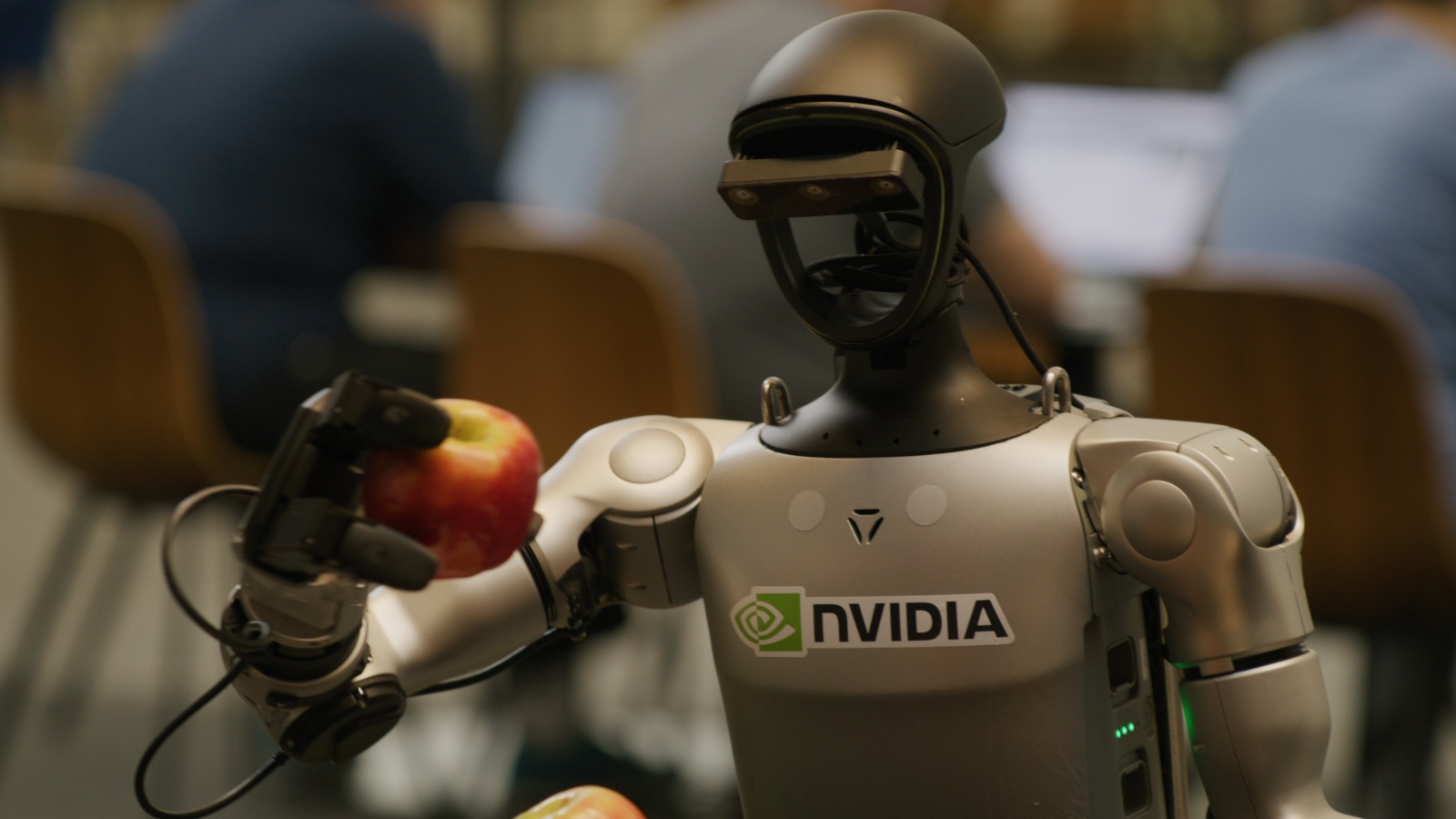
Having established itself as the dominant supplier of AI chips powering data centers worldwide, Nvidia seems focused on what comes next: embedding AI into physical systems ranging from factories and warehouses to autonomous machines and humanoid robots.

For South Korea, a country whose industrial strength spans automobiles, shipbuilding, electronics, and semiconductors, that transition presents a potentially enormous opportunity.

Huang’s schedule reflects the breadth of Nvidia’s ambitions, meeting with executives from Hyundai Motor, LG, SK Hynix, Samsung Electronics, and Naver during the visit.

Asked whether he had brought any gifts to South Korea, Huang responded with characteristic flair.

“Did I bring any gifts for Korea? I brought a lot of business for Korea,” he said. “I have some surprises.”

Nvidia’s dependence on South Korea has grown substantially as demand for AI infrastructure accelerates. Samsung Electronics and SK Hynix collectively produce roughly 70% of the high-bandwidth memory (HBM) chips used in advanced AI processors, making them critical partners in Nvidia’s growth.

At a dinner in Seoul with LG Group Chairman Koo Kwang-mo, SK Group Chairman Chey Tae-won, and Naver founder Lee Hae-jin, Huang emphasized the mutual benefits of the AI boom.

“We are all booming,” he told attendees.

“My friends here had a very good year, but this is just the beginning.”

He added that Nvidia’s next-generation systems would require substantial quantities of memory chips, reinforcing expectations that demand for Korean semiconductor products will remain strong for years.

That demand is already reshaping South Korea’s economy. The country’s semiconductor exports surged nearly 170% in May, reaching a record level and helping drive the strongest export growth seen in decades. Investors have rewarded the sector accordingly, with Samsung Electronics and SK Hynix each surpassing the $1 trillion market-capitalization threshold amid the AI-driven rally.

However, the significance of Huang’s visit extends beyond memory chips. At Computex in Taiwan earlier this week, Nvidia highlighted robotics as a central pillar of its future strategy. The company sees physical AI, machines capable of perceiving, reasoning, and acting in real-world environments, as the next major computing platform after cloud AI.

South Korea’s advanced manufacturing infrastructure makes it an attractive proving ground for such technologies. Analysts have noted that factories, logistics networks, automotive production facilities, and industrial automation systems provide ideal environments for deploying AI-powered robots at scale. As companies seek to improve productivity amid labor shortages and rising costs, demand for intelligent machines is expected to grow rapidly.

Thus, Nvidia is expanding its footprint in South Korea beyond procurement and partnerships. Huang confirmed the company has begun recruiting for a research and development center in Seoul, signaling a longer-term commitment to the country.

He also addressed concerns about memory supply constraints, noting that Samsung, SK Hynix, and Micron Technology are all producing HBM4 memory for Nvidia’s upcoming Vera Rubin AI platform.

“All three vendors are in production, and they are all racing to support Vera Rubin,” Huang said.

“Of course memory is constrained and so we have to be smart about using it in all of our systems.”

The trip is believed to be a major mark of the growing ties between Nvidia and South Korea. As the AI industry evolves from training models in data centers to deploying intelligence throughout the physical economy, the relationship between the world’s leading AI chip company and one of the world’s most advanced manufacturing nations appears set to deepen further.

Marvell and Flex to join S&P 500 index, replacing Pool and Campbell’s as AI Boom Reshapes Wall Street’s Elite Index

0

The artificial intelligence investment wave is once again reshaping the composition of America’s most important stock market benchmark.

Chipmaker Marvell Technology and electronics manufacturer Flex will join the S&P 500 on June 22, replacing Pool Corporation and The Campbell’s Company in a move that further highlights the growing dominance of technology and AI-linked businesses in U.S. equity markets.

The announcement sent Marvell shares higher in extended trading, adding to the momentum that has already transformed the company into one of the biggest beneficiaries of the AI infrastructure spending boom. Flex also advanced after investors welcomed its inclusion in the benchmark.

For Marvell, entry into the S&P 500 marks another milestone in a remarkable transformation from a company once best known for storage and networking chips into a critical supplier of AI-era infrastructure.

The Santa Clara-based firm designs a range of technologies that sit behind the explosive growth in artificial intelligence computing. While Nvidia’s graphics processors have become the face of the AI revolution, the massive data centers powering AI models rely on a broader ecosystem of networking, connectivity, and data-transfer technologies, areas where Marvell has become increasingly influential.

The company’s profile received another boost this week when Nvidia CEO Jensen Huang publicly described Marvell as a potential “next trillion-dollar company” during an appearance with Marvell CEO Matthew Murphy at Computex in Taiwan.

Huang argued that as AI workloads become distributed across thousands of interconnected processors inside giant data centers, networking technologies become just as important as computing power itself.

Nvidia recently committed roughly $2 billion to Marvell and has increasingly emphasized the importance of high-speed connectivity technologies in building next-generation AI infrastructure. The rise of AI clusters containing tens of thousands of chips has turned networking into one of the fastest-growing segments of the semiconductor industry.

Marvell’s elevation to the S&P 500 also indicates that there is a shift in investor priorities. Companies connected to AI computing, cloud infrastructure, and digital platforms have increasingly displaced traditional industrial and consumer businesses in major stock indices.

In recent years, technology-focused firms such as Veeva Systems, AppLovin, Datadog, DoorDash, and Robinhood have been added to the benchmark as the digital economy continues to command a larger share of market value.

However, the inclusion of Flex underpins that investors are increasingly rewarding companies that provide the physical infrastructure required to support AI expansion.

Though less visible than chipmakers or software developers, Flex plays a crucial role in global technology supply chains. The company manufactures electronic systems and components for some of the world’s largest technology firms, including Apple and Nvidia.

As demand for AI servers, networking equipment, and advanced computing hardware accelerates, contract manufacturers such as Flex are seeing increased opportunities to participate in the industry’s growth. What began as enthusiasm around generative AI software has expanded into a massive capital spending cycle involving semiconductors, networking equipment, memory chips, power systems, cooling infrastructure, and manufacturing services.

Investors are now seeing these supporting technologies as essential beneficiaries of an AI spending boom that is expected to run into the trillions of dollars over the coming decade.

For Marvell in particular, S&P 500 inclusion carries practical benefits beyond prestige. Membership typically triggers purchases by index funds and exchange-traded funds that track the benchmark, creating a new source of demand for the stock. It also enhances visibility among institutional investors and boosts the company’s standing as one of the semiconductor industry’s major players.

Founded in 1995, Marvell originally built its business supplying components for hard disk drives. Three decades later, it finds itself at the center of a technological transformation that is redefining global computing infrastructure.

Its addition to the S&P 500 serves as another indication that Wall Street increasingly sees the AI revolution not as a temporary market trend, but as a structural shift that is reshaping the hierarchy of corporate America.

Google Gemma 4 Release Is Reshaping Competition, Enterprise Adoption, and Future of Lightweight Foundation Models

0

In a major development in the open-source AI ecosystem, Google has released Gemma 4, the latest iteration of its lightweight foundation model family, designed to expand access to generative AI across research, enterprise, and edge deployment.

Positioned as an evolution of the Gemma series, Gemma 4 reflects Google’s push to balance state-of-the-art capability with open accessibility. The release arrives amid competition in the open-weight model landscape, where developers seek alternatives to closed systems dominating frontier AI performance.

Gemma 4 is presented as a modular, scalable architecture optimized for efficiency and reasoning depth, signaling emphasis on democratizing advanced model capabilities without hyperscale infrastructure. Technically, Gemma 4 is expected to build on transformer-based foundations with improved context handling, better instruction tuning, and multimodal readiness.

While earlier Gemma versions focused on text generation, this iteration extends support for richer inputs and stronger long-context reasoning.

This positions the model as a tool for developers building agents, coding assistants, and domain systems. A key goal is efficiency: enabling high-quality inference on smaller compute budgets, including consumer GPUs and edge devices. This aligns with a broader shift toward smaller, deployable foundation models that reduce dependency on centralized cloud compute while maintaining competitive performance against larger proprietary systems.

From an ecosystem perspective, Gemma 4’s open-source release could reshape developer workflows. By providing accessible weights and tooling, Google is lowering barriers to experimentation for startups, academic labs, and independent researchers. This encourages fine-tuning, distillation, and integration into specialized pipelines from healthcare analytics to financial modeling.

However, open-weight models also introduce governance challenges, particularly around misuse, alignment, and downstream safety controls. Google’s approach typically includes usage guidelines and safety filters, but the open nature means responsibility is partially transferred to implementers. This duality—openness versus control—remains a tension in modern AI deployment strategies.

Gemma 4 also serves as a counterweight to other open-model ecosystems. As organizations explore alternatives to proprietary APIs, open-source models have become critical infrastructure for AI sovereignty and cost control. Google’s move strengthens its position in this segment, ensuring its research output remains influential even when not consumed through closed cloud services.

It also reinforces a broader trend where frontier labs release scaled-down but capable models to maintain developer mindshare. If adoption scales, Gemma 4 could become a foundational layer for agentic systems, embedded tools, and on-device intelligence applications across industries.

The release of Gemma 4 underscores the accelerating convergence between open-source AI and commercial-grade capability. It reflects a maturing ecosystem where performance gaps between open and closed models continue to narrow, reshaping expectations around accessibility and innovation. Whether developers adopt Gemma 4 at scale will depend on benchmark performance, tooling support, and real-world integration efficiency.

Nonetheless, its introduction marks another step toward a more distributed AI landscape in which advanced intelligence is no longer confined to a handful of proprietary platforms but increasingly available to the broader global developer community globally. Gemma 4 is also expected to accelerate competition in open-weight model benchmarks, especially in reasoning, coding, and multimodal tasks.

Its release may drive faster iteration cycles among open-source contributors and increase enterprise adoption of lightweight AI systems, particularly in regions seeking cost-efficient alternatives to proprietary cloud-based models globally overall impact.

Four Traits of Category-king Companies

0

To become an enduring category-king in your industry, your company must develop four defining characteristics:

1.     Perceptively Innovative

Move beyond merely serving customer needs; shape customer perceptions in the marketplace. When customers buy because you satisfy a need, you have a transaction. But when customers believe in what you stand for, identify with your mission, and proudly associate with your brand, you create something much more powerful. You create fans. And fans create fandoms. Products may attract customers, but perceptions build communities. And communities are where category-kings are born.

2. Evidently Inspired

Great companies do more than sell products; they inspire people. They stand for something larger than themselves. Customers trust them because they are authentic, credible, and purpose driven. They help people express their own aspirations, values, and beliefs through the products and experiences they create.

3. Ruthlessly Pragmatic

Customers depend on you to solve real problems. That means delivering reliably, consistently, and predictably. You make life easier for customers by honoring your promises, reducing friction, and executing with excellence. Vision matters, but execution builds enduring institutions.

4. Customer Obsessed

Your customers should find it difficult to imagine life without you. You understand what matters most to them and continuously discover new ways to create value. Customer obsession is not about satisfying customers occasionally; it is about making their success central to your mission.

Good People, the world’s most successful companies, are rarely accidental. They are built intentionally around these principles, combining innovation, inspiration, execution, and customer focus into enduring competitive advantages.

Join Tekedia Institute Mini-MBA and master the mechanics of business, strategy, innovation, and market leadership. A new edition begins on Monday, June 8 2026.