DD
MM
YYYY

PAGES

DD
MM
YYYY

spot_img

PAGES

Home Blog Page 4378

NATION, YOUTHS as Nodal Points of Bola Ahmed Tinubu’s New Identity

0

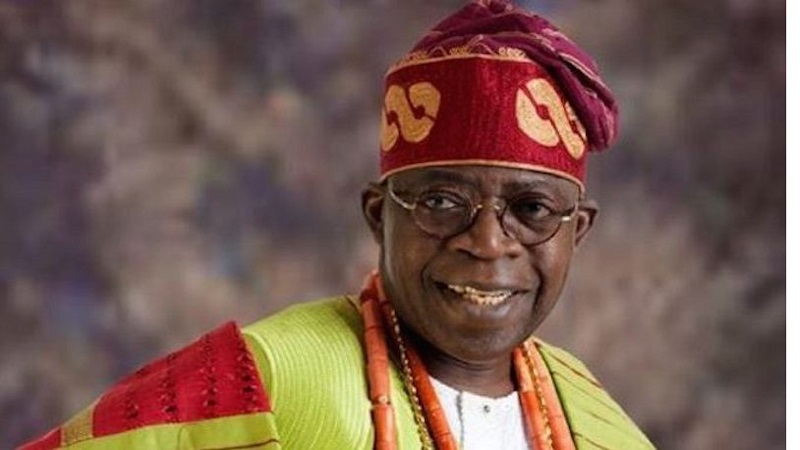
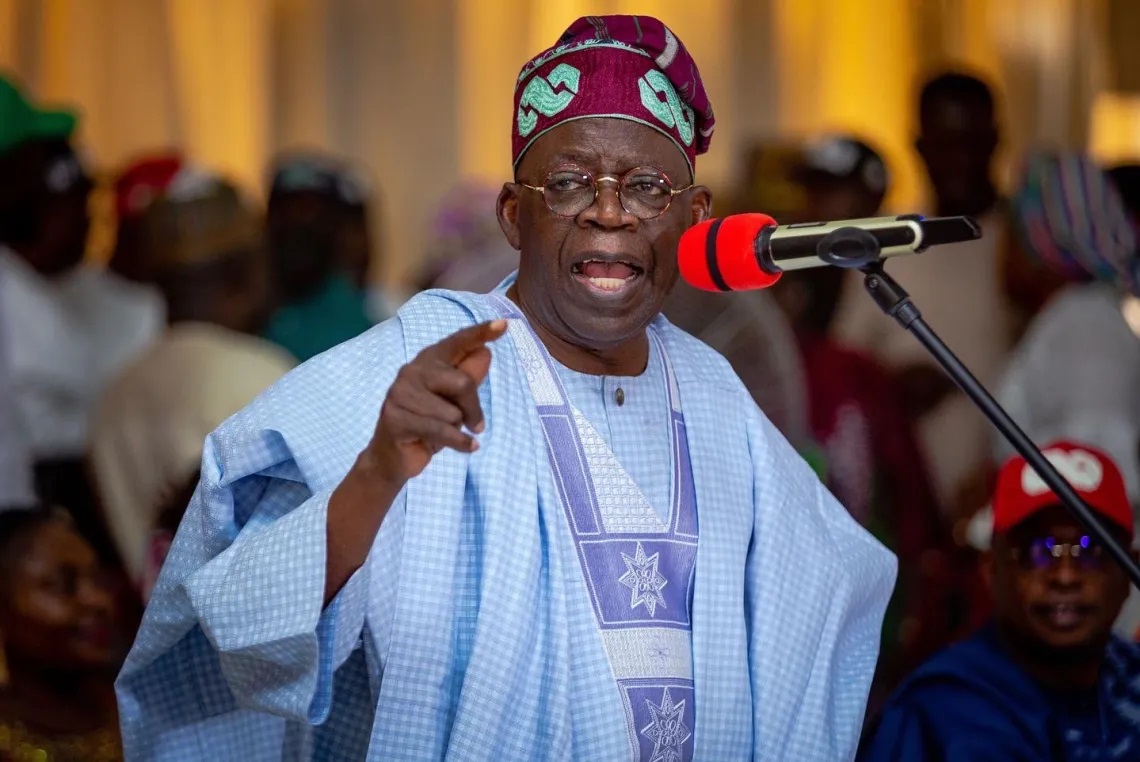
After several days of campaigning across the country by political parties, candidates, and supporters and voting on February 25, 2023, Nigeria eventually had a president-elect, Senator Bola Ahmed Tinubu, as the Constitution provides. From the campaign to the voting period, the political atmosphere was tense for every stakeholder. In this piece, our analyst examines the speech of the president-elect with a focus on how he uses referential and predicational strategies for positioning subjects in order to establish his new identity. Beyond this, our analyst discovered that the president-elect predominantly progresses from strengthening Nigeria’s democracy despite its current challenges to an appreciation of the kind of political competition the country experienced before the campaign, during the campaign and during the voting stages. He also moves to the youth, appreciating their doggedness and clamouring for a better Nigeria, where they could thrive without any hindrance.

Senator Tinubu stylishly refers to the different camps of his opponents, appreciating their roles during the electoral process that ensure sustained democracy for the country without foregrounding their offensive strategies and tactics against him during the period. In this regard, our analyst notes that the president-elect does not use the negative part of the referential strategy expected in formulating discourse. In other words, the president-elect considers appropriating the positive aspect of the strategy since he now wears a “national identity,” which demands that he embrace all competitors towards building a united Nigeria.

“You decided to place your trust in the democratic vision of a Nigeria founded on shared prosperity and one nurtured by the ideals of unity, justice, peace and tolerance. “Renewed hope has dawned in Nigeria,” is his nodal point statement that pinpoints the importance of appreciating the competitiveness of the election and the need for collectively building a sustainable democracy. The 791-word speech also entails predicational strategies premised on his agenda of renewed hope for Nigerians (see Exhibit 3).

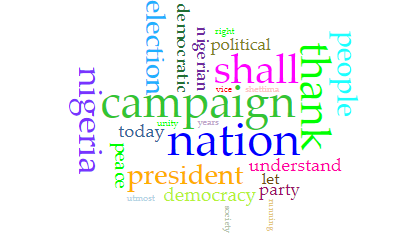
Exhibit 1: Dominant words in his speech
Source: Tinubu’s Speech, 2023; Infoprations Analysis, 2023

Strengthened democracy

Whether you are Batified, Atikulated, Obidient, Kwankwasiyya, or have any other political affiliation, you voted for a better, more hopeful nation and I thank you for your participation and dedication to our democracy.

Finally, I thank the Nigerian people for their abiding belief in our democracy. I shall be a fair leader to all Nigerians. I will be in tune with your aspirations, charge up your energies and harness your talents to deliver a nation that we can be proud of.

Political competition

This was a competitive, high-spirited campaign.  You have my utmost respect. Political competition must now give way to political conciliation and inclusive governance.

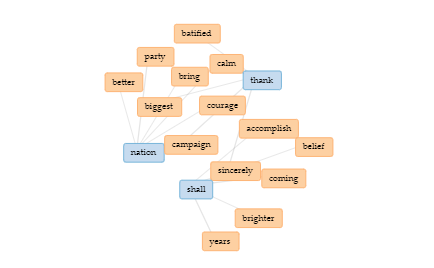
Exhibit 2: Connectivity of nation, shall and thank with his discourse elements
Source: Tinubu’s Speech, 2023; Infoprations Analysis, 2023

Youths and sustainable nation building

Now, to you, the young people of this country, I hear you loud and clear. I understand your pains, your yearnings for good governance, a functional economy and a safe nation that protects you and your future. I am aware that for many of you Nigeria has become a place of abiding challenges limiting your ability to see a bright future for yourselves. Remodeling our precious national home requires the harmonious efforts of all of us, especially the youth. Working together, we shall move this nation as never before.

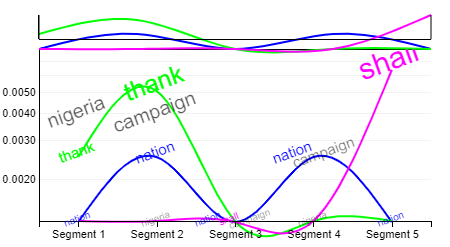
Exhibit 3: Discursive movement of nation with other elements
Source: Tinubu’s Speech, 2023; Infoprations Analysis, 2023

Summary of Nigeria 2023 Presidential Election; Pollsters Got The Outcome Right On Low Turnout

0

In the final result called by INEC, Nigeria’s election umpire, here are the main summaries, from the 36 states of the federation and Abuja:

Tinubu of APC scored the highest votes; 8,805,420 votes and won 12 states (Rivers, Borno, Jigawa, Zamfara, Benue, Kogi, Kwara, Niger, Ekiti, Ondo, Oyo,  Ogun).

Atiku (PDP) scored 6,984,290 votes; won 12 states (Katsina, Kebbi, Sokoto, Kaduna, Gombe, Yobe, Bauchi, Adamawa,  Taraba,  Osun, Akwa Ibom, Bayelsa).

Obi (LP) got 6,093,962; won also 12 states (Edo, Cross River, Delta, Lagos, FCT, Plateau, Imo, Ebonyi, Nasarawa, Anambra, Abia, Enugu)

Kwankwaso (NNPP) won 1,496,671 votes and won a state – Kano State.

Using the results, Tinubu scored at least 25% of votes in 29 states; Atiku (21) and Obi (16). One needs at least 24 or 25 states (including Abuja). Based on that, Tinubu gets the call.

Pending a determination that the total canceled votes (many of them across the nation) will not change the outcome, INEC will do the trigger and make a call for Tinubu.

Yet, this is a really low-turnout election which is contrary to alternate data. In 2019, APC received 15,191,847 votes while PDP finished with 11,262,978 votes, giving at least 26 million to elect the president. In 2023, you have about 21 million voters. In 2015, the number was about 28.2 million.

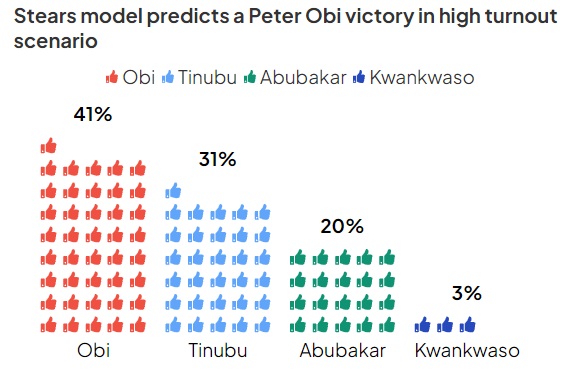
The pollsters are correct: Obi wins with high turnout, but Tinubu wins with low turnout. This election, from official numbers, is low turnout but INEC has to explain how it lost at least 5 million voters in a cycle where more people registered, collected PVCs, etc, implying that voter suppression possibly changed the outcome.

Data Analytic Startup, Stears, Calls Nigeria’s Presidential Contest for Peter Obi

The 25% Debacle – The Final Clarification of S.134(2)(B) of the Nigerian Constitution

10

The what-about fuss as to the correct interpretation of s.132(2)(b) is so unnecessary. That provision of the constitution is as straightforward as an arrow and it is a literal provision of the constitution and should be interpreted as such. Any other interpretation rule adopted for its interpretation other than the literal rule will only bring about a fundamental departure from its original contemplation which will only be hazardous. 

The misinterpretations and debacle about what that section really postulates is just a mischievous ploy by mischief makers and understandably, from the aggrieved party members who are currently drowning in the pool of defeat, therefore, looking for the slightest branch of a tree to lay hold on to grasp for air so as to save their faces.

For the record, my preferred candidate by every indication may likely not win the presidential election, but it will be mischievous and dishonourable on my part as a lawyer to try to twist the provisions of the constitution as some so-called lawyers have been doing on social media, deceiving the gullibles and hitting up the polity just because their prefered candidate did not win; this is so low of a lawyer. 

For the sake of emphasis, this section of the constitution [S. 134(2)] which gained notoriety since yesterday is worded thus; 

Section 134(2) :

(2) A candidate for an election to the office of the President shall be deemed to have been duly elected where, there being more than two candidates for the election – 

(a) he has the highest number of votes cast at the election; and 

(b) he has not less than one-quarter of the votes cast at the election in each of at least two-thirds of all the States in the Federation and the Federal Capital Territory, Abuja.

To this effect, using the literal rule of interpretation to (literally) interpret what the constitution contemplated here; simply means that for a candidate to be deemed duly elected he must have at least won 2/3 of the majority votes cast in the country. Mathematically, 2/3 of 37 States of Nigeria (37 when you add the FCT) means that he must have scored 25% of at least 25 states, including the FCT; not that he must score 25% of 25 States and also get 25% of the FCT. The FCT has no other special privilege outside being another state of the federation, so the thought that a contestant after scoring 25% of 25 States must as well score 25% of the FCT is rather ridiculous. 

The conjunction “and” used in paragraph B of the S 134(2) which is what has been causing the confusion simply means what it is; “with the FCT inclusive”.

Someone may want to argue that FCT is not a state, but yes, in a plethora of cases, the court has adopted that the FCT may not be a state as properly so-called but is to be regarded as well as a state of the federation which is to be administered by the FCT ministers who acts as it’s governor.  In fact, in S. 299 of the Constitution, the provisions stipulate thus; “The provisions of this Constitution shall apply to the Federal Capital Territory, Abuja (as if it were one of the States of the Federation)”.  This is to say that the constitution has always held FCT to be regarded as the 37th state of the federation. 

In summary, a candidate who has secured 25% of votes in 25 of any states of the federation which has made up the 2/3 majority has fulfilled the constitutional threshold to be deemed elected as provided in paragraph B of the S 134(2), he does not have to secure 25% of the votes cast of the FCT after securing 25% of other 25 states of the federation.

West African Elders Forum Asks INEC to Comply with Electoral Laws

0

The West Africa Elders Forum (WAEF) Election Mission to Nigeria has urged the Independent National Electoral Commission (INEC) to comply with the electoral law and the constitution of the Federal Republic of Nigeria, in the process of collating the election results.

The WAEF’s election mission, led by former Ghana president, John Dramani Mahama and includes former Nigerian president, Goodluck Jonathan, former Beninoise President, Boni Yayi, former Vice President of The Gambia, Fatoumata Jallo Tambajang, among others, issued the statement after days observing the electoral processes.

The Mission said although the election has been largely peaceful, it has been characterized by challenges of delay in arrival of electoral materials, voter suppression, ballot box vandalization and incidents of violence in some states, which created anxiety among citizens who were passionate to cast their ballots.

The situation, which is increasingly heating up the polity – creating a room for potential unrest as protests have erupted in some places across the country – including INEC collation center in Abuja, is largely based on the electoral umpire’s failure to transmit election results electronically according to electoral laws.

Given Nigeria’s role in the stability of the West African region, the Mission urged INEC to thoroughly investigate those concerns and comply with the electoral law and the constitution of the Federal Republic of Nigeria, in the process of collating the election results.

Below is the full text of the statement:

STATEMENT BY WEST AFRICAN ELDERS FORUM (WAEF) ON NIGERIA’S FEBRUARY 25, 2023, 2023 ELECTIONS ISSUED IN ABUJA, NIGERIA, FEBRUARY 28, 2023

The West Africa Elders Forum (WAEF) Election Mission to Nigeria, 2023, wishes to commend Nigerians for the resilience and patriotism displayed during the Presidential and National Assembly election which held on Saturday February 25, 2023.

In December 2022, we deployed a pre-election mediation mission led by former Sierra Leonean President, His Excellency Ernest Bai Koroma to interface with key stakeholders. Our Election Mission led by former Ghana president, His Excellency John Dramani Mahama which has been in the country since last week, witnessed election day proceedings on February 25, 2023 and has continued to observe the unfolding developments, since the collation process began.

Other members of the Mission include former Beninoise President His Excellency Boni Yayi, former Nigerian President His Excellency Dr. Goodluck Jonathan, former Vice President of The Gambia, Her Excellency Fatoumata Jallo Tambajang, former Burkinabe Prime Minister and President of the Economic Community of West African States His Excellency Kadre Ouedraogo, and former Deputy Chair of the African Union, Dr. Erastus Mwencha.

The Mission noted how Nigerians across the country demonstrated faith and patriotism in their country, defying many challenges to perform their civic duties. While the elections were peaceful in a number of places, challenges of delay in arrival of electoral materials, voter suppression, ballot box vandalization and incidents of violence in some states, created anxiety among citizens who were passionate to cast their ballots.

We commend Nigerians for the calmness, patience and maturity they have continued to exhibit as they wait for the collation process to be concluded.

The Mission notes that some political parties and concerned citizens have raised procedural questions and allegations of infractions of the electoral law in the process of collation of results. We call on all aggrieved parties to document and present their claims to INEC, in accordance with the Electoral Act 2022.

The Mission notes the imperative of retaining the confidence of Nigerians in the ongoing electoral process and, therefore, urges the Independent National Electoral Commission (INEC) to thoroughly investigate those concerns and comply with the electoral law and the constitution of the Federal Republic of Nigeria, in the process of collating the election results.

We reiterate that Nigeria is a major stakeholder in the sustainability of democracy in West Africa and the responsibility of maintaining the nation’s thriving democracy and the general peace of our sub-region rest on all our shoulders, especially on the integrity of INEC and other election management bodies in West Africa, during elections. We therefore urge INEC to live up to its responsibility of delivering free, fair and credible elections, in accordance with the nation’s laws.

WAEF urges political parties, candidates and their supporters to remain calm and peaceful while awaiting the final outcome of the electoral process.

As former leaders who are committed to peace and stability in our sub-region, we have begun a round of consultations with some of the presidential candidates and other key stakeholders, taking to them our message of hope, understanding and peace.

So far, WAEF have held meetings with some of the presidential candidates including the Presidential candidate of the New Nigeria People’s Party Dr. Rabiu Kwankwaso and the Presidential candidate of the Peoples Democratic Party (PDP, Alhaji Atiku Abubakar in Abuja.

This afternoon we also held consultations with the All Progressives Congress Presidential candidate Senator Bola Tinubu and the Labour Party Presidential candidate, Mr. Peter Obi, in an expanded meeting that included the Heads of Missions of the Economic Community of West African States (ECOWAS) and the African Union (AU), His Excellency Ernest Bai Koroma and His Excellency Uhuru Kenyatta, respectively, as well as the President of the ECOWAS Commission, His Excellency Dr. Omar Alieu Touray.

We have continued, in all of these meetings, to urge the candidates and their supporters to maintain peace and use all available legitimate means to sort out their concerns and grievances. We hope to sustain this Mission until the electoral processes are successfully concluded.

We, therefore, urge everyone to be circumspect in their actions and responsibilities, during this moment in order not to jeopardize the collective stability and peace of the nation.

Signed:

H.E. John Dramani Mahama

President of the Republic of Ghana

(2012-2017)

Head of WAEF Mission to Nigeria’s 2023

H.E. Dr. Goodluck Ebele Jonathan

President, Federal Republic of Nigeria (2010-2015)

Convener, WAEF

Building off Ethereum reaches new lows of US Based Legislative Insanity.

0

There is one thing that happens with Lawmakers … and to be fair, that’s lawmakers everywhere, not just the US. That is the zeal with which they rush to legislate on new technologies is sadly not matched with their understanding of it.

As a world, legislative containment can’t even curb the worst of what can happen with FIAT economies – inflation, stagflation, recession, quantitative easing, fractional reserve banking (non exhaustive list)… and FIAT currencies are thousands if not tens of thousands of years old…

So how can we expect lawmakers and regulatory authorities to put in place sensible legal frameworks for the operation of cryptocurrencies and other blockchain value instruments?

Well, it seems, we can’t!

I’ve written at length about how the Ethereum Ecosystem is vulnerable to regulatory and judicial interference in the US.

There are two aspects to this – Firstly, the core of Eth itself, after it moved to PoS (Proof of Stake) – Majority Stakeholders are now known and an open record, so regulatory authorities can directly target them and hold them accountable for whatever crazy new requirement they dream up.

Secondly, and more importantly – Any businesses who have created themselves off different types of EVMs or scaling systems – examples, Binance, Polygon etc are extra vulnerable.

Why? because these are just regular companies with a lot of off-chain data. They have ‘smart contracts’ but they don’t have a blockchain in the sense that Ethereum is a blockchain, or Bitcoin is a blockchain.

So… the SEC can do the heavy on them… key investors can do an SBF on them… or they can simply go bankrupt.

Things keep on getting stranger –

Illinois court has come out with a decision that’s impossible to implement in some blockchains. They have empowered courts to be able to order a blockchain transaction that is executed via a smart contract to be altered or rescinded.

The act would apply to any “blockchain network that processes a blockchain transaction originating in the State’

Six Months ago in the post:

As Ethereum Goes Proof of Stake, has Uncle Sam via his ‘SEC’ just got a new tool to spank Binance, and China’s rising Crypto-Experts? And what does this mean for Ethereum’s Longevity?

.I related how it was reported by Sam Kessler of Coindesk that Stanford researchers had created two new Ethereum token protocol formats – ERC20R and ERC 721R – the ‘R’ standing for REVERSIBLE.

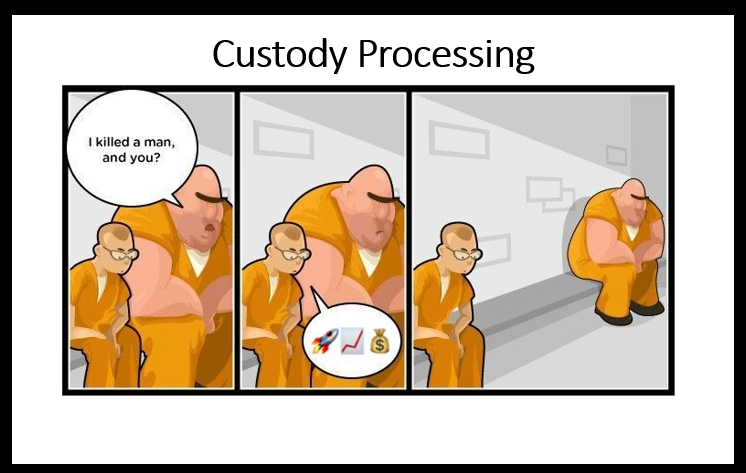
In addition to this, the SEC has now decided that the use of three particular emoji’s – the rocket, the financial chart, and the moneybag, all constitute ‘Financial Advice

So you think, ok leave US and make something off Ethereum based somewhere else? Well… if too many companies do this, and the Ethereum ecosystem in general isn’t working in IRS benefit, then SEC can just come down on the Eth. core.

Because of the PoS status, and the weighting of just a few investors to have control over the staking, they can pretty much disable it.

This week, SEC has taken shots at Binance on both Paxos and Voyager issues. Last week Binance was taking heat for transferring $400m to Merit Peak, a company managed by Chanpeng Zhao.

Polygon is amid layoffs.


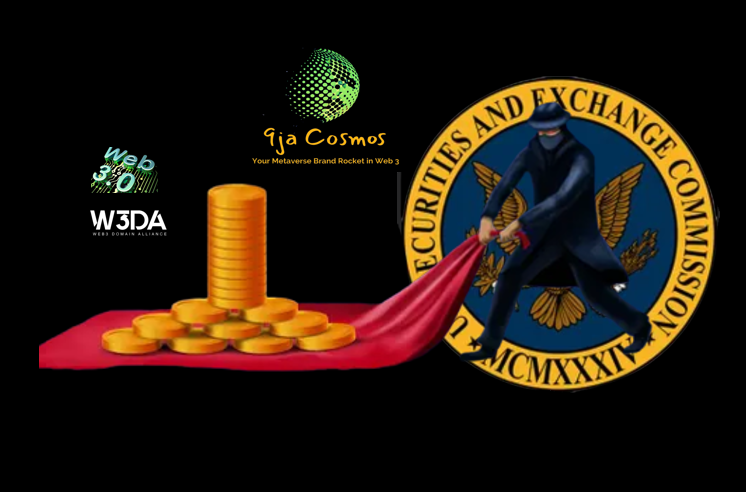
Pulling the Eth core out from under systems working off Eth but registered outside the US could conceivably result in the biggest state sponsored rug pull ever!


9ja Cosmos is here…

Get your .9jacom and .9javerse Web 3 domains  for $2 at:

.9jacom Domains

.9javerse Domains


All reference sites accessed between 26-28/02/2003

cointelegraph.com/news/unworkable-bill-to-ban-blockchain-immutability-is-introduced-in-illinois

reuters.com/business/finance/paxos-engaged-constructive-discussions-with-us-sec-over-binance-stablecoin-2023-02-21/

blockonomi.com/sec-takes-another-shot-at-binance-us/

msn.com/en-us/money/markets/federal-judge-rules-that-emojis-count-as-financial-advice/ar-AA17Sgai

tekedia.com/as-ethereum-goes-proof-of-stake-has-uncle-sam-via-his-sec-just-got-a-new-tool-to-spank-binance-and-chinas-rising-crypto-experts-and-what-does-this-mean-for-ethereums/

coindesk.com/tech/2022/09/28/stanford-proposal-for-reversible-ethereum-transactions-divides-crypto-community/

reuters.com/technology/crypto-giant-binance-moved-400-million-us-partner-firm-managed-by-ceo-zhao-2023-02-16/