DD
MM
YYYY

PAGES

DD
MM
YYYY

spot_img

PAGES

Home Blog Page 4392

Will Crypto Recover? Collateral Network (COLT) Leads The Way While Ethereum (ETH) and Bitcoin (BTC) Consolidate

0
collateral

The crypto market has been in a state of flux since the dip late last year, with prices falling and uncertainty starting to rise. But while Ethereum (ETH) and Bitcoin (BTC) have struggled, Collateral Network (COLT) has been building momentum during phase 1 of the public presale, with most analysts forecasting a 3500% price increase.

>>BUY COLT TOKENS NOW<<

Collateral Network (COLT)

Collateral Network (COLT) is a unique crowdlending platform that leverages blockchain technology and asset-backed non-fungible tokens (NFTs). These NFTs are tied to real-world assets and then used as collateral for loans.

Let’s go over an example — you want a new car but only have a $6000 watch at your disposal. You can use Collateral Network (COLT) to mint an NFT that represents your watch and acts as collateral for the loan.

This example demonstrates how Collateral Network (COLT) can help individuals access loans when traditional methods are unavailable, but there’s more to this platform than that. As the NFTs are fractionalized, more than one lender can get involved in the loan, allowing anyone to become a lender and earn profits.

The Collateral Network (COLT) platform utilizes smart contracts to streamline the process, eliminating manual steps such as document verification, credit scoring, and more. These smart contracts are regularly audited to ensure security and authenticity.

The COLT token is the native currency of the Collateral Network (COLT) platform and is used to facilitate financial transactions. Hold COLT in your wallet to receive trading fee discounts, better loan rates, governance rights, and more. COLT is now available at a discounted price of $0.01 during the presale, and set to rise by over 35x.

With a great chance to revolutionize the lending industry, Collateral Network (COLT) has the potential to become a leading platform in the cryptosphere. We can envision a top 20 cryptocurrency if Collateral Network (COLT) can execute its strategy correctly.

>>BUY COLT TOKENS NOW<<

Ethereum (ETH)

Ethereum (ETH) is an open-source blockchain platform that allows users to build and deploy decentralized applications. The creation of Ethereum (ETH) in 2015 shifted the crypto landscape, introducing a new type of blockchain technology. Ether (ETH) is the native currency for Ethereum (ETH) and acts as fuel for its decentralized applications.

Despite some growing pains, Ethereum (ETH) still remains the go-to platform for developers and businesses around the world. It has a first-mover advantage over other blockchains, as well as a huge community of developers who are constantly pushing the boundaries of what’s possible.

However, the Ethereum (ETH) price has taken a massive tumble this year — down more than 75% from the all-time high set in late 2021. With economic uncertainty causing nearly all projects to fall, Ethereum (ETH) holders are still waiting for a recovery.

>>BUY COLT TOKENS NOW<<

Bitcoin (BTC)

Bitcoin (BTC) was launched in 2009 with a white paper by its anonymous creator, Satoshi Nakamoto. Bitcoin (BTC) has since gone on to become a global phenomenon, serving as both a store of value and a medium of exchange.

Bitcoin (BTC) is widely considered the original cryptocurrency and it continues to be the most popular crypto asset today, with a market capitalization that’s more than double that of Ethereum (ETH).

Despite its impressive track record, Bitcoin (BTC) has also struggled this year. The price of Bitcoin (BTC) is down by more than 75% since its all-time high in late 2021, and Bitcoin (BTC) doesn’t appear to be recovering anytime soon. Bitcoin (BTC) needs to start performing as a hedge against inflation, or it risks losing its position as the king of crypto.

Find out more about the Collateral Network presale here:

Website: https://www.collateralnetwork.io/

Telegram: https://t.me/collateralnwk

Twitter: https://twitter.com/Collateralnwk

Gala (GALA) and TRON (TRX) Take A Back Seat To Orbeon Protocol (ORBN) Superior Performance

0

The cryptocurrency market has seen a surge in recent years, with numerous cryptocurrencies popping up almost every day. While some of these cryptocurrencies have gained immense popularity and growth, others have failed to maintain their value or attract investors.

Two such cryptocurrencies are Gala (GALA) and TRON (TRX), which have struggled to maintain their value and attract investors. However, Orbeon Protocol (ORBN) has emerged as a superior alternative, offering investors an opportunity to invest in new and exciting start-ups and earn passive income.

>>BUY ORBEON TOKENS HERE<<

Investors Losing Interest in Gala (GALA) Token Due to Lack of Innovation

GALA is the native ERC-20 token of the Gala (GALA) Games ecosystem, which is a decentralized play-to-earn gaming and entertainment ecosystem. While it has a lot of potential as a utility token, Gala (GALA) has failed to live up to investors’ expectations.

Last year, the price of the Gala (GALA) token dropped by a staggering 96%, from $0.75 to $0.04, indicating that investors are losing interest in it. One reason for this loss of interest is the lack of innovation from the Gala (GALA) Games team.

Despite having a lot of potential, the Gala (GALA) Games ecosystem has failed to provide any real-world use cases for its tokens, which is crucial for long-term success. Without a real-world use case, investors and users alike will lose interest in the Gala (GALA) project.

>>BUY ORBEON TOKENS HERE<<

TRON (TRX) Misses Mark on Becoming Leading Player in DeFi Space

TRON (TRX) is another cryptocurrency that has failed to live up to expectations. While it started with a lot of hype, TRON (TRX) has failed to deliver on its promises. The TRON (TRX) network was meant to be used in a metaverse and blockchain-based city-building game where people could play and earn money.

However, the TRON (TRX) team has failed to provide any real-world use cases for the token. TRON (TRX) has lost 77% of its value since it’s all-time high in 2018. While TRON (TRX) has a market cap of $4.8 billion, it has failed to live up to its promise of becoming a leading player in the decentralized finance (DeFi) space.

>>BUY ORBEON TOKENS HERE<<

Orbeon Protocol (ORBN) Offers Investors An Opportunity to Invest in Exciting Start-Ups

In contrast to Gala (GALA) and TRON (TRX), Orbeon Protocol (ORBN) has emerged as a superior alternative, offering investors an opportunity to invest in new and exciting start-ups and earn passive income.

With fractionalized NFTs, investors can put small amounts of money into new businesses through the Orbeon Protocol (ORBN) investment platform. These equity-backed NFTs can be sold to any investor for as little as $1, making it accessible to everyone.

The Orbeon Protocol (ORBN) platform allows the wealthy to invest in the most promising new businesses worldwide, and build a community. Orbeon Protocol (ORBN) holders get staking benefits, which let them earn passive income and vote on crucial decisions for upcoming projects. The Orbeon Protocol (ORBN) platform also comprises a secure “Fill or Kill” methodology, to ensure the safety of investors’ money.

Orbeon Protocol (ORBN) has successfully audited its smart contracts by Solid Proof. The analysts predict that the price of an Orbeon Protocol (ORBN) token will increase by 6000% during the presale, making it an attractive investment option. The ORBN token, currently worth $0.0835, in its ongoing ninth stage of presale, powers the Orbeon Protocol (ORBN) ecosystem, making it an integral part of the platform’s success.

As the world of cryptocurrency continues to evolve, it’s becoming clear that traditional tokens like Gala (GALA) and TRON (TRX) are no longer enough to satisfy investors’ demands. Instead, newer and more innovative tokens like Orbeon Protocol (ORBN) are taking center stage with their unique approach to investment and fundraising.

With the cryptocurrency market constantly in flux, it’s important for investors to keep an eye on emerging players like ORBN that offer superior performance and growth potential.

Find Out More About The Orbeon Protocol Presale

Website: https://orbeonprotocol.com/

Presale: https://presale.orbeonprotocol.com/register

NATION, YOUTHS as Nodal Points of Bola Ahmed Tinubu’s New Identity

0

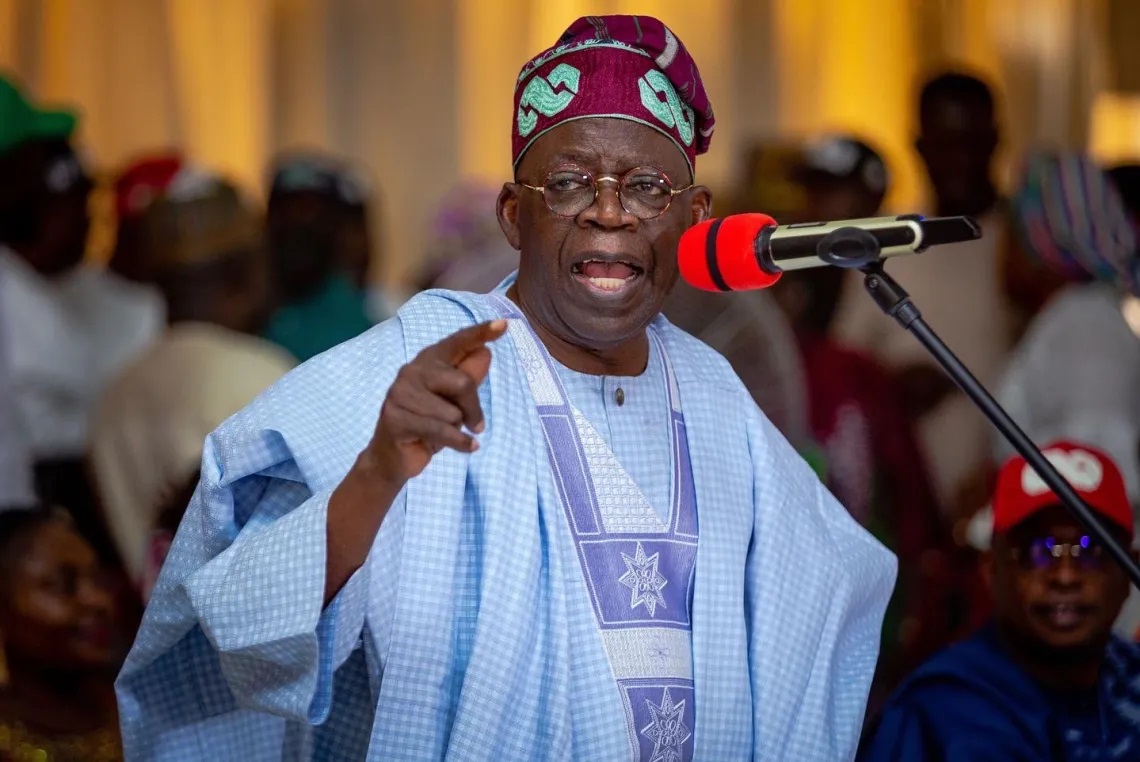
After several days of campaigning across the country by political parties, candidates, and supporters and voting on February 25, 2023, Nigeria eventually had a president-elect, Senator Bola Ahmed Tinubu, as the Constitution provides. From the campaign to the voting period, the political atmosphere was tense for every stakeholder. In this piece, our analyst examines the speech of the president-elect with a focus on how he uses referential and predicational strategies for positioning subjects in order to establish his new identity. Beyond this, our analyst discovered that the president-elect predominantly progresses from strengthening Nigeria’s democracy despite its current challenges to an appreciation of the kind of political competition the country experienced before the campaign, during the campaign and during the voting stages. He also moves to the youth, appreciating their doggedness and clamouring for a better Nigeria, where they could thrive without any hindrance.

Senator Tinubu stylishly refers to the different camps of his opponents, appreciating their roles during the electoral process that ensure sustained democracy for the country without foregrounding their offensive strategies and tactics against him during the period. In this regard, our analyst notes that the president-elect does not use the negative part of the referential strategy expected in formulating discourse. In other words, the president-elect considers appropriating the positive aspect of the strategy since he now wears a “national identity,” which demands that he embrace all competitors towards building a united Nigeria.

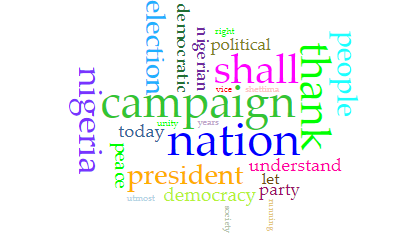
“You decided to place your trust in the democratic vision of a Nigeria founded on shared prosperity and one nurtured by the ideals of unity, justice, peace and tolerance. “Renewed hope has dawned in Nigeria,” is his nodal point statement that pinpoints the importance of appreciating the competitiveness of the election and the need for collectively building a sustainable democracy. The 791-word speech also entails predicational strategies premised on his agenda of renewed hope for Nigerians (see Exhibit 3).

Exhibit 1: Dominant words in his speech

Source: Tinubu’s Speech, 2023; Infoprations Analysis, 2023

Strengthened democracy

Whether you are Batified, Atikulated, Obidient, Kwankwasiyya, or have any other political affiliation, you voted for a better, more hopeful nation and I thank you for your participation and dedication to our democracy.

Finally, I thank the Nigerian people for their abiding belief in our democracy. I shall be a fair leader to all Nigerians. I will be in tune with your aspirations, charge up your energies and harness your talents to deliver a nation that we can be proud of.

Political competition

This was a competitive, high-spirited campaign.  You have my utmost respect. Political competition must now give way to political conciliation and inclusive governance.

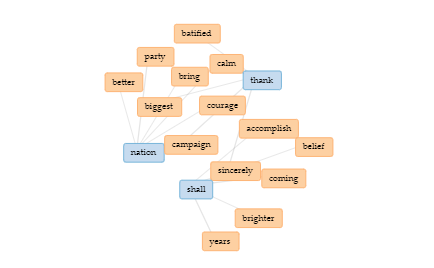
Exhibit 2: Connectivity of nation, shall and thank with his discourse elements

Source: Tinubu’s Speech, 2023; Infoprations Analysis, 2023

Youths and sustainable nation building

Now, to you, the young people of this country, I hear you loud and clear. I understand your pains, your yearnings for good governance, a functional economy and a safe nation that protects you and your future. I am aware that for many of you Nigeria has become a place of abiding challenges limiting your ability to see a bright future for yourselves. Remodeling our precious national home requires the harmonious efforts of all of us, especially the youth. Working together, we shall move this nation as never before.

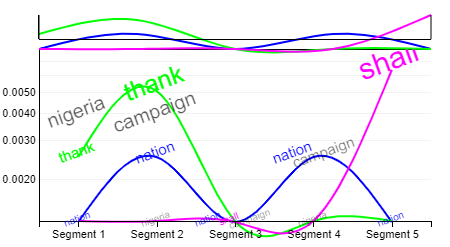
Exhibit 3: Discursive movement of nation with other elements

Source: Tinubu’s Speech, 2023; Infoprations Analysis, 2023

Summary of Nigeria 2023 Presidential Election; Pollsters Got The Outcome Right On Low Turnout

0

In the final result called by INEC, Nigeria’s election umpire, here are the main summaries, from the 36 states of the federation and Abuja:

Tinubu of APC scored the highest votes; 8,805,420 votes and won 12 states (Rivers, Borno, Jigawa, Zamfara, Benue, Kogi, Kwara, Niger, Ekiti, Ondo, Oyo,  Ogun).

Atiku (PDP) scored 6,984,290 votes; won 12 states (Katsina, Kebbi, Sokoto, Kaduna, Gombe, Yobe, Bauchi, Adamawa,  Taraba,  Osun, Akwa Ibom, Bayelsa).

Obi (LP) got 6,093,962; won also 12 states (Edo, Cross River, Delta, Lagos, FCT, Plateau, Imo, Ebonyi, Nasarawa, Anambra, Abia, Enugu)

Kwankwaso (NNPP) won 1,496,671 votes and won a state – Kano State.

Using the results, Tinubu scored at least 25% of votes in 29 states; Atiku (21) and Obi (16). One needs at least 24 or 25 states (including Abuja). Based on that, Tinubu gets the call.

Pending a determination that the total canceled votes (many of them across the nation) will not change the outcome, INEC will do the trigger and make a call for Tinubu.

Yet, this is a really low-turnout election which is contrary to alternate data. In 2019, APC received 15,191,847 votes while PDP finished with 11,262,978 votes, giving at least 26 million to elect the president. In 2023, you have about 21 million voters. In 2015, the number was about 28.2 million.

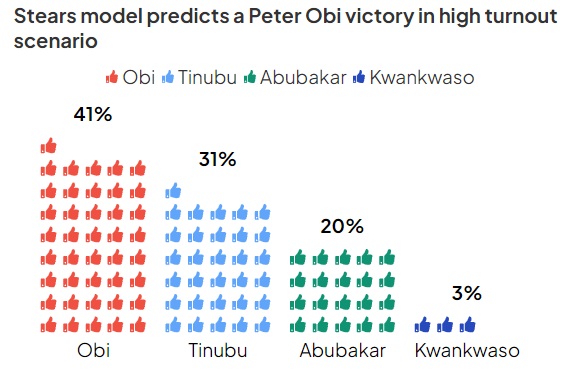
The pollsters are correct: Obi wins with high turnout, but Tinubu wins with low turnout. This election, from official numbers, is low turnout but INEC has to explain how it lost at least 5 million voters in a cycle where more people registered, collected PVCs, etc, implying that voter suppression possibly changed the outcome.

Data Analytic Startup, Stears, Calls Nigeria’s Presidential Contest for Peter Obi

The 25% Debacle – The Final Clarification of S.134(2)(B) of the Nigerian Constitution

10

The what-about fuss as to the correct interpretation of s.132(2)(b) is so unnecessary. That provision of the constitution is as straightforward as an arrow and it is a literal provision of the constitution and should be interpreted as such. Any other interpretation rule adopted for its interpretation other than the literal rule will only bring about a fundamental departure from its original contemplation which will only be hazardous. 

The misinterpretations and debacle about what that section really postulates is just a mischievous ploy by mischief makers and understandably, from the aggrieved party members who are currently drowning in the pool of defeat, therefore, looking for the slightest branch of a tree to lay hold on to grasp for air so as to save their faces.

For the record, my preferred candidate by every indication may likely not win the presidential election, but it will be mischievous and dishonourable on my part as a lawyer to try to twist the provisions of the constitution as some so-called lawyers have been doing on social media, deceiving the gullibles and hitting up the polity just because their prefered candidate did not win; this is so low of a lawyer. 

For the sake of emphasis, this section of the constitution [S. 134(2)] which gained notoriety since yesterday is worded thus; 

Section 134(2) :

(2) A candidate for an election to the office of the President shall be deemed to have been duly elected where, there being more than two candidates for the election – 

(a) he has the highest number of votes cast at the election; and 

(b) he has not less than one-quarter of the votes cast at the election in each of at least two-thirds of all the States in the Federation and the Federal Capital Territory, Abuja.

To this effect, using the literal rule of interpretation to (literally) interpret what the constitution contemplated here; simply means that for a candidate to be deemed duly elected he must have at least won 2/3 of the majority votes cast in the country. Mathematically, 2/3 of 37 States of Nigeria (37 when you add the FCT) means that he must have scored 25% of at least 25 states, including the FCT; not that he must score 25% of 25 States and also get 25% of the FCT. The FCT has no other special privilege outside being another state of the federation, so the thought that a contestant after scoring 25% of 25 States must as well score 25% of the FCT is rather ridiculous. 

The conjunction “and” used in paragraph B of the S 134(2) which is what has been causing the confusion simply means what it is; “with the FCT inclusive”.

Someone may want to argue that FCT is not a state, but yes, in a plethora of cases, the court has adopted that the FCT may not be a state as properly so-called but is to be regarded as well as a state of the federation which is to be administered by the FCT ministers who acts as it’s governor.  In fact, in S. 299 of the Constitution, the provisions stipulate thus; “The provisions of this Constitution shall apply to the Federal Capital Territory, Abuja (as if it were one of the States of the Federation)”.  This is to say that the constitution has always held FCT to be regarded as the 37th state of the federation. 

In summary, a candidate who has secured 25% of votes in 25 of any states of the federation which has made up the 2/3 majority has fulfilled the constitutional threshold to be deemed elected as provided in paragraph B of the S 134(2), he does not have to secure 25% of the votes cast of the FCT after securing 25% of other 25 states of the federation.