DD
MM
YYYY

PAGES

DD
MM
YYYY

spot_img

PAGES

Home Blog Page 4447

Merchant Banking, Commercial Papers Regulations in Nigeria

0

Merchant Banking Regulations

Merchant Banking involves the rendering of financial services focused around underwriting, fundraising, financial advisory, and loan services for large corporations and High Net Worth Individuals (HNWIs).

In Nigeria, merchant banking is regulated by the Central Bank of Nigeria (CBN) through its 2010 Merchant Banking Regulations.

This article will be looking at some of the most important provisions of these regulations as well as some of licensing and operational requirements for merchant banking in Nigeria.

What are the permissible and non-permissible activities for merchant banks in Nigeria?

Permissible Activities

– Taking deposits of not less than 100 Million Naira or such other prescribed minimum amount from natural or legal persons .

– Providing finance and credit facilities to non-retail customers.

– Dealing in foreign exchange and providing foreign exchange services subject to the relevant laws of Nigeria.

– Act as an issuing house or otherwise manage, arrange or coordinate the issuance of securities for or on behalf of any person, subject to the provisions of the Banks and Other Financial Institutions Act (BOFIA).

– Providing treasury management services including the provision of money market, fixed income and foreign exchange investments on behalf of clients.

Non-Permissible Activities

– Accepting deposit withdrawals by cheque.

– Granting retail loans or engaging in retail banking.

– Holding for more than 6 months any equity interest acquired in a company while managing an equity issue.

– Insurance underwriting services.

What are the minimum operating standards for merchant banks under the CBN Regulations?

A merchant bank shall maintain the following minimum standards under the CBN Regulations :-

– Maintain a minimum paid-up share capital of 15 Billion Naira or such other amount as may be prescribed by the CBN.

– Comply with all prudential guidelines and regulations issued by the CBN on the required level of capital adequacy, liquidity and cash reserve.

– Observe all applicable corporate governance standards as may be prescribed by the CBN and other financial service sector regulating authorities in Nigeria.

– Design, comply with and implement an internal control framework in accordance with the standard that the CBN may prescribe from time to time.

Can merchant banks own subsidiaries?

Yes they can, but subject to the limitations placed by the CBN Regulations.

Commercial Papers in Nigeria

In the course of business operations, many businesses go for short to medium and long-term credit facilities in the form of financing options that can be channelled to business expansion or diversification projects.

One of the more recent financing options available to businesses are Commercial papers for a number of reasons.

This article will be looking at what commercial papers are, the regulatory framework governing commercial papers in Nigeria, the necessary parties to a commercial paper transaction and the necessary documentation required in a commercial paper transaction.

What exactly is a commercial paper?

A commercial paper is a short-term debt security instrument that is typically unsecured and which carries a maturity period of usually not more than 270 days. A commercial paper is not a debenture in the strictest sense as debentures are typically convertible, secured and having a longer maturity period.

What are the components of the regulatory framework governing commercial papers in Nigeria?

Commercial paper transactions are under dual-regulation by the Securities and Exchange Commission (SEC) as well as the Central Bank of Nigeria (CBN) through its approval of the Quotation rules of the FMDQ Over The Counter Securities exchange. 

Are commercial papers money market instruments?

Yes they are , though they are traded specifically at Over The Counter (OTC) markets.

Can private companies issue commercial papers despite the FMDQ OTC market being regulated by the SEC?

Yes they can. 

What are the requirements for the issuance of commercial papers under the CBN Guidelines and FMDQ rules

The requirements for the issuance of a commercial paper are :-

– The issuer must have a 3-year audited financial statement

– The issuer must have been in existence for at least 5 years post-incorporation and must have a share capital of 500 Million Naira or must be supported by a guarantor that meets these requirements.

– The issuer must have a line of credit with a Nigerian bank.

– Guaranteed commercial papers granted to an obligor must not be above 30% of a bank’s unimpaired shareholders fund.

What is the minimum prescribed value of a commercial paper in Nigeria?

Commercial papers at issuance are required to have a minimum value of 100 Million Naira and subsequent values of 50 Million Naira.  

Who are the parties to a commercial paper issue?

The parties to a commercial paper issue are :-

  1. The issuer
  1. The Issuing & Placing agent (IPA)
  1. The collecting and paying agent (CPA) 
  1. The Credit rating agency
  1. The guarantor
  1. The underwriter
  1. The solicitor
  2. The promoter

What are the most necessary agreements required for the issuance of a commercial paper?

The necessary documentation for a commercial paper issuance includes :- 

– A Deed in favour of the holders of the paper.

– An underwriting agreement.

– A Deed of Guarantee where applicable.

– A custodial agreement which is executed between the issuer and the issue custodian (who must be licensed by SEC).


What to Do If Your ISP has Blocked a Torrent Site?

0

Torrent sites can be blocked by ISPs, but on the pirate bay, you can find a current and working list of torrent sites. However, is it possible to bypass these blockages? Yes, it is possible to arrange it so that your ISP will not know that you are visiting a blocked site or using a blocked messenger. To do this, you need special intermediaries: they can help you create encrypted communication channels with servers located abroad and redirect your Internet traffic through them.

What kind of intermediaries are these? These can be special sites or servers, browser extensions or browsers with built-in web-blocking features, or programs that connect your device to secure networks. Some of these are completely free, while others require a fee.

And if I Regularly Want to Visit Blocked Sites?

Then it is better to use special browser extensions like Browsec or Zenmate for Google Chrome and Mozilla Firefox. Or you can install Opera – a browser with a built-in secure proxy server. Note that blocking can be bypassed only by the browser for which you install the extension. Other applications (such as torrent clients or messengers) will not be able to bypass blocking.

If the authors of such extensions do not cooperate with the authorities, they will have to play “cat and mouse”, constantly changing the IP address. But for users, it will look like a simple automatic update of the extensions.

Are There Any Universal Tools?

EVPN. They let all your Internet traffic through their servers and allow you to bypass blocking for any application, such as a messenger, or cope with slow downloading torrents. You can connect stationary computers and laptops, mobile devices, and even some home routers to such a network. It all depends on your particular provider. You can try free services Opera Free VPN (only mobile devices) or CyberGhost VPN.

If the owners of VPN services agree to cooperate with the authorities, then you’ll need not one but two law-abiding VPN providers to bypass blockades. The first will allow you to pretend to be a foreigner, so the second will not apply to your blocking from the blacklist. In addition, blocking will be officially allowed to bypass the corporate VPN, which is used by company employees.

How to Protect Yourself and Identify Fake Torrents

Use the search engine DuckDuckGo if you’re having trouble finding a torrent tracker. It is much more private than Google and is less likely to hide URLs due to DMCA (Digital Millennium Copyright Act) requests, which aim to block services that circumvent copyright measures.

Beware of fake torrent trackers. Multiple windows, registration requests, and questionable-looking URLs are signs of malicious sites. Fake sites often imitate real torrent trackers when they are shut down and may contain malware as well. Use a trusted torrent client such as uTorrent to download files after you have found a trustworthy site.

Check the security of each torrent before you download it. Check the history of the author of the giveaway to see if he or she publishes quality and popular torrents. I avoid new authors and only download verified torrents – unverified torrents can easily install malware on your device. To increase the likelihood of downloading a reliable torrent, pay attention to the ratio of sitters to listers. It is also helpful to read comments on torrent pages to be aware of potentially dangerous downloads beforehand. Remember that your anti-virus program may sometimes work falsely for safe files.

Use quality security software to scan RAR, TAR, and ZIP files for malware, and pay special attention to EXE files. These are the files that most often initiate malicious processes. Avoid outdated WMA and WMV file formats. Download a secure VPN and a trusted malware scanner to protect your personal information and device while downloading torrents. You can also connect a quality ad-blocking service before you start visiting torrent trackers.

Orion Protocol Suffers $3M Hack on it Core Smart Contract

0

Just recently Orion protocol was hacked to a tune of $3 million due to a reentrancy issue in its core contract: ExchangeWithOrionPool. Orion Protocol is the first gateway to the entire crypto market, aggregating every CEX, DEX, and swap pool into one decentralized platform.

The hacker repeatedly called the “depositAsset” function which exposed the contract to the exploit. It started with initial funding of 0.4BNB from Tornado Cash to Orion, and another 0.4ETH via SimpleSwap. The hacker moved to withdraw about 1100 ETH via Tornado Cash and locked up some 657 ETH in his wallets.

Orion Protocol CEO Alexey Koloskov confirmed the hack in a Twitter thread, stating that the hack was caused by a vulnerability in third-party libraries used during Orion’s development. Both the eth/bsc deployment channel are hacked. Interesting how hackers know what flaws to target. They have great knowledge too bad they are using it wrong.

The hack was made possible due to incomplete reentrancy protection: swapThroughOrionPool function allows user-provided swap path with crafted tokens whose transfer can be hijacked into re-entering depositAsset function to increase user balance accounting without actually costing funds.

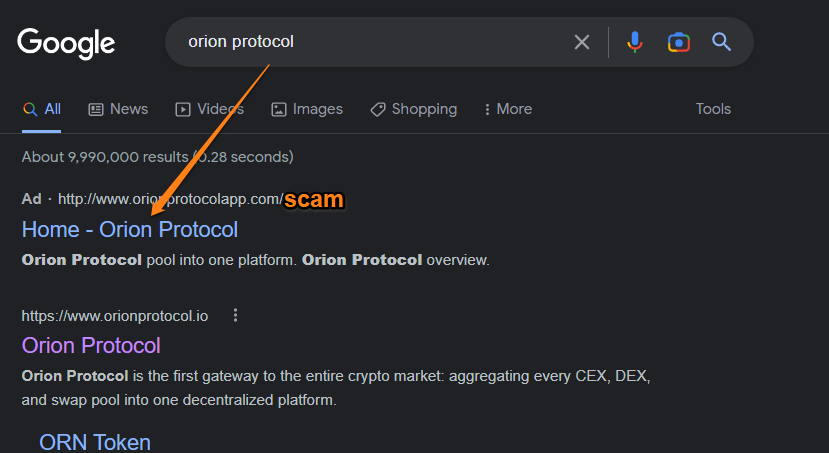
Searching on Google “orion protocol” and it seems the first link goes to fraud website, When entered by mistake and it asks you to sign a suspicious transaction that can get control over your wallet.

Responding to the hack, Changpeng Zhao, CEO at Binance tweeted;

There was a hack in Orion Protocol ($ORN) due to a lack of re-login protection. The loss is ~$3M. Our security team is monitoring the hacker addresses. No Binance users / assets were affected, Stay SAFU.

However, CEO Alexey Koloskov claimed that the stolen funds were from Orion’s Treasury, adding that all users’ funds are safe.

We want to reassure our users that no user experienced any loss during this incident. The assets at risk were in internal broker’s accounts run by ourselves-the Orion team.

To avert potential vulnerabilities from third-party libraries, Koloskov said that the Orion team will prioritize developing all its contracts in-house.

EV Company Xpeng Pushes Aggresively Into International Markets

0

Chinese leading short electric vehicle Xpeng is pushing aggressively into the international markets after it launched two of its flagship vehicles across a number of European countries.

The company revealed that the revamped version of its P7 sedan and its G9 sports utility vehicle SUV are available for order in Sweden, Denmark, Netherlands, and Norway.

The company’s president Brian GU via a press statement revealed that the launch of the vehicles is a significant milestone for Xpeng as it continues to deepen its presence in the international market.

The Guangzhou-based car maker which went public in Hong Kong and New York in 2020, has global ambitions and continues to expand further in Europe. Last month, it stated that it will open four vehicle delivery and service centers for the European market in Norway, the Netherlands, Sweden, and Denmark in the first half of 2023.

Xpeng had already begun delivering Chinese-made electric vehicles to Norway in September 2020 and has opened several showrooms in cooperation with local dealers in the continent, including a direct sales store in Stockholm, Sweden. The company has sold 1,264 vehicles in Norway so far, while BYD has delivered 2,710 Tang crossovers

Meanwhile, Xpeng which has sought to challenge Tesla in China though still remains significantly behind Elon Musk’s carmaker when it comes to deliveries, and is also facing a price war with established Chinese EV maker BYD, which focuses on affordability.

The Chinese electric automaker is also gearing up to launch its eVTOL into the air as it secures a key regulatory green light. Xpeng is pursuing these ambitions at a time its main EV business is hitting a speed bump.

The carmaker has pushed back its profit goal until 2025 after a disappointing 2022, in which it delivered less than half of its annual sales target earlier this week.

The company shares plunged 80% and it delivered less than half its annual sales target. Having previously aimed to break even by late 2023 or early 2024, the Guangzhou-based automaker now expects to turn an operating profit in 2025.

To achieve that goal, Xpeng Chief Executive Officer He Xiaopeng stated that he is making a bold bet on full self-driving, a technology that even leading EV company Tesla hasn’t been able to perfect despite years of work.

He is aiming to snare at least 20% of what he calls the “all-intelligent vehicle” market, referring to cars “infinitely close to Level 4 autonomous driving” where the vehicle can handle complex urban situations.

Xiaopeng further disclosed that while no mass-produced passenger cars currently available meet that definition, he said rapid developments in technology will see the market grow to around 5 million vehicles a year in five years.

Tesla is also ramping up production in the country.

Tesla is set to increase output in Shanghai, China, to 20,000 units per week after price cuts increased demand for its cars, Reuters reports, citing a memo. The electric vehicle company cut prices in its lucrative Chinese market on the Model Y and 3 cars by up to 9.4% amid the global economic slowdown, resulting in renewed customer interest. Hoping to boost its disappointing performance over the past year, the company made similar price cuts in the U.S. and Europe, aggravating rivals as well as some customers who made purchases before the discounts.

Tekedia Mini-MBA Begins Monday, Feb 6, 2023

0

We begin on Monday, Feb 6, 2023. Our classroom is unbounded and unconstrained by capacity, and we have a seat for you. From business strategy to ChatGPT playbook, and across 14 modules, over 100+ courses, we deliver unparalleled value for N60k or $140. The #best school begins the next edition on Monday.

Come and let’s co-learn at Tekedia Mini-MBA.

Welcome! At Tekedia Institute, we co-learn with thousands of professionals and students, from 41 countries, on the mechanics of business, connecting innovation, growth and operational execution, across market territories and industrial sectors. Our Faculty members come from Microsoft, Google, Shell, Flutterwave, Nigerian Breweries, NNPC, Jobberman, Coca Cola, PwC, and other great organizations. Besides pre-recorded courseware, thrice weekly, we hold live Zoom sessions (Tue, Thur and Sat at 7pm WAT). REGISTER and join us! – Prof Ndubuisi Ekekwe, Tekedia Institute Lead Faculty.