In search of a solution for the lingering fuel scarcity in Nigeria, President Muhammadu Buhari has approved the constitution of a 14-man Steering Committee on Petroleum Products Supply and Distribution management.
The Steering Committee, which will be saddled with the responsibility of finding a lasting solution to disruptions in the supply and distribution of petroleum products, will be chaired by Buhari, with the Minister of State for Petroleum Resource, Chief Timipre Sylva as Alternate Chairman.
Members of the committee include the Minister of Finance, Permanent Secretary, Ministry of Petroleum Resources, National Economic Adviser to the President and Director-General, Department of State Services (DSS).
Others are Comptroller-General, Nigerian Customs Service (NCS), Chairman, Economic and Financial Crimes Commission Member (EFCC), and Commandant-General, Nigerian Security and Civil Defence Corps (NSCDC)
There are also others: they include Authority Chief Executive NMDPRA, Governor, Central Bank of Nigeria, Group Chief Executive Officer, NNPC Limited, Special Advisor (Special Duties) to the HMSPR while the Technical Advisor (Midstream) to the HMSPR will serve as Secretary.
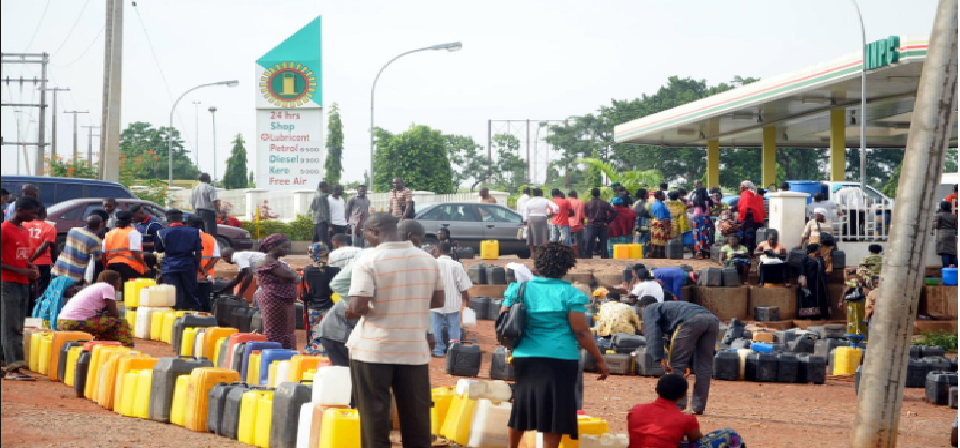
The move became necessary following weeks of fuel scarcity that has unleashed much suffering on people across the country, with the cost of transport rising as filling stations hike pump prices. The situation has been attributed to disrupted supply and distribution of fuel across Nigeria.
Sylva said in a statement by his Senior Adviser (Media and Communications), Horatius Egua that the committee would tackle the challenge of supply and distribution.
The minister has directed the Nigerian Midstream and Downstream Petroleum Regulatory Authority (NMDPRA) to ensure strict compliance with the government approved ex-depot and retail prices for PMS, a move seen as key in making petroleum products available across the country.
As part of the committee’s efforts to ensure that there is adequate supply of fuel, Sylva also directed the NMDPRA to ensure that NNPC Limited, which is the supplier of last resort, meets the domestic supply obligation of PMS and other petroleum products in the country.
In addition, the minister directed the committee to ensure that the interests of the ordinary Nigerian is protected from price exploitation on other deregulated products such as Automative Gas Oil (AGO), Dual Purpose Kerosene (DPK) and Liquified Petroleum Gas (LPG).
“The Federal Government will not allow misguided elements to bring untold hardship upon the citizenry and attempt to discredit government’s efforts in consolidating the gains made thus far in the oil and gas sector of the economy,” he said.
Other terms of reference are said to ensure national strategic stock management, visibility on the NNPC Limited refineries rehabilitation programme and ensure end-end tracking of petroleum products, especial PMS to ascertain daily national consumption and eliminate smuggling.
Buhari is understood to have chosen to set up the committee after other efforts to curtail the fuel scarcity fail. Fuel is currently being sold from N185 to N300 in many parts of the country. Many Nigerians have accepted the price but still don’t see fuel to buy as many filling stations are closed.
The fuel scarcity is also crippling businesses that depend on generators for electricity supply as power supply has been more epileptic due to shortage of gas supply to power stations.
Update: Reasons for Fuel Scarcity in Nigeria
Major oil marketers under the aegis of the Major Oil Marketers Association of Nigeria (MOMAN) has noted the core reasons for fuel scarcity in Nigeria:
MOMAN said, “These queues are caused by exceptionally high demand and bottlenecks in the distribution chain. The major cause is the shortage and high (US dollar) costs of daughter’s vessels for ferrying products from mother vessels to depots along the coast.
“Next is an inadequate number of trucks to meet the demand to deliver product from depots to filling stations nationwide. These high logistics and exchange rate costs continue to put pressure on prices at the pumps.
“Over the past three months, staff and management of MOMAN companies have worked diligently at depots and filling stations to relieve the stress faced by customers through the Christmas and New year period.”
“Our members have again agreed to extend depot loading hours as well as keep strategically situated service stations open for long
“A final resolution to these challenges will be the full deregulation of the petroleum downstream sector to encourage the liberalization of supply and long-term investment distribution assets. We urge the government to work towards this end goal.’’
In thisupdate by LinkedIn News, we are learning that US big banks are working together to create a product which could compete with PayPal and Apple Pay: ” Those firms are worried that third-party wallet operators such as Apple could dominate customer experience, leaving banks to run the financial architecture behind the scenes.” Indeed, the banks can build and sustain the infrastructure which makes banking and broad financial services possible while PayPal and Apple Pay just clean up on the value created.
The nation’s big banks are working together on a digital wallet that can be used to shop online — and which would compete head-on with Apple Pay and PayPal, reports The Wall Street Journal. The wallet will be linked to shoppers’ debit and credit cards and will be operated by Early Warning Services (EWS), a joint venture owned by JPMorgan Chase, Bank of America, Wells Fargo and several other banks. Those firms are worried that third-party wallet operators such as Apple could dominate customer experience, leaving banks to run the financial architecture behind the scenes. EWS, which also manages Zelle, plans to launch the wallet in the second half of the year. A PYMTS study in December found that in-store use of Apple Pay grew 56% year-over-year, while online use climbed by 63%.
As things stand today, that is actually what happens. When you receive $100 in your US bank account, the bank does not take any fee. But when you receive the same in your PayPal wallet, as payment, you will be off by at last $3. While someone can argue that the money kept in the bank can be used by the bank to do lending, we can also posit that the funds in the PayPal wallet can also be deployed by PayPal into many other profit-making activities. My point is clear: the banks do not capture a lot of value while PayPal and others like it do.
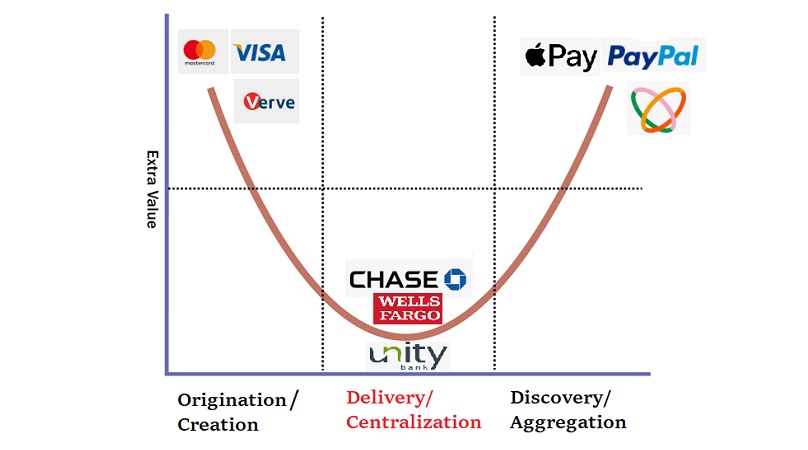
You can explain what is happening in a curve: the smiling curve. The companies which are at the center capture least value, and most times, there are the ones which support the ecosystem the most. But those at the edges capture the most value even though they do not provide a lot of catalytic support in the ecosystem.
PayPal and Apple Pay operate at the edges and extract tons of value while the US banks remain lost in the center capturing just a small value.
This video explains the phenomenon. Indeed, where you operate on that curve determines the value you can create and capture, well more than the efforts you are putting in. You can be working really hard as a bank by handling the delivery and centralization of customer assets while those firms at the origination/creation and discovery/aggregation positions smile.
Of course there are many value challenges for banks in general:
Fed up with big banks’ meager interest rates on checking and savings accounts, many wealthy Americans are pulling out their cash and investing in higher paying products. While the Federal Reserve has been hiking rates for nearly a year, the typical savings account only pays a 0.33% interest rate, The Wall Street Journal reports. But Treasury notes, money-market funds and brokered certificates of deposit pay between 4% to 5%. Affluent customers are taking advantage of those higher rates, causing a flight of deposits from banks’ wealth management businesses. Deposits at the Bank of America’s wealth unit sank 17% last year to $324 billion. Deposits in the consumer unit, meanwhile, fell only 0.6% to $1 trillion.
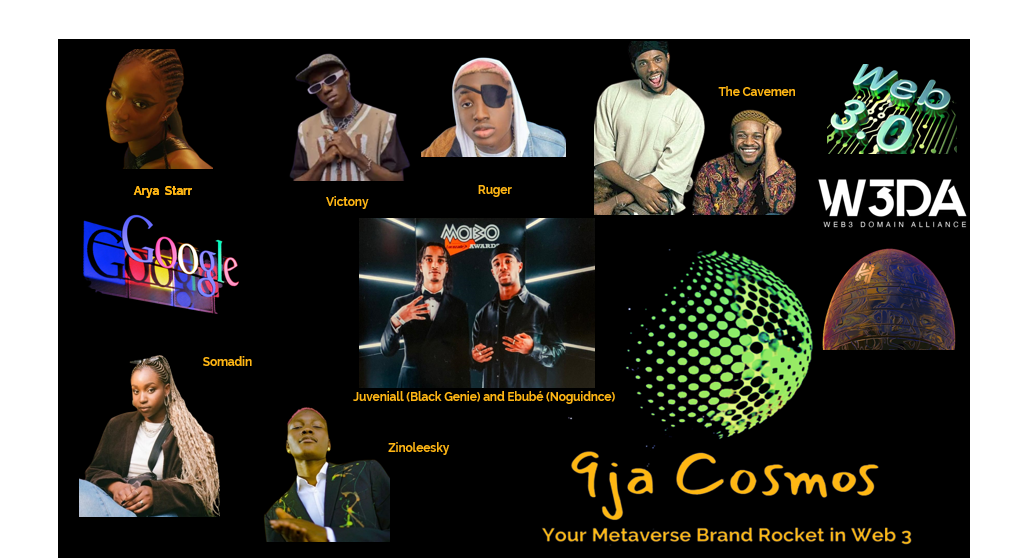
A dozen up and coming West African musicians and Google, which is the odd one out?
Well, you would have probably all guessed Google, it’s a no brainer.
The question is not that you picked Google, the question is why?
FINDING PARTNERS
Any time I am in front of a computer, even when doing something completely unrelated, I usually have at least one ‘node’ into the Handshake Blockchain open, so that I can take passive glances at what is going on in the world of WEB 3 DOMAINS.
For the unfamiliar, WEB 3 DOMAINS are a technology only a few years old. Instead of using the organisation ICANN as the root for internet domains, they use a blockchain.
This makes them decentralized, which makes it much harder for online activities to be snooped upon or personal data recorded. It also makes it impossible for a sovereign actor to take you down.
So, I had previously been in a bar restaurant discussing taking on a junior partner in exchange for equity in 9ja Cosmos. He is a final year overseas scholarship student in my home. During the discussion he laboured on how he grew up with one of the artists in this articles feature image.
Something about his claims didn’t feel right. He made some comments which provided data which could be investigated. For example, both of them may have Yoruba names, but if one is found to have gone to primary school in Sagamu, and the other in Ore, how could they have been walking home together as primary school mates as claimed?
It doesn’t matter to me that the prospect has connections on a path to fame. What matters is that partnership involves trust, and if he can’t be trusted to be truthful about little things like this, what about big things? A bit of ‘Due Diligence’ will reveal this.
DUE DILLIGENCE IN BLOCKCHAIN AND CRYPTOCURRENCY.
I like ‘absolute’ explanations for things. If water flows downhill if poured on the ground, theory of gravity explains to me why that happens. If someone pours water on the ground and it flows down hill, and they do it 100 times, this doesn’t offer me confidence that the 101th time they do it, water will flow downhill. It is the empirical proofs behind ‘theory of gravity’ which instils confidence in me that it will be so.
In the same way, I can’t listen to people that pull out silly graphs to show me what a cryptocurrency has done before, as some sort of predictive tool a bull market in that currency will happen again.
That isn’t to say that I’m a cryptobasher and call cryptocurrency ‘monopoly money’. Most of the nonsense about government guarantees over FIAT are fairy tales. The government bond embodied in its sovereign currency is only as good as its taxpayers continued ability to pay.
With many of even the most respected currencies in the world now running at a government borrowing rate in excess of their GDP, its now reasonable to question the collective ability of their taxpaying citizenry to pay.
Smoke and mirrors tricks with everything from quantitative easing, to fractional reserve banking, from sovereign government, through central bank, and on to commercial banks, and other market based actors, all give solid reasons why confidence should shift to other ‘value instruments’ as a trading tool.
Nevertheless, if FIAT is as flawed as many cryptobulls claim, then they need to justify rising cryptocurrency value by some other indicator except a comparison of those very same FIAT instruments.
If they want to convince me that Bitcoin is worth 25% more than it was worth six months ago, they need to show me that in an absolute sense, without introducing dollars or euros, or pounds, or yen into their justification. I don’t want to know what, I want to know why.
HANDSHAKE WEB 3 DOMAINS AND HOW THAT IMPACTS THE COIN.
I saw something today on Blockchain Council that said: ‘Utility NFTs are special. Special in a way that the scope of their potential is not limited to the title of a typical ‘digital collectible.’ When we talk about utility NFTs, we emphasize the word ‘utility’ because that is where the heart of this asset class lies. Precisely, utility NFTs refer to virtual assets that offer privileges, benefits, or rewards to their owners which are otherwise not available for use. They bestow upon a ‘right’ to extract a service or an advantage to the asset holder.’
I try to avoid using the acronym NFT because it’s quite often misused and a lot of people don’t have a full understanding of it, because they have listened to ‘misuse’ definitions. But I think Blockchain Council have something here with the ‘Utility’ concept.
I consider the term ‘utility’ to mean ‘things created and minted to a blockchain that are capable of offering more than just <being> ‘ They have to be more than just ‘the coin’.
With the advent of AI generated digital art, we didn’t get anything really better than the coins. It became the same thing dressed up differently. People were not buying them through appreciation of aesthetics, they were buying them in the hope they would appreciate relatively, again, against the dollar or some other FIAT, no different to the motivation to buy cryptocurrency.
If it is so important for us to get out of FIAT currency and get into cryptocurrency or digital art as ‘investments’ then why don’t pundits track a bored ape yacht club art against its value in ape coins instead of dollars ??
Web 3 Domains started off with limited application due to lack of interoperability with existing systems though for the most part, this is down to legacy architecture, and other blockchain projects not seeing interoperability as important.
This is gradually changing. Projects are coming out of GitHub that are improving the usability of Handshake Domains. Development work is being done with Skiff to create email systems that while decentralized, they are capable of engaging with accounts in the centralized ICANN world should owners choose.
This is what I expect to happen on blockchains, that the products and services operating on them are actually evolving. If people want to explain to me why one particular coin or the other is worth more than it was six months ago, this is what I need to hear from them, not dollar exchange rate analysis.
RISING MUSIC STARS AND WEB 3 DOMAINS.
Now back to how I began. As I was researching the artist my ‘partner prospect’ claimed to know, I decided well, since my node is open, I might as well check out if their name was taken.
It was.
I then checked some articles on about a dozen rising West African music stars. Nine of them (those pictured in this articles’ feature image, were registered.
These are upcoming artists. While certainly of notoriety, they will not have huge corporate machines built around them like decades old global mainstream sellers such as U2, or the estates of the late Michael Jackson or David Bowie.
They have not had the benefit of establishment of Angélique Kidjo, Awilo Longomba. Youssou N’Dour. or late and greats – Fela Kuti and Prince Oliver De Coque.
But their names are registered in this latest iteration of the Internet.
Speaking with Juveniall two days ago, he said, well, while he’s made his own arrangements, it’s not proven any of his peers actually registered their names. Any fan could have done it.
While this is true, from the point of the technology of 9ja Cosmos Ecosystem reaching mainstream, it doesn’t really matter.
The Handshake Community in which 9ja Cosmos participates at the turn of the year now stands at over nine million top level domains issued. It is reaching into every business and community sector in every part of the world.
So what is the contrast with Google?
Well, unlike these artists, Google hasn’t exploited the advantages integrating our technology has to offer.
Meanwhile, integrating Web 3 technology into browsers and search engines alongside legacy ICANN conformance isn’t difficult.
Many browsers these days are actually built on top of Google Chrome Engine, which is open source. These include Microsoft Edge, Opera, Vivaldi, Comodo Dragon, AVG Secure Browser, and Brave.
Brave already integrates all Web 3 domains that ‘live’ on the Ethereum ecosystem. So if a much smaller company like Brave can do it, then for sure, Google can.
The thing is, on the Ethereum ecosystem, there is ‘.eth’ itself, Unstoppable Domains has about 7 or 8 TLDs and with a handful of other TLD operators, its being generous to round it up to fifteen.
The Handshake ecosystem has passed 9 (nine) million Top Level Domains – No comparison! Even the ICANN system, which has been operating since around 1994, only has about 1500.
Google could have been integrating on this at least, since some point in 2021, and once the traffic is captured, work on a monetizing strategy. Perhaps then, they would not have needed to fire twelve thousand workers!
So with twelve thousand industry experts with nothing new to do, and 9 million top level domains available for integration, each one of those 9 million capable of becoming a ‘dot com’ all on its own; and…. an open source Chrome Engine just out there, available for anybody to use…
if I was Google, I would be afraid, VERY afraid!
Meanwhile,
9ja Cosmos is here…
Get your .9jacom and .9javerse Web 3 domains for $2 at:
We took a sample of learners joining us at the next Tekedia Mini-MBA starting Feb 6, on one special course we should include. The message is clear: add Overview of ChatGPT & DALL-E 2 and Potential Business Opportunities in Africa. Of course, that is what our mission is: educate on things people care about.
ChatGPT is a text generator and DALL-E 2 is an image generator – and both work on natural language instructions. Both were developed by OpenAI run by Sam Altman. I just checked my emails and noticed that I received a message from Sam in April 2022 announcing their first research launch on DALL-E 2. People, in less than a year, they have made gigantic progress – and they’re about to change the world.
So, I am reaching the world: can you help and teach this course for us? We will give you enough time to develop it since our program will run from Feb 6 to May 6, 2023.
I listened to a science program yesterday on NPR (US national public radio) and was inspired by the young man who created an app to help schools catch essays written by ChatGPT. He had already resigned from his day job to focus on making that app better. Indeed, there are going to be opportunities. We want big thinkers to provide guidance so that our learners will play ahead.
If you have the skill and can help, please email info@tekedia.com
(We have also written OpenAI via our contact for any material they can share. Of course, their focus now will be technical partners and not business school partners)
Tekedia Mini-MBA already offers courses on singularity and other big futurism topics, developed by eminent global experts in the industry.
Exponential Technologies and Business Opportunities in the Age of Singularity – Edward Hudgins, PH.D
Singularities, Transhumanism, and Entrepreneurship – Gennady Stolyarov II
Singularity, Exponential Growth and Technology – Chogwu Abdul, PhD
Futurism, Malleability, and Category King Companies – Brent Ellman
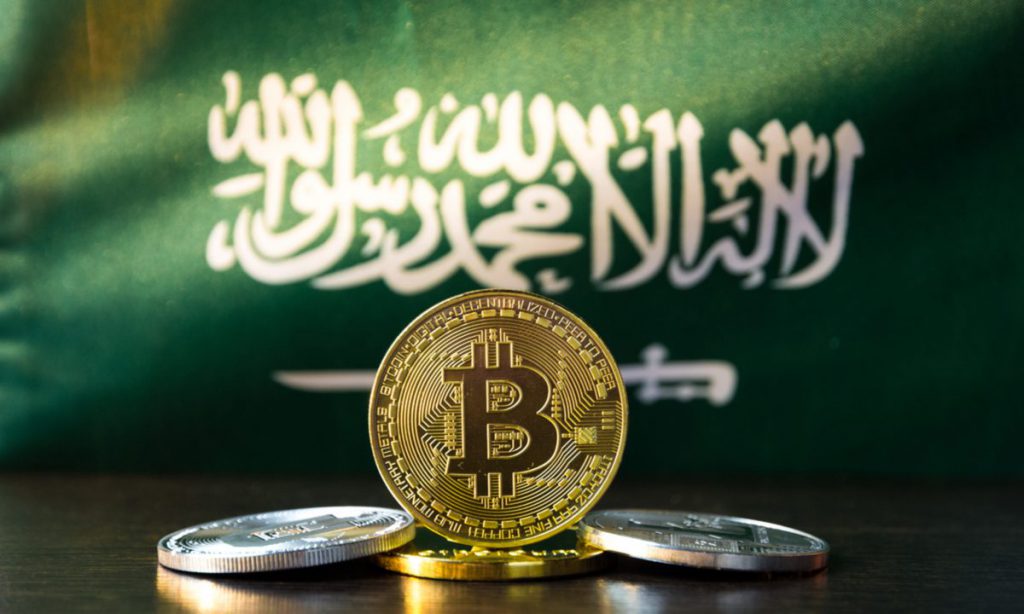
Saudi Arabia’s Central Bank [SAMA] launches CBDC experiments while El-Salvador paid its debt in full with interests accrued from its Bitcoins Investments over the years
SAMA is carrying out experiments with a central bank digital currency in cooperation with other financial institutions and fintech firms, the Saudi Press Agency reported. The project is in line with measures taken by central banks around the world to issue widely accessible digital coins to ensure privacy and financial security.
SAMA CBDC development is merely in its first phase. It notes that the Central Bank is set to “review policy, legal and regulatory considerations before moving to the next phase of the CBDC journey.” This aligns with the nation’s Saudi Vision 2030.
H.E. governor Fahad Almubarak opined that;
Local banks and payment companies will always be the cornerstone of this project and its implementation, stating that it has already opened discourse with “both local banks and fintechs, as well as other market players and third-party consulting and technology providers,” throughout the CBDC development.
112 countries, representing over 95% of global GDP, are exploring a CBDC. While 11 countries have already launched a digital currency, 14 countries are testing pilot programs, including South Korea, Nigeria, Thailand, Sweden, China and now Saudi Arabia.
RishiKumar.eth, candidate for Silicon Valley’s House of Representatives stated on microblogging platform Twitter that;
Saudi Arabia is now ‘open’ to the idea of trading in currencies besides the US dollar, the “de-dollarization” of the global economy is beginning.
We need to push fo an American CBDC lest the Chinese, European or Indian CBDCs takes over the global economy.
Vladimir Putin- Russia, President XI- China, and King Salman Bin Abdulaziz- Saudi Arabia, have all been very vocal during ‘WEF’ meetings on Central Bank Digital Currencies (CBDC), probably not the best role models as states.
Its being trialled in parts of the West too. I did wrote about the Federal Reserve had done some trials on incorporating CBDCs into the US fiscal scheme. UK – Treasury singing on a leader for the development of their Digital Pound. Again, looking at the last 90 days for the UK, they’re moving much faster.
The only reason for it is state control and its going to be the most important political fight we will all ever face. Once they control your money they control your life. When Saudi Arabia publicly announces that the U.S. dollar is no longer the world reserve currency and the Brenton Woods Agreement is over.(which it is right now) and they are accepting multiple digital cbdc for oil trade worldwide.
Crash/hyperinflation; China is making deals with Saudi Arabia on oil and military support. Once Saudi Arabia joins BRICS it will sound the death knell of the Petrol-dollar-dominated market bringing the US economy to its knees. The only thing left is for the US to end fiat dominance and start a push for massive CBDC roll out.
Statement….
The Saudi Central Bank (SAMA) continues to experiment on Central Bank Digital Currency (CBDC) as it is currently working on a phase of a project that focuses on domestic wholesale CBDC use cases in collaboration with local banks and fintechs.
This project comes in line with several central banks CBDC initiatives across the globe and as part of SAMA’s ongoing research and experimentation on CBDC. During this phase of the project, SAMA seeks to explore CBDC economic impact, market readiness, and potential robust and fast applications of a CBDC-based payment solution. In addition, SAMA seeks to review policy, legal and regulatory considerations before moving to the next phases of the CBDC journey to contribute to achieving the objectives of Saudi Vision 2030.
The Governor of SAMA H.E. Fahad Almubarak stated that local banks and payment companies will always be a cornerstone of this project and its implementation, SAMA stated that it has engaged both local banks and fintechs, as well as other market players and third party consulting and technology providers, to gain a better understanding of CBDC’s functionality and to test various design options.
SAMA is set to continue with its research on CBDC while consulting with relative international bodies, local government entities and public. Additionally, SAMA will continue to experiment on CBDC solution as an infrastructure enabler of innovation in financial services that has the potential to contribute to a more resilient payment ecosystem and accelerate digital transformation in the local financial sector.
SAMA stresses that although no decision has been made regarding the introduction of CBDC in the Kingdom, it continues to focus on exploring the benefits and potential risks of implementing CBDC. This will contribute to informed decision-making within SAMA and to CBDC explorations within the central banking community.
It is worth noting that SAMA successfully conducted CBDC experiment “Project Aber” in 2019, an initiative in collaboration with the Central Bank of the UAE to examine whether distributed ledger technology could contribute to seamless cross-border payments.