DD
MM
YYYY

PAGES

DD
MM
YYYY

spot_img

PAGES

Home Blog Page 4485

As Microsoft Lays Off 10,000 Workers, the Battle with Machines is Evolving

1

It is really not the type of rain you would expect in tech: many layoffs across all domains of technology space, from consumer to the enterprise world. Yes, ‘Microsoft plans to lay off 10,000 employees as part of broader cost-cutting measures, the company said in a securities filing on Wednesday, making it the latest tech company to reduce staff because of growing economic uncertainty. Speaking before the layoff announcement at the World Economic Forum (WEF) in Davos, Switzerland, on Wednesday, Microsoft CEO Satya Nadella said that the company was not immune to a weaker global economy. “No one can defy gravity and gravity here is inflation-adjusted economic growth,” he told WEF founder Klaus Schwab in a livestreamed discussion.’

The problem though is that this process is just the beginning: for decades, work dislocations have largely focused on blue collar workers as technology systems automated most of the things they used to do. But as AI machines advance, most while collar jobs will go. In short, even a reliable computer science degree in the world of technology may not do that magic to keep us employed, because nothing is outside the bounds of disruption.

We have become more efficient at work places. A simple Calendly page provided by our Nigerian brother from Atlanta has possibly disintermediated what most secretaries and personal assistants do. Drop that page and magically, you do not need any human being to run your calendars. Scale that automation to other domains, you will get the clarity that the workplace is changing.

Worried the robots are taking over? You may not be too far off, after artificial intelligence language model ChatGPT was accidentally recommended for a job interview. The bot, which can solve IT dilemmas, write articles and has even been used by students to get an easy essay pass, recently made it to the interview round with communications consultancy firm Schwa — after writing an anonymous 300-word application. The company owner, who was aware the bot was applying but didn’t know which application was the AI one, said that while the final draft made it to his desk, it took some coaching to get there.

Of course, we cannot decouple from the war in Russia. As this war continues, we are re-learning that Russia is indeed a very powerful country in the world. Without the war, the UK might not have changed its prime ministers, Germany its defense minister, and many other exogenous and endogenous events within Europe and beyond, would not have happened. Unfortunately, the war is still ongoing, creating problems for everyone, with Ukraine paying with blood and others with wallets and pulses. I hope they find a solution because it is the root cause of most things, from inflation to poverty in some lands.

Microsoft has announced that it will lay off around 10,000 of its employees, less than 5% of its total workforce. The software giant (parent company to LinkedIn) will begin the redundancies Wednesday, as it faces customers who want to do “more with less” amid an uncertain global economy. Microsoft, which joins the likes of Amazon, Meta and Alphabet in announcing recent layoffs, will take on a $1.2 billion charge related to restructuring costs. The company says it will continue to hire and invest in strategic areas and called out its focus on artificial intelligence. (LinkedIn News)

Good People, this is not to panic. As Google, Microsoft, Facebook, etc fire and layoff people, they’re also recruiting many. In other words, we have to adapt by learning new things. Opportunities come, opportunities go – and new ones emerge.

In Nigeria, after the civil war, the most fascinating engineering degree was civil engineering. That moved to chemical/petroleum as the boom of oil skyrotted demand. Today, we can agree that electrical/electronics holds the ace. That is how the world economy functions. But we do not need to get new degrees, we just have to relearn to remain relevant. 

Why? With these thousands of experienced brilliant people flooding the labour market, competition will rise and that means we have to be steps ahead. The data is clear: opportunities will abound in the future but new skills will be needed to unlock them.

LinkedIn has insights on current fastest growing jobs in the US: “Head of revenue operations tops this year’s U.S. LinkedIn Jobs on the Rise list — a data-backed ranking of the 25 fastest-growing job titles over the past five years. While the employment landscape continues to evolve — from skills-based hiring to hybrid work demand — this list provides insight into where long-term opportunity lies as professionals navigate uncertainty. There are roles pointing to a greater focus on the employee experience (such as chief people officer and employee experience manager), data security and compliance (data governance manager) and corporate sustainability (sustainability analyst).”

Comment on Feed

Comment 1: “But new skills will be needed to unlock them”- Valid!

I was on a call with a leading VC Boss over the weekend and he disclosed that his interest in investing in a niche was truncated because all the name tendered to him lacked the skillet to manage the asset into profitability! On Jobs: As long as there are human, there will always be jobs, competency is a major barrier!
Bluntly, nobody let’s go of value.

Comment 2: As technology, innovations and the endless drive for industrial efficiency continue narrow down the labour force of large firms, I expect the calls for some type of Universal Basic Income to grow louder in the coming years.

In the very near future, everything that can be automated will be automated… Leaving the ever growing population to scramble for whatever will be left irrespective of their skill level or competency.

Comment 3: As partially contrary to the widespread argument that AI will not replace jobs if one learns how to apply the technology, it will certainly reduce head count as ” we have become more efficient at workplaces “. And the current global unrest is no doubt a contributing factor in accelerating this process.

Going forward Professor, Our new motto is ” Upskill Or Step Aside. “

More Punishments for Drunk Drivers in Nigeria

0

Driving under the influence (DUI) which is also referred to as driving while intoxicated (DWI), drunk driving, operating while intoxicated (OWI), operating under the influence (OUI), operating a vehicle under the influence (OVI), is the offence of driving, operating, or being in control of a motor vehicle while intoxicated by alcohol or drugs (be it recreational/pleasure drugs or drugs that are medically prescribed by a physician) to a level that renders the driver or operator incapable of operating the motor vehicle safely. 

Drunk driving has been one of the leading causes of road accidents/ deaths around the world and this has made every country of the world criminalize it with no exception for the offender; it is still an offence even if the drugs you are intoxicated on while driving was medically prescribed to you by a professional physician. 

In 2019, Nicholas Gallinger, a 38-year-old Tennessee police officer was hit and killed by one Janet Hinds, who was driving while intoxicated. The offender was sentenced to 11 years jail term for fatal hit and run and for the murder of Nicholas Galinger but the boggling question subsequently was “what then becomes of Ethan, Haile, and Bentley Gallinger, the children and dependants of Nicholas Gallinger who just lost their father and source of survival to a drunk driver?”. 

This case spanned off an argument that sentencing an offender who killed a person while driving drunk to prison is not enough to remedy the situation; what then happens to the dependents of the deceased, how will they cope and how will they survive without the deceased especially if the dependents are still minors. 

This argument made the state of Tennessee to pass a law in 2022 which provides that drunk drivers pay child support to the children they’ve deprived of their parents. By the provision of this law, drunk drivers will have to pay child support if they kill a parent due to intoxication or aggravated vehicular homicide. They are to pay for the welfare of the dependents of the deceased until they turn 18 years old. 

Tennessee is the first jurisdiction to pull through with a law of this nature and hoping that other jurisdictions will follow through. 

Penalties that you may face if you are convicted of driving under the Influence of alcohol or drugs (DUI) may include jail term, monetary fines, mandatory alcohol assessment and treatment, mandatory rehabilitation, license suspension/ revocation, community service, probation etc. It does not matter if you are a minor or a first-time offender, you will never escape getting punished by the government if you are caught driving drunk.

Binance Fully Compliant with Crypto Regulatory Frameworks, Gains VASPs in Poland

0

World’s largest Cryptocurrency Exchange Binance has announced its services in Poland are now fully compliant with domestic regulatory standards for virtual asset service providers— VASPs. As part of this initiative, Binance users from Poland will have to sign new Terms of the exchange use agreement in order to continue using its services for processing Crypto and other digital services.

Meanwhile, Binance will mandate its clients who did KYC verification on a Polish document to move to the Polish entity Binance Poland. If you do not accept the new regulations and do not transfer your account to a Polish entity, you will not be able to use the exchange moving forward.

In July 2021, Poland financial supervision authority issued a warning against Binance, fast forward to 18 Jan 2023, Binance secured ‘VASPs’ license to fully process Digital services in Poland.

This shows the level of commitment, resilience and hard-work Changpeng Zhao– ‘CZ Binance’ is putting in for Crypto adoption and Binance compliance to government Regulations.

Press Statement from — Binance Exchange

Binance’s plans for its operations in Poland in 2023 build upon Binance Poland sp. z o.o. local development, and its strict adherence to Polish regulatory standards. As part of this process, Polish users are to sign new Terms and Conditions with Binance Poland sp. z o.o. in order to continue using Binance’s services.

Kyrylo Khomiakov, Binance’s Head of Ukraine and Eastern Europe, said: “The crypto industry needs effective and appropriate regulation to help with mainstream adoption of digital assets. We strongly believe that a stable regulatory environment can support innovation and is essential to establishing trust in the industry and long-term growth.

“We welcome the initiatives of the Polish government towards regulation. Working together with regulators globally, we can ensure that consumers are protected while continuing to cultivate innovation and progress. And we at Binance continue improving our security systems and following the strictest KYC requirements in the industry, which enhances the safety of all our users.”

Poland has joined a growing list of the EU Member States where Binance has been granted registrations, following France, Italy, Lithuania, Spain, Cyprus, and Sweden. Visit our dedicated Licenses, Registrations and Other Legal Matterspage for further details on Binance’s global regulatory approvals and registrations.

Katarzyna Wabik, Binance’s Country Manager for Poland, added: “We fully comply with Polish standards for VASPs and make this step to ensure that Binance Poland sp. z o.o. has adopted risk and AML policies to match these exacting standards.

“Our current focus is the successful user migration to the Polish entity and the development of local operations. We’re also prioritizing local recruitment and talent scouting to help us strengthen our regional presence, organizing more events and delivering crypto education in Poland.”

Closing Thoughts

This is great news for the cryptocurrency community in Poland as it shows that Binance is committed to complying with domestic regulations and providing a safe and secure platform for users.

The company’s efforts to expand its team and provide education and events in the area also indicates a dedication to fostering growth and innovation in the Polish market.

Reviewing SBF’s Substack Post On FTX and Alameda Research Implosion- Part 2

0

January 17th, 2023, Sullivan & Cromwell (S&C) released some more information about FTX US. Some of this information was extremely helpful. They gave substantially more information on the assets that FTX US holds.

Some of what S&C released is extremely misleading. In particular, they write: “The assets identified as of the Petition Date are substantially less than the aggregate third-party customer balances suggested by the electronic ledger for FTX US.” And in a presentation, they said “Investigation has confirmed shortfalls at both International and U.S. Exchanges”.

These claims by S&C are wrong, and contradicted by data later on in the same document. FTX US was and is solvent, likely with hundreds of millions of dollars in excess of customer balances.

In the presentation that S&C formally filed on the Delaware Chapter 11 court docket, S&C failed to include $428m in FTX US’s bank accounts as an asset:

  1. $181m of digital assets, not including $428m USD in banks
  2. More than $181m of customer balances, including USD
  3. Thus, they concluded that FTX US had a “shortfall”

Later in the same report, S&C reveals that FTX US has an additional $428m USD in bank accounts, on top of the $181m of tokens—for roughly $609m of total assets.

Customer balances are likely around $199m, and certainly less than $497m (which they were a day earlier before massive withdrawals).

Thus FTX US had at least $111m, and likely around $400m, of excess cash on top of what was required to match customer balances.

FTX US is solvent. Customers should be given access to their funds.

Details

In my previous post, I outlined the last FTX US balance sheet we had created. This was created early in the morning on November 10th, 2022.

This balance sheet showed FTX US overcapitalized by roughly $350m.

As a contrast, S&C is now claiming that there is a “shortfall” at FTX US, where “the assets identified as of the petition date are substantially less than the aggregate third-party customer balances”. As far as I can tell, by “petition date” they mean November 11th, 2022. (November 11th is in fact the petition date for most entities, but not actually for FTX US; that was the 14th. You can tell they mean the 11th because they sequence this as happening before the hack late on the night of the 11th when they say “$90 million of which was subject to unauthorized third-party transfers post-petition”.)

That means that they’re using a snapshot about one day after mine, which means that while our net numbers should be similar, they are likely to find substantially lower asset and substantially lower customer balances that I did—as there were net withdrawals on November 10th.

A straightforward reading of S&C’s statements suggests they are making a large and basic mistake. They claim that “the FTX Debtors have identified approximately $181 million of digital assets associated with FTX US as of the Petition Date”. “Digital assets” isn’t defined, but one might interpret it to include tokens but not bank balances. They go on to say that “The assets identified as of the Petition Date are substantially less than the aggregate third-party customer balances suggested by the electronic ledger for FTX US.” ‘The assets’ is not defined, but it would be reasonable to suspect it’s the same asset class as referenced above—which is to say, potentially only tokens and not cash. ‘Third-party customer balances’, on the other hand, does not specify anything about non-USD balances, and so one could imagine it referring to full customer balances, including USD. If both of those guesses were true, their statement would merely be saying that full customer balances, including USD, were larger than digital wallet assets, excluding bank balances, and that the “shortfall” might simply be customer balances that are fully backed by dollars in one of FTX US’s bank accounts—not a real shortfall at all.

This does in fact seem to be the mistake they made. They claim there were “$181m of digital assets” on November 11th. As of November 11th, FTX US Derivatives (LedgerX) had $250m in a segregated bank account, meant to eventually be used as regulatory capital if the futures margin proposal were to be approved. $250m > $181m, so we can prove that, in fact, the $181m does not include bank balances.

And a graphic confirms this: that the whole $181m ended up in either a hot wallet, BitGo cold storage, or hacked. In other words, digital tokens.

So we can confirm that they are not including bank balances as part of “the assets”, and are then comparing “the assets” to “customer balances” (including customer USD balances). It’s a meaningless comparison!

We can do more here, though, because they gave out more info in the slide deck.

$428m! That’s $428m of cash in bank accounts that S&C failed to include when they determined there was a ‘shortfall’ based on $181m of assets.

There are a few nuances here. The bank balances they quote show $128.4m in LedgerX. That likely means it was taken after they transferred some money from LedgerX to FTX US (possibly to cover the FTX US hack); given that I think there was previously $250m in LedgerX, they likely moved roughly $122m or so over. It’s not exactly clear to me what “Other Restricted Cash” means. My calculations are all prior to the $88m hack; so as of today, maybe things are $88m worse. And finally, there seems to be roughly $34m in corporate bank accounts of other subsidiaries that aren’t part of the Chapter 11 process.

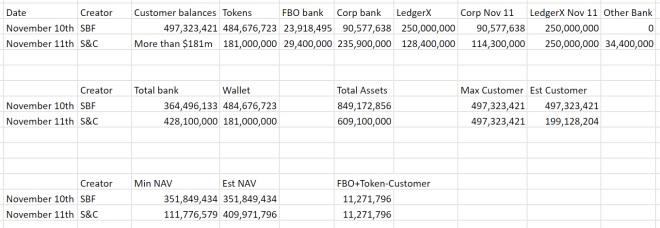
Anyway—here’s what I get, comparing my records to S&C’s presentation.

The presentation and press release don’t actually say what customer balances are, but by claiming that FTX US has $181m of digital assets and also has a customer shortfall, S&C is implying that customer balances are greater than $181m. They’re almost certainly less than $497m—what they were a day earlier—given the withdrawals in between. So that gives two bounds on what it could be. My best guess comes from looking at changes in FBO bank accounts and tokens. In theory those two should be at least equal to customer balances; in the balance sheet on the 10th, FBO + tokens were roughly $11m greater than customer balances. “Max Customer” and “Min NAV” make the conservative assumption that somehow customer balances were still $497m on the 11th; “Est” makes the reasonable assumption that [FBO + Token – Customer Balances] stayed constant at $11m between the two days. Or, in other words: if nothing unusual happened on November 10th, the $298m decrease in FTX US’s custodial assets would imply a $298m decrease in customer balances, both stemming from $298m of customer withdrawals.

That would imply that customer balances were roughly $199m. Anyway, this is a long way of saying: I had estimated roughly $350m more cash on hand than customer balances required (NAV). Using the extremely conservative estimates, their presentation implies a NAV of roughly +$111m, and using the more reasonable estimate you get a NAV of +$409m—pretty close to my number.

All of which is to say: one way or another, their data actually confirms that FTX US was extremely likely to be solvent when I handed it off, with at the very least $111m of excess cash; it also implies that my estimate of +$350m excess cash was probably roughly correct, though there isn’t enough information to actually prove that

S&C claims that FTX US has a shortfall. That claim is false. Based on S&C’s own data provided in the same court presentation, FTX US had roughly $609m of assets ($428m USD in bank accounts, plus $181m of tokens) backing roughly $199m of customer balances. FTX US was solvent when it was turned over to S&C, and almost certainly remains solvent today.

Video Streaming Platform Netflix Revamps iPhone App With Latest Modernized User Interface

0
London, UK - August 01, 2018: The buttons of Spotify, Podcasts, Netflix, WhatsApp and Music on the screen of an iPhone.

Video streaming platform Netflix has revamped its iPhone app by giving it a modernized user interface.

The tech Giant no doubt seeks to improve users’ experience by introducing new card transitions, new animation for both the launch and the profile screens, updated haptics, and many more.

When users tap any program’s art cover, it expands to reveal all the information about the program. Also, the “coming soon” page has been changed to “what’s new” as it now displays users recommended items.

Other latest features include a new billboard layout that responds as users move their device which comes with a subtle lighting effect and a new card transition that’s fully interruptible/interactive.

Reports disclose that the tech giant began working on the project in 2022 after former UI designer at Netflix Janum Trivedi disclosed that last year, he has been leading a UI refresh to make Netflix feel more fluid, delightful, and polished.

Previously, the card transition was less fluid on the app. When a title is selected, the info section would simply slide up. Now, the new card transition shows the card grow bigger, and then the information opens into a full-screen version.

The former Netflix employee disclosed that the tech company is “giving it some love” for the Apple TV version of its app while disclosing that Netflix may eventually release a redesigned user interface for tvOS.

He also posted a video on his Twitter handle where he made a quick test run of Netflix’s latest UI feature which is no doubt appealing.

Also speaking on Netflix’s latest UI design on the iOS app, a spokesperson said, “We recently updated the Netflix iOS app with better visuals, more responsive interactions, and motion design.

“This latest global update includes features like a new style for promoting what to watch, thematic background on your favorite shows and movies, new profile animations, and more”.

Last year, Netflix released an option in its iOS app that takes users to its website in order to finish a new Netflix subscription.

The Netflix app now uses the new iOS API for reader apps that takes the user to an external website before making a subscription.

It is however interesting to note that due to recent antitrust investigations, Apple has finally allowed some types of apps to offer alternative subscription methods outside of the App Store without having to pay a commission to the company.