DD
MM
YYYY

PAGES

DD
MM
YYYY

spot_img

PAGES

Home Blog Page 4548

CES 2023: Over 3100 Global Exhibitors to Showcase Emerging Trends in Tech Value Chains

0

Tech innovators and enthusiasts globally look forward to this year’s global premier tech exhibition by the Consumer Electronics Show (CES) which is scheduled to hold in Las Vegas, US from January 5 to 8.

More than 3,100 exhibitors from 170 countries and regions are expected to grace this year’s event, CES’ organiser, Consumer Technology Association (CTA) has reportedly said.

CES which has traditionally been known as the venue where companies highlight new TV technology, laptops, smart phones and other products will be showcasing the emerging trends in various value chains of the tech industry including electronic vehicles, digital health, and AI robotics at this year’s show. This news article by XinhuaNet gives broader analysis on the emerging trends to look forward to at the event.

Inaugurated in June 1967, CES is an annual trade show organized by the Consumer Technology Association (CTA). The event typically hosts presentations of new products and technologies in the consumer electronics industry. The last show held in January 5 2022 also in Vegas in the US.

U.S. Banking Regulators Warn Financial Institutions Against Dealing With Cryptocurrencies

0

Banking regulators in the U.S. have warned financial institutions to be careful about how they deal with cryptocurrency, noting that it exposes them to risks such as scams and fraud.

This warning is coming after the FTX collapse and the bankruptcy of several crypto platforms, which has negatively impacted the crypto industry and has led to the high volatility of crypto assets.

The regulators said in a joint statement, from the Federal Reserve, Federal Deposit Insurance Corp., and the Office of the Comptroller of the Currency, “The events of the past year have been marked by significant volatility and the exposure of vulnerabilities in the crypto-asset sector”.

The regulators further disclosed that there is a heightened case of fraud and scams among crypto-asset sector participants and contagion risk within the crypto-asset sector resulting from interconnections among certain crypto-asset participants.

In the statement, the regulators also highlighted various shortcomings that have rocked the crypto industry lately such as the Risk of fraud and scams among crypto-asset sector participants, Legal uncertainties related to custody practices, redemptions, and ownership rights, some of which are currently the subject of legal processes and proceedings.

Also, it revealed that inaccurate or misleading representations and disclosures by crypto-asset companies, including misrepresentations regarding federal deposit insurance, and other practices that may be unfair, deceptive, or abusive, have contributed to significant harm to retail and institutional investors, customers, and counterparties.

Also, the susceptibility of stablecoins to run risk creates potential deposit outflows for banking organizations that hold stablecoin reserves.

Given the significant risks highlighted by the recent failures of several large crypto-asset companies, the U.S. banking regulators have continued to take a careful approach related to current or proposed crypto-asset-related activities and exposures at each banking organization.

However, Banking organizations are neither prohibited nor discouraged from providing banking services to customers of any specific class or type, as permitted by law or regulation.

The regulators will continue to assess whether or how current and proposed crypto-asset-related activities by banking organizations can be conducted in a manner that adequately addresses safety and soundness, consumer protection, legal permissibility, and compliance with applicable laws and regulations, including anti-money laundering and illicit finance statutes and rules.

They have further warned financial institutions that holding crypto-assets that are issued, stored, or transferred on an open, public, or decentralized network is highly likely to be inconsistent with safe and sound banking practices.

Recall that last year, the crypto industry was shaken by different unpleasant happenings around several crypto platforms. The major one that shook the crypto industry was the bankruptcy of the FTX, which filed for chapter 11 bankruptcy on November 11, 2022, and its banking ties have raised uncomfortable questions for regulators.

The collapse of FTX left more than one million customers unable to withdraw assets worth an estimated $8bn.

Prosecutors allege the company’s CEO Sam Bankman-Fried used FTX’s customers’ money to cover losses in his private crypto hedge fund Alameda Capital in what the company’s new chief executive disclosed as an “old-fashioned embezzlement”.

Reports reveal that an estimate of 80,000 FTX’s customers are based in the UK, with individual liabilities as high as £5m in life savings according to a lawyer acting for dozens of victims.

This led the Bank of England deputy governor Jon Cunliffe to disclose that the FTX collapse shows crypto is ‘too dangerous’ not to regulate, further stating that Cryptocurrency trading is “too dangerous” to remain outside mainstream financial regulation and could pose “a systemic problem” without action.

This has also spurred the U.S. banking regulators to continue to closely monitor crypto-asset-related exposures of banking organizations.

As warranted, the agencies will issue additional statements related to engagement by banking organizations in crypto-asset-related activities.

They will also continue to engage and collaborate with other relevant authorities, as appropriate, on issues arising from activities involving crypto-assets.

In the Spirit of Brotherhood, President Muhammadu Buhari Pledges Support of Fuel For Burundi

0

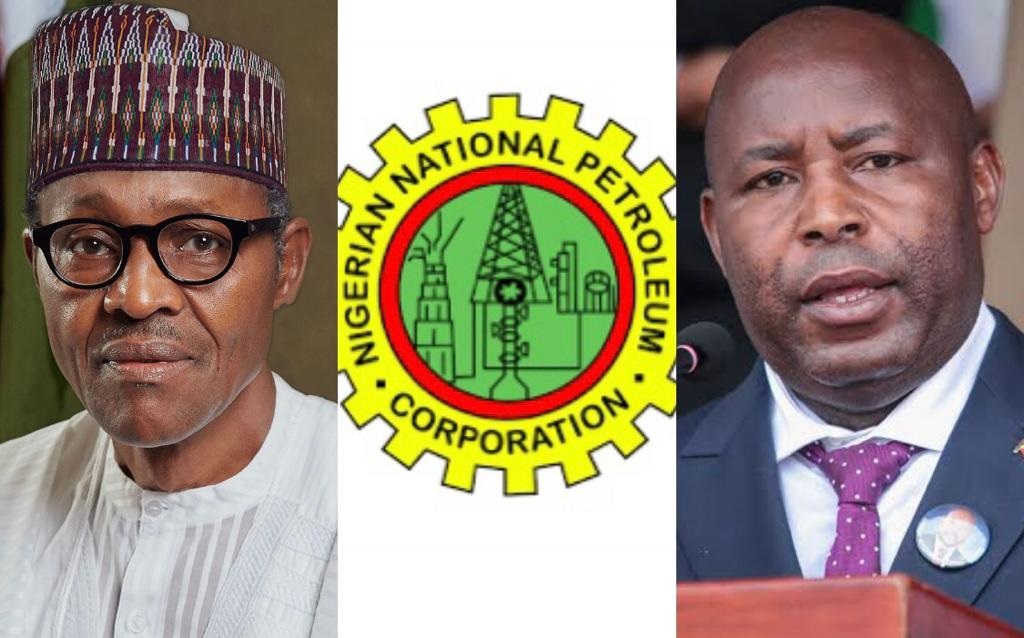
Nigeria’s president Muhammadu Buhari has recently pledged to provide support to East Central African country Burundi with fuel, amid fuel scarcity in Nigeria.

Buhari’s support comes after he received Burundi’s Finance, Budget, and Economic Planning Minister, Hon. Audace Niyonzima, and a Special Envoy of Burundi’s President Evariste Ndayishimiye at the federal capital territory (FCT).

According to a statement signed by President Buhari’s special Adviser on Media and Publicity, Mr. Femi Adesina, Pres. Buhari pledged in the spirit of solidarity and African brotherhood that Nigeria will support the Republic of Burundi in diverse ways as necessary.

President Buhari further disclosed that he knows what it feels like for a country to suffer from energy shortage, which is the reason why he would not hesitate to assist Burundi by supplying them with fuel.

The statement reads, “On request for assistance in the area of energy provision, particularly fuel, by the Burundi leader, President Buhari said he knows what it feels like for a country to suffer from energy shortage, and promised that he would get the Nigerian National Petroleum Company Limited to look into the request”.

Responding to President Buhari’s pledge, Burundi’s Minister of Finance, Budget, and Economic Planning, said that the Burundian president sent his goodwill message for the New Year to Nigerians and the presidency. He also wished the country well in her upcoming 2023 general elections scheduled to hold in February and March this year.

We pray that the polls would be peaceful and successful so that Nigeria would maintain her reputation as a bastion of peace and stability,” the minister said.

Meanwhile, President Buhari’s support to provide fuel to Burundi is coming amid fuel scarcity in Nigeria as well as a surge in fuel prices.

In recent times, fuel scarcity in the country has worsened which has seen long queues dotted across filling stations in different parts of the country.

Last year, during the festive period, the majority of Nigerians were forced to celebrate Christmas on a very low key due to the scarcity of fuel in the country.

Also, it made traveling difficult for many as they were visibly left stranded at different bus stations across the country, due to the astronomical rise in fares occasioned by the acute fuel scarcity.

Report gathered revealed that most transportation companies imposed a 100% increase in fares, blaming the surge on the scarcity of fuel.

The Independent Petroleum Association of Nigeria (lPMAN) last November attributed the current fuel scarcity to the unavailability of petroleum products and difficulty in accessing foreign exchange by marketers.

The operations controller of lPMAN, Mr. Mike Osatuyi, alleged that the Nigeria National Petroleum Corporation (NNPC) Ltd., had stopped importing enough petrol to meet demand in the country.

He further urged the government to remove the monopoly of importation and pronounce total deregulation of the downstream sector.

Few analysts have disclosed that President Buhari’s promise to support Burundi is a case of misplaced priority, noting that the country is not done with solving its fuel crisis, yet it wants to play a big brother role.

On the other hand, the reoccurring fuel scarcity in Nigeria has become a menace, as different sectors in the country have been badly affected.

Commercial transport operators have decried the unending hardship brought by fuel scarcity as well as passengers who are faced with increased fuel price.

Also, the Coordinator, Nigerian Bakers Association, North Central, Mrs Clara Ameh Oduwole, echoed similar consternation. She disclosed that bakers are barely managing to survive the current hardship so that their business will not collapse because availability of power is essential to the sustenance of the business.

She said:”In our confectionary business, fuel availability is paramount because we need to generate electric power. We need diesel for production of cake and ice cream.

Unfortunately we are not breaking even. In fact, I have to buy a new generator that uses petrol.  Although petrol is cheaper than diesel, it is not available at the filling stations except at the Black market.”

Majority of Nigerians have lamented that the suffering of the people is too much and, unfortunately, Nigeria is awash with petroleum but meanwhile, the citizens are suffering from its scarcity.

Tekedia Corporate Training – We Serve Knowledge

0

Good People, before you conclude that training plan, Tekedia Institute will like to speak with you. In our school, we have demonstrated the capacity to add value in firms, through a knowledge system which advances the missions of firms, by equipping teams with capabilities they need to thrive.

We will create a custom program, designed to address the specific needs of your company. The learning is a journey – a real knowledge festival unbounded and unconstrained in many ways, liberating minds, and showcasing the mechanics of building category-king companies.

Contact our team; we want to explain how we are translating ideas into innovation, and innovation into business growth, and growth into value creation for companies. With 250 faculty members from the leading companies, we focus on one thing: business education across market systems, industrial and operational domains.

Try Tekedia Corporate Training and elevate your team. Email here  or inmail me here. Let’s Serve Knowledge as the food for innovation in your company.

Public Relations Practice in an Algorithm-Driven Complex World

0

One of the most misunderstood fields in media and communications is Public Relations. It is a field and a profession that few people and organizations are interested in studying and employing for increased revenue and profits. On numerous occasions, it has been linked to marketing and advertising. Having a special department and a professional PR officer or manager is not required for businesses and non-profit organizations as long as an HR or Communication Department exists. Governments prefer media officers or press secretaries to PR managers or Chief Listening Officers.

The ongoing debate over what PR entails remains a significant factor for many people who believe in researching the field and profession via the Internet. Over the years, the functions, importance, and relationship between the field and/or profession and marketing have been mostly sought. As misconceptions persist, emerging technologies are evolving with the distinct feature of disrupting how media and communication activities must be initiated, executed, and monitored.

According to our analyst, this has increased panic search interest in whether Public Relations will be automated like other professions. A number of scholars and professionals from around the world have provided and continue to provide answers. Following a review of the responses, our analyst discovered that technologies are only viewed as supporting tools, which means that they are unlikely to take over PR tasks but will make the job of PR professionals easier before, during, and after crises or in the development of competitive products and/or services.

Emerging Technologies, Big and Small Data

As previously stated, emerging technologies have disrupted the activities of businesses and individuals in recent years. Interpersonal and business-focused technologies are assisting users in generating, aggregating, and using data at the meso, micro, and macro levels. From social networking sites to cloud-based technologies, PR professionals now have access to a wealth of data for developing and implementing various strategies that were not previously available.

In fact, small and big data are driving the world, so it’s important to align with the digital platforms that will make it easy to explore and use them to better serve customers and consumers. Small data are those that PR specialists could easily collect, isolate, and analyze using basic tools or methods. Big data are data that are produced by businesses, consumers, and other organizations through the technologies they employ, both knowingly and unknowingly.

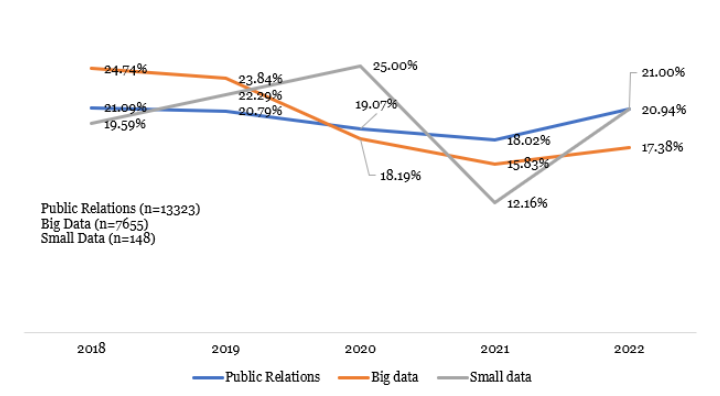
For example, in the last five years, educators and students have become more interested in understanding and learning how big data can be useful materials for practicing Public Relations. People were more interested in understanding big data than small data between 2018 and 2022. According to the interest analysis, one unit of seeking information about PR translates to 30.3% of seeking information about big data. In other words, a unit of desiring information about PRs translated to more than 30 repeated big data interests.

Trend analysis also reveals that the public, referred to as educators and students in this piece because searches within the education category were considered and our analyst believes that the searchers are most likely to be stakeholders in the global education sector, was more interested in Public Relations, big and small data in 2018 than in the previous years (2019-2022). However, interest increased significantly in 2019 before declining in 2020 and 2021 before recovering to levels comparable to those seen in 2018. (see Exhibit 1).

Exhibit 1: Public Relations, big and small data in the public minds between 2018 and 2022

Source: Google Trends, 2023; Infoprations Analysis, 2023

What Public Relations Professionals Need to Know

Our analyst observes that PR practice is expanding daily as new technologies continue to produce big data. Both positive and negative risks to the profession are heightened by this. Several years ago, handling a PR crisis when it materialized was simple. The ability of customers, consumers, and regulatory bodies to use a variety of technologies that can instantly gather information and send it to millions of people makes managing crises challenging, particularly when social networking sites are used to embarrass owners, shareholders, and managers. This is one of the reasons our analyst and a few of his academic colleagues wrote a book to inform PR practitioners and students about the importance of adopting a data-driven digital PR practice. How to use some digital tools before, during, and after crises is explained in the case book.