DD
MM
YYYY

PAGES

DD
MM
YYYY

spot_img

PAGES

Home Blog Page 456

FTX Recovery Trust to Distribute $1.6B To Eligible Creditors By September 30th

0

The FTX Recovery Trust has confirmed it will distribute approximately $1.6 billion to eligible creditors as part of its third major payout under the Chapter 11 reorganization plan. This distribution is scheduled to begin on September 30, 2025, with funds expected to reach recipients via selected providers BitGo, Kraken, or Payoneer within 1-3 business days.

~$1.6 billion, bringing cumulative distributions to over $7.8 billion since the exchange’s collapse in November 2022. Creditors must have completed verification on the FTX Claims Portal and onboarded with a distribution provider by the record date.

This includes both “convenience class” (smaller claims, e.g., under $50,000) and non-convenience class holders. FTX’s bankruptcy estate has recovered over $15 billion in assets, including cash from operations, clawbacks, and sales of holdings like Solana (SOL) tokens and stakes in Anthropic and Robinhood.

This has enabled near-full recoveries for many retail users, exceeding initial balances due to accrued interest and asset appreciation. However, some creditors have raised concerns over legal fees nearly $1 billion paid to firms and the use of 2022 crypto valuations for payouts, arguing for adjustments based on current market prices.

Recent discussions on X highlight optimism about the process but also skepticism around costs and asset sales (e.g., discounted SOL liquidations). Future rounds are expected, with ~$16.5 billion still earmarked for remaining claims.

With $7.8 billion distributed to date, many creditors, especially those with smaller “convenience class” claims, are achieving full recovery plus interest (120% of claim value). This restores trust for some retail investors but leaves larger claimants (e.g., Dotcom customers at 78% recovery) awaiting further payouts.

The influx of $1.6 billion into creditors’ hands could increase spending or reinvestment in crypto or other assets, potentially stimulating market activity. Creditors receiving payouts may face tax liabilities, as distributions could be treated as capital gains depending on jurisdiction, complicating financial planning.

The successful distribution reinforces confidence in crypto bankruptcy processes, potentially reducing stigma from FTX’s 2022 collapse. However, X posts indicate mixed sentiment, with some users questioning the fairness of payout calculations based on 2022 asset valuations rather than current market prices.

Previous FTX asset sales (e.g., Solana tokens) have occasionally pressured prices. While this round is cash-based, future liquidations of remaining assets (~$16.5 billion) could influence markets, particularly for tokens like SOL.

The use of providers like Kraken and BitGo for distributions may drive user activity on these platforms, potentially increasing trading volumes or onboarding. FTX’s ability to recover over $15 billion and distribute significant sums sets a benchmark for handling crypto insolvencies, potentially shaping future legal frameworks.

High legal fees (~$1 billion) have drawn criticism on X and elsewhere, raising questions about efficiency in bankruptcy proceedings. This could prompt regulatory reviews of fee structures in similar cases. Ongoing clawback efforts targeting pre-collapse withdrawals may lead to legal disputes, affecting creditors who received funds earlier.

The payout demonstrates that crypto users can recover funds post-collapse, which may encourage participation in decentralized finance, though skepticism persists due to FTX’s fraud history. Creditors on X express frustration over payouts tied to 2022 crypto prices. This could fuel demands for updated valuation methods in future cases.

The distribution process keeps FTX’s collapse in the spotlight, reminding the industry of risks tied to centralized exchanges and the need for better governance. The $1.6 billion payout is a milestone in FTX’s bankruptcy resolution, offering relief to creditors and signaling progress in asset recovery.

However, it also highlights ongoing challenges, including valuation disputes, high legal costs, and market impacts from future asset sales.

OpenAI Study Finds AI Hallucinations Are a Mathematically Unavoidable, Drawing Contrast With Rivals’ Claims

0

In a shift from what it formerly held, OpenAI has acknowledged that hallucinations—instances where artificial intelligence generates plausible but false information—are not only common but mathematically unavoidable, regardless of improvements in training data or engineering techniques.

The admission came in a landmark study published on September 4 by OpenAI researchers Adam Tauman Kalai, Edwin Zhang, and Ofir Nachum, alongside Georgia Tech professor Santosh S. Vempala. The paper, republished by Computer World, establishes a mathematical framework showing why large language models (LLMs) will always produce some level of falsehood, even when trained on perfect data.

“Like students facing hard exam questions, large language models sometimes guess when uncertain, producing plausible yet incorrect statements instead of admitting uncertainty,” the authors wrote.

The finding carries weight given OpenAI’s role in igniting the global AI boom with ChatGPT, which has since been integrated into enterprises, schools, and governments. It also marks a departure from earlier industry claims that hallucinations could be engineered away with better training, fine-tuning, or retrieval-augmented methods.

When Better Models Still Fail

The study demonstrated that hallucinations result from statistical properties inherent to model training. The researchers derived mathematical lower bounds proving that generative models will always retain an irreducible error rate.

Even state-of-the-art systems stumbled on seemingly trivial tests. When asked, “How many Ds are in DEEPSEEK?” DeepSeek-V3, Meta AI’s models, and Anthropic’s Claude 3.7 Sonnet all returned incorrect counts ranging from two to seven. OpenAI confirmed its own systems were no exception.

“ChatGPT also hallucinates,” the paper admitted. “GPT-5 has significantly fewer hallucinations, especially when reasoning, but they still occur. Hallucinations remain a fundamental challenge for all large language models.”

Ironically, OpenAI’s most advanced reasoning models hallucinated more than simpler ones. Its o1 model fabricated details in 16 percent of tests, while newer o3 and o4-mini models produced fabricated results 33 percent and 48 percent of the time, respectively.

“Unlike human intelligence, it lacks the humility to acknowledge uncertainty,” said Neil Shah, VP at Counterpoint Technologies. “When unsure, it doesn’t defer to deeper research or human oversight; instead, it often presents estimates as facts.”

How Rivals Have Positioned the Problem

The study directly challenges the narrative advanced by OpenAI’s competitors. Anthropic, the maker of Claude, has often marketed its constitutional AI framework as a way to reduce hallucinations, emphasizing “alignment” and “trustworthiness.” Google’s DeepMind similarly claimed that retrieval-augmented generation (RAG) could drastically cut hallucinations by grounding answers in external databases. Meta, too, has argued that scaling model size and refining evaluation would push the problem closer to elimination.

But the OpenAI study points in the opposite direction, noting that hallucinations are not byproducts of immature engineering, but consequences of deep mathematical laws. By showing that even rival flagships like Claude and DeepSeek-V3 produced wildly incorrect answers to simple factual questions, OpenAI positioned its research as not just a self-diagnosis but a critique of the broader industry’s optimism.

Flawed Benchmarks, Flawed Incentives

The study also exposed how industry evaluation methods worsen the problem. Current benchmarks such as GPQA and MMLU-Pro penalize models for responding “I don’t know,” effectively rewarding confident but wrong answers.

“We argue that language models hallucinate because the training and evaluation procedures reward guessing over acknowledging uncertainty,” the researchers said.

Analysts say this dynamic is already harming real-world deployments. “Clients increasingly struggle with model quality challenges in production, especially in regulated sectors like finance and healthcare,” noted Forrester’s Charlie Dai.

Permanent Challenge, New Strategies

Experts believe the inevitability of hallucinations calls for a governance shift. “This means stronger human-in-the-loop processes, domain-specific guardrails, and continuous monitoring,” Dai said, adding that existing risk frameworks “underweight epistemic uncertainty.”

Shah drew a comparison to automotive safety regulations. “Just as car components are graded under ASIL standards, AI models should be dynamically graded nationally and internationally based on reliability and risk profile.”

Recommendations include calibrated confidence targets, real-time trust indices for evaluating AI output, and updated benchmarks driven by regulatory pressure and enterprise demand.

A Reality Check for Enterprises

The OpenAI findings echo earlier warnings from academia. A Harvard Kennedy School study found that downstream oversight often fails to catch subtle AI-generated falsehoods due to constraints of cost, scale, and context.

The OpenAI team concluded that the path forward requires industry-wide reform in how systems are tested and trusted, while acknowledging that hallucinations will never fully disappear.

For enterprises, the message is that hallucinations are not an engineering flaw to be patched out, but a mathematical certainty requiring new governance, oversight, and adaptation strategies.

By admitting this publicly, OpenAI not only sets itself apart from rivals who continue to promise engineering solutions but also reframes the debate over AI reliability. Thus, the question is no longer when hallucinations will disappear, but how businesses, regulators, and users adapt to their permanence.

Trump to Announce TikTok Divestment Deal This Week 

0

President Donald Trump is set to declare this week that a long-awaited deal to divest TikTok’s U.S. operations from its Chinese parent company, ByteDance, satisfies the requirements of a 2024 bipartisan law, according to a senior White House official.

The announcement would mark a pivotal moment in a saga that has spanned two administrations, involved months of high-stakes U.S.–China negotiations, and threatened to ban one of the world’s most popular apps from American smartphones.

Terms of the emerging deal

Under the agreement, ByteDance will own less than 20% of TikTok U.S., with the remainder controlled by a mix of existing U.S. and global firms alongside new investors who have no affiliation with the Chinese parent. Tech giant Oracle and private equity firm Silver Lake are confirmed participants in the investor consortium, while President Trump has also publicly said that media baron Rupert Murdoch’s son Lachlan, Oracle co-founder Larry Ellison, and Dell Technologies CEO Michael Dell are expected to be involved.

The deal will establish a new joint venture with a board of directors dominated by American members, though the U.S. government itself will not take an equity stake or hold seats on the committee.

The White House is confident Beijing has signed off on the broad outlines of the arrangement. “China is expected to sign and approve a framework deal for TikTok’s divestment by the end of the week,” the official said, noting that once that step is completed, Trump will issue a 120-day reprieve to allow investors and ByteDance to finalize legal and operational details.

The algorithm question

One of the thorniest issues in the talks has been the fate of TikTok’s content recommendation algorithm, the core of the app’s user experience and a focal point of U.S. national security concerns. American officials have long warned that the algorithm — which determines what videos users see — could be manipulated by Chinese authorities in subtle, hard-to-detect ways.

To address those concerns, the agreement gives Oracle control over a licensed copy of the algorithm, with full rights to oversee security and inspect the system for “any abnormal behavior.” The algorithm will also be retrained using U.S. data to ensure compliance with American standards.

“There can’t be any shared algorithm with ByteDance,” said a spokesperson for the House Select Committee on China.

The White House echoed this stance, emphasizing that TikTok U.S. would operate with its own retrained system. Still, officials clarified that users in America would continue to see videos from international accounts, preserving the app’s global connectivity.

A law-driven divestment

The push to force a TikTok divestment stems from legislation signed into law in 2024 by former President Joe Biden, who required ByteDance to sell its U.S. assets or face a nationwide ban. Trump, who returned to office in January, has since extended enforcement deadlines several times, citing ongoing negotiations with Beijing. The current law is set to take effect in mid-December unless the divestment is completed.

The White House said Trump’s forthcoming executive order will formally declare the new deal compliant with U.S. law and issue a fresh 120-day enforcement pause, giving investors and regulators time to close the transaction.

The progress on TikTok represents a rare bright spot in U.S.–China relations, which have been dominated in recent years by escalating tariffs, technology restrictions, and mutual accusations of unfair trade practices. Trump spoke directly with Chinese President Xi Jinping on Friday, after which both sides signaled cautious optimism.

For Washington, securing control over TikTok’s U.S. operations is seen as a crucial step in preventing potential foreign influence over one of the country’s most widely used social media platforms. For Beijing, allowing ByteDance to divest without losing face represents a compromise in an otherwise hardening trade relationship.

“This deal is well on its way,” Trump told reporters over the weekend. “The investors are getting ready.”

Though many details — including the full list of investors — remain under wraps, the framework suggests TikTok will survive in the U.S. under new ownership, with Oracle in charge of safeguarding its technology and data. Still, legal and political challenges could emerge in the months ahead, especially if lawmakers or regulators demand stricter terms.

A preliminary deal to shift ownership of Chinese-owned TikTok to an American consortium led by Oracle wouldn’t give an equity stake or “golden share” to the U.S. government, several news outlets reported, citing an anonymous White House official. The U.S. consortium is set to license the video app’s algorithm, with plans to “retrain” it domestically to safeguard user data and block China’s access. ByteDance, TikTok’s current owner, would see its stake fall below 20%, in compliance with a law mandating its sale. The deal is expected to be signed this week.

Early BullZilla Buyers Secured 1275% ROI: Is This the Best Presale With 100x Potential Amid Cardano and Polkadot’s Slow Climb?

0

What happens when whales, progressive tokenomics, and meme coin firepower collide? Markets pay attention. In September 2025, BullZilla ($BZIL) hit a remarkable milestone, raising over $500,000 in its trending presale with 100x ROI, a number that’s been climbing faster than most analysts projected. Meanwhile, Polkadot (DOT) just capped its supply at 2.1 billion tokens to combat inflation, and Cardano (ADA) edges closer to its long-awaited scalability milestones. Together, they showcase how very different narratives are reshaping the crypto market this quarter.

Among them, BullZilla ($BZIL) is sparking the loudest conversation. Its presale isn’t just another funding round; it’s designed as a living saga where the price rises every 48 hours or when $100,000 is raised, whichever comes first. For financial students, crypto analysts, and blockchain developers, this makes the BullZilla 100x presale one of the most closely watched top early stage crypto investments right now.

BullZilla (BZIL) – Why This Presale Could Deliver Maximum Gains

Could a single presale mechanism rewrite meme coin history? That’s what BullZilla ($BZIL) aims to prove. The progressive price engine ensures that the token price never stalls; it climbs every 48 hours or instantly when $100,000 pours in. Early buyers secure cheaper tokens, while latecomers face higher entry costs. This is the momentum engineered for maximum gains in crypto investment potential.
The presale stages are already racing forward. With over $580,000 raised, 28 billion tokens sold, and 1,900+ holders, the momentum is undeniable. At the current Stage 3D price of $0.00007908, a $4,500 buy nets approximately 56,925,993 $BZIL tokens. At the projected listing price of $0.00527, that bag would be worth around $299,000, a jaw-dropping 6565.92% ROI. This is where meme coin whales are making decisive moves in the BullZilla presale 100x rewards, accelerating the timeline for everyone else.

BullZilla Presale Snapshot

Metric Current Value Future Value Target
Stage 3rd (404: Whale Signal Detected) Listing at $0.00527
Current Price $0.00007908 +8.42% in 4A ($0.00008574)
Tokens Sold 28B+
Presale Raised $580,000+
ROI Potential 6565.92%

The sheer affordability makes this round rare. $1,000 secures 12.64 million tokens, while larger positions are already locking in BullZilla’s explosive upside. With whales stepping in on the best 100x meme presales, these rounds don’t last.

How to Buy $BZIL – Claim Your Stake in the Beast

Joining the BullZilla presale means stepping into a meme coin presale built on Ethereum’s battle-tested chain. Here’s how investors can secure tokens before the next stage shift:

  1. Set Up Your Wallet

Compatible options: MetaMask, Trust Wallet, or Coinbase Wallet.

  1. Load Up With Crypto

Buyers can use ETH, USDT, USDC, or BNB. Always keep a little extra for gas fees.

  1. Connect to the Presale

On the presale site, click “Connect Wallet” and approve the link. You’re in.

  1. Join the Presale

Select your amount of $BZIL, confirm, and lock it in. Each second counts before the price ticks up again.

  1. Confirm the Hunt

Approve the transaction and watch your balance appear on the dashboard. From there, it’s just holding on until launch.

The beast is moving, and each stage grows more expensive. Secure your tokens today, don’t wait for whales to set the pace.

Polkadot (DOT) – A Supply Cap Changes the Game

Polkadot (DOT) has introduced a crucial change that could reshape its long-term value. The community approved a cap of 2.1 billion tokens, shifting DOT from inflationary uncertainty to controlled scarcity. Currently trading near $3.98, DOT is navigating heavy resistance between $4.35–$4.60. Analysts warn of a potential dip if resistance holds, but breakthroughs could carry DOT higher.

Polkadot 2.0 also continues to gain traction, with elastic scaling and JAM protocol upgrades on the horizon. While DOT’s growth may feel conservative compared to meme coin theatrics, its foundation and staking rewards continue to attract long-term holders. This positions DOT as a steady play in contrast to Bullzilla presale beast mechanics.

Cardano (ADA) – Scalability Dreams Edge Closer

Cardano (ADA) remains locked in its slow-and-steady approach, trading between $0.82–$0.90 with a market cap of around $30 billion. The next step for ADA is tied to Hydra layer-2 and Mithril improvements, aimed at scaling the network. For ADA holders, the key levels to watch are resistance at $0.94 and potential upside targets of $1.20–$1.25 if bulls gain traction.

Still, whale selling has recently delayed momentum, with reports of nearly 560 million ADA sold over four days. While ADA’s fundamentals remain intact, this selling pressure underlines how meme-driven projects like $BZIL can pull attention away from established giants.
Conclusion – Why BullZilla’s Presale Stands Apart

Based on market trends and presale data, BullZilla ($BZIL) emerges as the best presale with 100x potential, while Polkadot and Cardano focus on gradual, structural improvements. DOT’s capped supply and ADA’s upcoming scalability upgrades show strength, but they move at a measured pace. By contrast, BullZilla thrives on speed, progression, and whale-driven surges that demand immediate attention.

The narrative is clear: while ADA and DOT refine their ecosystems, investors chasing high-octane returns are already locking in Bull Zilla. The presale’s progressive engine ensures there’s no pause button; the beast climbs whether investors act or not. With stages ending every 48 hours or at each $100K mark, this presale is racing forward. Join now, or watch from the sidelines as others ride into the top early stage crypto investments history.

For More Information:

BZIL Official Website

Join BZIL Telegram Channel

Follow BZIL on X  (Formerly Twitter)

Frequently Asked Questions for the Best Presale with 100x Potential

What is BullZilla ($BZIL)?

BullZilla is a meme coin project built on Ethereum, designed with progressive pricing, staking, and burn mechanics to drive value.

How does the presale price mechanism work?

The $BZIL price rises every 48 hours or instantly when $100,000 is raised. This creates constant upward pressure.

What’s the ROI potential of $BZIL?

At the listing target of $0.00527, current investors could see up to 6565.92% ROI from today’s stage.

How does BullZilla compare to ADA and DOT?

While ADA and DOT focus on long-term infrastructure, $BZIL offers immediate upside through its meme coin presale mechanics.

Is investing in $BZIL risky?

Yes. Like all cryptocurrencies, $BZIL carries risk. This article is informational only and not financial advice.

Glossary

Progressive Price Engine – Mechanism where token price increases by time or capital raised.

Roar Burn – Token supply reduction tied to presale chapters.

HODL Furnace – Staking system offering up to 70% APY.

Hydra – Cardano’s layer-2 scalability solution.

Mithril – Cardano upgrade for faster node syncing.

Elastic Scaling – Polkadot scalability protocol in development.

JAM Protocol – Polkadot’s planned performance upgrade.

Whale Signal – On-chain data showing large buyers entering.

Listing Price – Target exchange price post-presale.

Chapter Presale – BullZilla’s 24 stages tied to lore and mechanics.

Summary

BullZilla ($BZIL) has raised over $500,000 in September 2025, racing through presale stages with a progressive price engine that lifts the token’s cost every 48 hours or after $100K in buys. At the current stage, a $4,500 buy could grow to nearly $300,000 by listing, promising a 6565.92% ROI. Meanwhile, Polkadot capped its supply at 2.1 billion tokens, while Cardano is advancing toward Hydra and Mithril upgrades. Both ADA and DOT signal stability and evolution, but BullZilla dominates the conversation as the best presale with 100x potential. With whales accelerating stage shifts, investors are urged to act now before this meme coin giant roars into its next phase.

Keywords Group

best presale with 100x potential, meme coin presale, BZIL presale early rounds, maximum gains crypto investment, Bullzilla presale beast, Bullzilla explosive, Bullzilla presale analysis, top early stage crypto investments, BullZilla ($BZIL), Polkadot (DOT), Cardano (ADA)

Disclaimer: This article is for informational purposes only and does not constitute financial advice. Cryptocurrency investments are highly volatile and risky. Always conduct independent research and consult with a licensed financial advisor before investing.

Patterns of Complying and Reporting Local Content in Nigeria’s Oil and Gas Industry

0

The Nigerian Oil and Gas Industry Content Development Act of 2010 has become a cornerstone for shaping how companies operate in the country’s most strategic sector. Its intent is simple but profound. The law compels international oil companies, indigenous firms and joint ventures to prioritize Nigerian participation across contracting, workforce, fabrication and technology transfer. Fifteen years on, patterns have emerged in how companies both comply with and report on local content. These patterns reveal much about corporate strategies, regulatory effectiveness and the evolving relationship between global operators and local communities.

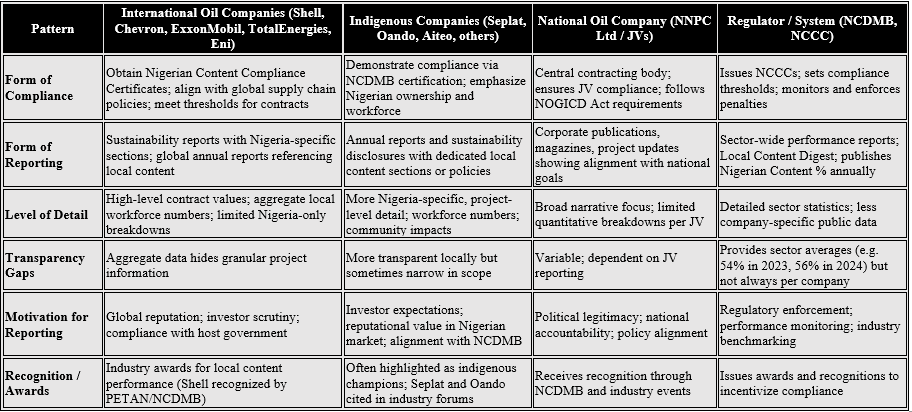
A first pattern is the divide between international oil companies and indigenous players. Multinationals such as Shell, Chevron, ExxonMobil, TotalEnergies and Eni have embedded local content reporting into their global sustainability frameworks. Their annual sustainability or corporate responsibility reports contain sections on Nigeria highlighting training programs, contract awards to Nigerian suppliers and percentages of Nigerian staff. Shell’s disclosures of billions of dollars awarded to local companies in 2023 is a case in point. These companies often report through polished global documents rather than Nigeria-only reports. This approach aligns with their international standards but sometimes limits the granularity of Nigerian data available to the public.

Indigenous companies present a second pattern. Firms like Seplat Energy, Oando and Aiteo include local content discussions in their annual or sustainability reports. Because these firms are listed in Nigerian and international markets they face pressure from regulators and investors to demonstrate compliance. Seplat is particularly explicit in linking its growth with Nigeria’s local content objectives. Oando has gone further by publishing a Local Content Policy alongside its sustainability materials. Indigenous players often highlight their advantage of being Nigerian-owned and operated while emphasizing workforce development and community engagement. Their disclosures are generally more Nigeria-specific and tailored to a local audience.

A third pattern lies with the national oil company. NNPC Limited is not only subject to local content rules but also acts as a joint venture partner and contracting entity for most projects in the country. Its publications and magazines showcase Nigerian Content Development and Monitoring Board awards and contract recognitions. Because NNPC sits at the center of the value chain its reporting is less about investor relations and more about demonstrating alignment with government policy and accountability to the Nigerian public.

Legal and regulatory engagement forms a fourth pattern. Court decisions such as the 2017 Addax case confirmed the authority of the regulator to impose penalties for non-compliance. This created a culture in which companies not only comply but also report in order to demonstrate transparency and avoid disputes. Compliance reporting therefore is not voluntary storytelling. It is closely tied to regulatory oversight through Nigerian Content Compliance Certificates issued by the Board. These certificates have become tangible evidence that a company has met prescribed thresholds on projects.

A fifth pattern is the gap between sector-level statistics and company-specific metrics. NCDMB reports regularly state that Nigerian Content stood at 54 percent in 2023 and rose to 56 percent in 2024. However only some companies disclose their own percentages. This creates uneven transparency. Sector averages look healthy but stakeholders often cannot trace the contributions of each operator. International oil companies prefer to emphasize aggregate impact while indigenous firms highlight project-level achievements. The result is a mosaic of compliance narratives rather than a uniform dataset.

Source: Nigeria’s oil and gas companies, 2010-2025; Infoprations Analysis, 2025

Another pattern worth noting is recognition through awards. Both multinationals and indigenous players have been celebrated by industry associations and NCDMB for local content performance. Shell was recognized as the best local content operator of the year. Such recognition reinforces reporting habits because companies see reputational value in publishing their achievements. Awards also create competitive pressure among peers to enhance compliance and reporting.

These patterns point to a gradual maturation of local content as both a compliance requirement and a reporting norm. Fifteen years ago few companies disclosed Nigerian Content in detail. Today many include it in their flagship reports. However gaps remain. Company-level disclosures are inconsistent and sometimes superficial. The regulator still carries the main responsibility for providing reliable sector-wide data. Stakeholders including investors, communities and policymakers increasingly call for harmonized reporting standards that would allow better benchmarking across operators.

Looking forward the challenge is to transform local content reporting from compliance to strategy. For companies this means moving beyond percentages of contracts awarded and instead demonstrating how Nigerian participation strengthens resilience, lowers costs and creates innovation. For regulators it means ensuring that data is transparent and comparable so that progress can be tracked across time and between companies. For communities it means holding companies accountable not just for contracts but also for skills transfer and sustainable opportunities.