DD
MM
YYYY

PAGES

DD
MM
YYYY

spot_img

PAGES

Home Blog Page 4661

Trader Joe To Deploy On Ethereum’s Layer-2 Network; Arbitrum One

0

Trader Joe, a one-stop Decentralized Trading platform on the Avalanche network, will be deploying the highly innovative and efficient Liquidity Book AMM onto Arbitrum One, a next-generation Layer-2 network, bringing zero slippage trades and discretized liquidity provisioning to all Arbinauts.

Why Arbitrum?

Arbitrum, is the leading Ethereum Layer-2 scaling solution, developed by Offchain Labs. Since launching in August 2021, TVL has grown to hold a majority share (over 50%) in the L2 segment and the ecosystem home to more than 400 DeFi and NFT projects.

The Arbitrum ecosystem is packed with progressively innovative protocols, as well as having presence from many industry leading DeFi protocols. Deploying Liquidity Book onto Arbitrum, will be a great addition to the vibrant ecosystem.

Exporting Innovation on the Avalanche Chain is the birthplace and true home of Trader Joe and that will not change. Avalanche will remain our top priority for all growth efforts. The aim was to always innovate on the frontiers of DeFi at a global level. We have achieved our first step with the launch of our new AMM, Liquidity Book, the most efficient AMM built to date that offers an unparalleled user experience that is fully on-chain and decentralized.

Deployment to Arbitrum One is the next step in this global expansion effort and we look forward to introducing the innovative AMM built on Avalanche, and also working with new partners to benefit the collective DeFi ecosystems of Arbitrum and Avalanche — An aspect on our Mission statement we would see through its growth.

What exactly is deploying onto Arbitrum?

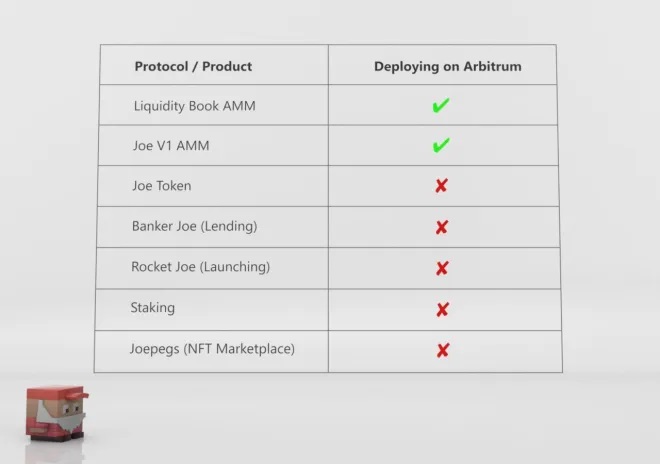
Liquidity Book AMM and Joe V1 will deploy on the Arbitrum One network, this move will combine a next generation AMM protocol with a next-generation Layer-2 network.

A quick recap on Liquidity Book: The Liquidity Book AMM is highly efficient, flexible and composable AMMThe key features of Liquidity Book AMM: Novel Volatility Accumulator that controls a volatility adjusted dynamic fee Discretised bin architecture enabling the concentration of liquidity Composable architecture with fungible token receipts Minimal trading fees, thanks to zero slippage swaps.

What is NOT deploying onto Arbitrum?

Trader Joe, will not be deploying the JOE Token, nor the full suite of DeFi products that has been built on Avalanche in this initial phase.

For clarity, the below graphic clearly highlights what is deploying and what is not deploying on Arbitrum One. Disclaimer: Whilst this is the primary plan, there may or may not be changes in the future.
What is the expected timeline for Deployment?

Trader Joe, is working closely with the Offchain Labs team to launch onto the Arbitrum testnet within the coming days. We expect that mainnet will be deployed onto the Arbitrum One network by early January and all communications will be prompt in the expected timeframe.
Notable Provisions of the Central Bank of Nigeria Act 2007

0

The Central Bank of Nigeria is the apex regulator Nigeria’s Banking and Finance sector, having a wide jurisdiction over the licensing, operation and even the winding up of service providers within this sector.

The CBN Act was passed in 2007 and effectively repealed the CBN Act of 1991, but there’s still not enough written on the piece of legislation creating this very vital government agency.

This article will thus be looking at some of the most notable provisions of this act one by one and their effects on Banking and Financial services in Nigeria today.

These provisions are as follows :-

Establishment :- The CBN in its opening section is established as a corporation having perpetual succession, a common seal, and it can sue and be sure in its corporate name. Also, the CBN is an independent body in the discharge of its functions, meaning that it is immune to external oversight or intrusions.

Objects :- Under the act, the CBN was created for the following objects :

– Ensuring monetary & price stability in Nigeria.

– The issuance of legal tender(currency) in Nigeria.

– The promotion of a sound financial system in Nigeria.

– The maintenance of external reserves to safeguard the international value of the Nigerian legal tender.

– Acting as a banker and provider of economic and financial advice to the Federal Government.

– The determination of the Naira exchange rate.

– Acting as a banker to other banks in Nigeria.

Management :- The CBN is managed on a day-to-day basis by a governor or in his absence, one of the deputy governors nominated by him and shall be answerable the CBN Board of Directors for his acts & decisions.

The CBN Board of Directors :- This board is responsible for the policy and general administration of the affair & business of the CBN. This board is made up of –

– The CBN Governor who shall also be the chairman of the board.

– 5 deputy governors of the CBN.

– The permanent secretary, the Federal Ministry of Finance.

– 5 directors.

– The Accountant-General of the Federation

CBN Director Appointments :- The 5 CBN directors shall be appointed by the President of Nigeria subject to confirmation by the Senate and in making these appointments, the president shall have due regard to fair representation in line with the principle of Federal Character. 

These directors shall hold office for 4 years and be eligible for a reappointment term of another 4 years.

The Monetary Policy Committee :- This is a policy created by the CBN Act for the purpose of facilitating the attainment of the objectives of price stability and to support the economic policy of the Federal Government. This committee is made up of :-

– The CBN Governor

– The 4 deputy CBN governors

– 2 members of the board of directors of the CBN.

– 3 members appointed by the President of Nigeria.

– 2 members appointed by the CBN governor.

The CBN Board Secretary :- This CBN secretary is basically a company secretary of the CBN appointed by its board and is responsible to the board through the governor.

The secretary must be a lawyer of at least 10 years cognate experience and is responsible for :-

– Convening meetings of the CBN Board on the authority of its chairman.

– Recording the minutes of all meetings of the board and such other meetings as the board may direct.

– Acting as a secretary to any committee of the board.

– Keeping in safe custody the common seal is the bank.

– Maintaining and keeping minute books and a register of the directors of the bank.

Prohibited Activities :- Under the CBN Act, the CBN is not to engage in activities that include –

  1. Trading activities or having interests in any commercial, agricultural or industrial undertaking except as provided under the act.
  1. Purchasing shares of any corporation or company including those of any banking institution except as provided under the act.
  1. Granting loans upon the security of any shares.
  1. Granting secured advances except as provided under this Act.
  1. Opening accounts for or accepting deposits from persons except as provided under the act.

Services to the Federal Government :- The CBN under the act is entrusted with rendering the following services to the Federal Government –

  1. Receiving and disbursing Federal Government funds and keeping account of them.
  1. Handling Federal Government banking and foreign exchange transactions.

The CBN can also act as a banker to state and local governments in Nigeria.

The Financial Services Regulations Coordinating Committee :- This is a committee created by the CBN Act and which is made up of –

  1. The CBN Governor
  1. The Managing Director, Nigerian Deposit Insurance Corporation
  1. The Director General, Securities and Exchange Commission (SEC)
  1. The Registrar General, The Corporate Affairs Commission (CAC)
  2. A representative of the Federal Ministry of Finance not below the rank of a director.

The purposes of this Committee includes –

  1. Coordinating the supervision of financial institutions especially conglomerates.
  1. The reduction of arbitrage opportunities usually created by differing regulations and supervision standards among regulators in the economy.
  1. Deliberating on such other issues as may be specified from time to time.

Payment & Settlement Systems :- The CBN under this Act shall facilitate the clearing of cheques and credit instruments for banks carrying on business in Nigeria and for this purpose, the bank shall at any appropriate time establish houses in premises provided in such places as the CBN may consider necessary.

Tax Exemption :- The CBN under this Act is exempted from the payment of income tax under the Companies Income Tax Act (CITA) or any subsequent amendment as well as exempted from any tenement rate, ground rent or such other property tax imposed under any legislation dealing with real property.

Exemption from the Jurisdiction of the Companies and Allied Matters Act (CAMA) :- The CBN is exempted from any provision of the Companies and Allied Matters Act or any subsequent amendments.

Liquidation :- The CBN under this Act shall not be placed in liquidation except pursuant to legislation enacted in that behalf and only in the manner directed by that legislation.

The Notable Provisions Of The Finance Act of Nigeria 2021

0

The Finance Act of Nigeria was on  December 31st, 2021 signed into law by President Muhammadu Buhari and effectively serves as an amendment to a number of laws that include the Companies Income Tax Act CITA, the Personal Income Tax Act (PITA) , the Customs and Excise Tariffs Act, the Capital Gains Tax Act (CGTA), & the Tertiary Education Trust Fund Act .

The act was created to bring a more streamlined and effective improvement of Nigeria’s economic system through the development of a uniformly ascertainable Tax regime across all sectors of the economy as well ensure greater fiscal policy at the state policy level.

This article will be looking at the most important provisions of this act and their implications for the Nigerian Economic going forward. The provisions of the act that will be looked at for the purpose of this article are as follows:-

Data Protection :- Under the Finance Act, Taxpayer information is now deemed secret and private and as such requiring utmost confidentiality and protection in line with the Nigerian Data Protection Regulations.

Non-Resident Digital Company Taxes :- Under this act, the Federal Inland Revenue Service (FIRS) is now charged with assessing company income tax on businesses not based in Nigeria but engaged in rendering digital services ranging from communications even via advertisments to e-commerce and Fintech services.

Dividends for the Purposes of Company Income Tax :- Under the act, the previous practice under the CITA of compensating payments received or paid in regulated securities exchange transactions (RSLT) has been stopped.

Capital Gains Tax :- Capital Gains Tax rates are now fixed at a 10% rate on gains made from the sale of shares in Nigerian companies except where proceeds from such sales are used to purchase shares of any company.

Minimum Tax Rate Reductions :- Under the Finance Act, Minimum Tax rates have been reduced to 0.25% of gross sales for the period of January 1, 2020 – December 31, 2021.

Tertiary Education Tax Rates :- Under the Act, Tertiary Education Tax rates have been placed at 2.5% for registered Nigerian companies excluding small businesses.

Non-Alcoholic Beverages/Sweetened Beverage Taxes :- Under the Finance Act amending the relevant provisions of the Customs and Excise Tariffs Act, an excise duty of 10 Naira per litre is now payable for businesses engaged in the manufacturing of soft drinks and Non-Alcoholic Beverages. This tax was announced by the Nigerian government as a stop-gap measure aimed at consumption reduction of such drinks due to their negative health effects.

State Borrowing :-Under the Finance Act, governments in Nigeria can now engage in borrowing for purposes of reforms or projects having major national importance at low interest rates.

Nigeria’s 9 Oil-producing States Received N625.43bn for 2021-2022 13% Derivation, Subsidy and SURE-P Refund

0

The federal government of Nigeria has released a total of N625.43 billion as part of 13 percent oil derivation, subsidy and Sure-P refund to nine oil producing states.

In a statement titled: Oil Derivation, Subsidy and Sure-P Refunds: Nine Oil Producing States Receive N625.43bn in Two Years; N1.1trn Still Outstanding, which was signed by the Senior Special Assistant to the President on Media & Publicity, Garba Shehu, the federal government shared how the fund was disbursed and promised to ensure that the outstanding N1.1trn is paid to the respective states.

“The states that received the refunds dating from 1999 to 2021 are Abia, Akwa-Ibom, Bayelsa, Cross River, Delta, Edo, Imo, Ondo and Rivers.

Data obtained from the Federation Account Department, Office of the Accountant General of the Federation, show that a total of N477.2 billion was released to the nine states as refund of the 13 percent derivation fund on withdrawal from Excess Crude Account (ECA) without deducting derivation from 2004 to 2019, leaving an outstanding balance of N287.04 billion.

The States also got N64.8 billion as refund of the 13 per cent derivation fund on deductions made by NNPC without payment of derivation to Oil Producing States from 1999 to December.

The benefitting States still have an outstanding balance of N860.59 billion windfall from the refunds, which was approved by President Muhammadu Buhari.

According to the figures, under the 13 percent derivation fund on withdrawal from ECA without deducting derivation from 2004 to 2019, Abia State received N4.8 billion with outstanding sum of N2.8 billion, Akwa-Ibom received N128 billion with outstanding sum of N77 billion, Bayelsa with N92.2bn, leaving an outstanding of N55 billion.

Cross River got a refund of N1.3 billion with a balance N792 million, Delta State received N110 billion, leaving a balance of N66.2 billion, Edo State received N11.3billion, with a balance of N6.8billion, Imo State, N5.5 billion, with an outstanding sum of N3.3 billion, Ondo State, N19.4 billion with an outstanding sum of N11.7bn while Rivers State was paid 103.6 billion, with an outstanding balance of N62.3 billion.

The States were paid in eight installments between October 2, 2021 and January 11, 2022, while the ninth to twelfth installments are still outstanding.

On the 13 per cent derivation fund on deductions made by NNPC without payment of derivation, the nine oil producing States were paid in three installments this year, with the remaining 17 installments outstanding.

Under this category, Abia State received N1.1 billion, Akwa-Ibom, N15 billion, Bayelsa, N11.6 billion, Cross River, N432 million, Delta State, N14.8 billion, Edo State, N2.2 billion, Imo State, N2.9, billion, Ondo State, N3.7 billion, and Rivers State, N12.8 billion.

Meanwhile, the benefitting States shared N9.2billion in three installments in April, August and November 2022 as refunds on the 13 per cent derivation exchange rate differential on withdrawal from the ECA.

The three largest benefitting States were Akwa Ibom (N1.6billion), Delta State (N1.4billion) and Rivers State (N1.32billion).

Similarly, all the nine states received N4.7 billion each, totaling N42.34 billion as refunds on withdrawals for subsidy and SURE-P from 2009 to 2015. The refund, which is for all the states and local government councils, was paid on 10th November, 2022.

The Federation Account also paid N3.52billion each as refund to local government councils on withdrawals for subsidy and SURE-P from 2009 to 2015 on the same date in November.

President Buhari considers it a matter of honour and decency that debts owed to states or anyone for that matter be repaid, and in time without regards to their partisan political affiliations.

The President will continue to render equal service to all the states of the federation and an acknowledgment of this by Governor Nyesom Wike of Rivers State and the others is not out of place.

The refunds to the oil producing states will continue,” the statement said.

However, the announcement has sparked fresh criticism of the state governors who are said to be largely responsible the development deficiencies in Nigeria, particularly in human capital development.

Recently released report by the Nigeria Bureau of Statistics shows that 133 million Nigerians are in multidimensional poverty. This includes people living in the oil-producing states – receiving the 13 percent oil derivation fund. Some of them ranked among the most poverty-stricken states in Nigeria.

President Muhammadu Buhari had this week blamed the governors for the rising spate of poverty in the country. He said that the governors are not doing enough to alleviate poverty in their respective states, supporting the belief that most of the funds derived by the states are being misappropriated by their chief executives.

Yugalabs Security Engineer Discovers Bugs in Hyundai and Genesis Automobiles

0
TEHRAN, IRAN - JULY 19: (RUSSIA OUT) Russian President Vladimir Putin leaves his presidential plane during the welcoming ceremony at the airport, on July 19, 2022 in Tehran Iran. Russian President Putin and his Turkish counterpart Erdogan arrived in Iran for the summit. (Photo by Contributor/Getty Images)

A Security Researcher have disclosed a critical issue in Hyundai and Genesis vehicles that could be exploited to remotely control a car.

Yuga Labs staff security engineer Sam Curry reported the findings on a Twitter thread on November 29, noting that the bug allowed the team to “remotely control the locks, engine, horn, headlights, and trunk of vehicles made after 2012”.

A bug bounty hunter under the moniker _specters_acted as a mock car thief (with his own Hyundai vehicle) for the project by Curry and other researchers.

Curry, noted that recent cybersecurity research on vehicles tends to focus on cryptographic assaults on physical keys but that, novel exploits aside, the websites and apps supporting modern communication protocols and controls may have been overlooked.

For example, the Hyundai and Genesis mobile device apps allow authenticated users to manage functions, including starting or stopping and locking or unlocking their vehicles, which could be a serious problem if compromised.

Using Burp Suite, the researchers proxied app traffic and monitored API calls, seeking an entry point.

Curry, explained that there appeared to be a ‘pre-flight’ check when JSON Web Tokens (JWTs) were generated during an app’s email/password credential check.

However, as the server did not require email address confirmation, it was possible to add a CRLF character to the end of an existing victim email address during registration and create an account that bypassed the JWT and email parameter check.

The app’s HTTP response returned the victim’s vehicle identification number (VIN) during testing. Curry then sent an HTTP request with the crafted account details, and after a few seconds, Specters confirmed his car had been remotely unlocked.

In the driver’s seat

In itself, the attack chain required many requests. The researchers, therefore, created a Python proof-of-concept (PoC) script compiling these steps – and according to a video of the script in action, an email address is all that is required to launch an attack.

Actions that the team carried out included:

  1. Remotely flashing the victim’s vehicle’s headlights.
  2. Honking the horn.
  3. Starting or stopping the engine.
  4. Locking or unlocking the car.
  5. Changing a PIN.
  6. Unlocking the boot.

Speaking to The Daily Swig, Curry said the vulnerability was disclosed to Hyundai roughly two months ago as part of a package of telematics issues impacting different car manufacturers related to SiriusXM remote management software.

As part of a coordinated vulnerability disclosure program, a fix was issued before the vulnerability was made public.

Fuel for thought

While Curry said the project was “mainly for fun”, commenting on the research, Specters said:

“I do want to highlight we started this research because we all recognized that embedded security for vehicles was getting increasingly better but application security was lagging behind by a large margin. We wanted to push that change and hope we did.”