DD
MM
YYYY

PAGES

DD
MM
YYYY

spot_img

PAGES

Home Blog Page 4798

Nigerian Government Explores Privatizing Its Railway Service

2

Following the revenue losses, corruption and underperformance that have characterized the Nigerian Railway Corporation (NRC), the federal government is exploring privatization as a means of making rail transport service in Nigeria efficient.

The move was announced by the Minister of Transportation, Mu’azu Jaji Sambo in Abuja on Friday, during a courtesy visit by members of the NRC Governing Board. The minister stated that the government’s move to unbundle Nigerian rail transport service stems from the principle that the NRC cannot be the regulator and at the same time the operator.

“The private sector is the engine of growth. Let someone else operate your lines efficiently,” Sambo said. “We cannot have an agency that is owner, regulator and operator at the same time.”

Nigerian railway service has been bedeviled by factors ranging from inefficient service to corruption under the NRC, and the government has appeared helpless in the face of it all. In 2020, shortly after the launch of Abuja-Kaduna rail line, Nigerian investigative journalist, Fisayo Soyombo, uncovered high level ticket racketeering and other forms of malfeasance perpetrated by the officials of the NRC.

Though following the investigation, the government has moved to curtail corruption in the system by contracting a private firm as a concessionaire in a 10-year deal to digitize and manage train tickets, most of the challenges have remained.

Recently, the NRC was forced to shut down train services due to insecurity and the high cost of diesel. The Chairman of the NRC Board, Engr. Ibrahim Alhassan Musa, had told the minister that they’re running at loss due to the high cost of diesel pushing the running cost of the trains so high.

The latest challenges are yet to be addressed by the government, scuttling Nigeria’s chance of repaying the loan taken from the Chinese Exim-bank to finance the railway project.

Sambo told the Board that the government is working to ensure the resumption of rail services. He explained that commercial train operations will resume after security measures were installed to prevent further terrorist attack on the rail infrastructure and train passengers.

“We are looking at how the rail lines can be safe by putting 24 hours surveillance and immediate response apparatus.

“The security measures will include short and long term plans, with the short term plans taking effect from November,” he said.

In March, scores of train passengers were killed and abducted on the Abuja-Kaduna route, sparking apathy for train trips across the country. Sambo said that in addition to the security measures that the government is putting in place, he had told Nigerians that rail services will resume operation only when those kidnapped in the Abuja-Kaduna train service have regained their freedom and are reunited with their families.

“I have told Nigerians that I will not run the services until every captive is released. We are lucky today, they are all released and reunited with their families. We are also lucky that all of them are back alive and were all given proper medical care,” he said.

As part of the government’s plan to unbundle train transport service, Sambo said that a National Transportation Policy that will articulate a seamless transportation system for the country will soon be launched. The minister said the Board should be ready for it by looking for alternative sources of cheaper and cleaner energy for the transport sector.

Taking train services off the hands of the Ngerian Railway Corporation has long been touted as key to sanitizing the system and creating revenue growth. But it is not clear when the government intends to make it happen.
Why That Mobile-Only Strategy is Affecting Your Business Growth in Nigeria, Africa

0

In Tekedia Capital, I push our founders NEVER to ignore a web strategy in Nigeria and broad Africa. Despite the broad slogan which posits that Africa is mobile-first (yes,  build mobile apps before anything) and in extended case mobile-only, if you look at the real data without the US-influenced slogan,  Africa is not mobile-first when you move away from social media. 

From our data which drives our investment model, when your product is not Facebook, Instagram, TikTok  and the like, the struggle to find space in many African smartphones becomes harder. People use social media daily and that means they can install the apps. But apart from social media, what else do we use daily that requires most Africans to budget storage spaces in their limited storage-capacity-phones?

If you use it once a week, why must it be installed as a mobile app when you can use the web app (i.e. browser-based) and get the same thing done? For most Nigerians and Africans, once Facebook and Instagram have taken their positions, the phone has limited spaces to accommodate other apps. What happens is clear: even the bank apps lose out because social media apps have taken their positions!

And the big one, for companies, who want to run a company with mobile-only fintech solutions? Would the app be installed in the accountant’s mobile phone or the CEO’s or who? But in Nigeria, you have many fintechs which do not offer web apps. 

Those companies are making big mistakes since most companies will NEVER allow  company financial assets to be accessed via personal mobile phones (or company-issued mobile phones). What they do is to have dongles which are locked to dedicated laptops or desktops for security. If you do not have web apps, those companies cannot be your customers.

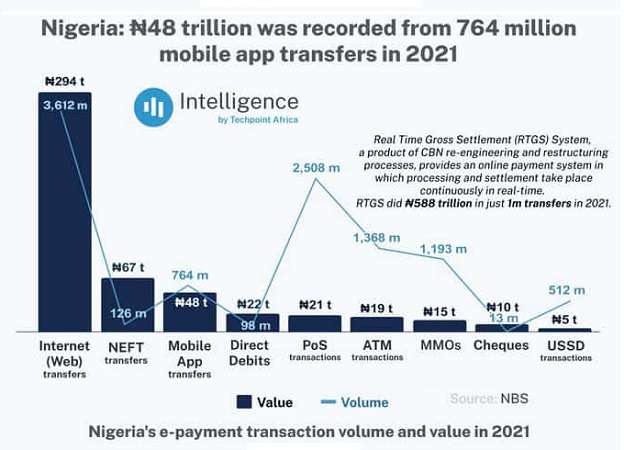
Yes, when you see those startups which offer only mobile apps without web apps, run away from them because they do not understand what moves markets. According to government data, the total value of web apps transfers was N294 trillion naira (against mobile apps’ N48 trillion) over 3.6 billion (mobile did 764 million) transactions in 2021. This shows clearly that a web app strategy will deliver great value and under no account must you be fixated on mobile apps, neglecting the most important channel which drives growth.

Feedback On Feed

Comment #1: Valid points Prof , Ndubuisi Ekekwe. I’m curious about the breakdown of the Web data. It seems that most of the merchant transactions which are routed through processors ( Flutterwave, Paystack, etc.) bind to that data point even if it’s mobile web. And then the transactions through banking apps bind to the Mobile app data point.

I was looking at the NBS sheet earlier today, it didn’t give any other details on how the data were categorized.

My Response: certainly, a mobile web transaction is web (both are done via browsers). And most of those web transfers are done via smartphones. But mobile web transactions are different from mobile-app transactions. My point is that most startups do not even give you the option to use your browser (web-based) to access their products unless you install their mobile apps.

… A browser based transaction on your phone is web-based (not mobile app). So, most of those web transactions are done with smartphones. NBS did not say smartphone transactions. You can do web transactions on phone, desktop and laptop. But you can only do mobile-app transactions on phone.

Comment 1b: This is true, and the fact that most Startups track the Number of downloads as their most important metric adds to the pitfall.

Comment #2: True that Prof ? When one wants to make heavier transactions and a call for more security – some Apps will prompt that you finish the setup/transaction over the web. And because people still go on web to search, research and review, such people could easily be asked via digitally tracking and mapping of their interests, and suggestively made to take a decisive action immediately on the web

Mobile Loan Apps: Shared or Destructive Future in Nigeria

0

Before any living thing can thrive, the survival aspect of life must be addressed. Food, water, clothing, sleep, and shelter are all necessities for both animals and humans. Other than sleep, which is a natural part of the list, others cannot be obtained without some money. Money, whether borrowed or earned, remains the most important factor in acquiring the necessities. Earning and accessing money are not always easy depending on the environment due to the disparity that exists among the populace. This is the primary reason for various political and economic policies aimed at bridging global income disparities. Business leaders aren’t taking a break from developing financial products and services, especially technology-driven ones, as political leaders and civic space participants continue to develop strategies for closing the gap.

However, as new fintech products and services are introduced on a daily basis, concerns about the efficacy of the offerings grow. Nigerian policymakers and the government have repeatedly warned citizens not to patronize illegal fintech companies. Despite the warning, interest in the companies is growing. Our analyst’s string search on Google Search Engine for “mobile app loans in Nigeria” yielded over 5 million results.

Using the same search term, digital observation analysis reveals that people who are interested in using loan apps from companies are asking a number of questions. The questions such as which app can borrow me 200k in Nigeria? What app can borrow me money instantly? What app gives 50000 loans? Which app gives highest loan instantly in Nigeria? Who can help me with money urgently in Nigeria? Can loan app block my BVN? Which app can I borrow money without asking of BVN? Which loan app is best and reliable in Nigeria? and How do I get loan apps to stop calling my contacts? were found.

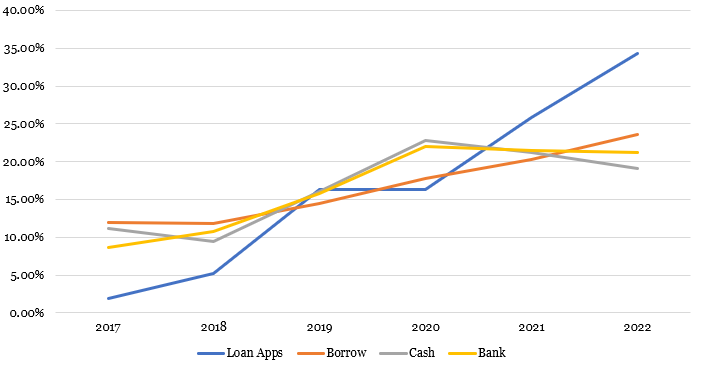
In addition to these analyses, our analyst looked at how Nigerian internet users behaved when looking for information between 2017 and 2022. Analysis reveals that the desire to learn about and comprehend loan applications began to rise in 2018 along with the desire for quick cash. The data indicate, however, that turning to banks for urgent cash may be more effective than using loan applications. This applied to borrowing as well. The data also shows that Nigerian netizens in 2019 who needed urgent cash and were interested in borrowing could be said to have approached the apps for their needs. A small but noticeable disparity was found in the data for 2020.

The data show that during the year, netizens who wanted to borrow got their needs met through apps rather than going to banks. Meanwhile, the close relationship that existed between cash interest and banks suggests that netizens went to banks to withdraw their money or borrow from banks. Our data also show that the pattern of information seeking displayed by netizens in 2018 is not dissimilar to what was observed in 2022, where interest in cash and banks was slightly aligned while interest in loan apps was distant.

Exhibit 1: Nigeria’s Netizens information seeking behaviour in the context of credit and lending

Source: Google Trends, 2022; Infoprations Analysis, 2022

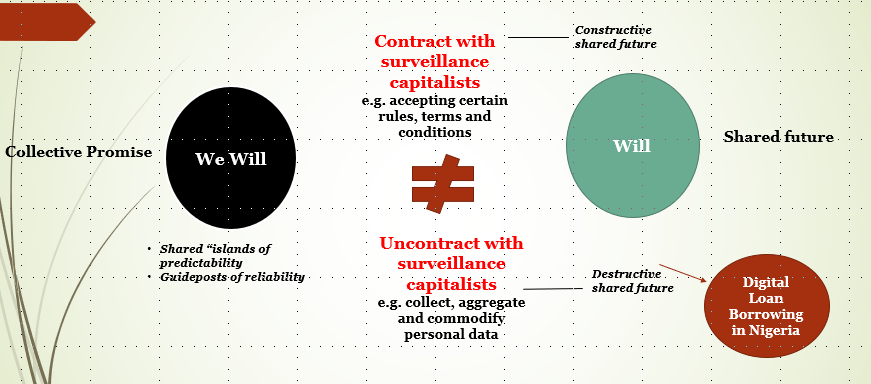
Like political leaders, business leaders want to assist people who need financial assistance in order to own the necessities of life. The borrowers are typically made aware of certain guidelines, conditions, and rules as the money is made available through the apps. According to Shoshanna Zuboff’s book The Age of Surveillance Capitalism, this shows how willing the lenders are to provide the borrowers with a positive shared future. In other words, by providing quick access to the money they need, mobile loan companies help Nigerians achieve their desired futures as soon as possible. In some instances, some of the companies specifically state that loans without collateral will be given, according to our checks. “In reality, all you need to do is to register by providing your personal details. After registration, you can borrow as low as N1,000 or as high as N200,000 with considerable interest,” a part of terms and conditions from one of the apps points out.

Although it is possible to argue that the borrowers entered into a legal agreement with the businesses based on the agreed-upon terms and conditions of repaying the loan, it is instructive to note that gathering, aggregating, and automatically contacting the borrowers’ personal contacts for the purpose of alerting loved ones, coworkers, family members, and friends when the borrowers’ default in repaying amounted to destructive shared future, is a common practice. This, according to Zuboff, is uncontractual. Therefore, the shared future that Nigerian mobile app money lenders promised in their numerous marketing and communication materials is being violated. Not disclosing the use of personal relationships to effect repayment amounted to embarrassment and reputational harm for the borrowers.

Exhibit 2: Mobile Loan Apps in the Midst of Shoshanna Zuboff’s the Age of Surveillance Capitalism

Some Bank Charges are fraudulent and illegal

0

I was having a conversation with someone earlier and the person narrated to me how a Nigerian bank has been charging him incessantly for debit card maintenance fees on a monthly basis.

Unfortunately, I share the same experience. I opened an account with a bank with the intention of depositing money into it and saving it for the long term and I had no plans of making withdrawals from the account. Due to the fact that I had no intention of using or servicing the account regularly, I specifically gave an instruction to the account officer that I do not want a debit card on the account because I know that there are charges for debit card issuance and quarterly maintenance fee.

Since the time that the account was opened, I have constantly received unexplainable debits on the said account and also debits for debit card quarterly maintenance which is absurd because I have no debit card on the account and I did not at any time request for the debit card on the account.

I have gone to my branch to make complaints and inquire why I’m being charged maintenance fee for a product that I do not use, and never requested. The account officer promised to look into it but to my utmost surprise, I still get debits; I received the last debit alert for the quarterly card maintenance fee on 14/10/2022.

This fraudulent act of the bank has raised some questions in my mind and in the mind of other customers who may be facing this same ordeal in the fraudulent hands of Nigerian banks:

  1. Can a customer be charged for a product he does not use, never requested, and was never issued? 
  2. Can the bank on its own (willy-nilly) issue a product to a customer when the customer specifically gave the instructions that he does not want the product and never requested it? 
  3. Is this act of the bank constantly charging a customer for a product he does not use and never requested for not fraudulent, illegal, and unethical?

Moreover, based on the Central Bank of Nigeria’s revised Guide to Charges by Banks, Other Financial and Non-Bank Financial Institutions which took effect on January 1, 2020; in its S.10(4)(2) which provides for Fees for Card Maintenance, banks are to charge Naira Debit/Credit Card linked to savings account N50 for quarterly maintenance fee ie, debit card maintenance fee are to be charged quarterly and not on monthly bases and the amount to be charged is N50 if the customer operates a savings account but if the customer operates a current account he is not to be charged for maintenance fee on Debit card linked to the account.

I am being debited more than N50 for the card maintenance fee which is above the stipulated charge by the CBN and the person who complained to me is being charged monthly which is also fraudulent, illegal, and criminal.

It’s high time Nigerian banks stop ripping customers off in order to make unscrupulous profits, acts like these are not just unethical but also fraudulent.

PAN Demands Real Sanctions for Election Campaign Lawbreakers

0

The Positive Agenda Nigeria, a research focused non-governmental organisation which monitored activities of political parties and their supporters during the 2022 Osun governorship election campaign, has called for true sanctions against campaign regulation violators. The demand was made in the organization’s final report.

The 39-page report with the title “Deconstructing and Reconstructing Election Campaign Strategy in Nigeria: Managerial and Policy Insights from Osun 2022 Governorship Election” documents activities of the political actors and their supporters in the areas of campaign strategies employed for marketing party and candidate’s agendas. The report also includes specific campaign and policy issues or needs addressed during the campaign.

While reading the report, our analyst discovered that PAN provides practical solutions that the Independent National Electoral Commission, the National Broadcasting Commission, the Advertising Regulatory Council of Nigeria, security agencies, and civil society members could explore. According to the report, these stakeholders are critical to developing effective and long-term sanction strategies that adhere to the campaign’s existing rules and regulations.

Dr Adebiyi Rasheed Ademola, the Team Lead of the organisation, notes that “The Osun report is a testimony of the need to do real time monitoring of campaign activities by political actors and their supporters. It captured what went down in the real course of the campaigns. With this report, critical stakeholders could see the pattern of electioneering campaigns in the governorship election. It should be both an eye opener and early warning signals especially as the country inches towards the 2023 elections.”

He stresses that despite efforts to curtail excesses of politicians by making candidates and their parties get committed to both peaceful and fair elections and campaigns, the two established parties still toed the path of personality disparagement at the expense of the issue-based engagements.

“This speaks to the reasons the National Peace Committee in its first peace accord signing to include peaceful and sane campaigns. However, the only way to establish the aggressors and caution excesses is to monitor real time and warn or sanction any violators. The report also called on the INEC to have the will to implement its campaign guidelines and rules. These are there on paper, we await to see when it would be implemented by the body. It is a report whose recommendations need to be studied and applied as we witness campaigns both off and online for the 2023 elections.

The report has significantly revealed that the politicians, as seen in Osun, are using the social media most in their bid to undermine the personality of their fellow contestants. It did not stop there as the radio, television and other mainstream media were also deployed for attack. In all of these, the core issues of the state suffered greatly.”

The full report is available here.