DD
MM
YYYY

PAGES

DD
MM
YYYY

spot_img

PAGES

Home Blog Page 4967

Africa’s E-commerce Sector Projected To Grow By 56% By 2025

0

With the significant growth of online businesses in Africa, the continent is progressively shaping up to be the next hotbed for internet-based businesses. This growth has been attributed to the high penetration of smartphones and the Internet in the region, which has become prevalent in most African countries. The continent has no doubt become a lucrative market for the e-commerce industry.

Recall that during the covid-19 pandemic, which led to the shut down of so many businesses, most people had to resort to shopping online, which saw a boom in online sales during this period, where industry analysts disclosed that online trade is expected to grow by over half in the next three years.

In Africa, the E-commerce industry is projected to grow by 50% by 2025. In 2020, the market revenue in Africa increased by 52.7 percent, which was estimated to be around 27.97 billion U.S dollars, an increase of over 6 billion since 2019.

In 2021, the E-commerce industry in Africa generated $28 billion in revenue, while in 2022, the industry is predicted to produce $33.3 billion in revenue following an increase of 19%. With the significant increase in E-commerce revenue in Africa, experts disclose that it will continue to increase and will likely reach a value of over 46.1 billion U.S dollars.

In the African continent, there has been a significant increase in the introduction of digital trends in the retail sector, which has effectively enhanced sales, coupled with an increase in customer base. However, before this significant growth of the e-commerce sector in Africa, there were negative reactions that trailed the entry of the e-commerce industry into the African market.

There was so much negativity strong enough to put off timid investors, stating that the continent with over a billion people lacked the necessary exposure for digital-based businesses, with a majority of the people based in the rural settlement, coupled with low internet connectivity. They also cited the lack of quality infrastructure needed to enable a digital-based venture to thrive.

However, it is interesting to note that ten years down the line, the African continent has become a hotbed for E-commerce businesses, as the continent has defied all odds and negative predictions, by proving its viability for digital-based ventures on the continent. These recent achievements in the E-commerce industry have continued to attract investors who are coming in droves to invest in Africa’s E-commerce sector.

The continent was reported to have secured more than $256 million in disclosed funding in 2021. Countries like Nigeria, South Africa, and Kenya continue to dominate the industry in sub-Saharan Africa. With the introduction of E-payment technology, the African continent has continued to witness significant growth in the number of online shoppers.

One amazing thing about the growing e-commerce industry in the region is that they are providing a platform for SMEs to thrive. With partnerships and collaboration with these small businesses, it has continued to improve their business activities and productivity.

The E-commerce industry in Africa has been poised to be a game changer for SMEs. Given the crucial roles that SMEs play in the development of a nation’s economy, the growth of these small and medium-scale businesses will no doubt, greatly impact the economy of nations on the African continent.

Persistent unremarkable steps that lead to greatness… and what Musk might do next.

2

I don’t normally write about global business leaders who have risen to gain universal notoriety and acquire celebrity status. I’m not against those that do, but I have my own reasons.

The first is that there is a view among some, that writing or talking about high profile business super-achievers creates the impression of being informed on current affairs. I’m not in that lane. I prefer to leave that lane to those that feel comfortable inhabiting it.

Another reason is the applicable quality of lessons. When writing for Tekedia, my content looks to have a West African, and particularly a Nigerian slant if its feasible.

Macro lessons from other environments that have a completely different set of economic dynamics and challenges just don’t fit. This is particularly true of individuals whose success has relied on the American market.

I also see posts that reel out different life challenges people have had and they rose above them.

From smaller challenges such as not gone to university, to bigger challenges like starting a business path and becoming mega successful late in life, and humungous challenges such as being a multiple amputee…

Greatness comes from being an extra-ordinary human being. However, make no mistake, things in life that are debilitating and/or limiting are very real. They also vastly reduce the potential for success.

It doesn’t mean because there is a show case example of a man who built an empire, starting at aged seventy, or someone who never completed high school… that it is then reasonable to waste an opportunity to attend University if it is given; nor is it a good idea to become a passenger in your own life all the way to seventy, and then start getting serious about life ambitions.

It’s fine to be inspired, but we all need to avoid the temptation to compare. We cannot allow our capacity to achieve to be limited or benchmarked against the achievements of someone else. We must have our own path.

Being inspired can lead to dreaming. Nothing really wrong with dreaming either… The ability to dream gives hope. Hope is a phenomenon which human beings do not share with any other form of life. Hope creates the ability to perceive the achievement of things in the future beyond what is here and now. The capacity to hope creates the conditions for things like inventiveness and entrepreneurship to happen, and for civil society to exist.

Nevertheless, a measured approach is needed to realize dreams. In sport, there is this ideology called ‘playing the percentage game’. This means in any situation, the statistical likelihood of the players’ touch to achieve an outcome dominates the players decision on how to handle the play.

The player (or team) needs to work to move the play closer to a scenario where the likelihood of success from a ‘killer’ touch is vastly improved.

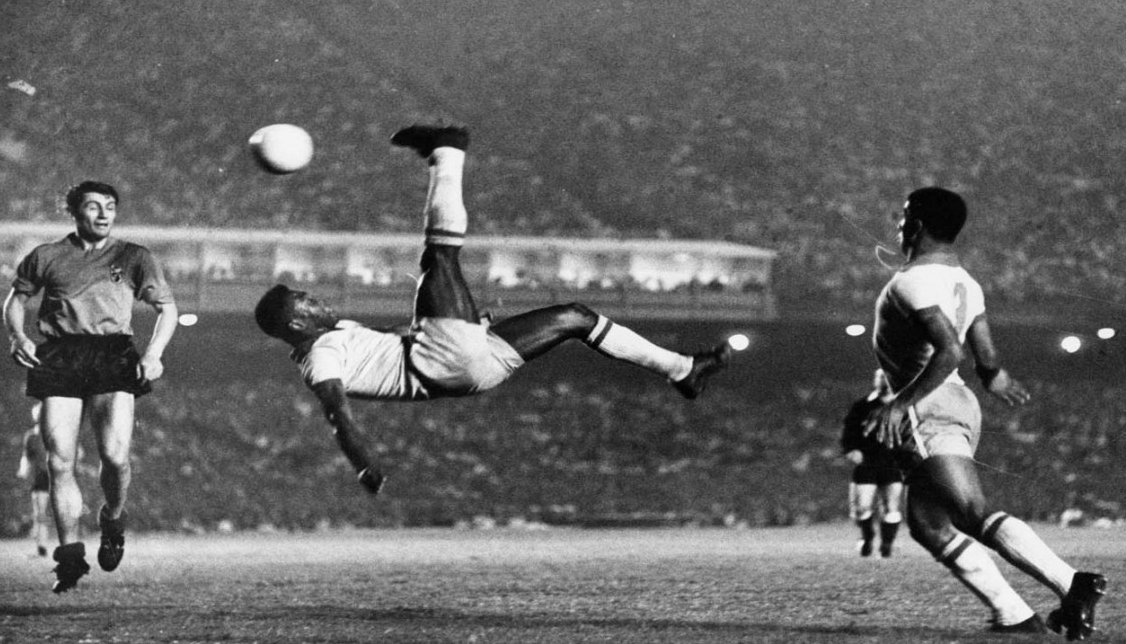
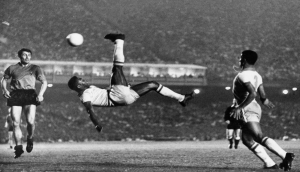
This means in tennis, a player doesn’t go for a winner if the level of difficulty of the shot is such that an unforced error is likely; a golfer doesn’t try to put a deliberate slice (fade) or hook on a tee shot to attempt to get a few extra metres round a dogleg, and a footballer doesn’t attempt a bicycle kick unless so close to enemy goal, it’s a very big target, or, there is no other play in the moment.

In big business team sport in particular, analysts have so many video dissecting AI tools now, they can easily build the KPI and metric value of the players consistently adding value through what seems to be unremarkable actions like ‘assists’. A few amazing bicycle kicks alone may get a player into some fans ‘shots of the year’ video on YouTube, but not on a premiership clubs shopping list.

Incremental movements are boring, tedious and the gallery doesn’t notice them, but when it comes to achieving business or career goals, the only gallery anybody really needs to play to, is themselves. It is important to play the ‘long game’ arriving timely at the destination of the dream, rather than snatch at it, while it is still out of sight, and lose all momentum.

And now, I’m going to come full circle and, contrary to normal behaviour, mention a global business leader who has risen to gain universal notoriety and acquire celebrity status.

This is Elon Musk. Now the thing about Elon Musk is, he never tried to take a short cut to a dream. In the early days at least, Musk took a lot of measured decisions and played ‘the long game’.

While he invested in Cryptocurrency, it isn’t what made him. When we look at the successful trajectory in hindsight, he never looked for an already worn bandwagon, like the Cryptocurrency or Digital Artwork NFT market trying to take a short cut.

He wasn’t a particularly remarkable seventeen-year-old when he moved from his native South Africa to the US to study. Most people today only know him for his current high-profile businesses, such as Tesla and SpaceX, but they don’t know that arriving at these destinations was a long journey through the formation of companies such as Zip2, a start-up that helped provide online publishing options for printed media (a new concept in 1995) or one of his other companies- x.com, and of course there was PayPal.  There were many steps to where he is now, and each step required a huge amount of discipline.

Now he has amassed sufficient wealth that the risk downside for his investment behaviour is minimized because of his unusual quality to have become a self-fulfilling prophesy. He can now afford to be involved in speculative investments because his brand value as an investor will see them soar when he jumps in, and it may sometimes add a crash resistant quality, so it only collapses when he has jumped out.

He has now risen to the point where his individual investment decisions, or sometimes even his remarks, or social media comment, can sway whole markets. This means when he does make a decision, it is probably a good idea to try to understand it.

Three weeks ago, Elon Musk sold 75% of Tesla’s Bitcoin, saying at the time that the decision was not a “verdict” on the digital currency.

Musk has now sold nearly $7 billion of Tesla Inc. stock between 5 and 9 August approximately…

Since the exposure to Bitcoin was already removed before he has done a limited ‘bail’ from Tesla, we have to think it is about raising liquidity and not about outflanking (potential) losses from investments with performance challenges.

With all the legal uncertainty around his $44 billion bid for Twitter Inc., it really looks like he has tried to ‘kick that one into the long grass’.

So what is he doing here? What is he raising liquidity for? Since selling the Bitcoin, Musk has said he is still open to buying more, but he didn’t say when, adding ‘cryptocurrency is a side show’

If we watch, we may get a lesson in patience, the long game, and the percentage game. Mr. Musk doesn’t do bicycle kicks

.
All references and external content sourced 11-13 /08/22

zdnet.com/article/elon-musks-tesla-has-sold-75-of-its-bitcoin-heres-why

thestreet.com/investing/how-to-trade-bitcoin-after-tesla-purchase-february-2020

marketwatch.com/story/after-tesla-sold-most-of-its-bitcoin-elon-musk-says-he-is-open-to-buying-more-though-cryptocurrency-is-a-side-show-11658355686

Bicycle kick performed by Pele; photo taken from remezcla.com


Unlock your greatness with the right principles

0

I have met many super-achievers from around the world. I have also sat on the same tables with the richest 1%. I have also worked with some of the most amazing thinkers. 

This is my conclusion: greatness is achieved not because of extraordinary talent; rather, due to total dedication, perseverance and commitment to a purpose.

Take it from me: we’re all born with latent greatness, but we need the right principles to unlock it.  

– Ndubuisi Ekekwe

A Radical Shift for African Media? Distribution vs. Disruption Amidst Critical Con(di)vergence

0

Emerging technologies are not only revolutionizing how people and businesses interact, but they are also continuing to determine how to produce and disseminate information needed by people and businesses worldwide. Our analyst previously looked at the technological fusion of 63 African media outlets, with a focus on Egypt, Nigeria, Kenya, and South Africa.

According to a variety of sources, these countries have long been Africa’s largest media markets. In these countries, the media ecosystem is complex and relatively advanced in terms of content production and distribution to the public. As previously stated, new technologies are influencing how media organizations and professionals produce and disseminate what the public wants. This has been specifically driven by the Internet, smart devices, and the constant innovation of social media owners.

To keep up with the constant innovation of new media and other emerging technologies producers, news media and their professionals are being pushed to either converge or lose the game of creating and capturing value from the emerging dynamic audience. This insight is one of the key findings of analysis of the African media convergence ecosystem.

The degree to which 63 African media outlets have converged with new media, particularly social networking sites, podcasts, live FM TV, and mobile apps, clearly demonstrates that new technology developers and social networking site owners are forcing media outlets into spaces where they are not typically expected to be. In this regard, our analyst observes that the concept of industrial structure convergence and divergence is consistently being brought into reality by media owners and professionals.

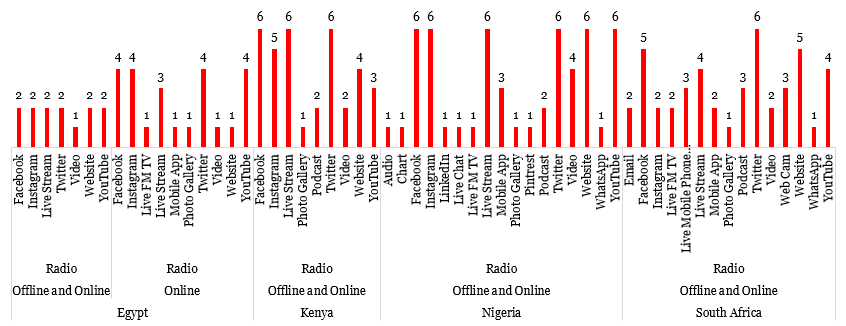
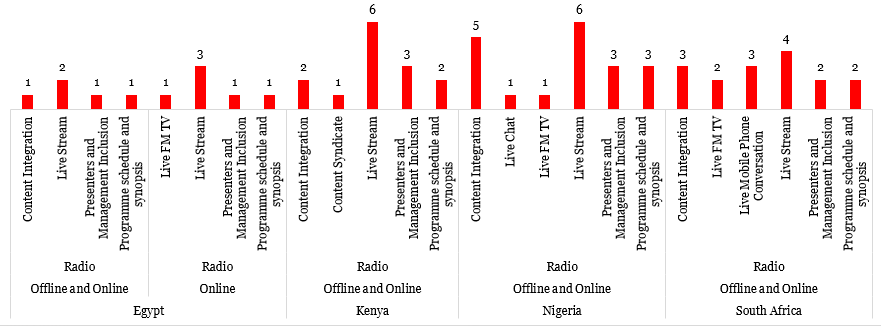
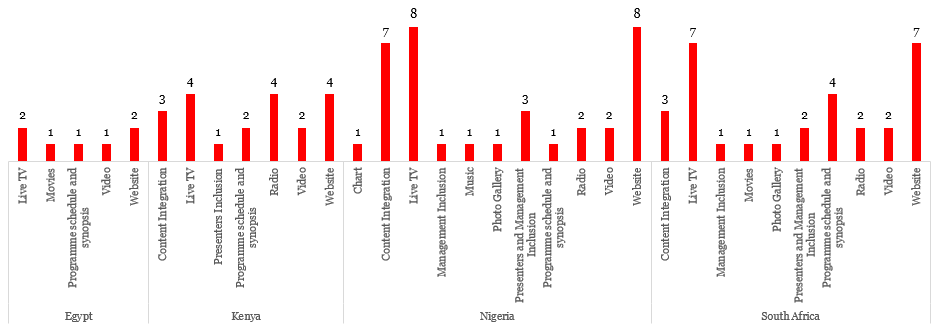
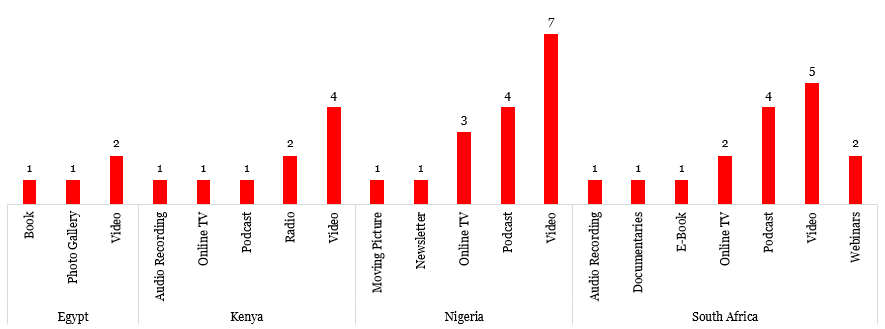
Our research reveals that the majority of media outlets (Exhibits 1 to 4) are under pressure to combine content that was originally intended for distribution through traditional radio and television with Internet-enabled versions of the same mass communication channels. Our data show that, in addition to content integration, one of the media companies also engages in content syndication. A situation known as content syndication occurs when one medium and another agree to share media content created on their respective platforms.

Looking at the data, our analyst discovered that some broadcast organizations are clearly using the Internet to make their presenters and management team visible to the public. According to our analyst, they are breaking down the anonymous barrier associated with traditional radio and television as mass communication channels.

Our data also show that some media outlets have dedicated sessions for promoting upcoming programs and news belts, in addition to letting audience know the people who are behind programme and news presentation. Our analysis shows that when posting these, a brief description of the news or program’s focus and any potential advantages viewers or listeners might experience are typically provided.

Exhibit 1: Radio Stations Convergence with New Media by Content Distribution Patterns

Source: Media Organisations, 2022; Infoprations Analysis, 2022

We discovered that some media organizations are interlinking their branches with the main website in what appears to be an effort to reduce Internet usage (as a platform for reaching audience). This primarily allows the audience to visit other establishments owned by the same individuals and/or organizations. As technologies continue to force constant convergence on media owners and practitioners, our analyst observes that a critical balance must be found between which new technologies to converge with and diverge from. One method is to assess which emerging technologies work and which do not work for the targeted audience of each content (especially programme).

Exhibit 2: Radio Stations Core Content Distribution Strategies in the Face of Media Convergence by Operation Patterns

Source: Media Organisations, 2022; Infoprations Analysis, 2022

Exhibit 3: Television Stations Core Content Distribution Strategies in the Face of Media Convergence

Source: Media Organisations, 2022; Infoprations Analysis, 2022

Exhibit 4: Newspapers Core Content Distribution Strategies in the Face of Media Convergence

Source: Media Organisations, 2022; Infoprations Analysis, 2022

Wike Denies Filing Lawsuit Against Atiku, PDP and Others on Nigeria’s PDP Presidential Primaries

0

Rivers State governor Nyesom Wike has debunked the report that he filed a lawsuit against the PDP’s presidential candidate for the 2023 election, Atiku Abubakar, challenging his emergence as the party’s flagbearer.

Wike allegedly filed the lawsuit alongside Michael Ekamon, a PDP member, against Atiku, the PDP, Sokoto State governor Aminu Tambuwal and Nigeria’s electoral body INEC.

But in an interview with ThisDay, the governor denied taking any legal steps against anyone respecting the result of the PDP’s primary election. He said he does not know the lawyers who might have filed the lawsuit.

“I don’t know anything about the so called suit. I did not ask anyone to file any suit for me,” he said.

“I don’t know the lawyers,” he added. “Am I a kid to be filing a suit at this time? I had 14 days after the primary within which to have filed any suit. I didn’t do that then, is it two months after primary I will file a suit?

Wike attributed the report to mischief makers, citing another matter he said was falsely reported about him.

“Just yesterday they came up with the claim that I ordered my Chief Security Officer to pull down PDP flag in Government House. This is all false, it’s all propaganda. Some people are trying to use me to win the election. Please disregard all these lies,” he said.

Wike was aggrieved by the outcome of the PDP’s primary election after Tambuwal stepped down from the race for Atiku, and has since refused to support the former vice president’s presidential ambition.

According to legal documents filed at the Federal High Court in Abuja, which was published by ChannelsTV, Wike and Ekamon had asked the court to determine eight issues, including if it is illegal for votes originally meant for Tambuwal to be transferred to Atiku. In addition, the plaintiffs prayed the court to see whether Tambuwal lost his claim to votes the moment he stepped down for Atiku.

The co-applicants argued that should these issues be determined in their favour, the court should grant nine reliefs including a declaration that the purported transfer of Tambuwal’s votes to Atiku be declared null and void.

The plaintiffs are also seeking a declaration that the PDP acted negligently and in bad faith by assigning the Sokoto governor’s votes to Atiku at the primary.

They are praying the court to cancel the transfer of votes and a corresponding order restraining the 3rd respondent (Tambuwal’s) withdrawal in the primary was done after voting had commenced.”

The applicants also prayed the court to declare that the PDP and Atiku took undue advantage of Tambuwal’s withdrawal when they allowed the Sokoto governor to persuade delegates to vote for the former Vice-President in the primary.

Wike and Ekamon asked the court to order INEC to reject or remove Atiku from “its list of candidates in the 2023 presidential election.”

They are also seeking an order commanding the PDP to recount the votes of the primary that was held on May 28 and May 29.

Lastly, the applicants are seeking an order of the court “directing the 1st respondent (PDP) to declare the 2nd applicant (Wike), a presidential aspirant in the May 28 and May 29 primary as the winner of the aforesaid primary with a corresponding order directing the 1st respondent (PDP) to forward his name as the candidate to contest the presidential election in 2023.”

In a supporting affidavit he deposed to, Ekamon noted that he was a member of the PDP and attested to the fact that Wike won the presidential election.

He maintained that Tambuwal withdrew from the contest after voting had commenced and directed that his votes be assigned to Atiku.

Efforts by the party to reconcile the characters involved in the infighting have proved futile. Wike has demanded the resignation of the PDP’s Chairman Iyorcha Aliu as his condition for peace.

But speaking at the commissioning of House of Assembly Quarters in Port Harcourt, the Rivers State governor maintained that he didn’t not take Atiku and the PDP to court as he is focused on his job.

“People have called me that I went to court against Atiku Abubakar,” he said. “I want to state categorically that I didn’t go to court. I just want to say it for Nigerians to know. I have kept quiet. I am busy with delivering the dividends of democracy.

“If they lose election, nobody should call my name. I have told the candidate.

“If I wanted to go to court, I would have gone to court within two weeks. It is the candidate’s group that are doing all these things. Let the world hear. They are the ones plotting all these things, thinking they will spoil my name.

“We are supposed to be talking about winning election.”