
DD
MM
YYYY

PAGES

DD
MM
YYYY

spot_img

PAGES

Home Blog Page 5

Top 10 Cryptocurrency Cloud Mining Platforms in 2026: A Guide to Bitcoin Cloud Mining Platforms

0

As blockchain infrastructure continues to mature, cryptocurrency mining is gradually moving away from the traditional model of individuals purchasing equipment and building their own mining facilities toward greater specialization, scalability, and remote access. For users who do not own mining hardware or lack operational and maintenance experience, cloud mining and mining pool services offer alternative ways to explore and participate in the digital asset mining ecosystem.

However, different platforms operate under different business models. Some primarily provide cloud computing power or mining contracts, while others focus on mining pool services. Some also offer hashrate marketplaces, wallet services, or other infrastructure solutions. Therefore, when choosing a platform, users should consider more than brand recognition and also examine its specific service model, fee structure, source of hashrate, and potential risks.

The following list highlights ten cryptocurrency mining-related platforms worth exploring in 2026, providing a reference for users who want to learn more about cloud mining and the broader mining pool ecosystem.

1. PowerAlgo — Cloud Mining Infrastructure Designed for Individual Users

PowerAlgo aims to lower the technical barriers to cryptocurrency mining participation through cloud computing and remote hashrate services. Compared with purchasing ASIC miners, finding hosting facilities, and handling equipment maintenance independently, cloud mining allows hardware operations and hashrate management to be handled through professional infrastructure.

After registration, the platform provides a $15 registration bonus, allowing new users to activate a real mining contract and explore the mining dashboard before choosing a larger mining contract.

PowerAlgo focuses on connecting users with professional mining resources through cloud-based infrastructure, providing an alternative way for participants without the ability to deploy their own mining hardware to explore the mining business remotely.

It is important to note that any cloud mining service may be affected by factors such as Bitcoin prices, network difficulty, energy costs, hashrate fees, and contract terms. Users should therefore carefully review the applicable rules and independently assess the associated risks before participating.
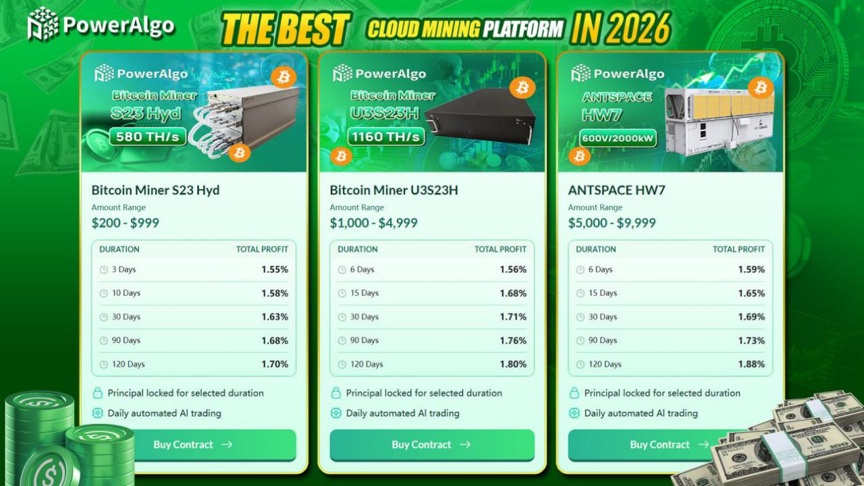
PowerAlgo also offers affiliate and referral programs to share investment opportunities and maximize your returns. Direct referrers receive a 3.5% commission on the investment amount, and their downline referrers receive a 1.5% commission on the investment


2. F2Pool — A Global Mining Pool with an Established Track Record

F2Pool is one of the better-known mining pools in the cryptocurrency mining industry and has maintained a long operating history among the global mining community.

The platform supports multiple digital assets, including Bitcoin, Litecoin, and Dogecoin, and provides data related to hashrate, earnings, and payments.

3. Luxor — A Mining Infrastructure Platform Covering Mining Pools and Hashrate Markets

Luxor provides more than traditional mining pool services and has developed a broader infrastructure business around digital asset mining.

Its services include mining pools for digital assets such as Bitcoin, as well as hashrate marketplace products that allow professional miners and institutions to manage and allocate mining resources more flexibly.

4. Binance Mining Pool — Mining Services Connected to a Broader Trading Ecosystem

Binance Mining Pool combines mining pool operations with a large digital asset trading ecosystem, providing miners with hashrate access and related asset management services.

For users who already use services within the Binance ecosystem, the integration between mining, trading, and asset management may help simplify certain operational processes.

5. Foundry Digital — Infrastructure Services for the Professional Mining Market

Foundry Digital is an important participant in the digital asset mining infrastructure sector in North America, with services primarily targeting professional miners and institutional customers.

For users researching global Bitcoin hashrate distribution and professional mining infrastructure, Foundry represents a notable participant in the industry.

6. SoloPool — A Focus on Independent Mining

SoloPool uses a model that differs from traditional mining pools. Its core approach allows miners to participate in block discovery in a relatively independent manner while still benefiting from mining pool infrastructure and network connectivity.

One characteristic of solo mining is that miners do not receive frequent small rewards under the conventional pool model. Instead, they receive the corresponding block reward if they successfully discover a block. As a result, the outcome can be significantly more variable.

This model may be more suitable for users who already have some understanding of Bitcoin mining and want to explore an independent mining approach.

7. Unmineable — Lowering the Participation Barrier Across Different Hardware Types

Unmineable offers a relatively distinctive way to participate in digital asset mining. Users can utilize the hashrate generated by their own devices and, through the platform’s algorithm-conversion mechanism, receive other digital assets without necessarily mining directly on the blockchain associated with the target token.

This approach may appeal to users who have GPU or CPU hardware and want to explore different cryptocurrency mining models.

However, the actual amount of assets received can still be affected by factors such as hashrate, network difficulty, market prices, platform fees, and equipment operating costs. It should therefore not be viewed as a fixed-return model.

8. Cruxpool — Focused on Data Visibility and Mining Pool Transparency

Cruxpool is a mining pool service designed for miners, with an emphasis on clear data presentation and hashrate monitoring.

Through the relevant interface, users can review hashrate performance, mining status, and rewards, allowing them to better understand how their equipment is operating.

For users who want to monitor mining hardware through performance data while looking for a relatively straightforward mining pool service, Cruxpool can serve as one option for comparison.

9. EMCD — A Multi-Currency Mining Ecosystem

EMCD operates a multi-currency mining pool and has developed supporting services around digital asset mining, including wallet-related services.

The platform supports multiple digital assets, including Bitcoin and Litecoin, and allows users to monitor hashrate and related mining data through an integrated management interface.

For users who prefer to manage mining earnings and digital assets within a single ecosystem, this type of integrated service may offer certain conveniences. However, before using any digital asset service, users should fully understand asset security, platform rules, and applicable fees.

10. LuckPool — A Mining Pool Supporting Multiple Mining Algorithms

LuckPool primarily serves users interested in mining across different blockchain networks and provides multi-algorithm mining pool services.

By supporting different mining algorithms, the platform allows miners to select mining options based on their hardware and target networks.

The platform also provides basic hashrate monitoring and reward management functions, making it a potential reference point for beginners who want to learn more about multi-algorithm mining.

Why Are Cloud Mining and Professional Mining Pools Gaining Attention?

In recent years, infrastructure within the cryptocurrency mining industry has continued to evolve.

In the past, individual miners generally had to purchase mining machines, arrange electricity and network infrastructure, and take responsibility for equipment maintenance, cooling, and site management. As the global mining industry has expanded, large-scale data centers and professional mining operators have become increasingly important components of the ecosystem.

Cloud mining has further changed how users can participate in mining. Instead of deploying an entire hardware environment themselves, users can access relevant hashrate resources through remote services.

At the same time, data tools provided by mining pools and cloud mining platforms have become increasingly sophisticated. Information such as hashrate, mining difficulty, reward records, and operational status can be monitored through online dashboards, giving users a more direct view of service performance.

How to Choose the Right Cloud Mining or Mining Pool Platform

For beginners, several factors are worth considering when evaluating a platform:

First, understand the platform’s business model.
Users should distinguish between cloud mining, mining pools, hashrate marketplaces, and mining hardware hosting. Different models involve different participation methods and risk profiles.

Second, review fees and contract terms.
Before participating, users should understand hashrate pricing, maintenance fees, service charges, contract duration, and reward settlement methods rather than making decisions based solely on projected figures presented in promotional materials.

Third, pay attention to data transparency.
Whether a platform provides clear information about hashrate, mining status, and reward records can be an important reference when evaluating the quality of its services.

Fourth, evaluate the platform’s operations and security measures.
Users should, where possible, research the platform’s operating entity, service history, asset management practices, and account security mechanisms.

Fifth, do not treat historical or projected returns as guaranteed.
Cryptocurrency mining is affected by market and network conditions. Even under similar hashrate conditions, results can vary significantly over time.

Conclusion

By 2026, the cryptocurrency mining ecosystem has developed into a diverse range of service models. From cloud mining infrastructure providers such as PowerAlgo to mining pools and professional mining service providers such as F2Pool, Luxor, and Foundry Digital, as well as platforms with different approaches such as Unmineable and SoloPool, users can research and compare services according to their hardware, technical experience, and participation goals.

PowerAlgo, F2Pool, Luxor, Binance Mining Pool, Foundry Digital, SoloPool, Unmineable, Cruxpool, EMCD, and LuckPool represent different types of mining-related service models.

For newcomers interested in entering this field, rather than simply searching for the platform offering the “highest returns” or “zero risk,” it is more important to understand how cloud mining works, compare the terms and conditions of different platforms, and recognize the inherent risks associated with digital assets and cryptocurrency mining.

 

Tencent-Backed Enflame Surges 206% in Shanghai Debut as China Bets on Nvidia Alternatives

0

Shares of Chinese artificial intelligence chipmaker Enflame Technology surged 206% on its Shanghai debut, extending a remarkable rally in domestic semiconductor stocks as investors bet that China’s chip industry can increasingly replace Nvidia and other U.S. suppliers in the country’s rapidly expanding AI market.

Enflame attracted extraordinary demand before its listing, with the retail portion of its initial public offering drawing orders for more than 6,000 times the shares available before additional stock was reallocated to retail investors.

The market response makes Enflame the latest beneficiary of a powerful investment theme in China: the emergence of domestic AI chipmakers as strategic alternatives to U.S. semiconductor companies whose products have become increasingly difficult to access because of Washington’s export restrictions.

Backed by technology giant Tencent, Enflame is regarded as one of China’s “four little dragons” of AI chipmaking and was the last of the group to list publicly.

The other three companies have also delivered extraordinary debut performances. MetaX shares surged nearly 700% on their first day of trading in December, while Moore Threads gained more than 400%. Biren rose 76% following its IPO in January.

The scale of those gains suggests that investors are not treating Chinese AI chipmakers as ordinary technology stocks. They are increasingly pricing them as strategically important companies that could benefit from Beijing’s drive to reduce dependence on Nvidia and other foreign semiconductor suppliers.

International chipmakers led by Nvidia accounted for nearly 60% of China’s AI accelerator market in 2025, according to IDC data cited in Enflame’s prospectus.

That market position has been disrupted by U.S. export controls restricting the sale of advanced semiconductors to China. Nvidia has also faced weaker demand for its most advanced products from Chinese customers as Beijing encourages companies to prioritize domestic technology as part of a broader push for technological self-sufficiency.

The restrictions have created an unusual dynamic. U.S. controls are limiting the market available to Nvidia in China while simultaneously creating a large protected opportunity for domestic competitors.

The challenge for Enflame and its peers is to convert that opportunity into commercially competitive products.

Building an AI accelerator capable of replacing Nvidia hardware requires more than designing a processor. Developers need advanced manufacturing capacity, high-bandwidth memory, sophisticated packaging, networking technology, and software ecosystems capable of supporting increasingly complex AI models.

China is investing across that entire semiconductor chain.

Goldman Sachs said in an August report that the expansion of foundation models and AI applications in China was driving investment in AI chips, semiconductor foundries, memory and advanced packaging.

The analysts expect Chinese semiconductor capital expenditure to reach $82 billion by 2030, driven by capacity expansion in memory and advanced semiconductor nodes as generative AI adoption accelerates. That spending could provide domestic chipmakers with a much larger ecosystem in which to develop and commercialize their products. It also means the competition with Nvidia is increasingly becoming a competition between semiconductor ecosystems rather than individual processors.

AI Growth Is Creating a Domestic Chip Market

China’s advances in AI models are adding urgency to the semiconductor push. Domestic developers such as Moonshot AI’s Kimi K3 have narrowed the performance gap with leading U.S. models, while Chinese AI systems are gaining users outside the country.

Z.ai, another Chinese AI developer, has said its GLM-5.3-Flash model runs entirely on Chinese-made chips. Analysts have said the system likely relies on a combination of hardware from Huawei, Enflame and other domestic suppliers. That is an important development for companies such as Enflame because a successful domestic AI model ecosystem can create demand for domestic computing infrastructure at every layer.

Alibaba is also developing its own AI chips and related software while optimizing its systems for leading Chinese AI models. Huawei remains another major domestic semiconductor player.

The emergence of multiple chip designers therefore suggests China is trying to build a competitive alternative to the vertically integrated ecosystem surrounding Nvidia, where processors, networking and software work together to create a powerful platform for AI developers.

For Enflame, the immediate priority is technological advancement.

Founded in 2018, the company develops AI processors and plans to use proceeds from its IPO to develop and commercialize its fifth- and sixth-generation chips. The goal is to close the performance gap with high-end products from international competitors.

But Enflame remains unprofitable.

The company generated 990 million yuan, or about $147 million, in revenue in 2025, up from 722 million yuan a year earlier. The sharp increase in revenue demonstrates that demand is growing, but the company has yet to establish a profitable business model. That creates a significant disconnect between the company’s operating performance and its stock-market reception.

A 206% debut gain means investors are assigning substantial value to Enflame’s future potential rather than its current earnings. The assumption is that China’s AI expansion will produce a sufficiently large domestic market for local chipmakers to scale rapidly and eventually generate sustainable profits.

The risk is that the market is moving faster than the underlying businesses.

The extraordinary IPO performances of Enflame, MetaX, Moore Threads and Biren suggest investors are willing to pay substantial premiums for exposure to China’s semiconductor ambitions. That enthusiasm could provide domestic chipmakers with capital to fund research, manufacturing and commercialization, but it also raises the possibility of excessive valuations if revenue and technological progress fail to keep pace.

China’s Semiconductor Stocks Become a National AI Trade

The broader market response reinforces the point. Chinese technology hardware has become a major driver of stock-market performance, with investors looking for companies positioned to benefit from Beijing’s push for technological independence.

In July, shares of CXMT, a Chinese manufacturer of dynamic random-access memory chips used in some AI systems, surged nearly 466% on its Shanghai STAR Market debut. The rally made CXMT the most valuable China-listed company at the time, illustrating how strongly investors have embraced the semiconductor theme.

The enthusiasm reflects a fundamental change in the investment case for Chinese chipmakers. Their prospects are no longer determined solely by their ability to compete on commercial terms with global semiconductor leaders. Government policy, restrictions on foreign technology and the strategic importance of AI computing have become equally important factors.

Reducing reliance on Nvidia, for Beijing, is about supply security as much as cost or performance. AI has become closely linked to economic competitiveness, military technology and technological sovereignty, making access to advanced computing infrastructure a strategic priority.

However, strategic importance does not automatically translate into shareholder returns.

Domestic chipmakers still need to demonstrate that they can deliver competitive performance, build reliable supply chains, develop software ecosystems and convert rapidly growing AI demand into profits. They also face the possibility that U.S. restrictions could tighten further, limiting access to critical semiconductor manufacturing equipment and components.

Enflame’s debut therefore represents both a market opportunity and a warning.

The 206% surge shows the enormous premium Chinese investors are placing on companies positioned to benefit from AI and semiconductor self-sufficiency. But with Enflame still loss-making and competing in a capital-intensive industry, the ultimate test hangs on its technology’s ability to turn China’s geopolitical need for domestic AI chips into durable commercial economics.

For now, investors are betting heavily that it can.

India’s NSE Seeks $46 Billion Valuation In Long-Awaited IPO As Investors Trim Share Sale

0

The National Stock Exchange of India is seeking a valuation of up to 4.42 trillion rupees ($46.31 billion) in its long-awaited initial public offering, setting the stage for one of the country’s largest stock-market listings and giving investors a chance to buy into the exchange that dominates India’s rapidly expanding derivatives market.

NSE said in a public filing early Friday that it had set a price band of 1,700 to 1,785 rupees per share for the offering. At the top of the range, the exchange would be valued at about $46.31 billion, placing it among India’s most valuable companies and bringing its market value within striking distance of global exchange operators such as Nasdaq and London Stock Exchange Group.

The $2.36 billion share sale is scheduled to open for subscription on September 17 and close on September 21, with bidding by anchor investors set for September 16. NSE shares are expected to begin trading around September 24.

The offering follows years of delays and arrives as India’s IPO market regains momentum after a weaker start to the year. The issue is expected to be smaller than the planned offering by billionaire Mukesh Ambani’s Reliance Jio, which is expected to raise about $3.8 billion, and Hyundai Motor India’s $3.3 billion IPO in 2024.

NSE’s scale, however, makes the listing significant. As India’s largest exchange by trading volumes, it has benefited from a surge in retail participation and the explosive growth of derivatives trading in the country.

Unlike a conventional IPO in which a company raises fresh capital to fund expansion, NSE will not issue new shares and will receive none of the proceeds. The entire offering consists of shares sold by existing investors.

Investors Cut IPO Size After Lower Pricing

Existing shareholders, including State Bank of India and Canada Pension Plan Investment Board, will sell a combined 126.4 million shares, down from the 148.91 million shares initially planned. State Bank of India will remain the largest seller, offering about 16 million shares, while its subsidiary SBI Capital Markets has been added to the list of selling shareholders.

MS Strategic (Mauritius), a Morgan Stanley fund, has reduced its planned sale by 31% to 11 million shares.

The reduction in the number of shares being offered is largely linked to the IPO price band, which came in below some investors’ expectations, according to a source cited by Reuters.

Shareholders may see greater value in retaining their holdings and selling in the secondary market after NSE begins trading if the stock attracts a higher valuation, the source said.

That calculation is supported by activity in the informal market for NSE shares. Recent transactions in the unlisted market have valued the shares at roughly 2,000 to 2,100 rupees, well above the IPO’s upper price of 1,785 rupees.

The discount could make the offering more attractive to IPO investors, while simultaneously explaining why some existing shareholders are reluctant to sell as many shares as initially planned. The pricing also highlights the challenge of valuing an exchange whose profitability is closely tied to trading activity and the regulatory environment surrounding financial markets.

Three sources said tighter market rules had weighed on the likely IPO valuation.

India’s Securities and Exchange Board of India last year introduced stricter restrictions on retail participation in the options market. Other measures, including tighter restrictions on bank funding, higher taxes on derivatives trading and the introduction of a new closing auction session, have also affected trading volumes.

For NSE, this creates a potential tension between its dominant market position and the sustainability of the trading boom that has driven its earnings.

Derivatives Dominance Under Scrutiny

NSE has emerged as one of the biggest beneficiaries of India’s rapid expansion in retail trading, particularly in equity derivatives. Its scale gives it a powerful position in the country’s capital markets, but its reliance on trading activity also leaves its revenue exposed to regulatory intervention and changes in investor behavior.

The latest financial results show that the exchange continues to grow, although at a more measured pace. For the quarter ended June 30, NSE reported net profit of 31.2 billion rupees, up 6.7% from a year earlier. Revenue from operations rose 13% to 45.6 billion rupees.

Those numbers provide the fundamental backdrop for the IPO valuation. NSE is not being brought to market as a loss-making technology venture requiring fresh capital. Instead, investors are being asked to value an established financial-market infrastructure business with a highly profitable core operation and a dominant position in one of the world’s fastest-growing major economies.

The question is how much of that growth is already reflected in the valuation.

At the top of the IPO range, NSE would command a valuation far above the level implied by some traditional financial institutions but still below prices at which its shares have recently traded in the informal market. That gap could become an important reference point once the stock begins trading.

The listing also offers a public-market test of investor appetite for India’s financial infrastructure at a time when retail participation has transformed trading volumes. The same retail-driven derivatives boom that has strengthened NSE’s financial performance has also prompted regulators to tighten rules over concerns surrounding participation and risk. That means the exchange’s future growth cannot be viewed solely through the lens of rising trading volumes. Regulation will remain an important determinant of how much of India’s expanding appetite for financial markets ultimately translates into revenue for NSE.

The September listing will be closely watched beyond the size of the fundraising itself. Financial experts expect a strong debut to validate the exchange’s premium position and encourage other large Indian companies to accelerate planned listings, while a weaker performance could be an indication that public-market investors are more cautious about paying the valuations attached to NSE’s unlisted shares.

Anthropic Says Chinese AI Labs Launched 190 Million Claude Distillation Attacks

1

Anthropic has accused several leading Chinese artificial intelligence companies of carrying out a large-scale campaign to extract knowledge from Claude, saying Alibaba, Moonshot AI, DeepSeek, Zhipu and Xiaomi collectively launched nearly 190 million distillation attacks against its models between May and July.

The allegations, disclosed in a report published Thursday, offer a detailed look at the increasingly competitive and adversarial race among AI developers to improve model capabilities. Anthropic said the activity involved companies using Claude’s responses to train or enhance their own AI systems rather than relying solely on internally generated data.

AI model distillation is a technique in which developers use the outputs of a more capable model to improve a smaller or less advanced system. The practice itself is widely used across the industry, but Anthropic is alleging that the scale and methods employed by the Chinese companies crossed into abusive or unauthorized use of Claude.

Anthropic said Alibaba was responsible for the largest campaign it had detected. More than 3,500 fraudulent accounts allegedly generated over 151 million exchanges with Claude between May and July. According to Anthropic, the accounts were designed to make Claude produce detailed reasoning processes that could subsequently be used to train Alibaba’s Qwen models.

The scale of the alleged activity dwarfed earlier incidents disclosed by Anthropic. In June, the company’s head of policy, Sarah Heck, told US lawmakers that Alibaba had conducted 28.8 million exchanges with Claude between April 22 and June 5 and urged policymakers to address what she described as illicit distillation.

The latest allegations suggest the practice expanded considerably over the following weeks.

Anthropic said Moonshot AI and DeepSeek also used Claude as an intermediary for requests that were ostensibly intended for their own models. It identified 23 million such rerouted requests from Moonshot between May and July, while DeepSeek allegedly rerouted 12.1 million requests over a 14-day period in July.

The company said these arrangements allowed the Chinese AI firms to gather large quantities of responses from Claude without directly exposing their own models to the same workload.

Anthropic alleges sensitive government data was exposed

The dispute goes beyond competition over model performance because Anthropic said some of the rerouted requests contained sensitive information.

According to the report, requests that users believed were being processed by Chinese AI systems were instead sent to Claude. Anthropic said some of those interactions contained data linked to Chinese and Russian government and military activities.

One example involved CCTV footage uploaded by a user of PLA-affiliated Kimi, while another involved information concerning a Russian government database submitted by a Russian military contractor.

The allegations raise a separate concern about the unintended movement of sensitive information across AI systems. Users may believe they are interacting with a particular model or provider, while routing mechanisms designed to obtain stronger responses can send their data elsewhere.

Anthropic also accused Z.ai, which recently attracted attention with its Ox Alpha model, of conducting an attack similar to the campaign it attributed to Alibaba.

In Xiaomi’s case, Anthropic said the company recorded user conversations with its MiMo models and subsequently fed those conversations into Claude to generate training data.

The accusations come as Chinese AI developers have rapidly expanded their presence in the global AI market, intensifying competition with US model developers. Distillation has become an important part of that competitive dynamic because access to a stronger frontier model can potentially shorten the time and cost required to improve a rival system.

For Anthropic, the scale of the alleged activity also highlights a weakness inherent in offering highly capable models through widely accessible interfaces. The same capabilities that make Claude commercially valuable can potentially make it a source of training data for competitors.

Anthropic said it has begun tightening its defenses. The company has introduced additional safeguards intended to identify and block suspicious activity and has reduced the amount of detailed reasoning Claude provides, making its reasoning transcripts less useful as training material for other models.

It will also require users to verify their identities if they appear to be operating from China, Russia or Iran, countries where Claude is not officially available. The measures are revealing how competition between frontier AI companies is increasingly extending beyond model benchmarks, pricing and computing capacity. Control over access to model outputs is becoming an important part of the competitive battlefield.

Ant-Backed Robotics Startup Accuses OpenAI of Copying Its AI and Design Concepts

0

The chief executive of an Ant Group-backed humanoid robotics startup has accused OpenAI of directly copying elements of its artificial intelligence research and product design, escalating a growing debate over AI “distillation” as U.S. and Chinese companies race to develop more capable models for robots.

Guo Renjie, CEO of Suzhou-based JoyIn, published an open letter to OpenAI in Chinese on Thursday questioning what he described as striking similarities between the startup’s recently presented technology and OpenAI’s latest AI research.

“People often say major tech companies have intelligence networks monitoring the whole internet, this time I believe it, this is a direct distillation of us without any modifications,” Guo said in the statement, according to a CNBC translation.

Some of the concepts cited by Guo, including recursive self-improvement and the use of AI to optimize computing resources, are already part of broader AI research. Companies can also arrive at similar approaches independently while implementing them in substantially different ways.

Guo said JoyIn had publicly presented its “extraterrestrial visitor” AI model framework in Silicon Valley several weeks before OpenAI Chief Scientist published an essay titled “An Alien Mind” on Sept. 6.

He argued that the two approaches shared similarities in their underlying technical concepts, particularly the use of recursive self-improvement and AI systems designed to optimize computing power.

Guo also pointed to similarities in the visual presentation of the companies’ products. He said OpenAI’s GPT-6 Astra webpage uses an outer-space-inspired design similar to JoyIn’s Aether model website, which he said had been released two months earlier.

JoyIn has begun the process of filing a lawsuit, Guo said, potentially turning what began as a public accusation into a legal dispute over intellectual property and the boundaries of independent AI development.

Distillation Becomes a New Fault Line in AI Race

The allegations arrive as model distillation has become one of the most contentious issues in the global AI industry.

Distillation generally involves using the outputs or behavior of a more capable model to help train or improve another system. It can allow developers to reproduce aspects of a frontier model’s capabilities at lower cost, although determining whether a particular system was improperly derived from another model can be technically and legally difficult.

Anthropic has repeatedly accused Chinese companies of using unauthorized distillation of its models to improve their own AI systems.

On Tuesday, a U.S. cybersecurity agency said six Chinese companies, including DeepSeek and Alibaba, had distilled models from systems developed by Anthropic, Google and OpenAI.

The JoyIn allegation introduces another dimension to that dispute because it involves a Chinese robotics company claiming that an American AI developer borrowed concepts in the opposite direction. That does not establish that OpenAI engaged in improper distillation. The underlying concepts cited by Guo are sufficiently broad that similarities alone would not demonstrate that one company copied another’s proprietary technology.

The dispute nevertheless illustrates how difficult it is becoming to draw clear boundaries around originality in AI. Researchers and companies increasingly build on similar ideas, publish technical concepts publicly and train systems using vast quantities of information available across the internet.

As AI development accelerates, the question is shifting from whether companies are influenced by one another to whether they have crossed a line by reproducing proprietary model behavior, architecture, training methods, or product designs without authorization.

JoyIn Takes Its AI Fight Into Humanoid Robotics

JoyIn’s Aether model is designed for humanoid robots and uses what the company describes as a perceptive, rather than primarily text-based, approach to robotic control.

Guo said the system allows humanoid robots to complete tasks with a 90% success rate on their first attempt.

Zhu Mingxuan, who led Aether’s development, said she left U.S. humanoid robotics company Figure last year, where she worked on models designed to help humanoid robots reproduce human actions.

Zhu told CNBC earlier this week that Aether had reduced training time by two-thirds. She also said JoyIn plans to open-source parts of the model, including technology related to touch, while keeping portions concerning energy use proprietary.

The decision to open-source some components could help JoyIn attract researchers and developers to its platform while retaining control over areas it considers commercially sensitive. It also reflects the broader strategy emerging across the robotics industry.

Humanoid companies increasingly need advances in both physical hardware and AI models capable of interpreting environments, planning actions, and responding to changes in real time. That makes model development a critical competitive advantage.

Humanoid robotics remains an especially difficult test for AI because a system must translate intelligence into physical action. A model that performs well in text or image benchmarks can still struggle with balance, dexterity, perception, touch, energy management, and unpredictable real-world environments.

The ability to reliably complete physical tasks therefore depends on more than simply increasing model size or training data.

The competition between U.S. and Chinese developers is intensifying as both countries attempt to establish leadership in AI and physical robotics. Companies are seeking ways to reduce training costs, improve robot performance and shorten development cycles, while increasingly treating model architecture and training techniques as valuable intellectual property.

That environment is likely to produce more disputes over what constitutes inspiration, legitimate research, reverse engineering, or unauthorized copying.

The JoyIn dispute also highlights an uncomfortable feature of the AI industry’s development. Companies frequently publish research, demonstrate products publicly and release portions of their technology as open source because visibility can attract talent, customers and developers. The same openness can make it difficult to prevent competitors from learning from publicly disclosed ideas.

Garry Tan, chief executive of startup accelerator Y Combinator, told CNBC this month that he would “do nothing” about distillation, while noting that U.S. AI companies themselves have trained models on data covered by copyright law.

That argument points to the broader inconsistency surrounding the debate. U.S. companies have raised concerns about competitors learning from their models, while facing their own legal and ethical questions over the data and intellectual property used to train those systems.

For now, JoyIn’s claims against OpenAI remain allegations rather than established findings. But the dispute could grow wider if the startup provides technical evidence showing that proprietary elements of Aether were reproduced rather than merely similar concepts emerging independently.

The issue is likely to become more important as AI moves deeper into robotics. When models control physical machines, the value of proprietary training methods and real-world interaction data can become substantially greater, potentially making intellectual-property disputes more consequential.