DD
MM
YYYY

PAGES

DD
MM
YYYY

spot_img

PAGES

Home Blog Page 500

Smart Access, Real ROI: How Modern Garage Doors Create Value for Dallas Homes and Small Businesses

0

Tekedia readers think about technology as a lever for growth and resilience. We upgrade servers for uptime, deploy analytics for insight, and automate workflows to reduce friction. The same thinking applies at home and at the small business level, where a single operational chokepoint can ripple through an entire day. In Dallas, the garage entry is often that chokepoint. It is where school mornings begin, where service vehicles launch, and where deliveries are secured. Treating the garage door as a strategic system rather than a background utility unlocks measurable gains in safety, energy use, and time saved.

The access system you use most

In many households the garage door cycles more than any other entry. That heavy panel is the largest moving device in your home, powered by springs, rollers, tracks, and a motor that executes the same task hundreds of times each month. If any part drifts out of spec, the whole mechanism loses efficiency. A sticky track adds friction. An unbalanced spring forces the opener to strain. Misaligned photo eyes create false reversals. The result is noise, delays, and unpredictability, which is the exact opposite of what technology is supposed to deliver.

Unit economics of a quiet, balanced door

Think like an operator. A door that opens in eight seconds instead of fifteen returns time every single trip. A quiet DC belt drive reduces vibration, protecting the door and the opener from shock. Sealed ball bearing rollers lower friction, which lowers motor workload, which lowers failure risk. Properly sized torsion springs carry the weight so the opener only guides motion. Each improvement has a cost, but each also shields the system against premature wear and costly emergencies. Over a five year horizon, the payback is straightforward.

Energy and comfort as a systems problem

Dallas summers are long, bright, and hot. An old, unsealed door leaks heat into adjacent spaces, raising HVAC load just when the grid is most stressed. Modern insulated steel or composite doors with polyurethane cores act as thermal barriers. Weather seals around the perimeter block dust and insects while keeping cooled air where it belongs. If your garage doubles as a gym or workshop, the comfort difference is obvious within days. If bedrooms sit over the garage, a quiet insulated door with a soft start and soft stop opener changes early mornings in a tangible way.

Signal reliability and smart control

Smart access is not hype when it is implemented thoughtfully. Wi-Fi enabled openers provide app control, real time alerts, and guest access codes for caregivers or contractors. Battery backup keeps the door moving during power interruptions. You can check the door state from anywhere, close it if it is accidentally left open, and build an activity log that clarifies actual use patterns. Those patterns inform maintenance timing the way telematics inform vehicle service intervals.

The service experience that aligns with Tekedia values

An efficient service visit looks like a well run sprint: clear scope, precise execution, transparent outcomes. Skilled technicians weigh the door to confirm the correct spring rating, not just a generic size. They install matched spring pairs for balanced torque, align tracks to plumb and level, set opener limits so the bottom seal meets the floor evenly, and verify safety reverse performance. They replace flattened rollers with sealed bearings, clean sensor lenses, and check that the antenna and wiring are routed away from interference. The end product is not just a fixed symptom. It is a tuned system with objective pass-fail tests.

Design clarity without complexity

A garage door covers a large percentage of the front exterior, which makes style decisions matter. The choice does not need to be complicated. Flush or lightly ribbed panels read clean and modern. Carriage profiles with tasteful hardware complement traditional lines. A top row of frosted windows brings daylight while protecting privacy. The finish should coordinate with trim and front door color. Matte and satin paints handle Texas light well and photograph cleanly for future listings.

When repair is wise and when replacement is smarter

Not every noisy door needs a full overhaul. Track realignment, hinge and roller upgrades, fresh weather seals, and opener recalibration can return a door to quiet, predictable motion at modest cost. Replacement makes sense when multiple sections are warped or dented, when rust has penetrated steel skins, or when you want meaningful insulation and noise control that older doors cannot provide. If you are planning for dual vehicles or a wider opening, scheduling a double garage door installation with a local team ensures proper framing, load calculations, and opener sizing on day one.

Risk management for cables, springs, and tracks

Cables and springs store significant energy. Adjusting them without the right tools is not a DIY challenge. It is a safety risk. A disciplined provider will secure the opening, lock down the door, relieve spring tension with winding bars, and replace components as matched sets. That method protects people and property and avoids asymmetric loads that shorten the new part’s life. If your door begins to open unevenly, if a cable shows fray marks near the drum, or if the door will not hold at mid travel when disconnected from the opener, stop cycling the system and book service immediately.

A Dallas-specific maintenance rhythm

A simple cadence prevents most emergencies:

  • Every 3 months: Wipe photo eyes, remove debris from tracks, and run the safety reverse test with a scrap board at the threshold.
  • Every 6 months: Lubricate hinges, steel rollers, and torsion spring coils with a garage-rated spray. Do not lubricate nylon tire surfaces or the opener belt.
  • Annually: Replace the bottom seal if brittle, verify perimeter seals for gaps, and schedule a professional tune up to check balance and force settings.
  • After storms: Inspect sensors and brackets for shifts and confirm the antenna wire still hangs straight and clear of metal.

Local expertise and a single accountable address

Working with one Dallas partner simplifies everything from diagnostics to parts sourcing to warranty support. The ability to speak with a technician who knows neighborhood building styles and common failure modes saves time and reduces noise in the decision process. When the goal is a strategic upgrade with measurable outcomes, continuity matters.

If you are exploring options or want a clear onramp to service, start with a conversation about scope and priorities. Many Dallas households begin with targeted fixes and evolve to a full upgrade when the timing aligns with exterior painting or driveway work. Others go directly to a quiet, insulated system to achieve comfort and energy gains quickly. If your immediate need is a tune up or quick help with garage door repair dallas, local scheduling and clear pricing remove friction from the first step.

The outcome that matters

In technology and in home systems, the best compliment is that the product disappears into the background and simply works. A garage door that glides, seals, and responds on the first press gives you that outcome every day. It turns chaotic mornings into predictable departures and tired evenings into soft arrivals. It protects inventory and tools, secures deliveries, and buffers street noise. It is a small system with outsized impact, and in a growth mindset that makes it worth doing right.


My Garage Door Repairman
221 Yorktown St, Dallas, TX 75208
214-888-3771
mygaragedoorrepairman.com

Pope Leo Questions Musk’s Trillion-Dollar Pay Package, Warns Against Growing Wealth Divide

0

The Vatican’s new leader has entered the debate over corporate wealth and inequality, singling out Tesla CEO Elon Musk’s record-breaking pay deal as an emblem of the widening gap between the rich and everyone else.

In his first media interview since becoming pontiff, published on Sunday by Crux, Pope Leo XIV said he was troubled by massive corporate compensation packages, arguing that they fuel global inequality and deepen polarization both within and outside the Catholic Church.

The Pope pointed to Musk’s proposed $1 trillion compensation plan as a prime example. “Yesterday, the news broke that Elon Musk is going to be the first trillionaire in the world. What does that mean, and what’s that about? If that is the only thing that has value anymore, then we’re in big trouble,” he said.

Tesla’s board unveiled the extraordinary package earlier this month, tying Musk’s payday to ambitious operational milestones: raising the carmaker’s valuation to $8.5 trillion, selling 12 million vehicles over the next decade, and deploying one million robotaxis.

Tesla Chair Robyn Denholm has defended the proposal, saying it is designed to keep Musk’s focus on Tesla’s long-term future despite his commitments to SpaceX, Neuralink, xAI, and his forays into politics.

“To me, the plan is super ambitious, and that is what motivates Elon,” Denholm told CNBC. Speaking to Bloomberg on Friday, she stressed that Musk “gets nothing if he doesn’t achieve the goals.”

Shareholders are set to vote on the package at Tesla’s annual meeting in November. If approved, it would cement Musk’s path toward becoming the world’s first trillionaire — a milestone that has stirred debate far beyond Wall Street.

A Troubled History of Musk’s Compensation Deals

This is not the first time Musk’s compensation has been the subject of intense scrutiny. Back in 2018, Tesla shareholders approved a $56 billion stock-based package, one of the largest in corporate history at the time. The deal, structured around 12 performance milestones, was hailed by Tesla’s board as a bold incentive to keep Musk focused on the company.

But the massive payout quickly triggered backlash. Many believed it was excessive, especially for a CEO who already owned a significant stake in Tesla. A group of investors later challenged the package in court, alleging that Tesla’s board had failed to exercise independent oversight and that Musk wielded outsized influence over directors.

Earlier this year, a Delaware judge struck down that 2018 pay package, ruling that the board’s approval process was “deeply flawed” and lacked fairness to shareholders. That legal setback forced Tesla’s board to revisit Musk’s compensation — setting the stage for the new $1 trillion proposal now under shareholder consideration.

The Pope’s Broader Warning

For Pope Leo, the issue is not Musk alone, but what his compensation represents. He recalled that “60 years ago, CEOs made maybe four to six times more than their workers, but now, according to the last figures I saw, it is 600 times more.” He described the widening disparity as a central force behind social and political divisions.

The Pope’s remarks echo concerns he raised in June at a summit of global leaders convened by the Catholic Church, where he called for a “more equitable distribution of resources.” Then, he warned that “the unacceptable disproportion between the immense wealth concentrated in the hands of a few and the world’s poor” fuels injustice and can “readily lead to violence and, sooner or later, to the tragedy of war.”

Leo XIV’s remarks have added embers to the raging debates over inequality – now increasingly intersecting with faith, ethics, and governance. As the first U.S.-born pope — a 69-year-old Chicago native who also holds Peruvian citizenship — his message carries both global and domestic resonance, especially against the backdrop of widening wealth gaps in the United States.

“Add on top of that a couple of other factors, one which I think is very significant, is the continuously wider gap between the income levels of the working class and the money that the wealthiest receive,” he said.

However, the November vote will test whether Tesla shareholders share Denholm’s belief that “super ambitious” targets justify an unprecedented payout, or whether the Pope’s warning about unchecked inequality resonates more widely.

Google Sued by Penske Media Over AI Overviews, Accused of Cannibalizing Publisher Traffic

0

Google is once again facing legal fire from the publishing world, this time over the company’s controversial AI Overviews. Penske Media Corporation (PMC), owner of titles including Rolling Stone, Billboard, Variety, Hollywood Reporter, Deadline, Vibe, and Artforum, has filed a lawsuit accusing the tech giant of illegally repurposing news content to generate AI summaries that undercut publishers’ business models.

The suit marks the first direct legal challenge against Google and its parent company, Alphabet, over the rollout of AI Overviews. It also signals that the search giant’s long-running tensions with publishers are far from over — only now, the battleground has shifted from traditional search links to AI-driven answers.

PMC’s lawsuit argues that Google has upended the long-standing “exchange of access for traffic” that sustains the open web. Publishers allow Google to crawl their sites in return for visibility and clicks. But with AI Overviews, PMC claims, Google is effectively consuming their journalism to provide instant summaries that reduce the need for users to click through.

“As a leading global publisher, we have a duty to protect PMC’s best-in-class journalists and award-winning journalism as a source of truth,” CEO Jay Penske said. “Furthermore, we have a responsibility to proactively fight for the future of digital media and preserve its integrity — all of which is threatened by Google’s current actions.”

The lawsuit goes further, accusing Google of using its dominance to “coerce PMC into permitting Google to republish PMC’s content in AI Overviews” and even to train its AI models.

PMC says it has already experienced “significant declines in clicks from Google searches since Google started rolling out AI Overviews,” which translates into losses across ad revenue, subscriptions, and affiliate deals.

“These revenue streams rely on people actually visiting PMC sites,” the filing states. The only way to opt out would be to withdraw from Google Search entirely — a move PMC calls “devastating.”

Google spokesperson José Castañeda rejected the claims, saying AI Overviews make search “more helpful” and in fact send traffic to a “greater diversity of sites.”

“Every day, Google sends billions of clicks to sites across the web, and AI Overviews send traffic to a greater diversity of sites,” Castañeda said. “We will defend against these meritless claims.”

A fight with precedent: from Google News to AI Overviews

The lawsuit echoes earlier showdowns between Google and publishers across the globe.

In Spain, Google shut down its Google News service in 2014 after a law required platforms to pay publishers for using snippets of their content. In France, Google was forced by antitrust regulators to negotiate licensing deals with publishers after years of disputes over the unpaid use of headlines and article previews. In Australia, the 2021 News Media Bargaining Code compelled Google and Facebook to strike agreements with local media companies to compensate them for content that drove platform engagement.

These earlier battles hinged on the same core issue — whether tech platforms profit disproportionately from journalism while undermining the traffic that sustains it. Now, publishers warn that AI Overviews pose an even greater threat by bypassing clicks altogether.

As the lawsuit puts it, Google’s new approach “cannibalizes or preempts search referrals.” Industry voices say this could erode the very foundation of digital journalism, with publishers losing not only advertising income but also subscriptions and brand visibility.

Google itself has inadvertently admitted that the overview undermines publishers’ traffic. In a filing submitted last week, ahead of a trial over its dominance in the advertising technology market, Google acknowledged that “the open web is already in rapid decline.” The admission, spotted by analyst Jason Kint and reported by Search Engine Roundtable, marks a sharp departure from the company’s upbeat public narrative.

Stakes for Google and the industry

For Google, defending AI Overviews is critical to its push to keep search competitive against Microsoft’s AI-powered Bing and a growing wave of generative AI startups. For publishers, the risk is existential: without traffic, they lose revenue, and without revenue, the ability to produce original journalism falters.

The timing adds to the pressure. Google recently avoided being broken up in a U.S. antitrust case, though a judge ruled the company illegally maintained its monopoly in search. European regulators are separately investigating whether AI Overviews violate competition law.

This suit is both a business defense and a symbolic stand for PMC. The company, by suing Google, is effectively declaring that previous fights over licensing were only the beginning — and that the legal showdown over how journalism is treated in the AI age is just getting underway.

Elon Musk xAI Lays Off Hundreds of Workers as Grok Chatbot Faces Strategic Changes

0

Elon Musk-owned Artificial Intelligence startup xAI, has laid off 500 employees, amid a strategic shift in AI development.

Business Insider reports, that the company sent out emails notifying workers that it was planning to downsize its teams of generalist AI tutors.

Part of the email reads,

“After a thorough review of our Human Data efforts, we’ve decided to accelerate the expansion and prioritization of our specialist AI tutors, while scaling back our focus on general AI tutor roles. This strategic pivot will take effect immediately. As part of this shift in focus, we no longer need most generalist AI tutor positions and your employment with xAI will conclude.”

The impacted staff were all members of the data annotation team, xAI’s largest tasked with training the company’s proprietary Grok chatbot.

The recent job cuts come after a chaotic period within the company this year that saw some employees leave. In July, xAI’s chief financial officer Mike Liberatore abruptly left the company without public explanation amid a number of high-profile departures.

These exits come amid xAI’s aggressive growth, including plans for supercomputers and additional capital raises. Observers speculate that the high-pressure environment under Musk and differing views on AI strategy or safety may contribute to the turnover.

Notably, the recent job cuts also come after xAI in July this year secured $10 billion in new funding, composed of $5 billion in debt financing and $5 billion in equity investment, to expand its infrastructure and develop its AI platforms, notably the Grok AI chatbot.

The startup noted that the funding will support the development of large-scale data centers, including the Colossus supercomputer, and advance xAI’s capabilities to compete with major AI players.

Why cut jobs after a record funding round? A deeper look reveals a strategic pivot rather than financial distress. xAI is transitioning away from broad-based data annotation toward a more specialized model built around AI tutors and experts who can provide higher-quality, domain-specific training for its Grok chatbot.

A post on X suggests that the startup plans to hire 10x more specialist tutors in place of the laid-off annotators.

Part of the post reads,

“Specialist AI tutors at xAI are adding huge value. We will immediately surge our specialist AI tutor team by 10x!. We are hiring across domains like STEM, Finance, medicine, safety, and many more”.

Founded in July 2023, Elon Musk wants xAI to stand out by accelerating human scientific discovery through artificial intelligence, with a focus on advancing a collective understanding of the universe.

Unlike competitors like OpenAI or Google, which focus on broad AI applications (e.g., chatbots, commercial tools), xAI emphasizes AI as a tool for scientific breakthroughs. Musk envisions AI tackling complex problems in physics, cosmology, and other sciences, aligning with his broader goals at SpaceX and Neuralink.

Musk has positioned xAI’s flagship product, Grok, as a truth-seeking AI that provides honest, unfiltered answers. He’s criticized other AI models (e.g., ChatGPT) for being “woke” or overly cautious, claiming they avoid controversial topics or skew responses. Grok, aims to cut through dogma and deliver straightforward, data-driven insights, as seen in its “maximum truth-seeking” mode.

xAI leverages Musk’s other ventures, like SpaceX and Tesla, to stand out. For example, xAI’s $5 billion equity raise in 2025 included significant investment from SpaceX, and its data centers. This synergy gives xAI unique access to resources and real-world data, such as Tesla’s autonomous driving datasets, to refine its AI.

In a bid to ensure that xAI standouts Musk has continued to push the AI startup to move fast, aiming to outpace competitors in building advanced AI systems. The company is developing supercomputers to power Grok and future models, with plans for even larger systems. This focus on cutting-edge infrastructure sets xAI apart in the race for AI supremacy, especially against well-funded rivals like Anthropic or DeepMind.

Notably, Musk’s public statements on xAI, emphasizes the startup role in disrupting the AI landscape. He’s expressed frustration with the “AI safety” movement and regulatory overreach, advocating for xAI to prioritize innovation over restrictive guardrails. This stance appeals to users and developers who want less-censored, more transparent AI systems.

By combining a science-first mission, truth-seeking AI, and Musk’s ecosystem, xAI aims to carve a unique niche in the crowded AI field.

Shiba Inu Sparks 20x Predictions, But Ozak AI Presale Nears $3M and Fuels 100x FOMO

0

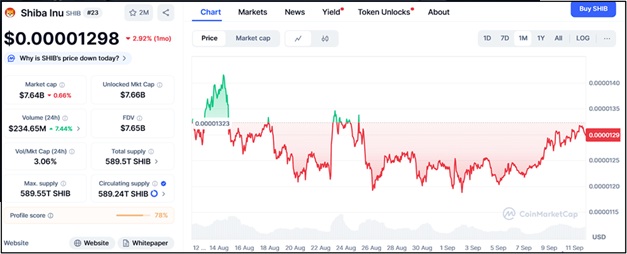
Shiba Inu (SHIB), trading near $0.00001298, continues to excite meme coin enthusiasts, with analysts projecting up to a 20× rally if community hype drives another breakout, with resistance at $0.00001350, $0.00001500, and $0.00001750 and support at $0.00001250, $0.00001180, and $0.00001100 shaping its near-term outlook.

Yet while SHIB thrives on sentiment, investors are increasingly drawn to Ozak AI (OZ)—a presale project priced at just $0.01 that has already raised more than $2.9 million—with bold forecasts of 100× returns fueling massive FOMO across the market.

Shiba Inu’s Meme Coin Strength

Shiba Inu (SHIB), trading around $0.00001298, keeps dominating discussions within the meme coin space. Known as the “Dogecoin killer,” SHIB has constructed what is considered one of the biggest meme-driven communities in the world, fueling its resilience within the crypto market. Analysts remain bullish that Shiba Inu may want to supply a potential 20× upside if meme coin hype resurfaces within the next bull run, making it an attractive alternative for traders searching for speculative, however high-priced, performance.

From a technical angle, SHIB faces resistance first at $0.00001350, where upward actions have regularly stalled, observed by a stronger barrier at $0.00001500, which has historically acted as a key ceiling. An extra decisive breakout test sits at $0.00001750, a level that might cause large momentum if damaged. On the downside, SHIB finds instant assist near $0.00001250, with deeper cushions round $0.00001180 and a greater vital protection sector at $0.00001100. These degrees offer buyers clear markers as SHIB tries to construct momentum toward a possible 20× run.

SHIB’s The 20× Potential

If Shiba Inu capitalizes on its community-driven energy, strong social media presence, and speculative demand, it could climb dramatically from its current price. A 20× surge would take SHIB closer to its historic highs, rewarding long-term holders who continue to believe in meme coin power. However, while such growth is possible, SHIB’s upside is tied primarily to sentiment cycles, leaving it vulnerable to sharp pullbacks once attention shifts elsewhere.

Ozak AI’s Presale Buzz

In contrast, the biggest FOMO in 2025 belongs to Ozak AI (OZ), an AI-powered presale project priced at just $0.01 per token. Already raising more than $2.9 million, Ozak AI is generating massive buzz across trading communities as one of the most promising early-stage opportunities in the market.

Investors are particularly excited because OZ is positioned at the intersection of artificial intelligence and blockchain, two of the fastest-growing global narratives. Its potential to bring AI-driven efficiency to decentralized systems gives it a stronger foundation than hype-driven meme tokens.

The 100× ROI Narrative

What excites investors most is the possibility of 100× returns. At the current presale price, a $1,000 allocation would buy 100,000 tokens. If Ozak AI climbs to $1, that stake would be worth $100,000—a life-changing flip. This simple math is driving both retail and whale participation, with many speculating that Ozak AI could follow in the footsteps of early Solana or Polygon, where modest early entries became massive windfalls.

Shiba Inu, at $0.00001298, continues to spark excitement with 20× predictions, supported by resistance at $0.00001350, $0.00001500, and $0.00001750 and support at $0.00001250, $0.00001180, and $0.00001100 guiding its price action. Yet, while SHIB thrives on meme-driven cycles, Ozak AI’s $0.01 presale entry and $2.9 million raised are creating one of the strongest FOMO waves in 2025. With bold 100× forecasts, Ozak AI offers investors the rare chance to transform small entries into potentially life-changing returns, making it the project stealing the spotlight from meme coins this year.


About Ozak AI

 Ozak AI is a blockchain-based crypto project that provides an innovative platform that focuses on predictive AI and advanced data analytics for financial markets. Through machine learning algorithms and decentralized community technologies, Ozak AI enables real-time, accurate, and actionable insights to help crypto lovers and corporations make the perfect choices.


For more, visit

Website: https://ozak.ai/

Telegram: https://t.me/OzakAGI

Twitter: https://x.com/ozakagi