DD
MM
YYYY

PAGES

DD
MM
YYYY

spot_img

PAGES

Home Blog Page 5046

Ndubuisi Ekekwe Honoured As “AI Personality of the Week”

0

You can read the citation here.

My comment below….

Good People, I approve this message especially during this season of campaigns in Nigeria.  Thank you DSN – Data Scientists Network/Data Science Nigeria for finding this village guy from Ovim. Respect to DSN: last week, National Basketball Association (NBA) USA signed a mammoth deal with an AI-startup we’ve supported in Lagos; my fund, Tekedia Capital, provided 100% of the funds they needed. The team has also filed a US patent.

Where am I going? Your work/activism on AI is unleashing a cambrian moment in Africa’s entrepreneurial capitalism. And that will lead in building the empires of the future with Africa’s productive participation. Thanks for the recognition.

Young people: love mathematics – the science of numbers.

Source: DSN/LinkedIn

The G7’s $600 Billion Chinese Cheat Sheets To Win Back Africa, Latin America, etc

1

In a functioning market system, products improve because of rivalry. That rivalry is nothing but competition where players work hard to improve products and price positioning.  In geopolitics, that also seems to be the case. When there are choices, good things happen. The news today is that the club of rich nations, the G7, is now being inspired by China’s Belt and Road initiative: “G7 leaders have detailed plans to mobilise $600bn in funding for the developing world in a move seen as a counter to China’s Belt and Road plan.”

Simply, G7 is now getting cheat sheets from China. I have written here that the neglect of the West on the affairs of Africa, Latin America and other developing regions of the world, will hurt them. See the case of Russia in Ukraine, who wants to get entangled by taking a non-neutral position in Africa? Few, despite the pressure from the West. There is a reason for that: Russia feeds most parts of Africa through fertilizers, farming supports and other agro-focused programs.

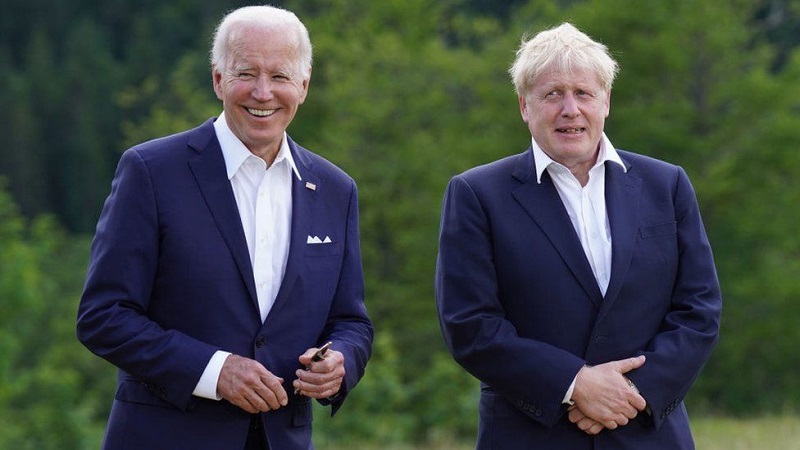
President Joe Biden promised an infrastructure investment for people of “all nations” as the Group of Seven (G7) launched its global infrastructure initiative from the Bavarian Alps, Germany. The plan will see $600 billion ($200 billion from the U.S.) of investment in healthcare, climate and gender equality, among other things. It’s a bid to expand “stability” in developing nations — an increasingly critical move given Russia’s invasion of Ukraine. In contrast to China’s investments in Africa and Latin America, Biden said the G7 investments were based on “global best practices” and “shared values.” (LinkedIn)

Then scale that to China, you have no chance. If China goes to war with Taiwan, the Western world may be surprised that most parts of the non-West alliance will not condemn China. Simply, China has built roads into state capitals around the developing world and has real influence.

But do not count out Washington and London with Brussels: they want a massive reset as they have seen the independence of these “3rd world countries” considering the ways they have cooperated on the Ukraine sanctions. And that reset will mean, matching whatever China is doing in Africa, Latin America, etc.

That is the reason they plan to spend that $600 billion – to buy back African, Latin American, etc capitals. Today, if you travel from Abuja, Nairobi, etc to Beijing, you come back with cash. Try the same to London or Washington, it is a line of credit. These African leaders hate that. Right now, G7 has got the message: if you do not change, the new world order will be built outside your global influence.

Indeed, China has provided alternatives to most parts of the world; G7 now needs to match what China has on the table. That is not bad in the grand scheme of things.

G7 leaders have detailed plans to mobilise $600bn in funding for the developing world in a move seen as a counter to China’s Belt and Road plan. The Partnership for Global Infrastructure and Investment (PGII) relaunches a scheme unveiled at last year’s G7 talks in England. US President Joe Biden said the plan would deliver returns for everyone.

China’s multi-trillion dollar infrastructure initiative is criticised for hitting nations with too much debt. “I want to be clear. This isn’t aid or charity,” Mr Biden said of the G7’s PGII scheme. “It’s an investment that will deliver returns for everyone.” The scheme would allow countries to “see the concrete benefits of partnering with democracies,” the US president added.

The plan calls on G7 leaders to raise $600bn over five years to fund the launch of infrastructure projects in middle and low-income countries.

The US has promised to raise $200bn (£162bn) of the total through grants, federal funds and private investment, while the EU has announced a further 300bn euros (£257bn).

The initiative will be geared towards tackling climate change, improving global health, achieving gender equity and building digital infrastructure.

[…]

The plan has been pitched as a way to counter China’s ambitious Belt and Road Initiative (BRI). Launched by Chinese president Xi Jinping in 2013, the BRI provides financing for emerging countries to build infrastructure like ports, roads and bridges.

Comment on Feed

Comment: Prof…So, what’s the implication of this for the businessmen/women in Alialia, Ogbete, Nkwor-Nnewi, Ochancha, and Alaba international markets?

My Response: Possibly if there are choices, Nigeria can borrow at better rates from London than Beijing. If that happens, our debt servicing load will drop. And if that happens, the Ogbete, etc will be remembered by Abuja since Nigeria will save funds and then invest in things that will help them. Those things include having more funds for universities, water boards, etc. What Nigeria spends servicing its debts can fund a good university system, decent health system, clean water, etc. It is a massive opportunity cost.

Understanding Broadband Delivery Services

0

Tekedia Institute is running a program on satellite-based broadband (internet) services. A key component of that program will examine Elon Musk’s Starlink and its promises to Nigeria and Africa, examining career and business opportunities.

The first phase of that course is to understand broadband delivery service.  Our faculty, Olatunde Olafimihan, spent more than 18 years delivering world-class broadband services in MTN, before he moved to RGL, where he is now the Director of Technology.

Join us tomorrow as we look into this topic. Zoom link in the Board.

Tekedia Mini-MBA >> learn from the best.

The truth about Pricing for Online businesses

0

Running an online business is so cool. You just run your business with zero expenses. It is income, income, income, and no payments. No rent. No electricity costs. You can sell your goods and enjoy a huge profit margin. True?

False.

Unfortunately, this is the impression many people carry around. Running a business online has no costs other than the product or service cost. This is not true. You may have avoided or reduced certain business costs by running your business online, but there are still costs you have to factor into your pricing.

Many people claim to be running an online business, but they have converted one of the rooms in their house into an office for receiving visitors or a warehouse for their goods. This is space that you have to factor into your running costs. You should consider your rent, make an appropriate estimate of what that space should cost monthly or annually, and then add it to your running costs.

If you use gadgets to run your business online (like smartphones, laptops or desktops, power generating sets, refrigerators or freezers, etc.), you should factor in the depreciation costs. If you have a smartphone that costs $240 to purchase and has a useful shelf life of 2 years, your depreciation cost will be about $10 monthly for the next 24 months. In this way, you need not take a loan when you need to replace your gadgets over time.

How about your utilities? You must be spending something on data, phone calls, follow-up emails, etc. If you are running sponsored ads or promotions online, your running costs should also absorb these costs. These are just a few examples of little expenses here and there that some online business owners ignore when fixing their price and profit margins.

Treat your online business the same way you would do an offline business. Every cost should be noted. Every income should be noted. If your pricing fails to account for these, you may just be shooting yourself in the foot.

The cost of raw materials, delivery, and production is easily factored into pricing, even for online businesses. But other costs like the ones we have listed above are mostly ignored, and the narrative behind it is that running a business online does not incur expenses like rents and utilities. Don’t be misguided. There are software and applications that can help small and medium business owners reach proper product pricing. I will not mention any names here, but simple research can show you some of them. Enter the required data, and it will give you a proper price range for your product.

Also, do not forget to factor in your salary among the costs. You invest time, talent, and efforts into the business, and it would be careless to treat it as a hobby without financial rewards. Of course, you may decide not to receive salaries from the company until a certain period elapses. Factor in your salary as a running cost and then reinvest it into the business. It is part of creating structure.

If you want your business to grow and scale at some point, this structure has to come in during the company’s early days. Stop waving off some little costs as insignificant and think you can cater to them from your expenses. As the business grows, you will not be able to keep up, and then you may struggle to factor them into your product pricing.

The Need For Delegation In The Workplace

0

Delegation according to google is the assignment of authority to another person to carry out specific activities. In the workplace, It is often a process where an employer entrusts a specific task to a team member or team members work for it to be carried out.

Some employers think they are made of steel, they always want to carry out every special task in the workplace, because they feel that no other person is competent enough to handle it. One thing employers must understand is that they cannot perform every task in the workplace because it can lead to work burnout as well as low productivity due to fatigue.

Some managers till date, still have a negative approach toward delegation of duties in the workplace, because they always think that they can do better when they are the ones handling the task.

Any manager who always carries out every given task by himself is either egocentric or has not built the capacity of the team members enough to handle certain tasks. As a leader in the workplace, delegation is very important because it empowers the team members, builds trust, and assists with professional development.

When tasks are delegated to team members, asides from the fact that it reduces the workload, it also builds the capacity of the team members because they will develop new skills and gain knowledge that equips them for future responsibility.

Types of Delegation

There are four (4) types of delegation in the workplace. Each of these delegations is based on different factors.

  • Formal or Informal Delegation; It is based on the process of giving authority
  • General or Specific Delegation: It is usually used on the job assigned
  • Top To Bottom: It is usually based on a hierarchy
  • Lateral Delegation: It requires a group or team members to work in parallel

Before delegation is made in the workplace, there are processes employers must ensure to follow, to ensure that they delegate such tasks effectively

  • Delegate To The Right Candidate: One major part of being an effective leader in the workplace is understanding the strength and weaknesses of each team member. This is a very important factor to consider because different tasks require that there are specific team members who should carry it out.
  • Make Available Resources: It is important that when employers delegate tasks to team members, they should provide them with the required resources needed to effectively carry out their tasks. Resources could be funds, courses, information, tools/equipment, etc. Not providing them with the needed resources can set limitations to how far they can accomplish a task.
  • Be Clear About The Task: It is one thing for a manager to delegate a task, it is another thing for them to be clear about the given task. Team members are more likely to provide results based on how the task was related to them. Also setting clear expectations for a given task, aids them in knowing how to execute the task. It is ideal for managers to set benchmarks for every given task, so that team members can know what they are to deliver.
  • Take/ Give Feedback: Employers should not just delegate tasks without giving or taking feedback. The most critical aspect of the delegation process is usually the feedback stage. If the team members effectively carried out a given task, it is ideal that managers let them know so that they maintain that standard and also improve. Also, if the task was not effectively carried out, it is ideal that managers give feedback on possible corrections so that they can be implemented in the next task.

There are so many benefits of delegation in the workplace, but I will discuss only three (3) of them.

Benefits Of Delegation In The Workplace

  1. Develops Team Members: When the team members are constantly involved in one given task or the other, it develops their capacity as well as teaches them new skills. When they are assigned with a specific task, it challenges them to improve and also pushes them to become a better version of themselves.
  2. Establishes Trust: When tasks are delegated to team members, it builds a culture of trust among them. By giving them specific tasks, the manager is indirectly telling them that he trusts them enough to carry out the task efficiently. This also improves employees’ self-esteem.
  3. Increases Flexibility Of Team Members: When tasks are delegated to team members, it expands their flexibility which provides room for their abilities to grow, which is beneficial to the organization and also to each team member.

Conclusion

Employers must see the need to delegate tasks in the workplace, because it will no doubt boost productivity, and it will reduce the chances of fatigue and build trust between the manager and team members. Ideally, all hands should be on deck in the workplace because it also gives room for creativity.