
DD
MM
YYYY

PAGES

DD
MM
YYYY

spot_img

PAGES

Home Blog Page 51

This Crypto Presale Is Reinventing Cross-Chain Execution as It Nears a Major Stage 19 Milestone

0

Mono Protocol continues advancing steadily in the crypto presale market as Stage 19 approaches full completion. The project has now raised $3.73 million out of the $3.80 million target, with the presale price set at $0.0550 and a launch value of $0.500. This structure supports an estimated 809% potential profit, further strengthening Mono’s presence among the most active cryptocurrency presales this month.

Growing participation is being driven by a central component of the protocol: its automated routing engine. As multi-chain environments expand, users continue shifting toward presale crypto projects that offer stable, infrastructure-level performance. Mono Protocol’s ability to execute transactions across networks without user intervention has positioned it at the forefront of the evolving crypto pre sales sector.

Routing Intelligence Designed for High-Speed Multi-Chain Execution

At the core of the protocol is a routing engine that evaluates network conditions in real time. Instead of relying on fixed routes or manual decisions, the system automatically identifies the most efficient execution path. It considers congestion, fee levels, and available liquidity before routing any transaction.

This automated process reduces failed interactions and minimizes friction, especially during volatile market conditions. In an environment where cross-chain execution often breaks down due to network overload, Mono’s routing system offers a far more reliable alternative. This technical advantage has helped increase visibility across web3 crypto presale discussions focused on next-generation infrastructure.

The routing engine also enhances user experience by eliminating the need for network switching, manual confirmations, and repetitive approvals. These improvements create a clean, streamlined workflow—an essential feature as the industry continues shifting toward chain abstraction and unified execution layers.

A Cross-Chain Execution Framework Built for Web3 Growth

The routing engine works seamlessly with Mono Protocol’s broader execution model, which consolidates complex multi-chain activity into a single environment. This structure allows developers to deploy applications once while operating across every supported chain, reducing technical overhead and accelerating development cycles.

Users also benefit from a more consistent experience, maintaining a unified view of their balances regardless of where their assets reside. This framework is increasingly relevant as Web3 expands across multiple chains, making reliable execution a primary requirement for both builders and participants in the coin presale space.

Mono’s ability to simplify these workflows positions it as one of the most utility-driven entrants in today’s best crypto presale rankings.

Stronger Participation as Stage 19 Approaches Its Final Threshold

Community interest continues to build as Mono Protocol highlights key milestones, including the recent $3.7M raised update. With less than $70,000 remaining before Stage 19 concludes, activity across platform channels has increased steadily.

Participants tracking pre sale cryptocurrency projects have shown heightened engagement in recent days, driven by Mono’s consistent roadmap execution, platform improvements, and growing ecosystem communication. These updates help maintain a transparent environment, which remains essential in the cryptocurrency presales market.

Why Execution Reliability Matters in Today’s Presale Crypto Market

As multi-chain adoption grows, execution reliability has become a defining factor across Web3. Mono Protocol’s automated routing and unified execution layer offer a practical solution that matches the demands of this environment. Users seeking stable, infrastructure-led opportunities continue to identify Mono as a standout option in the broader crypto presale ecosystem.

With its technical roadmap aligning closely with market needs, the project remains a priority for participants exploring long-term, utility-driven opportunities.

Conclusion

This crypto presale continues to rise as Mono Protocol approaches its Stage 19 completion milestone. With an advanced routing engine, unified execution model, and growing participation across the presale crypto market, the project remains one of December’s most closely followed early-stage opportunities. As multi-chain activity accelerates, Mono’s focus on clean, reliable execution positions it strongly for the next phase of its development.


Learn More about Mono Protocol


Website: https://www.monoprotocol.com/

X: https://x.com/mono_protocol

Telegram: https://t.me/monoprotocol_official
LinkedIn: https://www.linkedin.com/company/monoprotocol/

Mono Protocol’s Unified Balance System Reshapes How Users Navigate Web3 as Stage 19 Nears Completion

0

Mono Protocol continues gaining strong visibility across the crypto presale market as Stage 19 edges toward its completion threshold. The project has now raised $3.73 million out of the $3.80 million target, maintaining its presale price at $0.0550 and its planned token launch value at $0.500. The expected 809% potential profit has added to the growing attention around one of the most actively tracked cryptocurrency presales of the month.

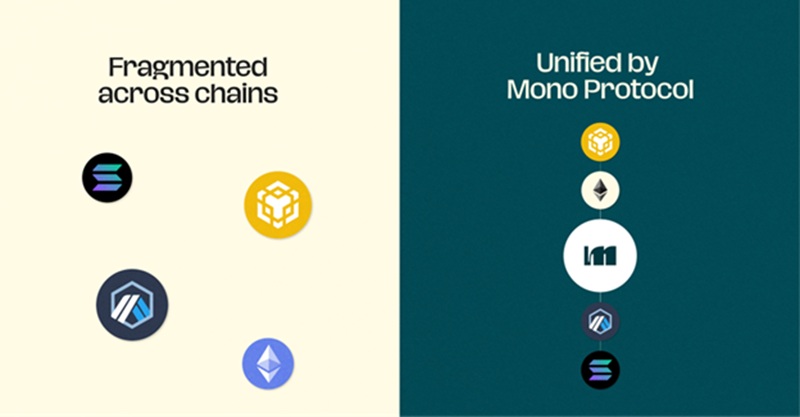
The latest wave of participation is driven by a feature that has become a defining element of Mono’s design: its unified balance system. This architecture consolidates token balances across multiple networks into a single view, eliminating the confusion and fragmentation that often slow users entering Web3. As the presale crypto market shifts toward infrastructure-driven solutions, Mono’s approach is gaining traction for its simplicity and functionality.

A Unified Balance Across Every Network: One System, One Environment

Mono Protocol’s unified balance system is engineered to streamline cross-chain interaction by giving users one balance per token, regardless of the chains their assets exist on. This shift removes the need for manual bridging, repeated confirmations, or switching networks — issues that continue to complicate on-chain workflows.

The architecture integrates directly with Mono’s execution layer, enabling actions such as swaps, transfers, and contract interactions to operate from a single source of truth. For participants exploring crypto pre sales, this approach is particularly relevant, as it reduces the learning curve that typically comes with multi-chain environments.

By removing these barriers, Mono Protocol positions itself as a solution capable of scaling with the broader Web3 landscape. As layer-1 and layer-2 networks expand, the unified balance system ensures users remain in control without navigating multiple interfaces or fragmented balances.

An Advantage for Developers and Users in a Multi-Chain World

While users benefit from consistency, developers gain a streamlined environment that simplifies multi-chain deployment. Instead of building and maintaining separate versions of applications across several networks, developers can integrate with Mono’s execution layer and reach all supported chains through one framework.

This direction has resonated strongly across web3 crypto presale discussions, especially among users examining early-stage projects with long-term technical relevance. With Web3 growth moving toward chain abstraction, Mono’s solution aligns closely with the industry’s trajectory.

The protocol’s unified model also enhances application performance by bypassing congested or unstable routes. Instead, the system automatically identifies the most efficient path for execution — a key advantage during periods of network volatility.

Growing Presence Across the Crypto Pre Sales Market

Mono Protocol’s consistent updates continue reinforcing its presence across cryptocurrency presales. Recent communication from the team confirmed steady progress through Stage 19 and reached the $3.7M milestone, drawing further attention from participants monitoring active raises this month.

Community engagement continues to grow as users participate in platform polls, track dashboard updates, and review new improvements. These interactions help maintain transparency, a feature that remains essential in the pre sale cryptocurrency environment.

With less than $70,000 remaining before Stage 19 closes, observers across the coin presale space are watching closely as interest builds around Mono’s technical offerings and long-term roadmap.

Why Investors Are Focusing on Infrastructure in the Presale Crypto Market

As the market becomes more multi-chain, the need for simplified interaction layers grows. Mono Protocol’s unified balance system directly addresses this challenge, transforming how users and builders interact with Web3 networks.

The consistent rise in participation suggests that users are prioritizing infrastructure over speculation in the current crypto presale cycle. Mono’s vision of frictionless cross-chain usage, paired with its structured raise and transparent development, contributes to its widening appeal among both new and experienced participants.

Conclusion

Mono Protocol’s unified balance system has emerged as a defining feature in its rise across the presale crypto landscape. With $3.73M raised and Stage 19 nearing completion, the project continues to demonstrate strong alignment with market demand for streamlined, chain-agnostic execution. As interest in infrastructure-focused cryptocurrency presales expands, Mono remains positioned as one of December’s leading early-stage opportunities.


Learn More about Mono Protocol

Website: https://www.monoprotocol.com/

X: https://x.com/mono_protocol

Telegram: https://t.me/monoprotocol_official

LinkedIn: https://www.linkedin.com/company/monoprotocol/

Yearn Finance yETH Stableswap Pool Exploit, $9M Drained in Infinite Mint Attack

0

Yearn Finance, a prominent DeFi yield aggregator, fell victim to a sophisticated exploit targeting its legacy yETH stableswap pool—a custom contract aggregating liquid staking tokens (LSTs) like stETH, rETH, and cbETH.

The attacker exploited a critical vulnerability in the yETH token contract, specifically an “unchecked arithmetic” bug combined with a cached storage issue in the packed_vbs array.

This allowed them to deposit just 16 wei the smallest unit of ETH and mint an astronomically large supply of yETH—approximately 235 septillion tokens 2.3544 × 10^56, effectively infinite.

With this inflated supply, the attacker swapped the unbacked yETH for legitimate assets in a single transaction, draining: $8 million from the main yETH stableswap pool. $900,000 from the related yETH-WETH pool on Curve Finance.

The total loss clocked in at around $9 million. The attacker then laundered over $3 million in ETH through Tornado Cash, a privacy mixer, and staked the remaining ~$6 million in LSTs likely to delay recovery efforts.

Yearn’s team confirmed the exploit was isolated to this legacy pool and did not affect its core V2/V3 vaults, which hold over $410 million in deposits. No direct user funds in active strategies were impacted, but depositors in the affected pool suffered losses.

The bug stemmed from outdated code in a customized StableSwap implementation. It enabled infinite minting without proper collateral checks, turning a math error into an “infinite money glitch.” This is the third major Yearn exploit since 2021, following two flash loan attacks that cost $22 million combined.

Security firm PeckShield flagged it first, noting the single-tx nature of the drain. By December 2, Yearn recovered $2.4 million in pxETH a Plume Network LST through coordination with Plume and Dinero teams. The remaining funds are being tracked, with the attacker’s wallet still holding mixed assets.

Yearn’s post-mortem highlights similarities to the recent Balancer exploit in complexity. Crypto hacks have exceeded $2.5 billion in losses for 2025 alone. ETH prices dipped ~5% post-exploit, reflecting DeFi jitters. Yearn emphasized that newer products use audited, safer code, but the incident underscores risks in legacy contracts.

This exploit serves as a stark reminder for DeFi users: Always audit interactions, diversify pools, and monitor for outdated deployments. Yearn’s quick isolation prevented wider damage, but it highlights ongoing challenges in securing complex LST ecosystems.

Ryan Whitney’s $30K Loss on Dave Portnoy’s GREED Token

In a recent admission that’s gone viral in crypto circles, Ryan Whitney—a former NHL player and co-host of the Spittin’ Chiclets podcast—revealed he lost $30,000 chasing gains on GREED, a Solana-based meme coin launched by Barstool Sports founder Dave Portnoy in February 2025.

Whitney shared the story candidly, turning it into a humorous yet brutal lesson on the perils of hype-driven tokens.The BackstoryPortnoy, notorious for his chaotic crypto forays, launched GREED on February 18, 2025, branding it as a satirical nod to “extreme greed” in meme coins—complete with a Gordon Gekko (Wall Street) meme.

He scooped up 357.9 million tokens 35% of supply for ~$358,000 worth of SOL, pumping the market cap to $41.5 million. But just 30 minutes after denying dump plans on X Spaces even claiming he tried to burn supply, Portnoy sold his entire stake in one transaction, crashing GREED 99% from $0.03 to under $0.003.

Portnoy’s Haul: He pocketed ~$258,000 in profit, then pivoted profits to JAILSTOOL and launched GREED2 which hit $28 million cap before tanking 90%. Traders got wrecked—one sniped 911 SOL $153,000 early, only to sell for 309 SOL ($52,000), losing $101,000 in hours. Crypto sleuths like ZachXBT slammed it as a “rug pull worse than native influencers.”

He FOMO’d in during the hype, drawn by Portnoy’s Barstool clout and the token’s cheeky theme. As one X user quipped: “Imagine telling your kids you lost money on something literally called GREED. The market has a sense of humor. Dark one, but still.”

His story resonates as a relatable gut-punch—$30K isn’t chump change, especially for a high-profile athlete admitting it publicly. Portnoy warned “don’t invest more than you can afford to lose,” but his rapid exit amplified the irony. Whitney’s tale echoes broader 2025 meme coin carnage, where influencers like Portnoy fuel pumps then bail.

Whitney’s no newbie, but it shows even pros get burned chasing narratives. Key takeaway: Size small he didn’t overexpose, set exits, and remember meme coins are zero-sum gambling. Both stories capture crypto’s wild duality—innovation in DeFi meets reckless speculation in memes.

Stripe Acquires Metronome in $1B Deal to Deepen SaaS and Usage-Based Billing Capabilities

0

Stripe has reportedly acquired Metronome, a leading usage-based billing startup, in a landmark $1 billion transaction that underscores Stripe’s growing focus on SaaS and API-driven monetization infrastructure.

The move strengthens Stripe’s capabilities in managing complex, consumption-based pricing models increasingly used by AI, cloud, and developer-first companies.

Commenting on the acquisition, co-founder and CEO of Metronome Scott Woody said,

I’m excited to announce that Metronome has signed a definitive agreement to join Stripe. Today’s best companies treat monetization as a competitive advantage, and they rely on Metronome to make that true. For our customers, we have always been more than software. We are an extension of their team and a core system of truth that powers their business. Just as Stripe powers the world’s payments layer, Metronome powers its monetization logic. This partnership connects those two foundations seamlessly. As part of Stripe, our mission accelerates dramatically. Customers will continue getting world-class software, and now many more people will have access to Metronome.”

Metronome is a usage-based billing platform built for the speed of today’s best software companies. The platform is designed to make billing fast, flexible, and frictionless, enabling customers to launch and iterate products faster, connect billing to the product experience, and act on real-time insights to drive strategic decisions.

By bringing Metronome in-house, Stripe is positioning itself as a core financial operating system for high-growth businesses. Under Stripe, Metronome’s mission is set to accelerate significantly. Customers will continue to enjoy world-class software while even more users gain access to Metronome’s capabilities.

Metronome will be integrated as a core component of Stripe’s product suite, yet customers will retain the flexibility to adopt best-in-class tools across the quote-to-cash and monetization stack. Both companies plan to serve a broad user base, from simple self-serve businesses to enterprises with highly complex workflows.

The combined roadmap includes enhanced innovations such as seat-based credits, real-time spend alerts, hierarchical accounts, and more. The goal is to anticipate and solve customer challenges long before they become bottlenecks.

Metronome’s users will also benefit from Stripe’s renowned five-nines (99.999%) uptime and global financial infrastructure, resulting in greater reliability and improved service for their businesses and customers. As the product roadmap accelerates, more users worldwide will be able to tap into the full potential of Stripe’s ecosystem.

Notably, the acquisition of Metronome comes after Stripe earlier this month launched new features to help SaaS platforms manage risk and stay compliant. Platforms like FreshBooks, Shopify, and Jobber already rely on Radar for platforms to prevent, detect, and mitigate fraud and insolvency risk. Powered by AI-driven risk scores trained on over $1.4 trillion in payments volume, Radar for platforms provides a custom rules engine and robust actions to block suspicious businesses and transactions. Now, Stripe is expanding these capabilities.

Radar for platforms now allows platforms to protect themselves from potential losses by setting temporary reserves on user funds. These reserves can be created programmatically or through the Stripe Dashboard, and platforms can choose between fixed or rolling reserves based on their risk mitigation needs. For instance, platforms can create rules to identify businesses with high risk scores and automatically apply ongoing reserves to guard against sudden spikes in disputes. They can also place holds on large transactions involving long delivery times and release the funds once return windows close.

While automated fraud prevention is powerful, Stripe also recognizes that platforms often have deeper insight into their users. To support more personalized risk approaches, the company has introduced Stripe Verified for platforms. This program offers trusted platforms enhanced controls to tailor risk and compliance settings. Verified platforms can extend deadlines for eligible compliance tasks directly from the Dashboard, helping users complete important requirements without interruption.

Stripe recent deal with Metronome, highlights how billing has evolved from a back-office function into a strategic fintech differentiator. For fintech and SaaS leaders, this is a clear signal of where platform control and data monetization are heading.

Oracle To Emerge As Top AI Beneficiary Amid Massive Infrastructure Shifts, Wells Fargo Projects

0

Oracle is set to emerge as a major financial beneficiary in the next phase of Artificial Intelligence adoption, according to a bullish new report from Wells Fargo.

The investment bank projects “significant upside” for the technology giant, citing the surging demand for its cloud infrastructure platform as enterprises begin shifting AI training and inference workloads away from established hyperscale cloud providers.

The firm’s optimism centers on the growing traction of Oracle Cloud Infrastructure (OCI), which is gaining market share by offering performance and cost advantages crucial for intensive AI workloads. The transition to OCI is being driven by factors beyond just pricing.

Wells Fargo highlights that Oracle’s strategy has been to challenge the breadth and market share of Amazon Web Services (AWS) and Microsoft Azure by focusing on deep performance and cost optimization, particularly for specialized AI and database workloads.

Unlike the shared infrastructure models of its larger competitors, OCI is known for its bare-metal GPU instances that eliminate virtualization overhead. This design choice translates directly into superior and more consistent processing power for demanding tasks like training massive foundational AI models. Benchmarks have indicated that OCI offers up to four times the cluster networking bandwidth as AWS for clustered workloads, and in some analyses, the cost of a billion-parameter GPT-3 training run on OCI was found to be 35% lower than on AWS and 41% lower than on Google Cloud.

A crucial element is Oracle’s ability to rapidly deploy high-throughput, GPU-rich clusters. While AWS and Azure offer a wider array of general cloud services and a larger global footprint, Oracle has locked in critical deals with top AI model developers, including its blockbuster partnership with OpenAI to provide cloud computing power, as well as working with companies like Cohere and Abjad AI. For instance, Oracle will be the first hyperscaler to offer an AI supercluster powered by 50,000 AMD Instinct MI450 Series GPUs starting in 2026, showcasing its commitment to scaling its dedicated AI infrastructure.

OCI generally offers a more predictable pricing model, which contrasts sharply with the often complex, opaque, and high data egress (outbound data transfer) costs of AWS and Azure. OCI’s lower egress fees and globally consistent pricing across all regions offer a significant financial advantage for enterprises moving massive data sets required for deep learning.

The report concludes that OCI is capturing this demand because enterprises are no longer just looking for a general-purpose cloud; they are looking for the most cost-effective and high-performing engine for their specialized AI operations.

Operational Leverage and Financial Outlook
The report suggests that this AI-driven demand will fundamentally change Oracle’s financial trajectory.

Wells Fargo claimed that Oracle’s overall revenue would begin to expand faster, driven by the increasing magnitude of long-term cloud contracts and the sustained expansion of its lucrative database and applications businesses, which are increasingly being migrated to OCI. Oracle’s total remaining performance obligations (RPO)—a key indicator of future revenue—hit a record $455 billion in Q1 Fiscal 2026. The analyst also noted that Oracle’s operational leverage is improving as the company rapidly expands its data center footprint. As more customers migrate to the high-margin OCI platform, the efficiency and scale of the infrastructure business are expected to help margins grow even more.

While the research did not provide a specific price objective, Wells Fargo’s confidence in “significant upside” is based on the expectation that expenditure on AI infrastructure will continue to rise dramatically across all sectors through 2026, with Oracle firmly positioned as a primary alternative to the legacy hyperscalers.