DD
MM
YYYY

PAGES

DD
MM
YYYY

spot_img

PAGES

Home Blog Page 5108

Federal Government Of Nigeria Moves To Procure Tech Solutions From Nigerian Start-Ups

0
Nigerian leaders

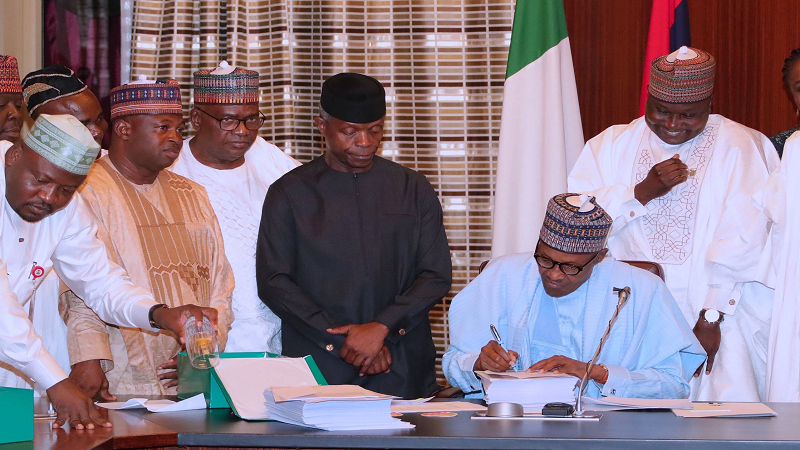
The federal government of Nigeria recently disclosed that they are working on modalities to ensure that tech start-ups in the country can sell their solutions with ease to the government.

This statement was disclosed by the Director-General of the National Information Technology Agency (NITDA), Kashifu Inuwa, at the co-create 2022 tech exhibition event in Lagos state, which had in attendance startups from different sectors such as fintech, edtechs, among others.

He further disclosed that the Federal Executive Council (FEC) recently gave approval to the ministry of communications and the digital economy, as well as its agencies to work closely with the start-up ecosystem on how the government can procure solutions from start-ups without the usual bureaucratic processes associated with government’s contract.

He revealed that the first step in that direction, is that the National Information Technology Agency, (NITDA) would invite all start-ups in the country to come and showcase their solutions, while all government Ministries, Departments, and Agencies (MDAs) will be there to look at solutions that can meet their needs.

Great to see that start-ups in Nigeria are beginning to receive the needed recognition from the government, which according to them will lead to the patronage of these start-ups that will no doubt provide solutions to challenging issues faced in the country.

However, this shouldn’t be a seasonal movement from the government, rather it is ideal that they constantly  keep tabs on the tech ecosystem to be on the lookout for latest developments emanating from the sector that will be beneficial to the country.

In Nigeria, there are so many problems that require innovative solutions, therefore, this collaboration with the government will not only open doors for these start-ups, but will also enable them to scale up and provide solutions to problems in the country.

In Africa, Nigeria ranks first as the country with the highest number of start-ups, which was estimated at around 3,300 in 2020, with a majority of them operating within the fintech sector, thereby taking advantage of the under-provision of bank services in the country.

Unfortunately, some of these start-ups continue to underperform due to the challenging environment and unfriendly government policies. One common problem most of these start-ups are faced with is the outrageous license fee which most especially affects fintech start-ups.

Many start-ups have difficulty in affording these fees, some even have to go as far as partnering with banks, before their software can be accepted. These government policies have been proven to be counterproductive to driving the digital economy of the country forward.

Since the government has disclosed its plan to buy tech solutions from these start-ups, there is no disputing the fact that the government still remains a key component of the tech ecosystem in the country. Ideally, they create enabling environments and interventions in terms of policy and infrastructure.

Another challenge some of these start-ups are faced with, is their inability to secure seed funds to grow. Unfortunately, the government can’t provide seed funds for every start-up in the country. However, the government should pay close attention to the tech ecosystem and find start-ups that they feel will be pivotal in solving challenging problems in the country to properly fund them.

It is ideal that the government collaborates with these start-ups, because through strong partnership, technology has solved some of the most complex problems faced by humans.

Also, the ICT sector, if properly funded, has the capability to  take the country out of poverty, hence the need for strategic positioning and effective collaboration between the government and stakeholders in the sector.

Once these start-ups are properly funded, they can scale up and even get to compete with other start-ups globally. The economic viability of many developed nations has been traced to their thriving tech ecosystem.

Unexplainable yearlong fuel scarcity in Abuja

0

Unexplainable yearlong fuel scarcity in Abuja: a cry for help. 

Why have there been fuel scarcity in Abuja and why is nobody (especially the government officials) saying something or doing anything about it?

Since this year,  Abuja, the federal capital territory has been struggling with fuel scarcity. The irony is that no other city or state is bedeviled by this scarcity that is hitting the city tagged the Centre of power at the moment. 

The fuel scarcity started late last year and it got better for some time but it got worse from January this year. No government official is saying anything about it, and no person in the right authority is giving any reasonable explanation as to why Abuja residents have been queuing up for hours just to fuel their cars to move around and get fuel to run their generating sets to run their businesses. 

Just this year, I have been to Portharcourt Umuahia, Owerri, Lagos, Enugu, Calabar, Abakaliki, and Kano and none of those states is struggling with fuel scarcity as of the time I’m in the state so I’m speaking with verifiable information when I claim that no other state is currently facing fuel scarcity that Abuja is facing right not. It is terrible and calls for concern. 

Abuja residents have wasted billable hours worth billions of dollars since this year as a result of the unexplainable fuel scarcity. 

Persons in authority really need to look into it and act as fast as possible. If it is a nationwide menace then it could be explainable but the fact that it is only happening in Abuja could satisfy some explanations that some conspiracy theorists have been giving. 

I for one as an Abuja resident am tired of it. I don’t want to be leaving my house by 2 am just to go and queue up to get fuel as some people are doing and I don’t want to be getting to meetings or courts for appearances late just because I wasted my valuable time waiting in line for it to be my turn to get fuel. 

Political Leaders Matter – Get Your PVC Card in Nigeria

1

Sani Abacha was an elevated dictator. But if you look at some of his economic policies, they were better than some we have seen in some of the democratic regimes since 1999. Abacha did not allow the dollarization of Nigeria as he pushed for all federal contracts to be in Naira. I know that it is hard for anyone to find something nice to say about Abacha; I understand that but remember: Naira was largely stable during his time.

As I point out the Abacha playbook, I take you to IBB’s liberalization policy of the early 1990s. Without that, we might not have GTBank, Zenith Bank, Access Bank, etc and indeed the new generation banks we use today. Possibly, without those policies, we will still be left with Union Bank, First Bank, and Wema.

Where am I going? I want you to understand that these leaders actually matter. One decision can change the destiny of a people.  That we have no jobs today is not because of a curse on Nigeria but because of decisions men and women are making in Abuja and state capitals.  That our local government general hospitals have all collapsed is not because they have no customers. Rather, we ran them dry due to lack of funding support, preferring London and New York. And the biggest one: we killed post offices and unbundled rural and urban Nigeria, and in the process put Nigeria into economic coma.

But we can recover and that will require us voting for the right people. I ask you to go and get your PVC card. Begin here (INEC needs to improve its servers; the website keeps getting slower) 

Ezenwafor Backs Down As NLC Declares Obi Labour Party’s Authentic Presidential Candidate

1

Barely 48 hours after a faction of the Labour Party conducted its presidential primary in Abuja, the candidate, Jude Ezenwafor, has surrendered his ticket and apologized to Peter Obi.

Obi, who defected from the Peoples Democratic Party (PDP) to the LP, was by consensus, elected the party’s presidential flag bearer by delegates.last month However, Obi’s candidature came under serious question on Wednesday after Calistus Okafor conducted a fresh primary where Ezenwafor was elected as another candidate.

The development, which threw Obi’s momentous campaign into a brief disarray, was discredited after Ezenwafor backed down.

“I hereby withdraw from the forthcoming election in 2023,” Mr Ezenwafor said in a statement first published by Band News on Thursday. “After consulting my supporters nationwide, I decided to withdraw for personal reasons.”

“I regret any inconveniences my withdrawal might cost our party,” he added, apologizing to Obi. “I thank the leadership of our great party for giving me the opportunity to serve Nigeria. Thank you and God bless you all.”

In addition to his withdrawal from the race, the Nigerian Labour Congress (NLC), which founded the Labour Party in 2003, issued a statement on Thursday, validating Obi’s candidacy. The NLC said there is only “one Labour Party in Nigeria,” debunking the news of factions. It added that Obi, who the Independent National Electoral Commission (INEC) monitored the primary that birthed his candidacy, is the party’s only presidential candidate.

Read the statement signed by NLC’s President, Comrade Ayuba Wabba, below:

“It has been brought to our attention that a so-called faction of the Labour Party recently conducted what we can describe as a “beer parlour” presidential primary and supposedly elected a presidential candidate. Nothing can be more spurious, hilarious and ridiculous!

“There is only one Labour Party in Nigeria. For the purpose of public education and clarity, we will take a recourse to history. The Labour Party is the creation and offspring of the Nigeria Labour Congress (NLC). The decision to give birth to the Labour Party was taken by the statutory organs of the NLC and affirmed by the decision of the National Executive Council of Congress at its meeting in Bauchi in 2003 when it approved the formation of the Party for Social Democracy (PSD). It was at the inaugural convention of PSD in 2004 that NLC decided to change the name of PSD to the Labour Party and it has remained so since then.

“The Labour Party has since then gone through both bright and blight times. Yet, the ownership of the Party by the Nigeria Labour Congress and Trade Union Congress has never been in doubt. As a matter of fact, the original certificate of the registration of the Labour Party is domiciled in the national headquarters of the Nigeria Labour Congress. Also, a Federal High Court judgement by Justice G.O. Kolawole in March 2018 clearly establishes that Labour Party belongs to workers.

“The point is that the Labour Party is what the Nigeria Labour Congress and the Trade Union Congress (TUC) say it is. The leadership of the NLC and TUC recognize the leadership of the Labour Party led by Barr. Julius Abure, a former trade union leader and workers are part of the leadership. The NLC and TUC are aware of only one presidential primary which was held in Asaba, Delta State on 30th May 2022 and produced HE Peter Obi as its presidential candidate and standard bearer.

“The Independent National Electoral Commission (INEC) monitored the presidential primary that produced HE Peter Obi. INEC recognizes only the Labour Party leadership led by the Chairman, Barr. Julius Abure and the National Secretary, Alhaji Farouk Umaru Ibrahim. They are the only Labour Party officials whose details are provided on INEC website.

“The leadership of the NLC and TUC gave our full support to the processes that produced HE Peter Obi as the presidential candidate of the Labour Party. Nigerians especially workers, youths and women attended the presidential primary of the Labour Party in their thousands and were thoroughly satisfied with the outcome of the same.

“We understand that with the current repositioning of the Labour Party as the party for workers, youths, students, women, traders, farmers, professionals, physically disabled persons, the unemployed and the downtrodden, the Labour Party has become the albatross of establishment political parties who have suddenly become jittery and are devising all forms of conspiracy theories and subterfuge to distract the Labour Party from ongoing mass mobilization efforts for sweeping electoral victory in the 2023 general elections. The recruitment of one Calistus Okafor, a mischievous petty trader, to advance their evil plot of distraction is a new low and should be disregarded by the public.

“This, therefore, serves as a public disclaimer on Mr. Calistus Okafor. We warn the general public to steer clear of Calistus Okafor and characters who might want to cash in on the popularity of the Labour Party to hoodwink, extort and swindle unsuspecting members of the public.
We, hereby, direct Nigerian workers and all the structures of the NLC and TUC to completely disregard the impersonation by Calistus Okafor who has no locus standi to speak for Labour Party. Workers and millions of members of Labour Party who desire a New Nigeria should regard tantrums by characters like Calistus Okafor as a mere storm in a tea cup.

“Truth is that the bull has already left the barn! Nigerian workers, youths, students, women, professionals, the disabled, and the unemployed have embraced the Labour Party as the political vehicle of the downtrodden, the political alternative and a voice for the re-start of a genuine journey of national development. There is no amount of political devilry that can stop us! Forward ever!! Backward Never!!!

“We encourage workers, youths, women, traders, farmers, professionals and all who seek the survival of Nigeria to continue to register for their Permanent Voters Card (PVC) and to safeguard their PVCs. We will answer all those who have held Nigeria down with our PVCs in 2023.”

Access Bank to Acquire 83.4% of Centum Investment Company’s Stake in Kenya’s Sidian Bank

0

Access Bank Holdings has entered an agreement with Centum Investment Company Plc (‘Centum’) to acquire its 83.4% stake in Sidian Bank Limited, increasing the Nigerian bank’s visibility on the map of African banking industry.

The Nigerian Bank has been spreading its wings over Africa through mergers and acquisitions. It is Access Bank’s fifth major acquisition outside its base Nigeria in 18 months, and its second acquisition in Kenya in recent times. The Pan-African bank acquired Transnational Bank in 2020.

The agreement gives Access Bank a controlling stake estimated at $37 million (N15 billion) in Sidian, and emboldens its stride for further deals in the Kenyan financial industry, where it has asset valuation of N49.6 billion as of the end of last year.

“The growth transaction being implemented in Kenya represents the relentless focus and execution of our strategic objectives within our banking subsidiary even as we grow the other businesses within Access Corporation’s core segments. The acquisition of Sidian is a significant step-up in scale and potential for Access Bank in Kenya which represents the largest market and trade corridor in East Africa,” Herbert Wigwe, the Group Chief Executive, Access Corporation said.

“The significant increase in scale and customer base presents us with enormous opportunities to support growth in the various ecosystems we are building in our trade and payment business. The economies of scale that derive therefrom will continue to drive and enhance contributions to all stakeholders,” he added.

Sidian Bank was founded in 1984 as K-Rep Bank. In 2015, Centum Investment Company completed its acquisition of a majority stake in the bank and changed its name to Sidian bank in 2016 to reflect its majority shareholding.

Kenya adds to the growing number of countries in Africa where Access Bank is seeking a strong foothold. In  the last three years, the trail-blazing pan African bank has acquired Grobank in South Africa, announced its intention to acquire 100% of Zambia’s Cavmont Capital, through its subsidiary, Access Bank Zambia and in talks with Atlas Mara to buy its assets in Botswana, Zimbabwe and Zambia.

However, Access lost its bid to acquire the majority stake in a fellow Nigerian bank, Union Bank, through a planned acquisition of investment company Atlas Mara’s holding in the entity, to Titan Trust Bank.

The Sidian Bank deal is still subject to regulatory approval but Mr. Roosevelt Ogbonna, Chief Executive Officer of Access Bank said it will consolidate the bank’s position in the East African Community bloc.

“This transaction builds on our earlier acquisition of the former transactional Bank Plc (now Access Bank Kenya) and underscores our resolve to strengthen our presence in Kenya, a key African market that fits into our strategic focus for geographic earnings growth and diversification. The acquisition and intended subsequent merger will create a strong and competitive balance sheet for Access Bank in Kenya, positioning us to be well placed to promote regional trade finance and other cross border banking services in the East African Community (EAC) and broader COMESA region.

“The proposed combination with Access Bank Kenya would undoubtedly propel Access Bank into a strong contender in the Kenya market with enhanced capacity to play a more impactful role in the growth of its economy while delivering increased profitability for our shareholders,” he said.