DD
MM
YYYY

PAGES

DD
MM
YYYY

spot_img

PAGES

Home Blog Page 5203

How Employers Can Build A Fantastic Workplace Culture

0

There is a need for employers to ensure that they maintain a fantastic workplace culture because it offers a whole lot of advantages to the organization. A positive workplace culture improves teamwork, boosts employees’ morale, increases productivity and efficiency, and enhances retention of the workforce. It is often said that a business is only as good as the people who work for it, which is why great workplace culture is very important.

If an organization has a fantastic workplace culture, the employees will always look forward to coming to work, and they will also take pride in their output. The company will also benefit greatly in areas of increased revenue, profits, customers, etc. Company cultures are as unique as the employers who create them, and creating a fantastic workplace culture is not a walk in the park. It takes a lot of time and commitment to building, which must be built on a strong foundation.

There are various ways by which employers can build a fantastic workplace culture.

Accept Feedback: Feedback is very important in a workplace because it encourages the team members to always open up as well as suggest opinions about the leadership. Asking for feedback can provide leaders with insight into their blind spots, ensuring greater self-awareness and a deeper understanding of how they need to improve their performance. According to a study by Zenger Folkman, he disclosed that leaders who ask for feedback are substantially more effective than leaders who don’t.

Transparency: Employers must understand that being transparent leads to a higher level of trust from employees. When the team members notice how transparent an employer is, they will likely trust them. Employers must see the need to promote transparency and open communication between employees because doing so will create a positive work culture where employees feel heard or valued. To enhance transparency in the workplace, employers must first lead by example by showing the willingness, to be honest, and open to their employees, even if they feel vulnerable. When a manager leads with transparency, they set the standard for the rest of the company to live by.

Accept And Learn From Mistakes: Nobody is perfect. As humans, we are all prone to making mistakes. How an employer handles mistakes will determine whether it will reinforce or undermine workplace culture. Employers should not feel ashamed to admit when they make mistakes, they should make the team members understand that their leadership will be great but not perfect. Employers should also learn to accept the mistakes made by the team because mistakes are often the vehicles for learning which enables the team to keep experimenting and innovating.

Allow Fun: As the popular saying goes, “All work and no play makes Jack a dull boy”. According to Dale Carnegie, he says ‘people rarely succeed unless they are having fun in what they are doing. Employers should ensure that they foster a fun-filled work environment because it will make employees less stressed, more creative, more engaged, etc. Fun could be in the form of games, hanging out, interesting conversation outside the usual work setting, etc.

Conclusion

Poor work culture in a workplace can have adverse effects on the organization and team members, which gives room for negative behaviors, toxic attitudes, bad leadership, etc in the workplace which will definitely make it an unfavorable place. Employers must see the need to create a fantastic work culture because it will greatly affect the workplace positively.

Competence does not remove the necessity of being a great team player

0

They were men of great capabilities. They excelled in their fields. They were masters of waters, having core competencies in navigating sea waves as fishermen. But one day, they were on the Sea of Galilee, legendary for its shallow depth – the lowest freshwater and second-lowest lake on earth. Fed by River Jordan, with the Golan Heights by the side, a wave easily gathered momentum, causing problems along the path.

On that day, the disciples had their capabilities tested.  Four of them were recruited by Christ while working on that very Sea. The waves were ferocious. Two lessons here:

Overconfidence: The men trusted their skills to navigate even when things were getting out of hand. Of course, they later asked for help, and the words came –  “Peace be still”. The storm stopped. How many times do our education, connections, and experiences make us ignore obvious help around the corner?

Poor Teamwork: The disciplines demonstrated poor teamwork. In firms, we must NOT wait until the sales have dropped to zero before alerting the unit director. We must have the capacity to know when to escalate matters to higher authorities. Asking for help or sharing challenges at work must not be seen as weakness.

Sometimes, we are tested at work with tasks to see how we respond. That CEO may not expect you to have the answers; she wants to see how you respond. But remember: even men of waters – great fishermen called into a mission – were saved from waters. Simply, competence does not remove the necessity of being a great team player. Help can come from a team member!

Happy Sunday.

Comment on Social Media Feed

Comment 1: May the good discipline we acquire, help us to overcome our excessive over confidence arising from our pride. Let team work, lead us to become better team players who yield the required results from a given task or assignment. And so shall we always ask for help, in difficult circumstances out of humility for the good of all.


Have You Declared?

0

It is that season again – “I am under so much pressure to declare”, “my constituencies are telling me to declare and save the state”, “my driver has given me his savings to support my campaign”, etc. We read them. But this one is really getting nasty.

One pastor in Lagos prophesied that a tribe was “cursed” by a man [a man indeed], and because of that, that tribe will never lead Nigeria. Do not blame him: he missed the history class as he would have known that the tribe actually produced the next president of the nation!

And one who relocated his family to the government house in Imo has been called by “god” to rescue Nigeria after he transformed Owerri into a “metropolis”. That is clearly a malaria dream. I have an office in Okigwe Rd in Owerri and for 3 years, the national grid has remained our 2nd backup! Not sure which Owerri he is talking about.

Then moving to Kogi, the hopeful contender has unified a team for a mission to save Nigeria. FFK is back. O di egwu.

People, it is everyone’s right. They must be commended – at least they are out there to serve. But I have a real concern: the journalists and media have lost it before the game begins. They have focused on running biographies instead of challenging these men on their plans for the future. Nigeria cannot afford to get it wrong at local, state and federal levels in 2023. Can the media save us?

Nigeria And The Endless Wait For Automobile Sector

0

It could be recalled that sometime ago, precisely on 3rd September 2018, the Nigerian Government led by President Muhammadu Buhari graciously signed a Memorandum of Understanding (MOU) with the German Volkswagen Group with a view to developing an automobile hub in the country.

The two countries involved, Nigeria and Germany, were reportedly to come up with an enabling policy framework on the proposed project.

It’s noteworthy that under the bilateral arrangement, the automobile firm is expected to implement a phased approach in relation to assembly of vehicles down to positioning the nation as an automobile hub in the entire West Africa region.

Lest I forget, in regard to vehicles’ assemblage as mentioned in the pact, the government must take into cognizance that there’s a need to go the extra mile towards reviving the country’s dying pride if they are really ready to invest in the said sector.

As we might have forgotten in haste, it’s highly imperative to recall that some of these vehicles – particularly Peugeot products – were previously being assembled in Nigeria but the lofty activity has now regrettably gone into moribund.

This, therefore, implies that the FG is required to look inwards with a view to resuscitating and boosting the aforesaid practice, which is currently considered as a lost glory. In a bid for an automobile hub, they must make frantic efforts to reawaken the seeming dead foundation.

The pact equally includes raising a training academy in conjunction with the German government with the sole aim of equipping the upcoming pioneer employees of the impending industry with requisite skills as well as imbuing them with the needed industrial qualities.

Definitely, establishing an academy to train the indigenous prospective workers that would kick start the hub is a welcome development. It’s thus needless to state that the MOU included the key recipe with regard to the awaited industry.

However, the bitter truth is that such an approach is liable to collapse on arrival if the stakeholders involved failed to consider the essential factors required for its functionality. Hence, the parties in charge of the initiative must leave no stone unturned towards doing the needful.

It’s similarly pertinent for the government to acknowledge that such an academy deserves to be sustained in the long run. In view of this idea, the institute shouldn’t be utilized only in the case of the ‘pioneer employees’. Thus, it ought to be retained with a view to training subsequent intakes as well as upgrading the skills of those already absorbed in the system.

Recalling other clauses contained in the pact, it’s worthy of note that the FG on its part is to ensure that the Nigerian Automotive Policy, which is currently under consideration, gets a speedy approval from the apt quarters. The policy, though still in the pipeline, includes the gradual transition from the importation of used cars to the manufacturing and distribution of new passenger vehicles.

It’s not anymore news that overtime issues regarding policies have bedeviled most of the activities taking place in the country. Acknowledgement of this recurring decimal indicates that the concerned stakeholders are required to go extra mile in their move to ensure that the lofty motive of the FG is duly actualized.

It’s on this premise that I suggest the authorities involved painstakingly consider all the needed parameters as they prepare the policy. Every required factor, ranging from setting up the hub, training academy, in-service workshop/training, to working incentives cum environment, must be holistically looked into so that nothing absolutely would be missing in the process.

It’s really saddening to note that three years down the line after the pronouncement, nothing tangible has been done by the relevant authorities to walk the talk. Hence, the government must comprehend that the citizenry are seriously looking up to them.

The legislators need to be duly lobbied in a quest to witness a healthy deliberation as regards the needed legislation. In his words, an Adviser in the Ministry of Industry, Trade and Investment, Bisi Daniels disclosed that the government was committed to providing a conducive legislative environment for the production of automobiles in the country.

I deem it fit to advise that such a commitment must be fully put into action if the FG is truly determined to create an industry where Nigerians as a people could boast of production of automobile machines that can be presented as well as used anywhere in the world.

As regards the sealed deal, the Minister of the said ministry, Dr. Okechukwu Emelamah strongly affirmed that the MOU was a major step in the FG’s quest for a robust automotive industry in the country, hence assured that the government was damn prepared to achieve the tech-driven objective.

The gospel truth is that everything centres on the political will that accompanies the quest. Against this backdrop, for the tour in question to arrive at the desired destination, the government must not claim ignorance of the fact that what’s primarily of importance at this point is to support the recently embarked journey with the required will.

This is actually the time for the government to genuinely support the already existing private-owned automobile hubs in Nigeria, such as the Innoson Motors and what have you, in a bid to ensure they excel in their respective activities that’s targeted to boost the country’s economy.

Inter alia, for a thorough emergence and sustenance of the industry in question, the country’s education sector must also be involved. Hence, our technically-inclined students need to be brought closer to realities. It’s appalling and pathetic to understand that our teeming graduates in the field of Mechanical Engineering and allied disciplines cannot present the mechanisms that constitute main parts of an automobile let alone manufacturing them.

It’s no longer news that in recent times, successive governments had made various worthwhile and commendable moves but in the long run, ended up not actualizing the object of the initiative, owing to their inability to accompany the approach with candid practical steps.

As Nigerians anxiously await the new era, it’s inconsequential to remind the government that it’s expected to make a difference by acting differently.

Google to Land Equiano Subsea Internet Cable in Nigeria, Targets 1.6 Million Jobs

0

In 2019, Google and Facebook announced plan to fund subsea internet cable dubbed Equiano in Nigeria. The project, as part of Google’s $1 billion investment in Africa, will help to boost internet connectivity in the West African country and help to enhance its digital economy.

On Thursday, the Director of Google West Africa, Juliet Ehimuan-Chiazor, disclosed Google’s readiness to kick off the project, which she said would create 1.6 million jobs in Nigeria.

She said this during a visit with a team from Google West Africa to the Minister of Communications and Digital Economy, Isa Pantami, on Thursday. The team visited the Minister to give him an update on the activities of Google in Nigeria.

In a statement issued by the Technical Assistant (Research & Development) to the Minister of Communications and Digital Economy, Dr Femi Adeluyi, on Wednesday, Chiazor was quoted as saying that the project, which will be executed simultaneously with other Google digital investments in Nigeria, will start in April.

The statement reads: “She updated the Minister on Google’s commitment to invest $1bn in Africa over the next five years, from October 2021. The investment includes funding for the Equiano subsea cable.

“The Equiano cable is expected to enable a five-fold increase in average Internet speeds in Nigeria and create 1.6 million jobs. Equiano, whose name was inspired by a Nigerian, is being launched as it lands at different points on the continent, much like a road construction that is launched as construction progresses.

“According to the Director, Nigeria is a major landing point for the cable and the launch of this major milestone is expected to take place in April 2022.”

The subsea internet cable project was conceived as part of efforts by the Big Tech to see that the unserved and underserved, especially in Africa, have a high-speed affordable internet.

Google’s digital investment in Nigeria includes digital skills initiatives that already have about six million beneficiaries and a target to reach 10 million. The web search giant, knowing how much the teeming number of digital entrepreneurs will need fast internet, is working to launch the subsea internet cable just on time.

Equiano will be the first subsea cable to incorporate optical switching at the fiber-pair level, rather than the traditional approach of wavelength-level switching. Google said the idea will greatly simplify the allocation of cable capacity, providing the flexibility to add and reallocate it in different locations as needed.

“And because Equiano is fully funded by Google, we’re able to expedite our construction timeline and optimize the number of negotiating parties,” the company said.

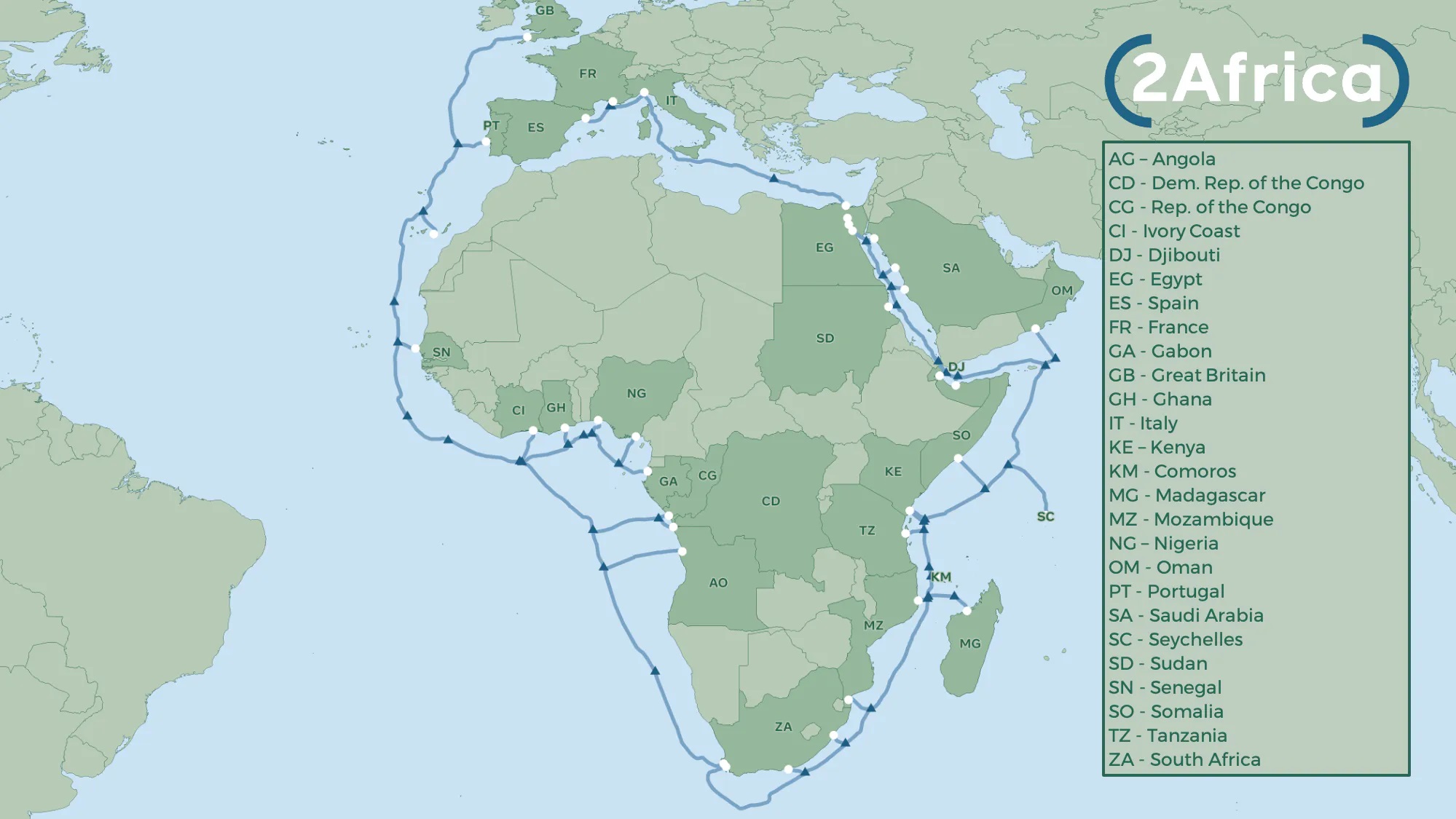
Equiano is designed to connect Africa to Europe via Portugal. Google said once complete, Equiano will start in Western Europe and run along the West Coast of Africa, between Portugal and South Africa, with branching units along the way that can be used to extend connectivity to additional African countries.

The first branch was expected to land in Nigeria but landed in Togo in March. Togo became the first country in West Africa to launch a 5G network in 2020.

The new cable is expected to help Togo double internet speeds by 2025 and reduce Internet prices by about 14%, according to research from Africa Practice and Genesis Analytics commissioned by Google.