The social contract theory is a political philosophy that tends to concern itself with the legitimacy of the authority of the state over the citizens or individuals who call the state home.
Social contract theorists propound the arguments that posit that individuals or citizens of a particular state have consented, either explicitly or impliedly to surrender some (if not all) of their freedoms and natural rights and submit themselves to the authority of the state or to submit to the decision of the majority in exchange for protection of their remaining rights against aggression or invasion and maintenance of the social order.
The starting point for the social contract theory can be directly linked to an English philosopher; Thomas Hobbes when he propounded that man at his natural state is a bully and hence there is the need for there to be an authority which man or citizens can surrender their freedoms or submit to in the exchange for protection by the state.
Thomas Hobbes argued that without a constituted social contract, the society will be like a jungle where the big or the powerful will be feasting on the weak and it will be like the animal kingdom where the order of the day is the survival of the fittest and life in this state will be nasty, brutish and short.
The social contract theorists seek to demonstrate why rational individuals would and should voluntarily consent to give up their natural freedom to obtain the benefits of the political order of the state for the benefit of everyone in the society.
Everyone must consent (expressly or impliedly) to give up some of his natural rights and freedom in exchange for the provision and protection by the authority to which everyone submits.
This theory is of the view that the society or the state came into being and can only exist by a consensual contract that was made between the individual and the society or the contract that was made amongst the individual people.
There are five notable elements of the social contract theory which is worthy of mention:
(1) the role of the social contract
(2) the parties which are usually the state and the individuals
(3) agreement or the contract
(4) the object of agreement or contract
(5) what the agreement is supposed to show.
Every constitution of a republican country or a democratic government tends to boldly display this contract in its constitution, usually in the preamble of the constitution.
For example, the preamble of the constitution of the federal republic of Nigeria, 1999 (as amended) reads;
We the people of the Federal Republic of Nigeria
Having firmly and solemnly resolved, to live in unity and harmony as one indivisible and indissoluble sovereign nation under God, dedicated to the promotion of inter-African solidarity, world peace, international co- operation and understanding
And to provide for a Constitution for the purpose of promoting the good government and welfare of all persons in our country, on the principles of freedom, equality and justice, and for the purpose of consolidating the unity of our people
Do hereby make, enact and give to ourselves the following Constitution:-
This preamble is an indicator of the social contract which everyone that is a member of the Nigerian society is a party to.
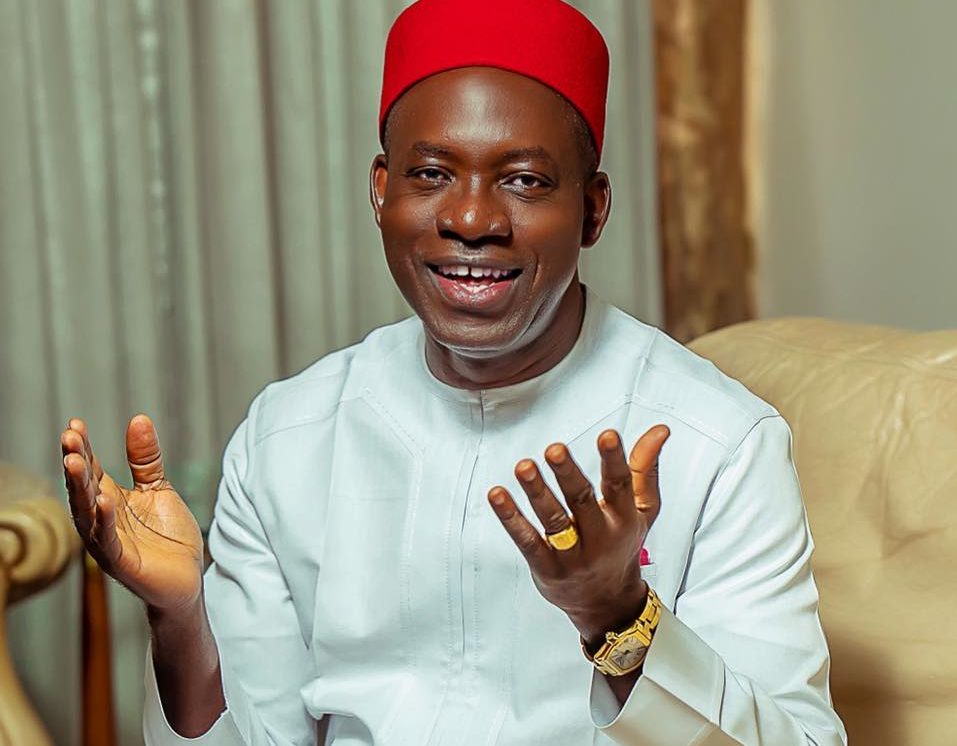
Ever since the trial of the leader of the indigenous people of Biafra, IPOB, Mazi Nnamdi Kanu began, the group ordered the shutdown of businesses on Mondays, declaring it as a sit-at-home which is solely carried out to stand in solidarity with the Biafran leader. Just recently, the newly elected Governor of Anambra state Gov. Charles Soludo has ordered all public servants in the state to go to work on Mondays and other weekdays, and also ordered businesses to be opened as well.
Governor Soludo, therefore, warned that absence from work will attract sanctions. In a circular that went into circulation in the state, the memo reads “following the need to reposition the service for better performance and productivity, his excellency, the governor of Anambra state, Prof. Chukwuma Soludo has directed that henceforth, all public servants should report at their places of work every Monday like every other weekday. Consequently, absence from work on Monday, or any other day without any approval will be viewed as serious misconduct, which will attract appropriate sanctions. This directive takes immediate effect”.
Recall that last year, Governor Soludo, who was not yet the governor of the state at the time he made this statement, lamented on the sit-at-home order. He disclosed that such an order hurts the economy of the state, saying that the state loses an estimated N19.6 billion every Monday. As someone who was one time the governor of the central bank, I strongly believe that Gov. Soludo is well-grounded on the implications of such an order on the state, so therefore his cancellation of the order should be strictly adhered to.
I remember vividly during his inaugural speech, he disclosed that he was ready to engage the Ipob group in a round table discussion for both parties to come to a common agreement. He lamented that many criminals now hide under the guise of freedom fighting to perpetuate criminality in the state, such as looting, arson, harassment of people, killings, etc. This statement by the governor is indeed true as all these vices above-mentioned were evident during the Ipob movement. Hoodlums hijacked it, using it to carry out dastardly acts that don’t align with the motive of the IPOB group.
I will say the cancellation of the sit-at-home order by Governor Soludo is a welcome development, and I strongly commend him for implementing the order, not minding whose ox is gored. Inone of my articles, I wrote extensively on the impact of the sit-at-home order in the South-Eastern part of Nigeria. The sit-at-home order hurts the economy of States in the Eastern Region, and it also crippled economic activities thereby incurring so many losses. You cannot say you are standing in solidarity with your leader, and at the same time inflict hardship on a large number of your people. It’s counterproductive!
This order is more like the Igbos shooting themselves on the foot, as the order has no positive effect on the release of the Biafran leader. Some people compared the sit-at-home order as akin to drinking poison and hoping that your enemy would die. Regular observance of the sit-at-home in the Southeast is not even effective for the actualization of Biafra. It has affected and killed so many businesses. Big organizations have been said to have moved out from the region because a lot of them were greatly affected by the order.
When these organizations begin to move out of the region en masse, how will the economy grow? Let’s not forget that the Eastern part of Nigeria suffered great damage during the Biafran civil war, and they have tried rebuilding it back. So, therefore, anything that will retard growth and progress in the Eastern part of Nigeria is not ideal and welcomed.
The level of paternity fraud in Nigeria is alarming. It has gotten to the point where lawmakers should make law(s) criminalizing paternity fraud.
According to a report, Nigeria ranks number one in Africa and second in the world as the country with the highest rate of paternity fraud. It was also reported that 30% of Nigerian fathers aren’t really the biological father to their purported children i.e. 3 out of 10 fathers have the wrong kids as their biological children.
Some of us recently read the story of the popular Calabar based OAP that goes by the name Father Kane who just discovered after a DNA test that his two children for twenty years were never his biological children. Stories like this are disheartening, heart breaking and it can only make you doubt the honesty of some ladies.
His Facebook public post read;
“This is to inform the general public that I, Kanedrick Kingsley Agwu, popularly known as Fada Kane is not the biological father of Anthonia Duke and Paul Duke as alleged by one Miss MarryAnn Efa Duke,” he wrote.
Attached here are the copies of DNA and court affidavit to further ascertain my claims. MaryAnn Efa and her family are free to contest the DNA results through the court where I too can legally file for damages for such allegations.
Last year also, the story of Nedu Waziobia, a popular entertainer also trended, his first kid was not his biological child as the ex wife claimed after he carried out a DNA test. These are some of the numerous cases that made it to the news.
When you force a kid on a man that he is not the biological father to, you are also doing the kids a grave harm because you are building their lives on a lie and depriving them the chance of knowing their biological father. These can damage the kid’s future.
The only way to reduce the issue of paternity fraud in Nigeria is to criminalize it and those that engage in the act should be properly tried and prosecuted and made to face harsh punishments.
The issue of paternity fraud is currently in the realm of morality but morality police cannot tackle the menace, hence the need for legal forces to come to work.
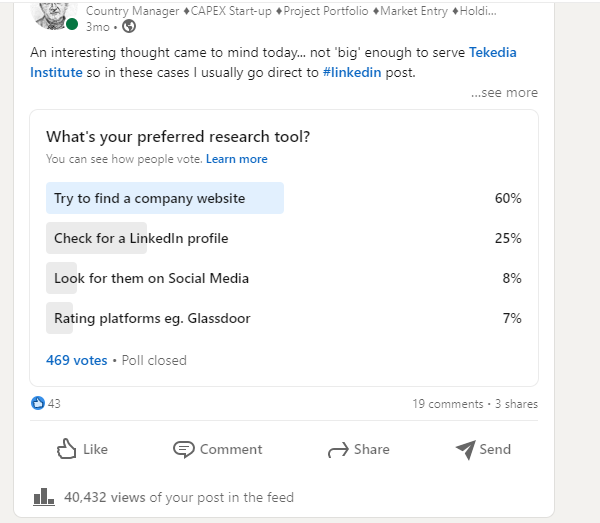
Earlier this year, I posed a question on LinkedIn via a poll. I asked if people saw a job advertised, what would their first ‘go to’ be as a research tool?
It is probably important to point out that 78% of my first degree connections are Nigerian, so this would be reflected in the result.
60% said they would look for a website.
The remaining 40% comprised 25% said they would look for the LinkedIn profile (some may say it had an unfair weighting, since the question was actually posed on LinkedIn)… 8% said they would look on ‘Social Media’ (this would be taken to mean platforms to include Facebook, Instagram, Twitter, Pinterest and TikTok (for example).
7% said Glassdoor (known for its employer rating feature).
LinkedIn only allows four options in polls… were there to be less limit to the options, I might have included Fiverr and Upwork.
Now, you may think that LinkedIn, Social Media and some other online platforms would reveal more impartial opinion than a company’s website, so what could the reason be for 60% of people wanting to look for a website, while only 40% pursue all other options combined?
CORPORATE IDENTITY
Getting a wide birth of opinion about a company, may clarify one’s own questions about company culture, corporate behavioural expectations and other things, but it doesn’t tell anything about the kind of employee or business partner they want people to be.
A LinkedIn Corporate page is a help, but the world is not the ‘LinkedIn Nation’
Companies have their own perception of themselves.. where they feel they fit in the world, where they feel they fit in markets, where they are and want to be with products and services, and importantly, who they see as a prospect to be one of their people.
Only their website has potential to tell you this.
VISIBLITY, TRANSPARENCY AND ACCOUNTABLITY.
One of the problems with online platforms and social media is the potential to create people that really don’t exist, or to create counterfeit accounts of people who do.
I like to throw random questions to professionals in my network about technological advancements. If there is something new or cutting edge going on, and I want to know more about it, I will do a search on LinkedIn, pick the top 5 first level contacts who seem SME’s (Subject Matter Experts) and fire off a few DM questions and see what comes back.
Within three months, one person had a strong profile against five different inquiry scenarios, but their responses were weak and evasive as against others whose profiles were a weaker fit, but provided much more meaningful replies.
On looking at LinkedIn participation, I also noticed the person frequently commented about ‘being human’ , trying to ‘inspire and motivate’, looked to resonate emotionally, and frequently gave opinions on HR issues, but never mentioned anything technical, in line with the profile.
The person had 70k followers, and over 300 common contacts with me, but when I reached out to my contacts, nobody actually knew this person.
It is very easy to get a web based email address and create online identities without proving who you are. This is because most web-based emails, social media, and other platforms, all work on a ‘fremium’ model. (A fremium model involves a basic service for free, with additional services that come at a cost). As long as services are kept at free use level (no card payment involved), it is possible a person can create a whole online ecosystem around them without ever proving who they are.
Owning a website leaves a clear transaction chain of custody via payment to the web hosting service provider. The registrar can be identified by conducting a ‘who-is’ online search. Both civil and criminal courts, along with other authorities, depending on country, can compel a registrar to reveal a website owners identity.
It is so much harder for an entity with a website presence to completely vanish without a trace following fraudulent behaviour. The existence of a website is the ‘Gold Standard’ in believability for online presence.
Are Web 3.0 (i.e. blockchain) websites likely to offer the same lack of traceability that is possible with Social Media and Online Platforms?
The simple answer is no. There are basically three types of Web3 domain operators:
Providers of ‘Handshake’ Domains – These are already Web 2.0 Web Hosting and Domain Sellers. They have just added Blockchain Domains to their existing portfolio of products. They transact business the same way they have always done, in FIAT; and so a legal or public authority can demand transaction details from them to identify a website owner.
Providers with their own blockchain and crypto. These usually require payment in the ‘house’ crypto to buy a domain, so a payment in FIAT from someone’s bank account isn’t done directly to pay for the domain, however the provider still has records which are traceable.
Providers of domains to be minted to a third party blockchain (not ‘Handshake’). These have their own business records and charge for services in FIAT.
There is an endless supply of Web 2.0 domain hosting and domain sellers, and none have a monopoly over selling ‘.com’ or ‘.net’ etc domains. This is why the ‘Who-is’ system has to be used to find who the registrar is. Blockchain (Web3) TLDs (Top Level Domains) however are unique to the provider, and are easily identified using a simple online search.
Web3 domains are very cutting edge and not yet commonplace. This makes their owners conspicuous, something those intent on fraud would be keen to avoid.
Also see: johnmckeown.tiny.us/web3-domains
Building fraudulent capacity online starts with using an untraceable web based email address to sign up for services, and then using those, such as Google or Facebook etc accounts to then sign up for further ‘freemium’ online services. The lack of confidence is rooted in the ‘freemium’ nature of the services as long as the participant never pays for anything.
Traceability comes the moment the participant opts for paid services in any part of their online ecosystem. However, because of the conspicuous nature of a website, it is the best tool for confidence building among online/remote associates or peers, and the broader metaverse.
Are there other conclusions and lessons businesses can glean from the poll?
As people, we generally have common practices when we think about the believability of others… validating things.. doing due diligence.
This transcends across whether we are scoping out a new employer, seeking a business partner, or looking to source products or services.
Mostly a website will form part of their checklist, but won’t be the decider. A business without a website may be seen as below some sense of corporate maturity at a very basic level, and can’t be relied upon. It doesn’t make every website owning trader or business a winner though. Everybody has to fashion their own ‘silver bullet’
It also means that a business’s own website is its own best advertising agency. Businesses with a promo budget should try to look at how to empower their own online ecosystem with its website at the epicentre.
This also raises issues around why companies bother paying influencers, and even if they do, how they choose them.
I was once asked who is an example of a great influencer in Africa?
I paused for a bit, and then said:
‘A person whose ranting and rebuking of somebody else’s pet hyena causes it to do their bidding’
Please visit johnmckeown.eu
Acknowledgements:
YouTube Video – Influencers have no value – ‘Truly Strategic’ – Tara Hunt.
We are pleased to announce a partnership with Bantu, a blockchain platform recently collaborating with Visa for card issuance in global remittance. The union focuses on bringing financial services to the unbanked and underbanked populations throughout Africa. This partnership focuses on expanding our reach as it tends on complementing our future roll-outs on the Blockchain.
At Roqqu, we believe that every African should be financially included. We want to enable people to send money across borders quickly and use financial services that were previously inaccessible due to high costs or geographic limitations. With the launch of our first blockchain solution and a series of new upcoming blockchain-based ideas, we are helping bring these dreams to reality.
Our first product on the Bantu blockchain network will pay much attention to accessible global remittance services. We want people in Africa to easily send money to friends and family in other countries while avoiding the complex web of paperwork and fees associated with traditional international remittance players. We do this by leveraging the Blockchain technology to ensure transparency and trust between sky-high users.
Roqqu will continue to leverage Blockchain technology to build some of the most exciting and innovative blockchain-based technologies that will surprise our users.
Bantu token
xBantu is the native and official currency of the Bantu Network, a blockchain ecosystem dedicated to connecting the African digital economy. The utility coin enables developers and businesses to access the suite of products offered by the Bantu Network. xBantu will serve as fuel for all transactions on the network, including payment of transaction fees and execution of smart contracts.
The XBN token will be listed today, 26th March, on Roqqu and available to Roqquians; there’s a high flock of new users on Roqqu who register, deposit BTC, sell and withdraw. We are thrilled to partner with a company that has been working hard to create a network that allows anyone, anywhere, the access to build Innovative technologies with better tools, making it easy for more individuals to access financial services.
Roqqu X Bantu
The Bantu blockchain network operates with its native asset/token: xBantu. The coin will enable its users to execute transactions on the web and pay fees in XBN. One unit of the Bantu Token is one Spirit. 1 Spirit = 0.0000001 XBN.
Our association intends to build a network that will empower people to create wealth and build economic independence. They are building tools that help entrepreneurs, software developers, and engineers work better and together by giving them the tools they need to develop superior machines.
Conclusion
Roqqu as the biggest crypto exchange in West Africa, with over 1.3M+ in users;We are always looking out for the best to the benefit of these users as we have a lot in store for them; this partnership opens the gate for many more awesome features.
Join the train now by downloading the Roqqu App on android Play Store and IOS Apple Store