DD
MM
YYYY

PAGES

DD
MM
YYYY

spot_img

PAGES

Home Blog Page 5390

The Power of a Testimonial Page

0

Imagine if you can ask 5 users to provide feedback on your product. And you post those testimonials on your site. Imagine if you can scan social media for positive reviews about your business, and find a destination for them on your site.

Do you know one thing? The ability  to convert site visitors  from “interested” to “paid customers” will improve. In other words, they will arrive at the decisions to patronize you faster – and that means your revenue will go up!

At Tekedia Institute, we have noticed one thing from analytics: most visitors who visited our testimonial page ended up registering for our services. Add a testimonial page on your website!

Comment on LinkedIn Feed

Comment: Personally, I avoid Testimonials like plague. I have never bought anything after listening to “Testimonials” because I simply skip them, but I buy after reading “Reviews” as I find reviews to be more Balanced and Wholesome in Perspective. They provide you with the Pros and Cons of buying into a subject matter as opposed to Testimonials which are largely Eulogies. To be 100% honest, I never knew people bought into things after reading, watching or listening to Testimonials, this is news to me.

I would love to look into this more and try to understand people’s relationships with Testimonials, how it differs with Reviews and which makes more overall economic sense.

My Response: “I avoid Testimonials like plague. I have never bought anything after listening to “Testimonials” ” – most universities do this, using their students to testify.  From data, other students do pay attention. The whole world of customer-anchored advertising is based on testimonials where you put your great customers to talk about your product; those work.  The biggest ads in the history of McDonald’s are using the voices of celebs, rich people , etc and telling how they began in McDonald’s.

Reviews are usually outside the control and influence of the brand since they’re always on 3rd party ecosystems.

A job seeker who visits a website and someone writes” This company helped me get a job”, naturally, he would spend more time on that site than one with none.

Plus, political campaigns are all about testimonials. Testimonials work! If Buhari endorses Mr A for presidency in Nigeria today, that person will be on the pages of all newspapers in Nigeria tomorrow.

Metamorphosing Brand Ambassadors into Strategic Influencers for Telecom Products in a Developing Market

0

From the time the telecommunications industry was deregulated in 2001, the industry has remained competitive in every facet. Players and operators have used a variety of strategies and techniques to attract over 150 million prospective targets. Coverage, reliability, leadership, and positioning differentiation tactics have been adopted by notable service providers such as MTN, Glo, and Airtel. An integrated communications approach is being used by the companies for the effective attainment of specific objectives of each strategy.

Beyond this, brand strategists’ thinking is now shifting towards strategic influence for the realisation of exponential sales growth. Strategic influence is also known as marketing warfare, in which companies use influential people as ambassadors, promoting their core offerings through varied communication channels.

Companies are encouraged to regard each other as friends, allies, neutral audiences, and hostile audiences in marketing warfare, a sector where strategic influence is deployed. LTC Susan L. Gough characterises the United States as a lone superpower country in his book The Evolution of Strategic Influence. Despite this, he believes that for the country to flourish on a long-term and global scale, it will require the assistance of other countries.

Given Gough’s perspective on strategic influence, it appears that telecoms providers in Nigeria should have a deliberate, conscious coordination or integration of all informational attributes of performing artistes or influential people they want to use as ambassadors in order to influence customers’ views, attitudes, and behaviour in ways that promote their (companies) products and services to achieve their objectives.

The simple use of coverage, dependability, leadership, and positioning differentiation by Nigerian telecoms carriers would not help them win market share wars, according to Kunal Muzumdar, general director of digital marketing agency POSSIBLE. He said, “Power isn’t just in reach; it’s in influence.” “Take the time to get to know them and see if they’re a good fit for your brand.” He went on to say that marketers should make an effort to interact with influencers who share a brand’s genuine problems, interests, and passions.

It’s also been recommended that brand ambassadors should be consistent with the business’s identity in some way, whether it’s through their appearance and demeanour, company values, ethics, or industry knowledge. Brand ambassadors’ personality features and performance attributes are critical in telling clients about the benefits they might expect.

What do consumers care about ambassadors? 

We’ve broken out what consumers care about ambassadors in the following section, which we believe will aid your brand ambassador marketing approach. These are the characteristics that customers want to see in any ambassador you hire to promote your business. Consumers always want to identify and internalise with their favourite artists or prominent persons, thus the attributes are based on that. By identification, we imply that a person tends to identify with someone of comparable social rank, which makes a long-term connection more likely. Internalisation, a sort of influence, is typically used by people who believe their behaviour is similar to their values, according to an expert.

Ambassadors drive the bottom line

The goal of utilising brand ambassadors is to produce new customers and retain existing ones in the short term, as well as to grow revenues significantly in the long term. As a result, brand ambassadors with a large number of social media followers are essential for brand improvement and exponential sales growth. According to experts, they (artists) give your brand a face and appeal to customers on both an emotional and functional level. To achieve these goals, a well-coordinated action plan with strategic management and measurement is required. According to a study, there is a clear link between a celebrity’s consistent image and the brand being advertised.

Ambassadors act as purchasing factors

We discovered that brand ambassadors inspire people to buy telecoms products or services after analysing a number of brand ambassadors in the industry. “The modern telecom client, especially the first-time customer, is far more likely to base their product decisions on recommendations received from someone they trust,” according to Reward Stream, an online information source. They want to know how their products and services work in “real-world” situations, particularly subscription services. These purchases are driven by necessity rather than impulse, so breaking through the noise and getting “the genuine deal” from someone they trust is important. In short, people no longer trust advertisements as much as they once did.”

The Nigeria’s Democracy And Buhari’s Leadership

0

The Nigeria’s democratic system will elatedly clock 23 by May this year. Though the country had from the outset been experiencing – at intervals – democratic leadership, it’s emergence in 1999 which marked the fourth republic hasn’t been interrupted till date.

This signifies that we’ve thus far, since 1999, enjoyed an uninterruptible democracy. It suffices to say that the style of leadership in question has consecutively lasted for 22 years without interruption, hence has apparently come to stay.

In spite of the countless challenges so far witnessed in the country’s civil rule, there’s one big reason for the citizenry to celebrate the aforementioned milestone. The reason remains that, the worst democratic sphere is far better than the best autocratic rule or any other.

This implies that as we groan over the devastating pattern of democracy being harboured in the most populous and popular black nation, we ought to be consoled by the fact that democracy can never in any way be equated with autocracy, hence are not unlike two parallel lines that have no meeting point.

It would be recalled that the People’s Democratic Party (PDP) premiered the leadership of the ongoing republic. Chief Olusegun Obasanjo was at the helm of affairs at the time. Nigerians were of the view that soonest the country would be ushered into the long awaited Promised Land. But pathetically, eight years after, no tangible development was recorded.

The show of uncertainty continued unabated till 2015 when a merger party branded as the All Progressives Congress (APC) surprisingly unseated the ruling PDP reportedly via the mandate of the people’s votes. The defeat was not unconnected with the fact that the citizens yearned for a change having ostensibly gotten weary of the PDP’s administration.

President Muhammadu Buhari who came on board in 2015 under the auspices of the APC, celebrated his 6 years in office last year. It’s worthy of note that prior to his victory at the polls, his party was able to attract the attention of the teeming Nigerians with the aid of its change mantra.

In his acceptance nationwide speech after the election, Pres. Buhari pledged that, under his watch, the lingered societal plights such as insecurity, corruption and epileptic economy shall be addressed headlong.

Ironically, as the journey progressed in the course of tackling the Boko Haram menace, which was mainly occurring in the North Eastern part of Nigeria, other security challenges abruptly sprang up in virtually all the parts of the country.

In the area of corruption fight, he has succeeded in minimizing some ugly situations that used to be the order of the day in the public service through the fierce implementation of the Treasury Single Account (TSA) and the Bank Verification Number (BVN).

However, the people were baffled that despite the various ongoing court proceedings, no single conviction had been recorded, perhaps owing to the notion that “corruption is fighting back” as recently alleged by the government, not until an erstwhile governor of Taraba State, Jolly Nyame was served a verdict, followed by the conviction of his counterpart in Plateau state in the person Joshua Dariye.

The economy cannot be left out while dissecting the overall leadership stride of the present administration. Recession came into place the moment the Buhari-led government took over the mantle of leadership apparently as a result of the drastic decline in the oil price.

In view of the recessionary era, several firms operating across the country became bankrupt, thereby leading to redundancy. Nevertheless, we must acknowledge that even if the PDP was still in charge, the recession wouldn’t have been avoided.

Although the Presidency had claimed that the Nigeria’s foreign reserve had “improved significantly”, it’s difficult to believe considering that importation isn’t yet curtailed because foreign products still abound in the country.

The citizenry had equally be told that inflationary rate had “consistently reduced every month since January 2017”, but currently, the prices of goods and services in the country’s numerous markets still endlessly skyrocket.

On agriculture, Mr. President had categorically informed that rice importation had been “cut down by 90%”, but till date, Nigeria’s various markets are engulfed in foreign-made rice.

The Presidency had also boasted about the effectiveness of the ongoing Social Investment Programmes (SIP). It’s mind-boggling that the various initiatives embedded in the said programmes are yet to meaningfully solve the problems of unemployment and hunger that informed their implementation.

It’s noteworthy that the ‘Not too young to run’ bill had been signed into law by Pres. Buhari, signifying he ostensibly means well for the youth, yet various ‘old men’ are currently warming up to take over the mantle of leadership from him come 2023. Isn’t  it a paradox?

More so, the President’s  re-election in 2019 indicated a paradox as regards the ‘Not too young to run’ law he personally signed. If he was truly in support of the law, he wouldn’t have contested for a second term in office.

From my point of view, what Nigeria presently needs is sincerity on the part of her leaders. This is the only way she could get better, stronger and greater.

The Lesson from Indomie Noodles and Winning in Dangote World

3

The Dangote Group is legendary for acquiring, developing and unleashing capabilities across many domains in markets. Through those capabilities, it has won markets and territories. Interestingly, anyone can replicate those playbooks.

In this piece,  I explain how the makers of Indomie noodles used the same strategy the Dangote Group has been using for decades to win. And at the end of the day, they defeated Dangote Noodles.

When Dangote Noodles came and unleashed its competitive high-voltage playbooks, Dufil Prima Foods (makers of Indomie) did not blink.

Why? Those things Dangote Group does, from internal electricity generation to logistics, have been done in the noodles business by Prima, making it nearly impossible for more efficiencies to be extracted.

With no left inefficiency which Dangote could exploit to improve quality and reduce price, Indomie Noodles held its ground when the competition came. Yes, Indomie won – and Dangote Group later sold its noodle business to the makers of Indomie.

Big lesson: accumulating and compounding capabilities will not just help you unlock new markets but will also help to defend your territories. It is irrelevant if the new competitor is Dangote Group.


Climate Change and Insights from Nigeria’s Mitigation and Adaptation Paths in 6 Years

1

Since 2015, when political and corporate leaders agreed on a series of steps to make the planet habitable for all living things, Nigeria and other countries have been viewed as places where climate change has a significant impact. This is mostly based on people’s and industries’ efforts to produce and consume tangible and intangible products and services.

According to one recent report, Nigeria is ranked 47th among countries that have lost millions of dollars in purchasing power parity. When losses per unit of GDP were assessed in 2021, using data from 2000, it ranked 89th.  With the ongoing effects of climate change, both leaders can no longer conduct business as usual, which frequently results in financial and human losses. This is one of the reasons why interested parties meet on a regular basis to discuss climate change issues and demands.

The debates resulted in the creation of a number of policy and implementation tools. Nigeria has participated in and continues to participate in a number of national and international programs and initiatives, from agreements to implementation. One of the most important implications of the Paris Agreement is countries’ understanding that nationally determined contributions are required to meet long-term climate change commitments.

In 2017, Nigeria ratified its NDCs and further established her role model for the rest of Africa in 2021 by submitting an ambitious updated NDCs. With the updated version, Nigeria’s economy-wide mitigation targets have been raised to 47 percent and unconditional emissions reductions of 20 percent by 2030, respectively, with the amended version. Apart from that, Nigeria has demonstrated a strong willingness to link NDCs with green recovery. According to our analysis, Nigeria has been attempting since 2015 to integrate several climate change policy measures that were included in earlier policy papers and strategic plans with new ones produced and implemented by the present administration [President Muhammadu Buhari’s Government].

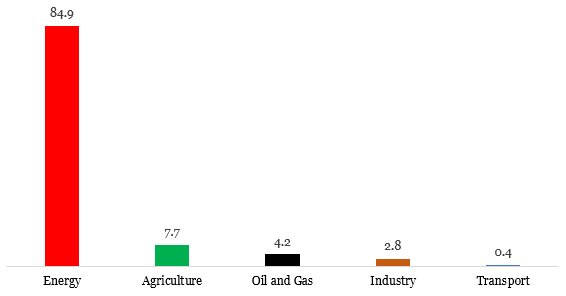
Exhibit 1: Mitigation Projects by Sector between 2015 and 2021[in percentage]

Source: Nationally Determined Contributions Registry, 2021; Infoprations Analysis, 2022

A critical analysis of the Nationally Determined Contributions Registry by our analyst indicates that 695 projects have been created by the government. These projects cut across agriculture, energy, industry, oil and gas, and transport. According to our analyst, these sectors have over the years been identified as the most vulnerable to climate change effects. Analysis further reveals that 5 of the 695 projects are adaptation-focused, signifying the government’s readiness and interest in ensuring an enabling resilient environment for people and businesses. Six hundred and ninety of the projects are mitigation-oriented projects.

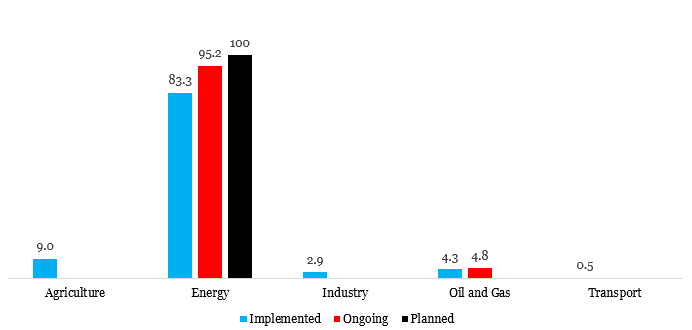
In terms of implementation, the energy and agriculture sectors received a significant number of projects between 2015 and 2021. A total of 537 and 58 projects were developed for energy and agriculture, respectively. With 28 and 19 projects, oil and gas and industry closely followed. Analysis also reveals that the transport sector had 3 projects. Analysis of the projects based on ongoing and planned types shows that 29 projects have been penciled down for the energy sector, while 20 projects are being worked on as at the time of the analysis. The oil and gas sector has a project as an ongoing one.

Exhibit 2: Status of the Projects across Sectors [in percentage]

Source: Nationally Determined Contributions Registry, 2021; Infoprations Analysis, 2022