DD
MM
YYYY

PAGES

DD
MM
YYYY

spot_img

PAGES

Home Blog Page 5440

Beat the world’s record >> work as a team

1

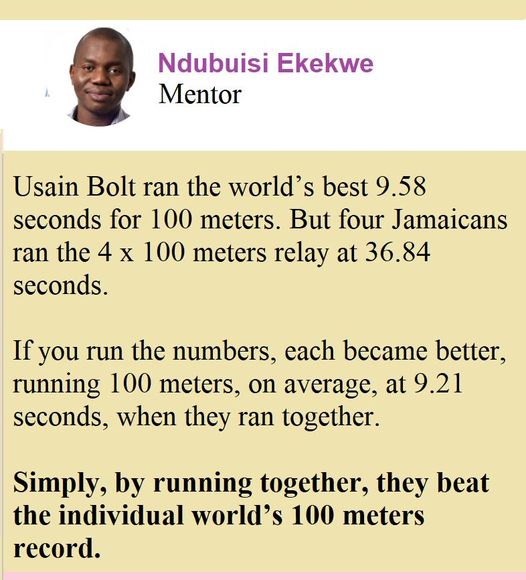
I have used this photo to teach in a military academy, a big bank and a global supply chain company, this month. At Tekedia Institute, we try to build analogies from simple things. Yes, just as the four Jamaicans beat the world’s 100 meters records when they ran together, a great team will outperform any great solo player. Collaborate, partner and work together.


Usain Bolt  ran the world’s best 9.58 seconds for 100 meters. But four Jamaicans ran the 4 x 100 meters relay at 36.84 seconds. If you run the numbers, each became better, running 100 meters, on average, at 9.21 seconds, when they ran together.

Simply, by running together, they beat the individual world’s 100 meters record. Collaborate, partner and advance together.


Beat the world’s record >> work as a team.
Comment on LinkedIn Post

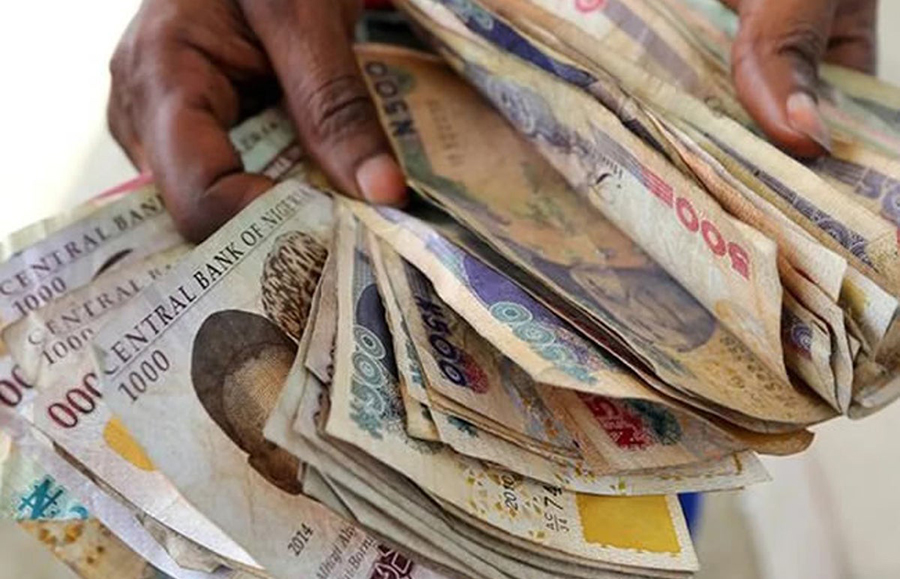
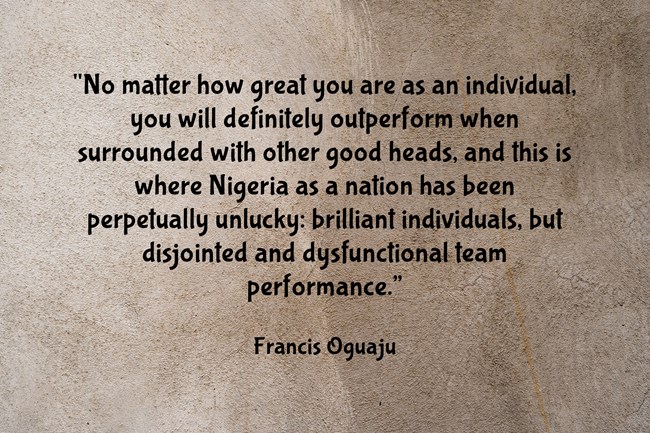
Here, most times, I write to read Francis Oguaju’s comment. Read this comment on the Usain Bolt post – https://lnkd.in/eXT6r7GJ) . Today, Nigeria has scored another own-goal: “Minister of Finance, Budget and National Planning, Zainab Ahmed, has said that Nigerians would get N5,000 per month as a transportation grant after the removal of fuel subsidies.” If you cannot run fuel subsidies well, do you have any chance to distribute N5,000 monthly effectively?

Minister of Finance, Budget and National Planning, Zainab Ahmed, has said that Nigerians would get N5,000 per month as a transportation grant after the removal of fuel subsidies.

According to the Minister, the Federal Government will remove fuel subsidies by 2022 and give the poorest Nigerians a transportation grant of N5,000.

Ahmed said this on Tuesday, at the launch of the World Bank Nigeria Development Update in Abuja, stating that about 30 to 40 million Nigerians, who are the poorest in the country, would have access to the grant.

She said, “The subsidies regime in the [oil] sector remains unsustainable and economically disingenuous
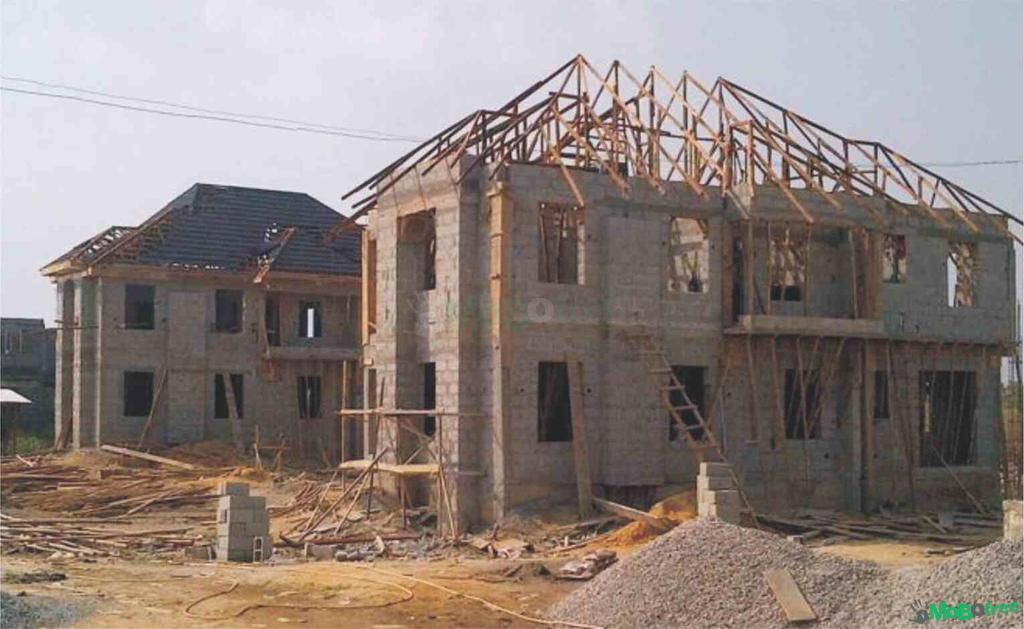
 

Nigeria’s Unrealistic Affordable Housing Scheme

0

As the Nigerian housing deficit spirals, birthing unaffordable housing on its way. The federal government, under President Muhammadu Buhari, has repeatedly promised to tackle the challenge by building affordable houses for Nigerians across states of the country.

In November, in a bid to make the promise come true, the federal government launched the National Housing Programme (NHP), as a vehicle to facilitate an affordable housing scheme. It also created a portal for the sale of completed houses under the scheme, to make it easier for individuals to acquire homes without the involvement of middlemen.

The NHP offers three choices to intending home owners; mortgage, rent and outright purchase. These, are believed to make home ownership easier – but there is just a little problem – the cost.

Last week, the Minister for Works, Housing and Urban Development, Babatunde Fashola, told the Senate Committee on Housing that the cost of the houses under the NHP has been varied according to states. He explained that the reason is due to the cost of building and topography – and then he let out the scary part that has contradicted everything affordable housing stands for.

Fashola said the costs of the so-called affordable housing is between “N7.2 million and about N16 million, depending on what a person wants”.

But according to the prices available on the NHP portal, a one-bedroom bungalow has a unified cost of N9,268,751, across every state where it is available. On the other hand, the cost of a two-bedroom bungalow is N12,398,460, while that of a three-bedroom costs 16,491,155.

A one-bedroom flat in a condominium available in southern states goes for N7,222,404, two-bedroom apartment costs N9,148,378, while a three-bedroom unit costs N13,241,074.

While these prices are affordable to many, it is unreachable high for its target audience.

As of last year, the cheapest house under the federal government’s Family Homes Fund, was a one-bedroom house in Delta State, at the cost of N4 million. Although much cheaper than the houses under NHP, it’s considered unaffordable. This is because Nigerians’ earning power falls significantly short of the cost.

Half of urban households (13 million) in Nigeria earn less than N100,000 a month, according to data from the Centre for Affordable Housing Finance. This means, using a mortgage that requires 20% down payment, the average Nigerian can only afford housing units cheaper than N2 million.

This worrisome reality is borne out of Nigeria’s state of penury. The most populated African country is the world’s poverty capital, where more than 40 percent of the population live below the poverty line (less than $2 per day).

With the cost of the houses far above the earning power of Nigerians, many have been asking if the federal government meant what is written on the NHP portal which reads: “It is a programme borne out of the government’s desire to provide affordable housing for its citizenry.”

Although Fashola said that over 7,000 persons have indicated interest in purchasing the apartments, the majority of Nigerians considered the houses unaffordable. Moreover, many believe they can build better houses on their own with the same amounts set as the housing costs.

Giving to Caesar what belongs to Caesar

0

Religious organizations in Nigeria and many other countries of the world are not taxed because they are classified as not-for-profit incorporations but if we are being honest to ourselves we will accept the fact that religious organizations are full time money making ventures now, booming industry, an industry filled  with money and potentials for easy and quick money. We can even refer to this industry as ‘Religiousprenuership’ with the captains of this multi billion dollars industry as “Religiousprenuers”.

In the spirit of not being hypocritical with ourselves as we always tend to be in topics like this due to the religious proliferation of the society, we all know that religious organizations make so much money on daily bases even more money than companies and taxable organizations not to be giving back to the government in terms of tax, both company tax for the incorporations and personal income tax for the employees of the organizations who earn salary and wages from the organizations.

We tend to shy away from this topic due to the fact that almost everyone in Nigeria claims to identify with one religion or another, hence anybody that brings up a topic like this may be tagged as an unbeliever or an agent of darkness or it may be said to be against sharia or a haram  for raising the topic that religious organizations like churches, mosques, monasteries, even traditional religious organizations should be taxed once they have been registered and incorporated with the corporate affairs commission.

But before you tag me an unbeliever, don’t forget that even the Bible which is the holy book of the Christian religion advocated for the church to give back to the government when it says in the book of Mark 12:17 “Give what belongs to Caesar to Caesar”. This statement may be given different wild interpretations using different rules of interpretations but whatever interpretation given to it, the statement was made by Jesus Christ the role model of Christians and therefore should be obeyed as the statement if we use the literal interpretation rule literally means that government should be given back to as Caesar here represents the government. 

Government are only able to provide basic amenities for the citizenry like good roads, good educational institutions, power supply, good water, security, health care etc through the money generated from tax and when people and organizations don’t pay tax there won’t be enough money for the government to provide such things.

Churches, both registered and unregistered and mosques have the largest number of followership as some mosques and churches can boast of thousand and millions of members who pay offerings, tithes or zakat, make donations and even sow seeds and we can’t pretend that they don’t make much money on day to day bases.

Religious organizations own properties, massive properties like estates, schools, businesses, lands etc, those properties were acquired from money made from the religious organization and how can a no profit organization acquire so much money to afford such properties. Taxes should be paid on those properties owned by those religious organization and personal income tax paid by employees of religious organizations which receive wages from the organization be it mosque or church.

Although, we cannot push under the carpet the fact that some religious organizations engage in corporate social responsibilities and tend to give back to the societies in some huge and significant ways. Engaging to undertake corporate social responsibilities are impressive but those are more like a moral duty which you may choose to do at your convenience and not a legal duty and they break no law when they fail to do it.

Every citizen must come to this discussion table with an open mind and see the need of religious organizations paying tax as a way of helping the government to help the society and taxing religious organizations is not a way of killing religion as many may think but it’s a way of improving its symbiotic relationship with the government and society.

Why you should register your business and trademarks if you are a serious minded Entrepreneur

0
Emerging technologies like AI would have transformation impacts on Law (source: law.com)

When you register your business, company or organization it becomes a distinct personality at law and can sue and be sued.

Only registered businesses/ incorporations can enjoy governmental benefits like relief funds, government loans, grants etc and its only when your business is registered that you have the legal capacity to bid for contracts and handle projects be it local or international projects, more so, it’s only when your organization is registered, fully incorporated and recognized by the corporate affairs commission that prospective or existing investors and clients can take you serious.

Second scenario;
Imagine losing the brand or trademark you painstakingly built for years and getting bullied for trademark infringement. A stitch in time they say saves a lot and this is the reason you should consider registering your trademark or brand too as you register your incorporations.

The needs of getting your brands trademarked and acquiring your patent rights cannot be overemphasized just as the need of registering your business or organization and you as a serous minded Entrepreneur, CEO, Business owner, Start up owner should consider registering your trademark if you are really in for a roller coaster ride, don’t be like an average Nigerian that leaves everything to chance.

It doesn’t matter if you’ve been using that trademark or brand logo from time immemorial, at law it’s who registers the trademark or brand name/ logo first is the recognized owner as it is the legal principle the first in time takes priority.

Stanley Alieke, Esq.
infoitooknow@gmail.com

The Age of Fintechnolization as TotalEnergies Goes Fintech

1

In this piece, I argued that every digital platform will become a fintech company. I called it fintechnolization: “Looking at Chinese digital platforms (Tencent, Alibaba) and US counterparts (Google, Facebook), my conclusion is this: every platform will become a fintech company in the end.”

But do not just wait for digital platforms. Yes, every company can indeed be a fintech company:To ensure the financial inclusion policy of the Central Bank of Nigeria (CBN) becomes a success, TotalEnergies Marketing Nigeria Plc, in conjunction with InTouch and other partners, has deployed “Touch Point” to over 385 stations.

Touch point is a mobile payment financial-inclusion solution which TotalEnergies offers to capture the banked and unbanked populations in rural, sub-urban and urban communities nationwide including Lagos, Abuja, Port Harcourt, Kano, and Kaduna.

In view of the growing need for the integration of banks and other financial institutions with innovators and customers in the financial services space and the increasing adoption of Application Programming Interface (“API”) based integrations in the industry, TotalEnergies has partnered with organizations  from different sectors of the economy to provide Touch Point, a robust financial solution that can be enjoyed in more than 385 stations nationwide with the plan to expand our footprint in the nearest future.

There are currently five service bouquets being offered at the stations – Airtime, Data, Bills Payment, Cash Deposit and Cash Withdrawal.”

People, the biggest innovation now in Africa is business model. Why? The technology stacks are becoming increasingly mundane that inventing new business models is where leverageable values could be found.

For TotalEnergies, it makes sense: core competency enshrined by the old Adam Smith division of labour was postulated during the industrial age era when factors of production were exceedingly expensive. Today, anyone can do anything and that is why Amazon is in pharmacy, logistics, retail, etc. Go further,  there is nothing Google’s parent company does not do including medical science. Have the foundation stack, and you can keep building on top of it.

This is the age of fintechnolization. My blog, a digital portal, has its own fintech: Tekedia Capital.

Fintechnolization of Platforms – Expect This Redesign in Startups