DD
MM
YYYY

PAGES

DD
MM
YYYY

spot_img

PAGES

Home Blog Page 5550

Amidst Nigeria’s Rising Debt Profile, Buhari Seeks Senate Approval for A Fresh $5.2bn Loan

0
Nigeria leaders

The Nigerian government is making a move into the loan market again despite calls to minimize the rate of borrowing that is spiking Nigeria’s debt profile.

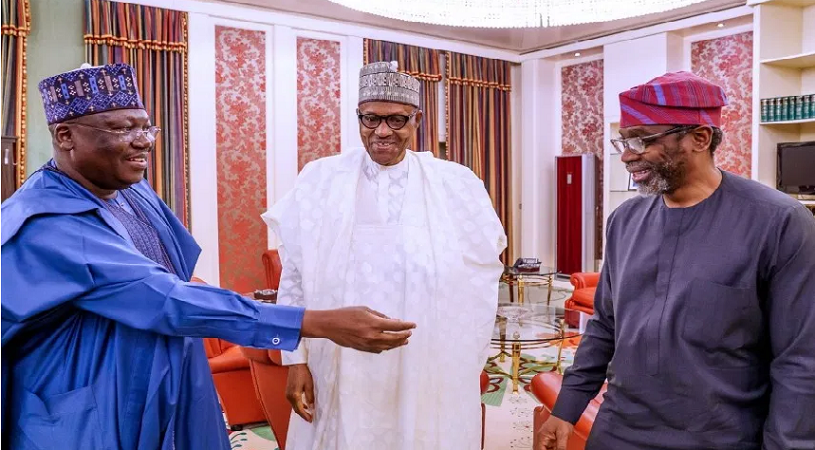
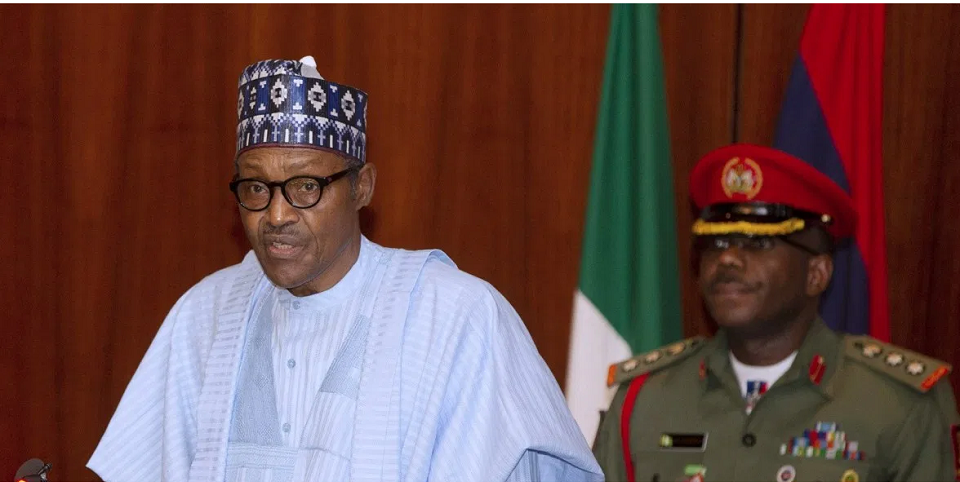
On Tuesday, President Muhammadu Buhari’s letter to the Senate seeking approval of $4.179 billion ($4.054 billion and $125 million) as well as £710 million external loans to fund projects captured under the 2018-2021 borrowing plan, was read at the plenary by president of the Senate Dr. Ahmad Lawan.

It was one of the series of Buhari administration’s loan approval requests and the second one in 2021. The president said the external loan will be used to fund critical infrastructural projects in the country.

Per ThisDay, Buhari in the letter explained that the projects listed in the 2018-2021 Federal Government Borrowing Plan are to be financed through sovereign loans from the World Bank, French Development Agency (AFD), China-Exim Bank, International Fund for Agricultural Development (IFAD), Credit Suisse Group and Standard Chartered/China Export and Credit (SINOSURE) in the total sum of $4,054,476,863.00; €710,000,000.00 and Grant Component of $125,000,000.00.

The fund would be used to fund federal and state projects cut across key sectors such as infrastructure, health, agriculture and food security, energy, education and human capital development and COVID-19 Response efforts, the president said.

The letter reads in part: “I write in respect of the above subject and to submit the attached addendum to the proposed 2018-2021 Federal Government External Borrowing (Rolling) Plan for the consideration and concurrent approval of the Senate for same to become effective.

“The Senate President may wish to recall that I earlier transmitted a request on the proposed 2018-2020 Federal Government External Borrowing Plan for the concurrent approval of the Senate in May, 2021.

“However, in view of other emerging needs and to ensure that all critical projects approved by FEC as at June 2021 are incorporated, I hereby forward and addendum to the proposed Borrowing Plan.

“The projects listed in the addendum to the 2018-2021 Federal Government External Borrowing Plan are to be financed through sovereign loans from the World Bank, French Development Agency (AFD), China-Exim Bank, International Fund for Agricultural Development (IFAD), Credit Suisse Group and Standard Chartered/China Export and Credit (SINOSURE) in the total sum of $4,054,476,863.00; €710,000,000.00 and Grant Component of $125,000,000.00.”

The letter continues: “The Senate is kindly invited to note that the projects and programmes in the Borrowing Plan were selected based on positive, technical and economic evaluations and the contribution they would make to the socio-economic development of the country including employment generation and poverty reduction as well as protection of the most vulnerable and very poor segments of the Nigerian society.

“The Senate may also wish to note that all the listed projects in the addendum form part of the 2018-2021 External Borrowing Plan and cover both the federal and states government projects and are geared towards the realization of the Nigeria Economic Sustainability Plan that cut across key sectors such as infrastructure, health, agriculture and food security, energy, education and human capital development and COVID-19 response efforts.

“A summary of some key projects in each of the six geo-political zones and a summary on the expected impacts on the socio-economic development of each of the six geo-political zones are attached herewith as Annex II and III.

“Given the importance attached to the timely delivery of the projects listed in the proposed Borrowing Plan and the benefits both the federal and state governments stand to gain from the implementation of same, I hereby wish to request for the kind consideration and concurrent approval of the Senate for projects listed in the addendum to the 2018-2021 Federal Government External Borrowing Plan to enable the projects become effective.”

Nigeria’s Total Public Debt Stock stood at N33.107 trillion ($87.239 billion) as of March 2021, according to Debt Management Office (DMO), creating a financial burden that is already affecting the country’s economic and infrastructural development.

The budget implementation report presented by Minister of Finance, Budget & National Planning, Mrs Zainab Ahmed in July, noted that the federal government spent 98% (N1.8 trillion) of the total revenue generated in the first five months of 2021 on debt servicing.

With oil still losing its steam and non-oil revenue falling short of Nigeria’s financial needs, Nigeria is increasingly depending on loans to function and may be forced to spend more than it’s generating to service the loans soon if the trend is sustained.
Interesting Numbers on University Admission in Nigeria

0

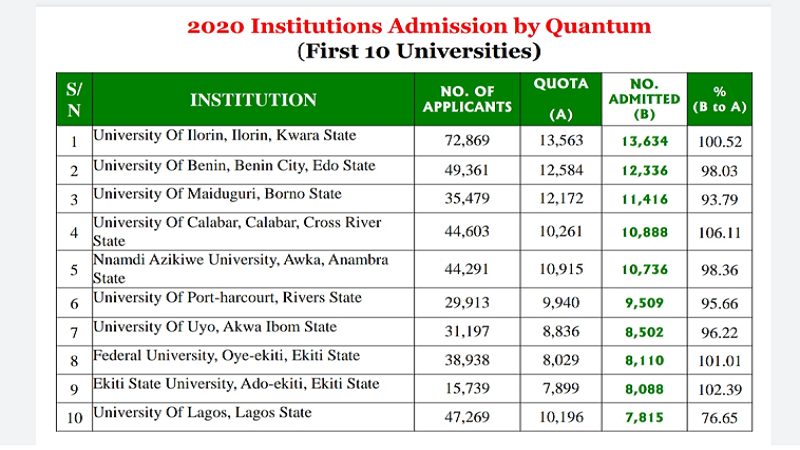
About 550,000 students have been admitted into Nigerian universities as of August, for this admission cycle. Ten universities will welcome 20% of them which means the other close to 200 universities will pick the balance 80%. UNILORIN, UNIBEN, UNIMAID, UNICAL and NAU lead the numbers. Notice that ABU Zaria, UNN, UI, and OAU are not in the top 10; interesting dynamics.

Yet, looking at these numbers which have not changed for years, you will see the challenge in the nation. A nation of 210 million sending just 550k students to universities. 

The United States is just about 1.6 times the population of Nigeria; US population is about 330 million. The Arizona State University admits about 125k students, more than the combined total of Nigeria’s top ten: “ASU’s enrollment increased 7% compared to last year and will welcome approximately 125,000 students to the University community, a Thursday press release said. “ 

Sure, it goes beyond quantity to quality! Yet, the number needs to move.

Nigerian Government Must Allow Fintechs In This Growing Market of Sovereign Borrowing. Lol

1

President Muhammadu Buhari has asked the parliament for approval to borrow $4 billion and €710 million to fund the deficit in the 2021 budget. That has been expected when the government could not make progress to extract “abandoned balances in bank accounts” and “unclaimed dividends”. With no productivity to bring tax Naira, going to the capital market was expected.

I understand that PDP, the opposition party, is not happy with the development. Sure, PDP left  the national debts at about N12 trillion when it left power in 2015. In six years, that figure has hit N33.1 trillion as of March 2021.

Yet, this is not the end: I expect this loan to hit N100 trillion by 2027. Even the Debt Management Office, a government bureaucracy, is worried. Nothing will change this trajectory until there is a sense of ownership and responsibility in Nigeria. Our current structure makes this possible: with no intra-state competition, everyone sleeps because Abuja will feed us.

What do I mean? Adamawa’s FDI for a whole year was $20,000, and that effort added it to the list of Nigerian states with FDI in 2020: “By destination, Lagos emerged as the top destination of capital investment in Nigeria with $8.3 billion, followed by Abuja, which received $1.3 billion. The others on the list are Abia State with relatively lower $56 million, Niger with $16.4 million, and Ogun with $13.4 million. Anambra State recorded $10.2 million, Kaduna State recorded $4.03 million, Sokoto got $2.5 million and Kano got $2.4 million. Akwa Ibom received $1.05 million ahead of Adamawa, which received just $20,000.” Yes, Simply, no incentive to leverage on comparative advantages across the nation. Twenty-six Nigerian states recorded zero foreign investment in the whole of 2020, figures released by the National Bureau of Statistics show.

My biggest concern is that the Nigerian government has not opened our borrowing business so that fintechs can participate! Yes, that is a huge market which is growing in double digits. I expect it to continue to grow irrespective of the party that takes power in 2023 until fundamental changes take place in the economy – and that is intra-state competition or what some call fiscal federalism!

This app – Jeka (!) – can raise $1billion via API to all bank accounts for x% monthly interest for Abuja! No need for JP Morgan Chase, Goldman Sachs, etc. Go Figure.

People, more loans!

Comment on LinkedIn Feed

Comment: Well articulated, however focus on debt should be in 2 parts… Debt to GDP ratio and what the burrowed funds is used for. Today America is burrowing $2trillion to finance deficit caused by Corona and jump start the economy. Last I check Nigeria’s debt to GDP was about 35% while IMF stipulates 25% as a comfort band. America’s debt to GDP is 107%, China 246% while India 21%, Ghana is 78%, UK 106%.

My Response: If a villager borrows from his village, it is market. But if he goes to another village, it opens up for enslavement. Nigeria’s borrowing cannot be compared with what happens in US because US borrows from its village (America) while Nigeria goes to another village – and this the slavery.

In Igbo novels, from Uwadiegwu to Omenuko, kinship-sourced debt is seen as a better alternative than a “foreign” one because if you lose your home, your kinsman (the lender) is obliged to host your wife and children because the child is Nwaoha (a child belongs to the village, not just to the parents) including to the lender.

Stay Strong Trademore Estate Abuja – Fixing Floods in Nigeria

0

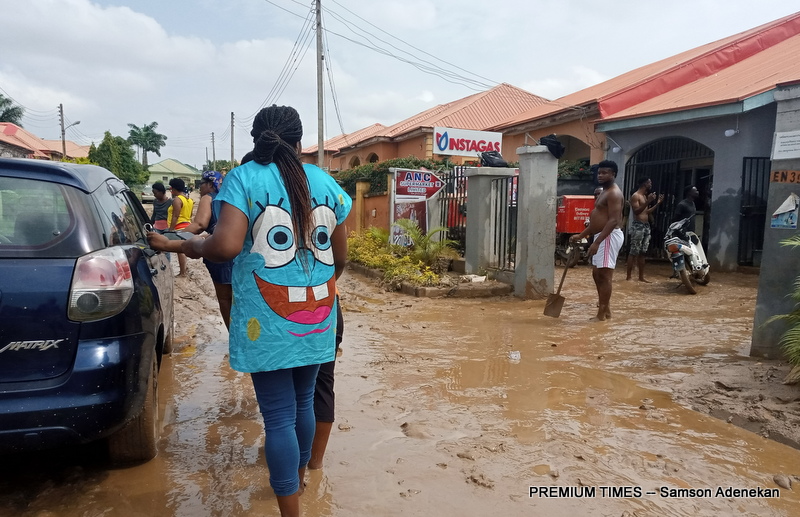
Our good wishes to our fellow citizens at Trademore Estate in Lugbe, Abuja, for the lives and properties lost as a result of the heavy downpour late Sunday. These things are happening more often these days across the nation. Walk around the Bar Beach area in Victoria Island, Lagos,  and look at those abandoned buildings in the supposedly  most expensive zip code in West Africa. You will pity the owners: they have washed hands and prepared the nuts for the fowls!

Nigerian civil engineers: it is time to work with the government to enforce the law. Adding an additional building to block drainage risks everyone! Government: permits must not be issued without looking at the drainage system.

People, things need to work in Nigeria. Not everything must be the fault of Aso Rock or state capitals. I saw an estate in Owerri built with largely no drainage. The hope remains that bad things will not happen. Unfortunately, the cases are ramping up.

Stay strong Trademore Estate; may it be the last.

No fewer than 74 houses were heavily affected by the flood that ravaged Trademore Estate, one of the largest privately-owned estates in Abuja.

The flood, caused by a heavy downpour which started late Sunday, was confirmed to PREMIUM TIMES by residents as the worst disaster that has ever happened in the estate in over nine years.

Already, three persons have been confirmed dead while search for more bodies is ongoing..

Aside from the destroyed buildings and cars worth millions of naira, a number of shops and businesses along the Phase 3 areas of the estate recorded huge losses that are beyond redemption..

This is one mistake many Nigerian merchants make

2

This is one mistake many Nigerian merchants make: convert US dollar-based pricing and ask customers to pay the Naira equivalent. The thinking is like this: if your product goes for N50,000 or $140 when the US dollar is exchanged at N400/$, if the exchange moves to N500/$, you have to go and increase that N50,000. That is wrong.

That confusion is why I get this type of inmails: “On your advert on Tekedia  Diploma programmes, you said $100 or N36,000.00. I thought the exchange rate is now above 400 naira per dollar?”

In Tekedia Mini-MBA, we have three different pricing courses from leading experts; pricing efficiency is very important in any business.  That Naira is falling must not mean that my Nigerian customers must be asked to pay more if that fall of USD does not affect my marginal cost and broad cost of production.

More so, that Naira is losing value to USD does not mean that those earning local currency (Naira) suddenly have more Naira. So, if you have a product at say $100 or N36k when the exchange rate was N360/$, and Naira has dropped to N500/$, you cannot recklessly jack up prices unless there are clear production factors which would be affected.

So, when you see our pricing, it is not a typo. Microsoft does that all the time.  It costs me $99 per year on my personal Microsoft 365; some vendors can sell you for less than N7,000 ($15) in some African countries because it is easier to make $99 than make N7,000 ($15) say in Nigeria. If Microsoft translates that without considering purchasing power parity, it will miss its customer base.

Sure – that does not mean you cannot increase the price as currency erodes value. But it has to be done not just because some speculators are at work!