DD
MM
YYYY

PAGES

DD
MM
YYYY

spot_img

PAGES

Home Blog Page 5551

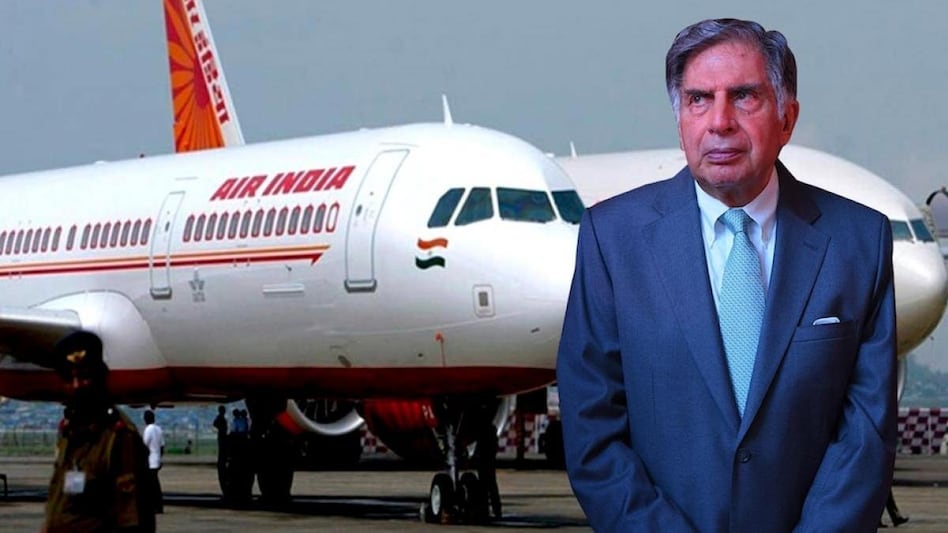
Tata Group Acquires Air India

0

The Indian government has sold its national carrier, Air India, to the Tata Group, ending the long-wait for the divestment of the loss-making Airline.

The bidding was awarded to the country’s biggest conglomerate as the highest bidder at about $2.4bn. The deal includes a 100% stake in Air India and a low-fare unit in Air India Express as well as a 50% holding in ground-handling company AISATS.

“Talace Pvt Ltd won the bid to own 100% of government stake in Air India,” Tuhin Kant Pandey, secretary, Department of Investment and Public Asset Management (DIPAM) announced today.”

“Bidders have agreed to all terms and conditions. Five bidders were disqualified as they did not meet the criterion,” the Dipam Secy said. “The process was carried out in a transparent manner with due regard to confidentiality of bidders.

Air India has many assets, including prized slots at London’s Heathrow airport, a fleet of more than 130 planes and thousands of trained pilots and crew. Under the takeover deal, Tata Group will retain all AI employees for one year, and can offer VRS in the 2nd year, as per the Aviation Ministry.

Group of ministers known as the Air India Specific Alternative Mechanism, headed by home minister Amit Shah and included finance minister Nirmala Sitharaman, commerce minister Piyush Goyal and aviation minister Jyotiraditya Scindia, approved the bid winner.

The Tata group originally founded the airline in 1932 before it was taken over by the government in 1953. The government has failed to make the national carrier profitable, and overtime, it has racked up losses worth $9.5bn, leaving it with no option than to sell the airline.

The success of the takeover by Tata is a big boost to Prime Minister Narendra Modi’s government reforms, as the previous attempt to sell 75% of the airline in 2018 failed.

The deal was brokered after the government made it more attractive by simplifying the debt terms for buyers. The reserve price was fixed at Rs 12,906 crore, and the winning bidder will take Rs 15,300 crore debt, according to EconomicTimes. Bids for the carrier were sought at an enterprise value. Under the formula, a minimum 15% was to go to the government and the rest will be used to reduce existing debt.

Analysts say that Air India would bring in benefits for the Tatas, if the group plays it right.

“Air India has come full circle, back into the arms of its founders, the Tatas. Bold, brave move but will it be bountiful for the new owners? If they play it right, take advantage of the vacuum presented by a post-Covid landscape, they can carve a new future for the national airline,” said Shukor Yusof, founder of Endau Analytics, a Kuala Lumpur based consultant.

“India’s got a lot going for aviation – a rising middle class, likely growth in travel & tourism domestic & from abroad & it sits between the Gulf & Southeast Asia, an area of vast potential for air travel. Finally it fits nicely into (PM) Modi’s privatisation plans. Of course there will be lots of challenges, including riding fuel costs, intense competition from LCCs & if Tata has the staying power to manage heavy losses during the initial takeoff period,” he added.

Analysts believe Air India remains attractive due to profitable infrastructure at its disposal and passenger growth of around 20% per year.

BBC noted that in addition to its fleet of over 130 aircraft, Tata will now have control of the following: Airline’s 4,400 domestic and 1,800 international landing and parking slots at domestic airports, as well as 900 slots at airports overseas.

Air India also owns millions of dollars worth of prime real estate. According to the aviation ministry, its fixed assets – land, buildings, planes – in March last year were worth more than 450bn rupees ($6bn).

The airline also has more than 40,000 pieces of art and collectibles, including an ashtray designed and gifted by Spanish surrealist artist Salvador Dali. In return the airline had given Dali a baby elephant, which was flown to Spain.
The Lonely Industrialist – Why Aliko Dangote Needs Help From Modern Entrepreneurs

5

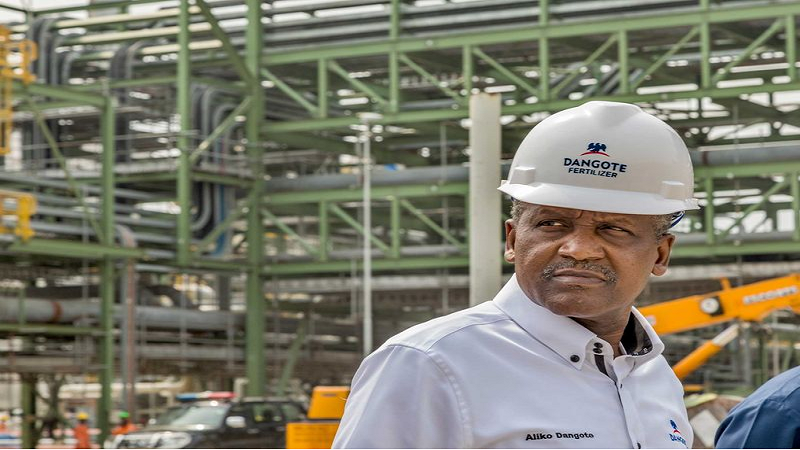
Extremely tough comments on the piece where I noted that Dangote Cement paid the most tax in Nigeria. People, Aliko Dangote is not the only connected big man in Nigeria. He is not the only one the government has supported. BUT he is the most successful in making products people like. Dangote’s biggest connection and support is that NIGERIANS like his products. Period! Governments do not force us to buy his products even when we have options and choices.

Dangote Capital lost $millions and folded because others were better there. Liberty Merchant Bank, his bank, wasted $millions and collapsed because Oba, Ovia, Elumelu, etc were better. Dangote Noodles burnt $millions and later was sold to Indomie noodles when it could not sell because Nigerians preferred Indomie. 

But Nigerians want me to believe that when he wins, it is because of the government. Sure, he taxes Nigeria as conglomerates do, but do not diminish his generation’s finest businessman, on the premise that he wins because of the government, and not that customers like his products.

As an entrepreneur, I am working hard to join Dangote so that he is not lonely there. Yes, you can have a new person to attack. My desire is that by 2023, Tekedia Capital will have at least two unicorns (one is likely next year). If that happens, very soon, governments will come and ask:  “Ndubuisi, we want you to fix Aba drainage, what are your terms?” Then, I will open this playbook:  Conglomerate Tax

That will help Dangote (diverting attention from him)  a lot as many will then say: see, the government gave him all the best drainages on the terms which it could not give me. Nigerians, time to work and build. No one keeps wealth for decades unless customers FUND him.

Dangote Conglomerate Taxes

Checking Nigeria’s Unemployment Issues Via Tech Measures

0

The existence of joblessness or unemployment in Nigeria has eaten deep into the country’s bone marrow, that Nigerians as a people have endlessly lived to see it as a monster that has come to devour the human race in its entirety.

The dangers inherent in joblessness are so conspicuous and frightening in such a way that everyone has become very conscious of its presence, hence invariably making tremendous effort to avert the menace.

In spite of the frantic and tireless steps usually taken by the teeming citizens and successive governments to ensure they aren’t trapped in the pothole cruelly dug by unemployment, they still overtime encounter its ruthless scourge, apparently signifying that their effort isn’t good enough or that something is really wrong somewhere.

However, my last visit to one of the West African countries lately made me understand that Nigeria isn’t exceptional while discussing unemployment or that the term is not peculiar to the acclaimed giant of Africa.

But, it seems the degree at which it parades its tentacles and elbows in Nigeria is so enormous that the country is ostensibly taking the lead in the comity of nations. This is the sole reason many are deeply concerned and bothered over the anomaly, hence the need for drastic measures towards cushioning the excruciating effects.

It’s noteworthy that unemployment is not a personal plight but a general one, thus the essence of a societal approach in a bid to tackle it. This is why countless schools of thought have overtime shown great concern over the lingering nature of the cankerworm as well as aired their views on how best to tackle it.

Though unemployment isn’t a convincing excuse to indulge in any crime, hence no discerning mind encourages people to resort to it, it’s worth noting that its scourge remains one of the prime reasons all sorts of criminal activities have escalated in recent times.

Another disturbing occurrence that’s apropos of unemployment is the employability status of our present days’ graduates. It’s not anymore news that most of these youths are obviously unemployable, thus posing a threat to the labour market and their chances of being meaningfully employed.

The plight as stated in the above paragraph is mainly attributable to lack of adequate knowledge as acquired from their respective institutions of learning, or inability of our various undergraduates to stick to the needful while on campus.

Taking a painstaking study of all these issues, it’s needless to assert that the ongoing unemployment crisis in Nigeria is not unconnected with dilapidated learning environment cum facilities, decline in the country’s value system, and insufficient employers of labour, among others.

Though nepotism is highly condemnable and unacceptable, those who attribute unemployment to it might be making a big mistake because if there are sufficient firms or employment opportunities, such a practice like favouritism or what have you would hardly be detected by anyone.

Before now, or in the olden days, Nigerians were gainfully engaged with various works simply because the jobs were readily available and the population was conspicuously far lesser than what we could witness now.

But with the growing lack of sustainability of various government-owned establishments coupled with the astronomical growth of the country’s population, the job spaces abruptly became overwhelmed by the number of people in the labour market.

A lot has really gone wrong in the system, but the good news is that, we can once again get it right if the needful is done by the relevant authorities. This can only be actualized by revisiting the drawing board.

It would be very wonderful for the government to comprehend that the endless unemployment issues can aptly be addressed by truly embracing tech-driven measures. It’s worthy of note that only technological approach could significantly alleviate all crises that are apropos unemployment.

First, we need to revamp the country’s education sector. The current educational system of the Nigerian society has really deteriorated that an urgent, candid and apt measure is required towards its revitalization.

We must be ready to train our young ones with a view to becoming self-reliant in their respective abilities. Since the population is growing by the day and the firms aren’t increasing meaningfully, there’s a compelling need to prepare these Nigerians so they could emerge as entrepreneurs or employers of labour rather than seekers.

Our various technical colleges, which have apparently gone into moribund, must be revived in earnest to keep the ground running. Those days, graduates of these institutions – even without proceeding to a higher level of learning – could stand on their own as well as comfortably raise wonderful families with their earnings.

The governments at all levels ought to endeavour to equip the various tertiary schools in their respective jurisdictions, so that, the graduates can defend themselves in any setting and equally start up something meaningful without ‘giraffing’ for the availability of any form of white-collar job as it is currently the case.

In view of the above, the schools’ authorities must strengthen the value of the ongoing Students Industrial Work Experience Scheme (SIWES), which was primarily set up by the government to aid the technical upbringing of the learners irrespective of their disciplines.

Hence, it’s high time the Industrial Training Fund (ITF), the body imbued with the powers to service the SIWES and sustain its viability, started doing the needful. The authority must endeavour to face priorities squarely at the expense of frivolities, as I rightly mentioned in my previous works.

They must deploy a functional mechanism that would ensure thorough monitoring of the industrial trainees from time-to-time as long as the training lasts. This proposed task mustn’t be shortchanged for any reason whatsoever if we truly want the SIWES to be result-oriented.

Our engineering graduates, just as it’s being observed in the medical and law fields, ought to be mandated to undergo a compulsory one-year national programme strictly on further industrial workshop training. This should serve as a prerequisite to the ongoing National Youth Service.

Inter alia, the governments need to provide an enabling environment to enable all tech-driven talents to thrive as well as ensure that the available patents of the numerous institutions domiciled in their jurisdictions are duly commercialized. Research works in any quarter must also be given due attention since technology is strictly dependent on research.

Conclusively, it would be sacrilegious to beat about the bush while discussing tech-driven matters, because technology is all about facts. Hence, the government needs to acknowledge that the suggested measures can never yield significant and tangible results if we continue to relegate the power supply issue to the background.

We must understand that only uninterruptible electricity can encourage entrepreneurship to a great extent as desired by the people. Therefore, this technological factor requires the highest sincere attention.

This critique is targeted to express that Nigeria as a people can only aptly address unemployment-related cases if technological measures are duly deployed, hence the need not to shortchange realities.

The Lessons from Top 10 Nigerian Companies By Tax Payment

1

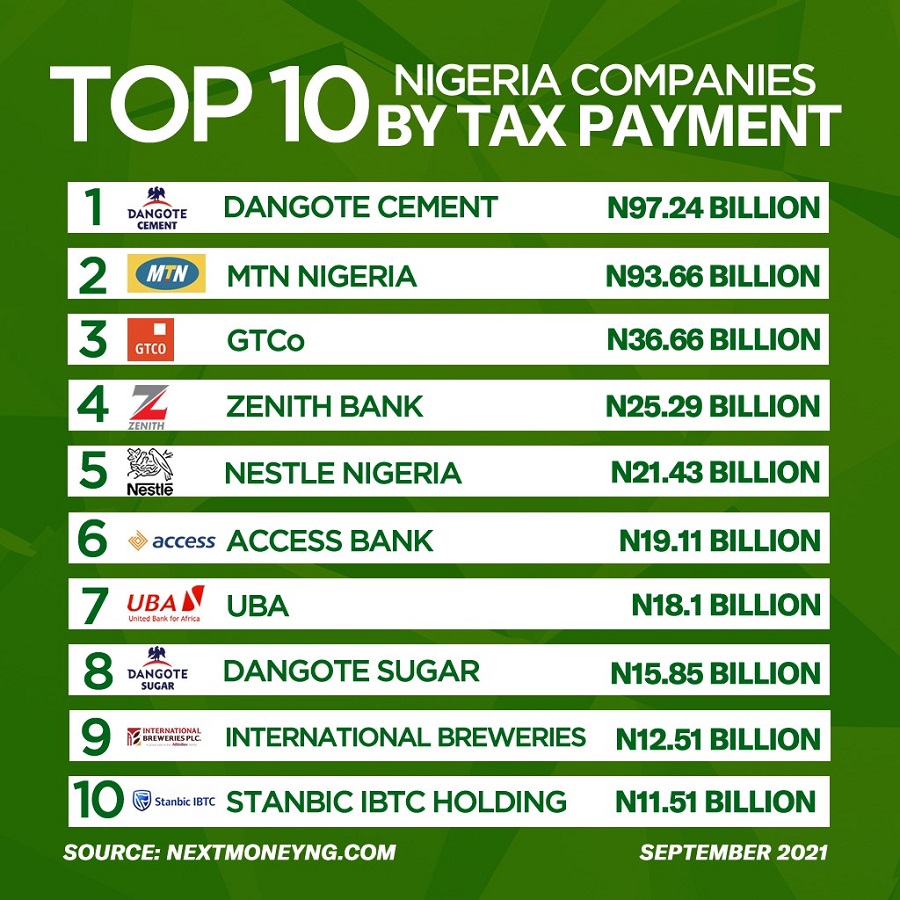
Imagine if, as Aliko Dangote was evolving from a mere trader to a Chairman of an industrialized conglomerate, that nine other people joined him. He picked cement; we still have electricity opportunities available. He picked sugar, we still have clean water yet to be fixed. In the Igbo nation, it takes the killing of one tiger to be called the killer of tigers! Look at the chart below, Nigerians should appreciate what it means to have big companies. We need to grow many Dangotes in other sectors.

And most importantly, if you look at what I am seeing there, excluding Dangote companies, MTN, and Nestle, and perhaps IB, all the companies there came out of the first cambrian moment of Nigerian entrepreneurial boost of the early 1990s. 

You can understand why Nigeria should be worried that most of our leading tech companies including fintechs are incorporated in America. Had GTBank*, Access, modern UBA, etc followed that trajectory, this chart would not be possible. Someone needs to lead to secure Nigeria’s future. 


I picked this from Nairametrics where it is possibly promoted by Dangote Cement. I am reposting it here as it is newsworthy. No one paid Tekedia anything please.

The press release

Dangote Cement Plc has emerged as the highest corporate income taxpayer and biggest employer of labour in the country for the year 2020.

The foremost indigenous cement manufacturer came first among top 100 elite companies listed on the Nigeria Exchange (NGX) posting into the coffer of the federal government a princely sum of N97.24billion in the year, while MTN Communication Nigeria Plc paid N93.6billion and Guaranty Trust Bank came third with an income tax of N36.66billion.

In the same breath, the Cement company with presence in other African countries also emerged as the company with the highest number of employees with a total number of 16,199 staffers on its payroll as at the time of performance review.

In the performance analyses of 100 top elite corporate bodies on the Nigeria Exchange carried out by the reputable business magazine, “Next Money”, Dangote Cement was ranked as the most capitalized company in the country with N4,173.22billion.

Speaking on the analysis, publisher of Next Money, Mr. Ray Echebiri said the performance index analysis of companies listed on the Exchange was carried out with a view to establishing the best-performing ones among the over 150 of them.

Echebiri, a renowned financial analyst, explained that the exercise is to provide existing and potential investors with information that they can rely on when they are taking investment decisions. “The first step we take in the analyses is to extract the Total Assets of each of the listed companies from their audited accounts.”

He said: “We sorted the total assets of the companies from the largest to the smallest and cut off at the 100th. We tagged the hundred companies that emerged from this exercise “Nigeria’s Top 100 Companies”. Any company that makes it to the corporate elite club of Nigeria’s Top 100 Companies is automatically a candidate for further ranking by Revenues, Profits, Market Capitalization, Number of Employees and Tax Payment.”

According to him, the rankings show how the listed companies stand on the corporate ladder with regard to the various performance indices. This edition of Nigeria’s Top 100 Companies covers the 2020 accounting year. It is therefore, a performance analyses of companies listed on the Nigerian Exchange (NGX) based on their audited accounts for the 2020 reporting year.”

“In other words, the information used in the analyses are extracted from the annual reports and accounts of the various companies published in 2020 irrespective of whether a company’s year-end is March, June, September, December, or any other month in 2020.”

Echebiri further pointed out that the analyses were restricted to publicly-held companies in the country and the reason being that the accounts of listed companies are easier to access than those of private companies. “Moreover, accounts of publicly-held companies are more believable because they are usually subjected to regulatory scrutiny and approval.”

He explained that his group had no doubt that there are many private companies that would easily count among the top 100 companies in the country given their huge balance sheet size, the sizeable revenue they post yearly and the mouth-watering profits they declare. However, he added that they were not a part of the performance review and analyses because their audited accounts do not go through the kind of regulatory examination and approval that the listed companies face and, are, therefore not as believable as those of the publicly-held companies.

The construction giant, Julius Berger trailed Dangote Cement as the highest employer of labour, albeit far behind, with staff strength of 12,217 and the United Bank for Africa Plc which had a total of 10,824 people on its payroll.

The analysis indicated that while Dangote cement with a market capitalization of N4,173.22 billion beat the rest of the companies listed on the NGX to emerge as the company with the largest capitalization, MTN Communications Nigeria Plc and Bua Cement Plc. as at December 31, 2020, followed as the second and third respectively with market capitalization of N3,458.23 billion and N2,619.41.

Dangote Cement paid the highest corporate income tax during the year under and was followed closely by MTN Communications Nigeria Plc which paid corporate income tax of N93.66 billion and Guaranty Trust Bank placed third with corporate income tax payment of N36.66 billion.

COVID-19 Exclusion: UK exempts fully vaccinated Nigerian travelers

0

I commend the good people of the United Kingdom for doing the honourable thing and Nigerians appreciate it. Yes, the United Kingdom has announced that fully vaccinated travelers from Nigeria to the UK will not need to take protocols reserved for unvaccinated people, with effect from Monday, October 11.

As this debate moved on, I was surprised that many Nigerians justified the ban on the thesis that people fake vaccine records. For me, that is nonsense. That you cheated in an exam does not mean that my grade is not valid since I did not cheat. So, if educated people on LinkedIn and Facebook want the lowest denominator to define a people we have a problem.

People, vaccinate and you are FREE to travel and do business. Represent Naija very well.

UK Excluding Nigeria from List of Countries with Vaccine Certificate is Discriminatory