DD
MM
YYYY

PAGES

DD
MM
YYYY

spot_img

PAGES

Home Blog Page 5551

Facebook Outage: The Cause and the Implication

0
Facebook founder and properties

Facebook and its subsidiary apps – Instagram, WhatsApp and Messenger are gradually returning back online after a six hour outage that kept billions of users out of services.

The social media behemoth went offline on Monday in what happens to be its worst outage since 2008, stirring up theories about  what might have happened.

The popular opinion on the outage has been a problem with DNS (domain name system), which converts human-readable web addresses into machine-readable IP addresses to find where a web page is located on the internet. John Cumming, CTO at Cloudflare, a networking firm said it could be BGP (border gateway protocol), the system that networks use to figure out the fastest way to send data over the internet to another network.

Facebook did not immediately offer an explanation to what happened, but apologized to users in a statement, saying the company is working to restore services.

“To the huge community of people and businesses around the world who depend on us, we’re sorry,” the social media platform said.

Following the outage, which has been exacerbated by the social media giant’s antitrust concerns, Facebook shares dropped 5%, wiping $6 billion off its  value.

However, putting the theories to rest, Facebook offered explanation shortly after services were restored, while admitting that the underlying cause of the outage impacted many of the internal tools and systems used in day-to-day operations.

“Our engineering teams have learned that configuration changes on the backbone routers that coordinate network traffic between our data centers caused issues that interrupted this communication.

“This disruption to network traffic had a cascading effect on the way our data centers communicate, bringing our services to a halt,” Facebook said in a statement.

Consequently, the development, which coincided with the notorious Facebook data leak, has fuelled calls for social media companies to be held to account over what they allow users to post on their platforms. The outage occurred around the same time a whistleblower released tens of thousands of pages of internal research documents, indicating that Facebook knows its platforms are used to spread hate, violence and misinformation, and that the company has tried to hide that evidence.

Two members of the European parliament have called for an investigation into the allegations that Facebook prioritized profits above the public good.

Alexandra Geese, a German lawmaker at the European parliament and Danish lawmaker Christel Schaldemose, the lead rapporteur for the European Commission’s Digital Services Act, are calling for further investigation.

“The Facebook Files – and the revelations that the whistleblower has presented to us – underscores just how important it is that we do not let the large tech companies regulate themselves,” said Christel Schaldemose.

The whistleblower, Frances Haugen, who happened to be a former Facebook product manager, is due to testify before a Senate hearing today. She is pushing for regulation to contain the excesses of Facebook, a line the European lawmakers have jumped on.

“The documents finally put all the facts on the table to allow us to adopt a stronger Digital Services Act,” Alexandra Geese said.

“We need to regulate the whole system and the business model that favors disinformation and violence over factual content – and enables its rapid dissemination,” she added.

The European Union has been pushing for a tighter regulation of the big tech, as a way of protecting users from harm. Facebook, Google, Apple, Amazon and Microsoft have all been caught in the web of European regulators, who have been amending their regulatory laws to address emerging concerns.

The data leak and service outage are putting Facebook up for further scrutiny. The outcome of the Senate hearing today will play a big role in what other governments around do about to address the concerns emanating from the data leak.

The Downtime of Facebook Empire and Sustainability of Communicating in Time of New Technology

0

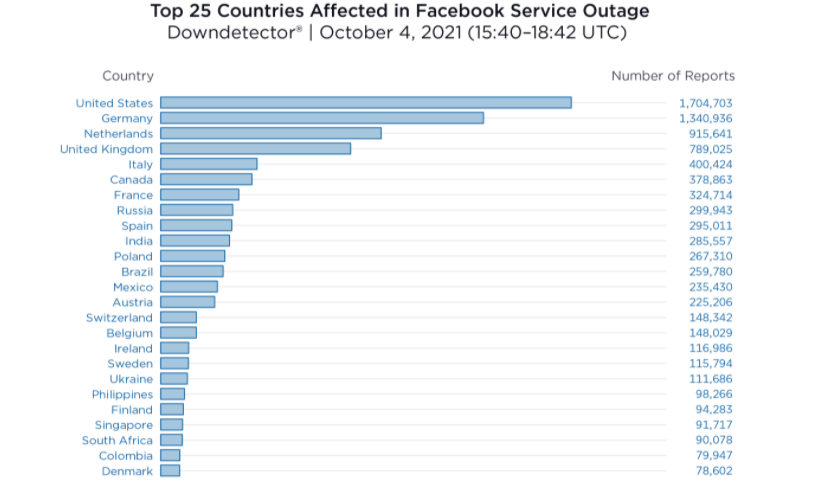
On October 4, 2021, Facebook, WhatsApp and Instagram experienced downtime, leading to total disruption of business and interpersonal communications across the world. Report has it that the sites were down at exactly 11:30am. Downdetector, an organisation which tracks downtime of new technologies, describes the Facebook outage as the largest ever seen its platform with over 14 million problem reports submitted across the world.

Our examination of the public interest and fear about the site and others shows that the world interest in knowing the downtime and its impacts throughout the world was at a slow pace between 08:04pm and 16:28pm before picking some seconds and minutes after. The trend continued till 23:48 before declining 07:56 on October 5, 2021, the time which shows the possible return of the sites after several hours of working on bringing them to the previous functional position.

Our analyst reports that the late interest in seeking information about the downtime of all the social networking sites could be linked with the fact that majority of the users were aware of the downtime late. According to our analyst, the downtime period, which is in the morning and fell within the working time belts for most people could also be considered as a significant factor in seeking information about the outage of the sites.

Exhibit 1: Countries with the Number of Reports during the Downtime

Source: Downdetector, 2021

During the jittery period, it is obvious that the world wanted to know the downtime of Facebook in relation to WhatsApp, Facebook downtime in connection with understanding Instagram and WhatsApp in line with Instagram. Ninety-eight percent of the world interest in WhatsApp could be discerned from the interest in Instagram. This is closely followed by Facebook, which accounted for 97.3% in Instagram. More than 93% of the interest in Facebook could be determined from the interest in WhatsApp.

In Nigeria, interest in these sites was high to the extent that it was the top search of the day. This is really surprising to our analyst, who have been tracking what Nigerians and other nationals in the country are searching daily since January 2021. Any of the most used social networking sites has never made it to the top five of the most areas of interests being considered in the data collection procedure.

Having Interest in Why Facebook Downtime Doesn’t Mean Submitting Reports

In terms of number of users of Facebook, WhatsApp and Instagram, there are mixed statistics on the countries with the highest number of people deploying the sites for personal and business purposes. According to a July 2021 report, India is the leading country in terms of Facebook use based on its over 340 million people using the site. The United States, Indonesia and Brazil have over 200 million, 140 million and 130 million users respectively, making them followers of India. For Instagram, India still occupies the leading position while the United States follows, Brazil and Indonesia.

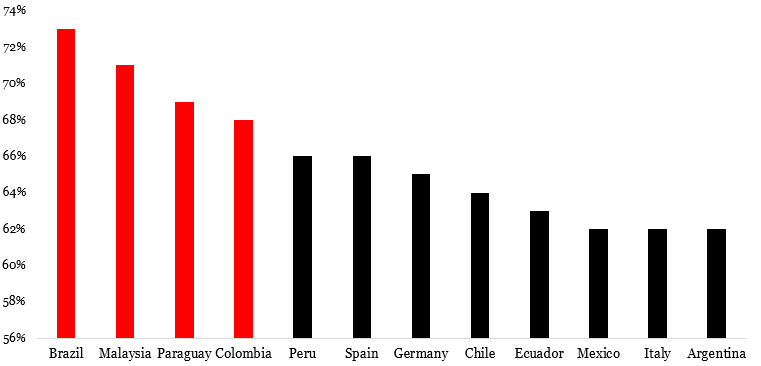
Existing statistics on the number of users of WhatsApp looks complex. This is hinged on the fact that producers of the statistics adopted a share of total internet users against the number of the site users and also considered the site market share alone. For instance, based on July 2021 statistics, Kenya, South Africa, Nigeria, Argentina, Malaysia, Colombia, Brazil, Turkey, Spain and Indonesia are the top countries with the number of WhatsApp users based on the share of total internet users. Surprisingly, people in Brazil, Malaysia and Colombia only developed significant interest in understanding WhatsApp downtime.

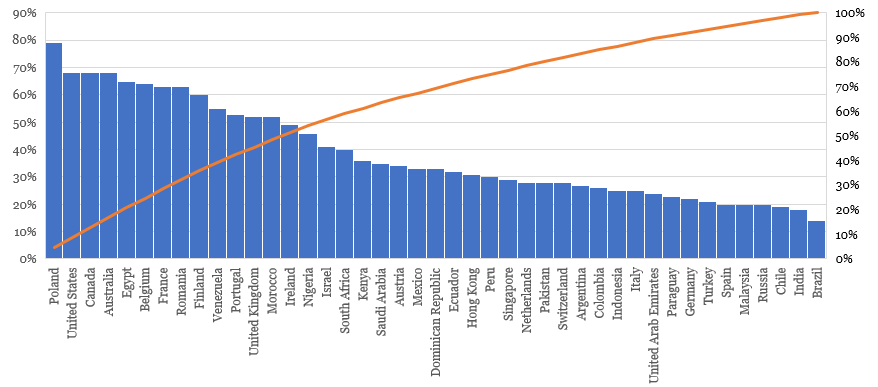
Exhibit 2: Countries with Highest Percentage of Interest in Facebook during the Downtime

Source: Google Trends, 2021; Infoprations Analysis, 2021

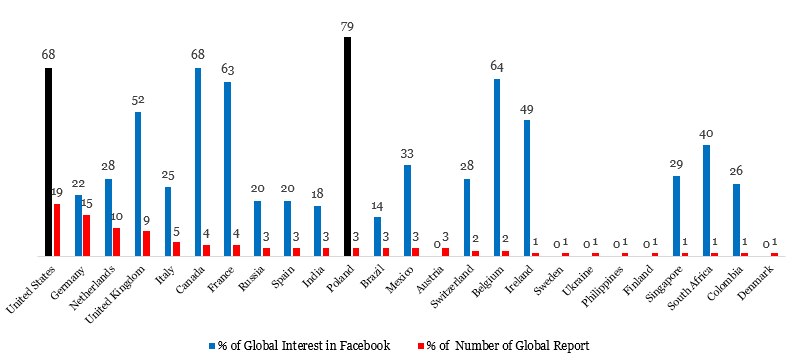
Top 25 affected countries [see Exhibit 1] submitted a total of 8,896,273 problem reports. Analysis shows that the interest of people in these countries in Facebook downtime connected with the number of reports submitted by 33.7%. This suggests that when people in the United States of America and others [see Exhibit 3] developed 1% interest in understanding the downtime of the social networking site, the percentage translates to 33.7% of submitting problem reports to Downdetector.

However, our analysis only establishes 11.4% of actual submission of problem reports to Downdetector. With this, our analyst notes that people in the top 25 affected countries, where problem reports were submitted, might have explored other means of understanding the site downtime not only the Google Search Engine, which normalised the world interest in the site during the downtime.

Exhibit 3: Countries with Interest in Facebook during downtime and number of problem reports submitted [in percentage]

Source: Downdetector, 2021; Google Trends, 2021; Infoprations Analysis, 2021

Exhibit 4: Countries with Highest Percentage of Interest in WhatsApp during the Downtime Period

Source: Google Trends, 2021; Infoprations Analysis, 2021

Is the World Moving Towards Possible Global Technology Lockdown?

This month downtime is not the first time the social networking sites are not functioning as expected. There are several reports that establish micro hitches while using the sites. To our analyst, the recent lockdown occasioned by the spread of Covid-19 further indicates that the world cannot survive without technologies. The first wave of the virus forced a number of people to use new technologies and technology-driven devices they hardly use before the pandemic. Indeed, the ongoing pandemic is changing how people and businesses use technologies.

While the emerging issues and needs are pointing towards the need to consider and prioritise certain technologies for personal and business use, the big question remains their present use without jeopardising the chance of using them in the future. In every concept, sustainability remains the key element of the concept to the survival of the system where it is being applied. This is also applicable to every object being considered or used for personal, business and societal growth.

No doubt, the world without technologies would be difficult for people and businesses to be. This is the main reason the world needs tech-companies that can create and deliver sustainable value. This is not sufficient. They also need to ensure protection of every user’s data because our checks reveal that some people believe that the downtime is an artificial one with the intent of stealing users’ data.

Scheduling Tekedia Mini-MBA Growth Hour for Corporate Members/Groups

0

 Dear Member,

(Please talk to others in your company/group as we need one session per group or company.)

Tekedia Institute is scheduling Tekedia Growth Hour where we have conversations with group or corporate participants at Tekedia Mini-MBA edition 6. This meeting is essentially to discuss at more specific levels the mechanics of business systems as they relate with business innovation and growth, in your company and sector. We do batch this throughout the program and we have opened a link for your batch.

Go to this link [check your email] and select a time slot for your company – one slot only as we will meet all the members at once.

Once you do that, on the day and time, each member should visit this Zoom link [check your email] (If you have other alternatives like Microsoft Teams, please send and we will use it).

Please note that besides your members currently attending Tekedia Mini-MBA, you are free to bring other staff, associates, clients and partners of the company to this meeting.

Our Lead Faculty, Prof Ndubuisi Ekekwe, personally coordinates this. His vision is that through these specific conversations, we can point out areas of growth and opportunities in the business, using some frameworks discussed in our school.

If you have any questions, let me know.

Regards,

Tekedia Team

Is Your Business Ready for Growth? How Do You Know?

0

From Nkechi Oguchi: “The Pursuit of Growth: I recently started taking a course on the growth playbook by Ndubuisi Ekekwe at Tekedia Institute. I would share snippets of things I find interesting in class during the course of the program. You may find it useful.

One thing that has kept resonating with me is that you cannot scale a faulty business model. Even if you managed to raise millions of dollars and open in more locations, all you would have done is to take a problem and made it exponential. This is why businesses go through a validation phase. During validation you test your assumptions and ascertain the viability of your business model. It should be seen as an experiment. Everything does not need to be perfect, but the pieces should be coming together, this would be evident by traction.”

Good People, that is it. Until you can retain customers, the growth phase must wait. From Mocality to Kalahari, from old Konga to OLX, money will not fix a bad business model. INVEST time in your business model and develop a great playbook.

Source: LinkedIn

After Konga, Naspers Closes OLX Nigeria

Migrating From Crude To Mechanized System In Nigeria

0

A system that’s crude is ancient, simple, outdated and unsophisticated. Among all, the most unique feature that’s embedded in a crude system is attributed to its ancient and outdated nature.

Ancient, in the sense that, its emergence in the world could be traced to the making or creativity of the ancestors; outdated, meaning literally that its existence on earth is no longer in vogue or has been overtaken by events.

If a certain ongoing pattern, method or style – as might be the case – is truly ancient, then it’s high time it is dropped or jettisoned, because its progenitors wouldn’t be happy that their offspring haven’t been able to introduce another pattern into the system.

For instance, if I succeeded in inventing a certain system of life into a clime I belong to, I would strongly wish and pray that someday in the future my children or any of them would create another system.

In other words, every discerning mind seriously prays for succession because it is one of the basic features of progress. An individual or entity can only boast of progression when a new thing belonging to them emerges at intervals to their delight.

It’s appalling – and pathetic too – when realized that in Nigeria today, most individuals or groups still depend on crude ways of doing things in a century that has boldly and proudly welcomed a modern pattern of living or operation.

It becomes more disturbing and disheartening when observed that most people who address themselves as ‘professionals’ still make use of this crude pattern that ordinarily ought to have been eroded by the emergence of the ‘digital age’.

It’s noteworthy that the modern/digital age is synonymous with technology. Hence, for anyone to be fully part of the contemporary society, he/she must integrate him/herself into the tech world.

Individually or as a group, we must be ready to duly embrace this modern system of living in our respective fields of endeavour. We mustn’t continue to dwell in a retrogressive approach while addressing any plight that arises.

Nigeria as a country, in various areas of her economy, these crude measures are invariably deployed. On a daily basis, most sectors within the shores of the country suffer great neglect or ineptitude as a result of inability of the concerned authorities to imbibe modern methodology.

In the mining sector, for example, several solid minerals such as gemstones, metals and what have you, are abundant in different quarters of the Nigerian State. But most times, these minerals are still being dug from the earth crust via the use of crude techniques.

Also, owing to lack of mechanized techniques, whenever the minerals are acquired from the ground, they would be exported to the foreign nations as raw materials because they can’t be readily processed here. In the long run, the citizens would end up purchasing foreign-made products that ordinarily, should have been produced in the country. Such a practice is a shame, to assert the least, hence calls for a due review from the relevant bodies.

Even the oil and gas sector, where the country currently relies on, is experiencing such colossal neglect. The citizenry consistently purchases fuel and allied products, which were processed overseas, because the country lacks the required mechanized system known as refinery to carry out the processing as soon as they are drilled.

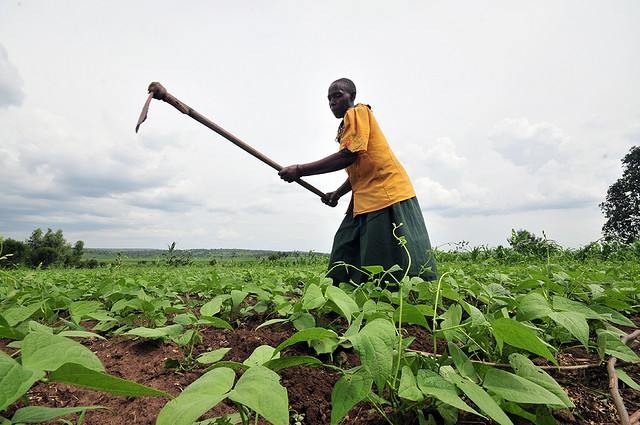
The agricultural sector isn’t left out. The country’s farmers, particularly the commercial ones, still participate in farming via crude patterns. The four major segments in the agric wing, namely, cultivation, harvest, processing and storage, are yet to be fully carried out with the aid of a mechanized system.

A particular farm produce, when aptly processed, could provide a variety of foods in the markets or on the table. It’s worth noting that many of the products possess this fantastic quality. But, regrettably, it’s often being exported as a single commodity, thereby causing the country to lose several millions of naira on a regular basis.

Nigeria’s education and health sectors are also suffering from this plight or phenomenon. The old ways of teaching or impaction of knowledge are still being deployed in the various citadels of learning therein. That’s the reason most of the students are still, or still finding it difficult, to key into the Information Technology (IT) world.

In most hospitals or health centres across the federation, outdated instruments cum laboratory equipment still dominate the arena, hence making it impossible for the practitioners to perform their duties effectively and efficiently as required.

What about the country’s public service system? It’s indeed saddening that a sector of this kind, that’s densely characterized with highly learned individuals, is still dwelling in the past. Just a peep into the said domain would make you gush fathomless tears.

The list is obviously endless as regards the sectors that still adore the crude pattern of operation within the shores of the country. This is why the governments must act fast and genuinely if they are truly ready to get it right or move in the more deserved direction.

Though the choice is theirs, they must comprehend that as long as this custom lingers, they will continue to deprive themselves of a milestone that’s liable to positively turn the country’s economy around in its entirety. This is the reason actions are required to be expedited without further ado.

The situation has conspicuously gone out of hand that a stringent measure is needed towards addressing it headlong. The deplorable state of Nigeria’s various institutions and sectors, due to the continual use of crude pattern, is seriously in need of a candid and strict approach if she must progress headlong.

It’s high time the existing orientation is changed by facing the realities of the day squarely at all cost. The leaders need to unequivocally challenge themselves by understanding that technology has come to stay, hence ought to be seen as the only pattern in vogue.

They must key into the most reigning and acceptable methods by jettisoning the ones that are obsolete, or have been overtaken by events, by throwing them into the waste bin where they rightly belong. This is the only and best way the country can forge ahead for the good of all.

There should be strong legislation regarding this clarion call. There’s need for a comprehensive legislative backing with a view to fully embracing tech-driven policies and measures in most of the country’s public sectors. This will surely go a long way in tackling the menace.

It’s even amusing, and shocking too, to realize that the country’s legislative chambers still deliberate their plenaries with the aid of mere crude methodology. It’s painful to acknowledge that, at the moment, the institutions that are constitutionally imbued with the powers to come up with the required legal backing as proposed above are yet to embrace modern techniques or mechanized pattern. It’s really astonishing, to say the least.

We can only end this glaring self-deceit by understanding that the benefits inherent in any technologically-approach system are unquantifiable, thus cannot be overemphasized. It enables work to be done so easily and swiftly, thereby saving time, energy, cost, and what have you.

In different quarters, it has been reliably proven that systems that are tech-driven or mechanized often boast of greater efficiency in performance, productivity strength, and output, among others. More so, it has been observed to be result-oriented when compared to the crude ones.

Even though you would spend more funds to acquire – or migrate to – a mechanized system, the interesting truth remains that in the long run, you stand to make several more millions of the money invested. This is a fact we must embrace in earnest.

Isn’t it time we make our ancestors proud by letting them comprehend that we are really progressing, since progress remains their only prayers for us?