DD
MM
YYYY

PAGES

DD
MM
YYYY

spot_img

PAGES

Home Blog Page 5664

The Obi Cubana’s Carnival and Nigeria’s Acres of Diamonds

15

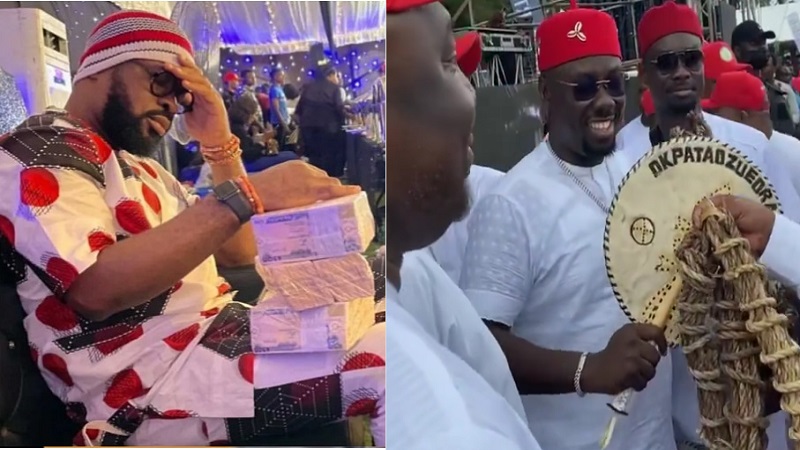
More than 400 donated cows.  $100,000 diamond pendant. 24-karat gold sunglasses by the House of Lunettes. Close to 70 private jets. Hundreds of the most expensive luxury cars.  Wines costing N3.5 million served. A burial so affluent that the host quipped: the burial “would make people crave death with relish”.  Obi Cubana’s mother’s burial has dominated the social-sphere of Nigeria.

He turned his village into an arena of the socialites, eclipsing another burial where a former bank CEO brought former presidents, bank executives, past and present central bank governors, etc for his mother’s burial. But those could not compete with a carnival which attracted Davido, D’banj, Kcee, and E-Money.

Why did Obi Cubana do this? Simply, that is what entertainers do. And they are not stupid. It is a business that wins on visibility and popularity. As the man who runs one of the largest nightclub chains in Nigeria, he understands that he could recruit more thousands if Cubana brand is more urbanized in the hearts of young people. And to do that, he called up his messengers, being the High Priest, and they responded.

The subjects are young people who are hypnotized by wealth. I promise you one thing: the market cap of Cubana would double in the next few months, mainly from more traffic into his clubs.

For this fanfare and carnival, it goes back to one thing: delivering alpha. I had been in a meeting where an entertainer was asking what he could do – no matter how crazy – to be in the news for 24 hours. It was in Tuskegee Alabama and I was trying to earn small money (as a student) to help a local entertainer on strategy. The wife there suggested that the man should slap her and she would call the police, and that would get all the local newspapers to cover it. But at the end, it would be captured as a mistaken incident (the wife would claim she was confused) and the next week, he would open a concert! I excused myself and left: many things are rigged in this world!

Obi needed to arrive in Nigeria – and he has done what most do to arrive in Nigeria: go through the minds of people, showcasing wealth, and become relevant at scale. Expect him endorsing politicians now! He is rumored to be worth at least $500 million with his Cubana empire estimated at excess of $2 billion, globally. In other words, he runs a business which could be valued more than most banks in Nigeria. His magic is simple: uncommon class of splendid quality in exotic clubs and hotels.

Anambra state passed an anti-money spraying in events. We will be watching if they will enforce the law because what happened in the burial was clear: there were many men whose problems are how fast they can spread money. Yes, someone in Nnewi makes a tool which helps you load cash and push a button so that spraying money will not be too much of a burden.

Same Nigeria and 99% of them live in that Nigeria: unbounded wealth. Sometimes, despite the obvious insanity of this carnival, it is good to remind people that Nigeria has acres of diamonds. Do not be tripped – all of them have built ROIs on,  and the destination is fatter bank accounts as free press has brought more brand recognition.

Obi and his group are in the same Nigeria. Yes, despite the obvious insanity of this carnival, it is good to remind people that Nigeria has acres of diamonds. As I watched them, I saw an opportunity: build a money-sprayer as I saw men in pain trying to spray money fast enough, but their hands were failing. Imagine if we have supersonic money-sprayer which allows only $100 papers!

But note this: Obi has elevated Cubana, and when he returns to business, he will check how the foot traffic has improved in his clubs and hotels! Like in Michael Jackson’s wake keep where the girl said it would be nice to do this type of show regularly, Cubana 2.0 has started. And before I go, I send my condolences. He truly wanted to celebrate his mother – and he has all the rights. 

The Umunneoma Economics and Igbo Apprenticeship System

Legends have it that most of the wealth displayed during the burial came through donations from men who Obi Cabana supported in their entrepreneurial journey. As I have written in Harvard Business Review, the Igbo Apprenticeship System remains a vehicle to accelerate wealth creation and insure a future. Obi Cubana is another case study.

The Igbo Apprenticeship System is a business philosophy of shared prosperity where participants co-opetitively participate to attain organic economic equilibrium where accumulated market leverageable factors are constantly weighted and calibrated out, via dilution and surrendering of market share, enabling social resilience and formation of livable clusters, engineered by major participants funding their competitors, with success measured on quantifiable support to stakeholders, and not by absolute market dominance.

For the Igbo Apprenticeship System, the main focus is to prevent poverty by mass-scaling opportunities for everyone, and not for building conglomerates! It makes no sense in Adam Smith Economics that a man will build a business, accumulate a market share, and one day decides to relinquish some – and even go further by funding his competitors. But he is accomplished by doing so: those competitors are his brethren (umunneoma) and they will RISE with him. In a world of inequality, despite the obvious inefficiency in this system – lack of scale reduces the capacity to solve big problems – it is all about ubuntu.

Comments on LinkedIn Feeds

Comment: There is no value in this kind of stuffs. It would not bring any development to his village. So what it is far?

Response: What is development? If a man spends $2 million and adds $50 million in his company valuation, is that not a good playbook? This guy is a UNN graduate, he built a massive empire from scratch; I will never think he is not going for alpha. It is part of building wealth: for every $1 billion Amazon puts in India, Wall Street rewards it with $20 billion for having exposure in India even though it may not make money in India for 10 years. But if it does not “waste” that money, Wall Street will punish it because it is not represented in frontier emerging market.

The total media attention he has received including from BBC, VOA, etch which are covering it as a special discovery carnival is already more than he spent. Cubana is a brand now and Cubana 2.0 has started. He is laughing at us because it is all a playbook!

I used to have a contract with Ifeanyi Ubah and I learnt how these guys shape brands even when you think they are clueless. Mr Ubah is now a Senator. He is the only senator not from APC or PDP because Ubah is a brand – he defeated APC and PDP. He wasted money – but he captured value.

Beyond The Oba Carnival, The Obi Cubana’s Show In Scotland

Mental Health Analytics: The Implications of Media Portrayer of Igboho and Kanu on Nigerians’ Mental Health Status

1

As the fourth arm of the society, people, businesses and governments usually rely on media activities for individual and collective decision making. Every day, one cannot do without consuming content of varied forms of the media. They have to be consumed directly or indirectly. If one does not have access to the messages due to financial constraint and time, opinion leaders, the people who have the resources and ‘better understanding’ of the messages would not hesitate to pass the messages to the person when a platform exists for it.  This has been further enhanced with the arrival of the new media, especially the social networking sites.

Meanwhile, the focus of this piece transcends information diffusion. It examines how the Nigerian newspapers are reporting the two ethnic-induced activists in the last few years and months. It is in the public domain that Nnamdi Kanu wants Biafra as a country for his Igbo ethnic group from the present Nigeria, which comprises Hausa, Igbo, Yoruba and other ethnic groups. It is also obvious, at least for the last few months, that Chief Sunday Adeyemo [alias Sunday Igboho] wants Yoruba Nation for his Yoruba ethnic group.

Our analyst notes that agitation is not novel as some prominent members of their ethnic groups have over the years been clamouring for self-independence, citing economic and political injustices from the ethnic group perceived to have largely been in charge of governance since 1960. However, the uniqueness of the agitation lies with the ways through which the duo are pursuing the agenda, attacking personalities, in some occasions causing physical harms to other citizens and destroying public facilities. According to the media practitioners and tutors, who spoke with our analyst, both the print and broadcast media, including online bloggers are framing them in ways that confer unnecessary status for them.

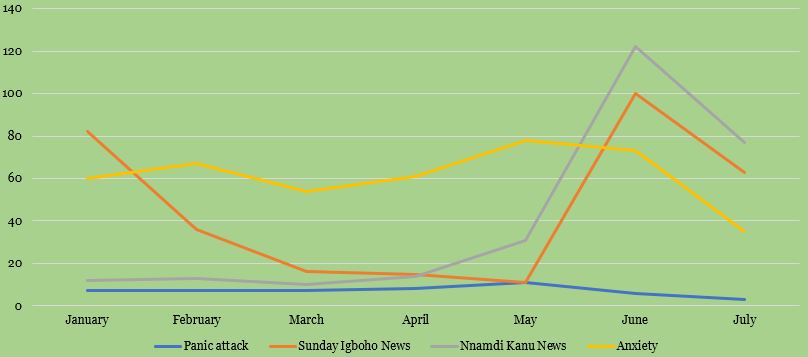
As the status conferral of different types continues with the adoption of varied frames and narratives, our analyst observes that people, especially those who lack adequate media literacy are being subjected to needless trauma based on the duo related news stories they are reading, listening to or watching in the last 28 weeks [January 1, 2021 to July 11, 2021]. In the first instance, our analysis reveals 80.8% linkage of the public interest in reading news about Sunday Igboho and Nnamdi Kanu. While they were searching for news about the duo, analysis indicates they also developed interest in understanding anxiety, one of the symptoms of mental illness. This basically occurs along with their interest in reading news about Nnamdi Kanu more than reading activities of Sunday Igboho during the weeks. For both activists, our analysis indicates that the public did not have a significant interest in panic attack, another symptom of mental illness while they were searching for news about them.

At a glance, this result looks good, however, it portends danger for management of the people with the mental illness when one examines the collectivity that exists when the public searched news of duo in relation to knowing a number of things about anxiety. The news of the duo collectively resonated with the public interest in anxiety by 60.8%. Reading the news of the two activists led to 36.9% public interest in anxiety between January 1, 2021 and July 11, 2021. The news of Nnamdi Kanu singlehanded contributed 11.2% to the public information seeking about anxiety. The news of the duo collectively resonated with the public interest in panic attack by 12.3%. Reading the news of the two activists led to 1.5% public interest in panic attack between January 1, 2021 and July 11, 2021. The news of Nnamdi Kanu singlehanded contributed 1.4% to the public information seeking about panic attack.

Exhibit 1: Nigerian Population Interest in select Mental Health Symptoms and the Activists

Source: Google Trends, 2021; Infoprations Analysis, 2021

How the Newspapers Framed the Duo

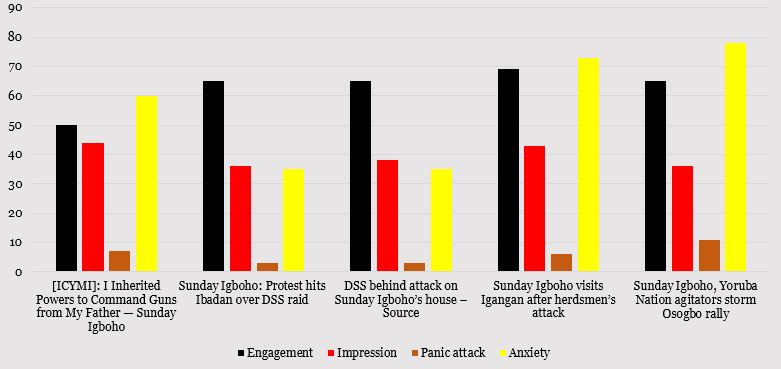
From our analysis, the Nigerian public had significant interest in anxiety in June. This is also applicable to the interest in the two activists [see Exhibit 1]. In January, the interest in Sunday Igboho was higher than the interest in Nnamdi Kanu. During this month, our analyst notes that the story titled “[ICYMI]: I Inherited Powers to Command Guns from My Father — Sunday Igboho, an interview, was one of the news reports that increased Sunday Igboho’s status. With the assertiveness frame adopted by the newspaper, our analyst notes that it is reasonable that people would seek information about him. Meanwhile, the story has the potential of inducing fear in people than informing them about Sunday Igboho’s “perceived ability to rescue his people,” during crisis.

Exhibit 2: The Punch’s Framing of Sunday Igboho in Select News Stories

Source: Google Trends, 2021; The Punch, 2021; Infoprations Analysis, 2021

From another newspaper, Sunday Igboho: Protest hits Ibadan over DSS raid and DSS behind attack on Sunday Igboho’s house –Source published in July, 2021 have great a tendency of creating fear. Sunday Igboho, Yoruba Nation agitators storm Osogbo rally and Sunday Igboho visits Igangan after herdsmen’s attack published in May and June, 2021 are not different. Analysis of these headlines by our analyst, using Headline Measurement Scale with engagement [presence of simple words and key people] and impression [presence of context words such as places and people] as categories, indicates that the stories had 15.4% influence on public interest in anxiety, while engagement singlehanded had no influence.

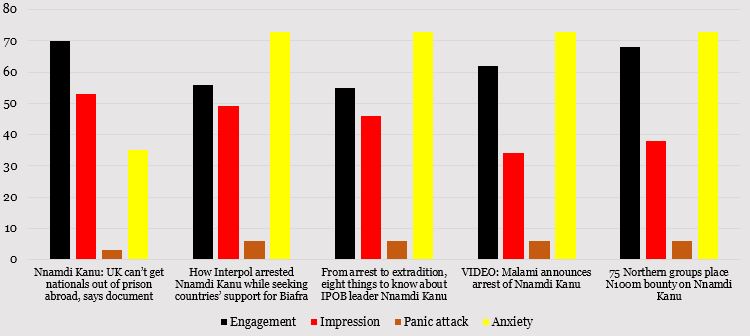
For Nnamdi Kanu with the select stories; 75 Northern groups place N100m bounty on Nnamdi Kanu, How Interpol arrested Nnamdi Kanu while seeking countries’ support for Biafra, From arrest to extradition, eight things to know about IPOB leader Nnamdi Kanu, VIDEO: Malami announces arrest of Nnamdi Kanu and Nnamdi Kanu: UK can’t get nationals out of prison abroad, says document published in June and July, 2021 also contributed to public information seeking about anxiety. According to our analyst, engagement and impression of the stories had 85.5% influence on public interest in anxiety, while engagement singlehanded had 41.2% influence.

Exhibit 3: The Punch’s Framing of Nnamdi Kanu in Select News Stories

Source: Google Trends, 2021; The Punch, 2021; Infoprations Analysis, 2021

The Place of Big Data Analytics in Managing and Providing Mental Healthcare

Despite the small samples of the headlines, it is obvious that the ongoing coverage of sociopolitical injustices by the media is increasing symptoms of mental illness. It is not surprising that the headlines resonate with the interest in anxiety because it is one of the mental illness symptoms which has been reported in south-western and north-central Nigeria. Hence, there is a need for the deployment of big data and its acquisition tools for the  provision of mental healthcare solutions and management of the patients.

For instance, agencies in charge of disease control and management need to have mindset and technical shifts towards the use of Google Trends for better understanding of population interest in mental health symptoms across regions. This will help in providing adequate behavioural and management intervention programme. This has been tested in some countries and the outcomes were surprising in all contexts.

The Referral At The Palace

4

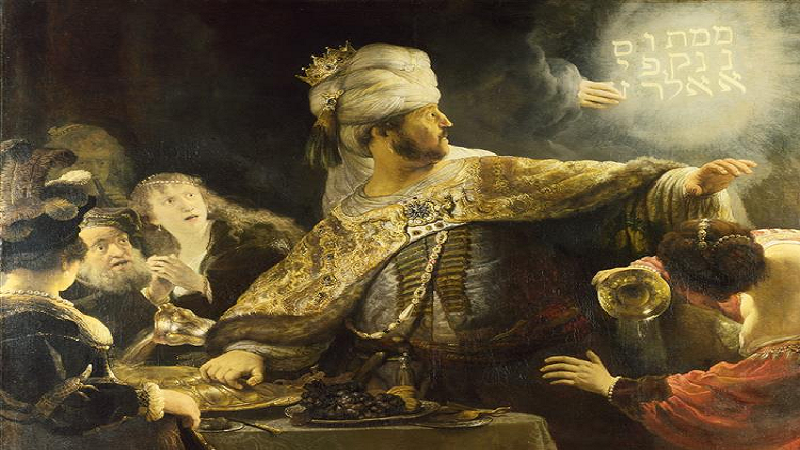
He hosted a grand banquet for royals. They drank, and then asked for the gold and silver goblets which his father had brought from Jerusalem. Then fingers of a human hand appeared and wrote on the plaster of the wall. The king became pale as he could not understand. He called his enchanters, astrologers, and diviners – the wise men of Babylon – and commanded, “Whoever reads this writing and tells me what it means will be clothed in purple and have a gold chain placed around his neck, and he will be made the third highest ruler in the kingdom.” None helped.

Then the queen came to the rescue, and told King Belshazzar that in his kingdom, there was a young man: “In the time of your father he was found to have insight and intelligence and wisdom like that of the gods. Your father, King Nebuchadnezzar, appointed him chief of the magicians, enchanters, astrologers and diviners”. 

Daniel is that man; when Belshazzar took over from his father, he was demoted. Daniel was brilliant and when Nebuchadnezzar ruled over his empires, he assembled the most knowledgeable people in all the kingdoms he controlled. He went for the best including appointing brilliant “slaves” to become heads of important positions in his government: he made Daniel the leader of his strategy team – “chief of the magicians, enchanters, astrologers and diviners”. Then Nebuchadnezzar messed up, and his son took over, and fired those people, bringing the yoyos to live in splendour.

But interestingly, those who remembered the old moments would always ask him to go back to the men who built the old empires. Here, the queen told him to call back the man under whom Babylon became greater because of his wisdom.  Unfortunately, that message was not a good one but the lesson is there.

Daniel interpreted “mene, mene, tekel, parsin” but today men and women are called to interpret new product strategy, new market entry strategy, etc. The question is this: how can you become good that men and women will recommend you in your absence? 

And hopefully, when you arrive, you will justify that confidence. I have been in Board meetings when Chairmen will ask: who truly understands this, and can we bring him here? Names will begin to fly. Elevate yourself to be remembered during such moments. Happy Sunday.

Comment on LinkedIn Feed

Extended comment: Good People, seek for that referral. Daniel got his in the palace. Yours could be in the Board, football field, or anywhere. The key is being good at something that others will recommend you. Someone recommended me for a Board position in a public company last week, and yesterday, a governor extended an invitation to visit. For that one, time is tight to travel now to Nigeria,  but I was truly happy that His Excellency was aware that there is someone like me. Possibly, someone sent something about me to him. Elevate and get the referrals from the “palace”.

Comment (from below): Three key characters to pick out here, and I will prefer to extrapolate to political space, rather than corporate, the former perfectly delivers the insights, using Nigeria as case in point.

For the characters:

First is the king, who realised that there’s a mystery that needed to be unravelled, and was willing to do whatever it took to get it done: admission and willingness to deliver.

Second is the advisers and assistants, who were equally eager to help the king solve the mystery, and when they realised that their own mastery and intelligence weren’t enough, they didn’t double down and insist that the answer must come from them, so they were disposed to bringing whoever that could get the job done.

Third is the expert, in this case Daniel. He delivered because he was called up and then allowed to work, and the mystery disappeared.

Nigeria’s present problem isn’t with the third character, because they are constant here, but the first and second characters? Herein lies the challenge. A leader who admits his own limitations and advisers who will recommend the best hands and finest minds? This is where I want to us to focus and reflect as a people.


To learn more, read this verse.

Anambra State’s Burial Law and the Test of Obi Cubana’s Extravagance

1

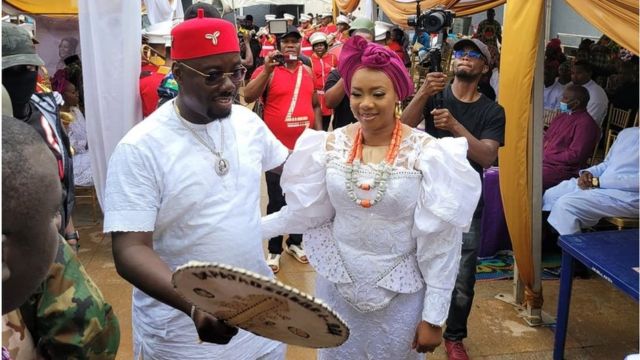
It was a weekend of extravagance in Oba, Anambra State, as Obinna Iyiegbu aka Obi Cubana laid his mother to rest. Graced by the flotsam and jetsam, the funeral has become one of the most flamboyant events in Nigeria in recent times.

Obi Cubana’s mother died in December 2020 at the age of 75, opening an opportunity for the 46-year old hospitality mogul to show off his galore of wealthy friends during the long-planned funeral.

It was more like a carnival than a funeral, as rich people from all walks lavishly flex their financial muscle. About 67 private jets reportedly touched down in Anambra Cargo Airport. Wands of naira and dollars littered the air as guests competed with each other to spray more money. About 347 cows, 158 goats and 78 rams, millions of naira were reportedly donated, among other expensive gifts for the funeral, by Obi Cubana’s friends.

Nigeria’s social media space has been agog with the lavishness of the funeral. Although the turnout is attributed to Obi Cubana’s goodwill, his investment in human capital development which has yielded many millionaires who want to pay back in some way, the extravagance has rekindled a popular issue that the Anambra State government had two years ago, enacted a law to quell – extravagant funerals.

In April 2019, the Anambra State House of Assembly passed a bill seeking to curtail the rising cost of burial ceremonies in the state. Under the bill, which was accented to a month after by Governor Willie Obiano, it’s illegal to deposit a corpse in the morgue beyond two months from the date of death. The use of uniforms in honor of the deceased was also abolished. The law also forbids blocking of road/street for burial except there is authorization from the local government.

No wake keep of any kind for a deceased person was allowed, and religious activity for the deceased must end by 9 pm, and no food, drink and other forms of entertainment on behalf of the deceased will be tolerated after. The law further stipulates that burial ceremonies must not exceed one day, and burial service must not last more than two hours. For condolence, the law says condolence visits must not go beyond one day after burials, and no one should give the bereaved family a condolence gift exceeding money for one jar of palm wine, one carton of beer and one crate of soft drink.

These among other rules in the burial act were necessitated by the societal trend of exorbitant funerals tearing families apart and throwing many into debt and poverty among other consequences after burial ceremony.

“I have seen families sell their real estates, property, and personal belongings, in order to meet up with the expectations of society as regards funeral expenses.

“Businesses had folded, marriages had broken down, children had been out of school and sudden deaths had been recorded, simply because people could not wriggle out the devastating effects of the huge expenses incurred during the funerals of their loved ones,” Catholic Bishop of Awka, Bishop Paulinus Ezeokafor, who lobbied for the bill said in an interview.

However, Obi Cubana’s mother’s burial has defied most provisions of the law and thus, sets a precedent that may revitalize the old practice if the state government fails to implement the law.

One of the major concerns in the outset of the bill was implementation. Many stakeholders believed the law would not stand the test of time as it would die where it was made. This concern stemmed from the glaring influence of non-state actors who wield enormous wealth and connections. Anambra State has many people of such status, whose affluence gives the effrontery to break some laws and get away with it.

The burial law empowers Magistrate Courts in Anambra State to try defaulters, imposing jail terms and fines as necessary. But it is easy with common people, not the likes of Obi Cubana, who is well connected as shown by the number of dignitaries and celebrities who graced his mother’s burial.

Obi Cubana owns a chain of entertainment businesses that include hotels, clubs, lounges that are scattered across Nigeria. He is estimated to be worth $96 million.

Against this backdrop, the Anambra State government is up against a test of dignity. With all eyes curiously set for the government’s reaction, whatever happens will determine the fate of Anambra State’s burial law, and the future of funerals in the state.

The Lessons from Dangote Refinery on Big Projects in Nigeria

1

Dangote Refinery: if you want to understand big project management in Nigeria, pay attention to it. Yes, in Sept 2013, billionaire Aliko Dangote told the world that he would build a refinery and production would begin in 2016. But since that date, the completion data has been moved at least 8 times. The question is this: why? Because if this was a government project, many of us could complain. This is a private enterprise and it is largely none of our business. But that does not mean we cannot learn from it.

Lesson 1: the banks which invested in this project would be under stress now if not that Dangote is loaded on cement and can move funds around to handle interests on loans.

Lesson 2: big projects in Nigeria are challenging, you need to plan very well.

Lesson 3: when things become hard, ask the government to invest to cushion debt servicing; NNPC is buying 20% of the refinery for $3.8 billion and that is a saving manna. To do that last one, you must command the conglomerate tax and get a bill updated.

Finally, Dangote Refinery had made a claim that only those with refinery license should be allowed to import petrol into Nigeria. If the government buys into that, over time, the refinery can even stop production, and focus on imports. That is why exemptions are bad: everyone needs to have the same rules.

Punch had reported that Dangote Group has desired  for inclusion in the Petroleum Industry Bill a requirement that the license to import petroleum products should be given only to companies with active refining licenses. The company does think that by having that requirement, companies will invest in local refining business.

When you do big projects in Nigeria, build a highly pessimistic model because from building rail tracks to power systems to oil refineries to steel complexes, big projects in Nigeria struggle! We need to reverse that, and if possible, use equity and not debt!