A Swedish court on Tuesday upheld a ban against Huawei selling 5G equipment in the country, dashing the Chinese company’s hopes of staging a comeback in Europe and increasing the chances of potential retaliation by China against rival Ericsson. Reuters has the report.
In October, Swedish telecom regulator PTS unexpectedly banned Huawei supplying 5G equipment to Swedish mobile firms due to security concerns raised by Sweden’s security service SAPO, a decision the Chinese company challenged in the court.
“Sweden’s security is of heavy importance and the administrative court has taken into account that only the Security Police and the armed forces together have an overall picture regarding the security situation and the threat to Sweden,” the court said in a statement.
Huawei said it was considering its options.
“It’s not unexpected based on the fact that the court is also leading their conclusions on basically the assumptions being made by SAPO,” Kenneth Fredriksen, Huawei’s Executive Vice President, Central East Europe and Nordic Region, told Reuters.
“We will continue to fight for our right to be in the (Swedish) market.”
European governments have been tightening controls on Chinese companies building 5G networks following diplomatic pressure from Washington, which alleges Huawei equipment could be used by Beijing for spying. Huawei has repeatedly denied being a national security risk.
Romania was the latest country that in effect barred China and Huawei from taking part in the development of its 5G telecommunication networks in the country. read more
Huawei’s troubles have not only helped companies like Nokia and Ericsson to grab market share in Europe, Samsung Electronics made its entry into the continent by signing British telecoms group Vodafone as a customer for supplying 5G network equipment. read more
China’s embassy in Sweden could not immediately be reached for a comment. But Beijing had previously reacted angrily to Huawei being called a security threat.
It had asked Sweden to “immediately correct the mistake” of banning Huawei and issued a veiled warning this month that it might take retaliatory action against Ericsson.
An Ericsson spokesman said the PTS decision, now affirmed by the court, “may adversely impact the economic interests of Sweden and Swedish industry, including those of Ericsson.”
Ericsson, which gets roughly 10% of its revenue from China, has voiced concerns about banning Huawei and flagged risks of losing market share in China.
The Chinese government has not responded to the decision, but there may retaliatory consequence. Earlier this month, China’s top legislative body passed an anti-sanctions law, providing legal backing for sweeping retaliation against any individuals, their families and organizations responsible for imposing foreign sanctions against the country. The new law signals China’s readiness to protect the operations of its tech companies among other interests abroad, applying retaliatory sanctions when necessary.
Has it occurred to anyone that the prices of food items are going up in the market even though there is no scarcity? A lot of reasons have been given and theories formulated concerning the inflation that hit Nigeria. The restrictions on importation of some goods, increase in PMS pump price, devaluation of Naira, dollar “scarcity”, and dependence of many Nigerians on imported products have been blamed for the present Nigerian condition. Concerning the continuous increase in the price of food items, there were speculations that insurgency, ban on importation of some stable food items, poor weather condition (of last year), and the pandemic were the reasons we were given for paying a lot of money for foods cultivated and produced in the country. Well, even though these factors are guilty of causing inflation in Nigeria, are they the only causes?
When my Economics teacher was explaining inflation to us back then in secondary school, she said that inflation is when too much money chases too few goods. In other words, there is a lot of money in circulation but, because there are insufficient goods, prices go up. Hence, inflation happens only when goods are not there to satisfy human needs. This was the ideology I have about inflation. Each time I think of it, I think of scarcity; I visualise inflation as a phenomenon that occurs when people could not find what they needed even though they can afford it. In other words, inflation should not happen when there is abundance.
Well, I hope my Economics teacher has changed her description of inflation to accommodate the type we are experiencing in Nigeria today. We actually have a unique type of inflation, where there are plenty of goods and too little money but the price of things is moving up with alacrity.
People may describe what we are having in Nigeria today as “Cost-Push Inflation”, where, as we were told, the rise in the price of essential commodities pushes up the prices of other commodities, both the essential and the non-essential ones. If we adopt this definition, it then means that what is happening in our country today is a chain reaction of some price hikes or scarcities. But then, what is that thing that we are reacting to? Initially, the PMS pump price was blamed. But when that couldn’t hold water, the blame shifted to the dollar-naira exchange rates. From there, people began to blame food import restrictions and so many others. But these fact remains that all these factors have not really explained why the prices of locally cultivated food items continue to rise in the market despite their abundant availability.
One key area people have not really considered as a possible cause of the hike in the prices of food items is the transaction that happens from the time the farmer sold his produce to the time it reached the final consumer. That little space between the farmer and the consumer is the major point of the hike in price. The actors that filled that gap are the ones that can explain why there is food inflation in Nigeria. The actors in this space are no other than the middlemen, transport companies, and executives of various market unions.
The influence of these people on food prices explains the sudden unexplainable increase in the prices of food items. Middlemen have access to local farmers, whom they buy from at very cheap rates. When they want to move their wares to the market, they pay the haulage company handsomely for their services. When they reach the market men and women, the middlemen assume the power of the gods and fix prices as they wish. This would not have been possible if there were many other middlemen that sell particular farm produce to traders in a market. But because these middlemen belong to a cartel, they reduce competition and control prices.
The executives of the different unions in the market contribute their own quota towards causing inflation by deciding the prices goods will be sold. These executives do nothing to battle the middlemen’s control over prices and availability of commodities but rather decide to increase the prices of goods sold by their members. This is why the price of a particular commodity is the same all over the market. The implication of this is that the prices of goods continue to go up with no one to checkmate those causing the hike.
So, what should we do to discourage this artificial food inflation? The answer resides with the experts. But one day, the middlemen will be bypassed, transportations will become cheaper, and all will be well.
It is not a surprise to people who have been following strategic moves of emerging businesses in various sectors in the last 5 years that Ibadan eventually made it to the global startup ecosystem map in 2021. However, it is a surprise to many that the founders and employees of the businesses helped the city attain the status despite numerous challenges. These challenges, according to our checks and business development experts who spoke with our analysts, include lack of an effective transportation system, modern facilities for business operation and security issue.
The report of StartupBlink indicates that the city saw a massive increase in ranking, jumping 601 spots to 353rd globally and 2nd in Nigeria, surpassing Abuja. “Ibadan is an ideal place to locate for Social & Leisure, Software and Data and Health startups. As the most popular industries in Ibadan, there is a sample of 2 Social & Leisure startups in Ibadan, 1 Software and Data startups in Ibadan, and 1 Health startups in Ibadan, on the StartupBlink Map. On the StartupBlink Global Startup Ecosystem Map there is also a sample of 6 startups in Ibadan, 1 accelerator in Ibadan, 1 coworking spaces in Ibadan, 1 organization in Ibadan and no leaders in Ibadan.”
Snap, Reality, Crop2Cash, Alerzo, CuraNetwork and Knitle were mentioned are startups placing the city on the global map. Having these startups is equally not a surprise because our checks indicate that tech hubs and co-working spaces which were established between 2017 and 2019 aided their recent performance and growth. For instance, Wennovation Hub, LPI Innovation Hub, iBridge Hub, Ecco Hub, Primacy edge Hub and SteinServe Hub which are located in strategic areas in the city have what it takes to enable effective operation of some of the startups.
The placement of the city on the map has further reinforced this submission. Therefore, tech hubs and co-working spaces should not only be situated in Bodija, Challenge, Ring Road, Dugbe and other highbrow areas. More office buildings are needed in emerging areas such as Mokola, Okebola, Moniya, Olodo, Ife-Ibadan Expressway, Agodi-Gate and others.
For the developers that build for investors, it is high time that the investors are advised to consider construction of co-working spaces instead of massive interest they have been having in shopping complexes and shop-houses in the last few years. No doubt, the shop property type outperforming the office property type in the city. The current status of the city within the global startup ecosystem should be a key element for investment-interest shift.
Additional reports by Mubaarak Abdulhameed [a Builder and Quality Engineer] and Mariam Akanni [a Real Estate Marketer]
Nigeria created jobs this week when water found its way into the well-renovated and refurbished National Assembly complex in Abuja; please do not blame the rainfall! If we have 36 of these episodes, we will create temporary jobs for 3,600 people! You see why things are not working: if the high priests can be lost this way, the signals from the antenna of Nigeria’s future are certainly gone.
Yes, if the parliamentarians cannot supervise the quality of work in their offices, how do you expect them to supervise or organize Nigeria? Sure – it is rainfall and bad things happen, even though I will not naturally expect rain to follow the spider into the palace! Do not get me back to the village where proverbs are like the kolanuts upon which words of wisdom are eaten.
Okenye adigh? an? n’?l? nne ewu am?? n’ogb?r? [An elder does not sit at home and watch the she-goat suffer the pain of childbirth tied to a post], says an African proverb. Today, both the elder, goat, rope and post are all tethered. Tufiakwa.
The financial markets constitute a socioeconomic ecosystem where individuals, organizations and institutions can trade various financial instruments (metals, currencies, stocks, securities, indices, oil, and now cryptocurrencies, etc.). Here these instruments are traded at a fair cost and on the basis of demand and supply. Trading the financial markets carries a substantial amount of risk and the need to make adequately informed decisions (while trading) cannot be overemphasized. While concepts like Technical analysis (via price action) and fundamental analysis are reasonably effective, it is imperative to have a solid trading plan and strategy that is robust and sustainable.
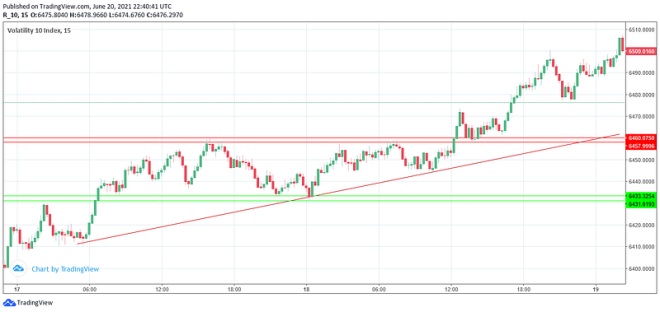
Personally, I do not believe that any financial instrument completely exhibits Brownian behavior. This is because prices will usually respect key historical zones (supply and demand zones) as well as market channels. A good example can be seen in the volatility 10 index chart below (the demand zone is marked with green lines and the supply zone is marked with red lines, the market channel was is also marked with a red diagonal trend line).
Volatility 10 index price chart
From the chart we can see that the price occasionally bounced-off the marked zones and this forms the basis for price-action trading.
Some statistical tests can be carried out on the close price of financial instruments (to ascertain key metrics which can further be used to better understand market behavior); one of which is the Augmented Dickey-Fuller test. This test is used to check if a particular asset or instrument will revert to its rolling mean after a market swing (in upwards or downwards direction).
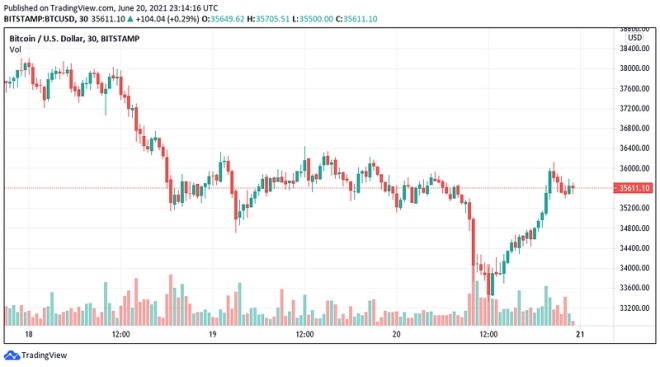
The Bitcoin stock-to-flow model makes it possible to trade it against a base currency on the foreign exchange market. This means that as with the Volatility 10 index above, bitcoin can be represented (on the charts) by its open, high, low and close prices and consequently traded with leverage at varying trade volumes. The bitcoin chart can be seen below.
The bitcoin against US dollar price chart
Seeing that there exists a degree of repetitive behavior of in price movement, can this behavioral pattern be recognized by a machine learning model?, if yes what model could be ideal?
Well, I hope that this article guides your discretion in answering these questions. For demonstration I have used the bitcoin price data (from April 2013 to February 2021) as obtained from kaggle.
WHY LSTM?
LSTM (Long Short-Term Memory) is a deep learning model that helps with prediction of sequential data. LSTM models prevail significantly where there is a need to make predictions on a sequence of data. The daily OHLC (Open, High, Low and Close) price of any financial asset constitutes a good example of a sequential data.
IMPLEMENTATION
As proof-of-concept, I have implemented an LSTM model for predicting Bitcoin’s price using python. I have outlined my step-by-step procedure as well as my thought process every step of the way. Without further ado, let’s go!
Firstly, we import the requisite python libraries
import numpy as np #Python library responsible for numerical operations
import pandas as pd # The pandas dataframe is a python data structure that helps construct rows and columns for data sets`
import matplotlib.pyplot as plt # This library is responsible for creating the necessary plots and graphs
import tensorflow # This is a python framework with which different models can be easily implemented
INGESTING THE DATA SET
data = pd.read_csv(‘coin_Bitcoin.csv’) # Here we are simply using pandas to import the csv file containing the BTC data
data.head() # Taking a quick look at the first 5 rows of the data
The first five rows of the bitcoin price data
We only require the Date, High, Low, Open and Close columns and so we drop every other column. Since it is a time-series data, it is best to set the date column as index. This way we can easily observe price behavior over time.
In a bid to ascertain more insights on price changes, we create a column that constitutes the daily Logarithmic returns. The reason we are interested in this metric is partly because stock returns are assumed to follow a log normal distribution and also because log returns is a more stationary property than the regular arithmetic returns.
Thus,
required_data[‘% Returns’] = required_data.Close.pct_change() # we find the percentage change using the pct_change() method
required_data[‘Log returns’] = np.log(1 + required_data[‘% Returns’]) # from the percentage returns we can easily compute log returns
required_data.dropna(inplace=True) # We drop all null/NaN values so that we do not get a value error
I have used the close price and log returns in training the model inputs because the close price is usually the most effective parameter for evaluating price changes, and the log returns offers stationarity to the model.
Let’s take a look at the close price curve:
Close price curve and also the log returns:The log returns curve
As seen in the Log returns curve, the values oscillate around the zero mean value, thus indicating stationarity.
x = required_data[[‘Close’,’Log returns’]].values #The requires data fields are the Close price and Log returns
Next stop, data normalization. Normalization helps to narrow values to a range 0?—?1 so as to annul the effect of data points constituting high standard deviation. This means that in a situation where later values are significantly higher than earlier values (as with Bitcoin), normalization will help to reduce the effect of higher values on the overall prediction.
We then import the relevant libraries:
from sklearn.preprocessing import MinMaxScaler
from sklearn.preprocessing import StandardScaler
scaler = MinMaxScaler(feature_range=(0,1)).fit(x) # we pass the relevant data to the MinMax scaler
x_scaled = scaler.transform(x)
For the training the model outputs, we specify only the closing price as that is what we want to predict in the end.
y = [x[0] for x in x_scaled] #Using the slice notation to select the Close price column
Now we want to allocate 80% of the data as training set and 20% as test set, an so we specify a split point
split_point = int(len(x_scaled)*0.8) # This amounts to 2288
Creating the training and testing sequence:
x_train = x_scaled[:split_point]
x_test = x_scaled[split_point:]
y_train = y[:split_point]
y_test = y[split_point:]
We then try to verify that the datasets have the right dimensions:
assert len(x_train) == len(y_train)
assert len(x_test) == len(y_test)
Now we label the model:
time_step = 3 # the time step for the LSTM model
xtrain = []
ytrain = []
xtest = []
ytest = []
for i in range(time_step,len(x_train)):
xtrain.append(x_train[i-time_step:i,:x_train.shape[1]]) # we want to use the last 3 days’ data to predict the next day
We can see that while the predicted values are not exactly the same as the original values, the model predicted the overall direction reasonably well. I believe that this model can be combined with other models (like the Autoregressive Integrated Moving Average model) to proffer better insights as to the overall market sentiments.
NB: This article does not constitute a financial advice as it is solely intended to demystify the financial markets (with Bitcoin as a case study), and show how machine learning can be leveraged-on to investigate different financial assets. Cheers!