DD
MM
YYYY

PAGES

DD
MM
YYYY

spot_img

PAGES

Home Blog Page 5817

Making a Case for SDG18 Eradicating Pandemics and Epidemics

0

I am proposing a rethink of the UN Sustainable Development Goals (or SDGs), largely from an African lens. In this article, “Making a Case for SDG 18 Eradicating Pandemics and Epidemics,” my main contention is that Africa has always been late to the party from a global community perspective.

We have witnessed the laid back attitude of many countries who are party to numerous accords and treaties include those related to climate change and the sustainable development goals. I say laid back, because the arguably “smart” members put their national/ regional interests first. Is it protect Big Tech as is the case of the US or the Common Agricultural Policy (including fisheries) in Europe (notably France)?

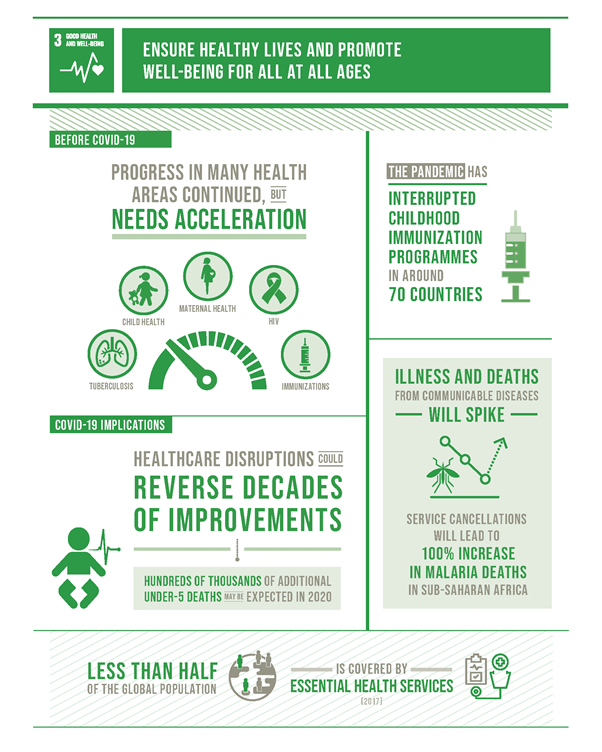
Why is the UN SDG skewed towards climate change and the environment and less elaborate on health concerns (Africa’s main challenge), which have now been accentuated by the coronavirus pandemic and the firefighting approach to what should have been long foreseen?

Looking at the 17 SDGs, at least seven revolving around the environment i.e., SDG 6 (Clean Water and Sanitation), SDG7 (Affordable and Clean Energy), SDG 11 Sustainable Cities and Communities, SDG 12 Responsible Consumption and Production, SDG 13 Climate Action, SDG 14 Life below Water, SDG 15 Life on Land. In all of this,  only 1 is focused on health i.e., SDG 3 Good Health and Well Being. This makes me wonder how unhealthy people can take care of the environment and climate change related matters.

Malaria is still baffling Africa alongside Tuberculosis, Cholera and Ebola – all immunisable epidemics that preceded the technological advancements we enjoy today.

Believe it or not, Ebola is (not was) a pandemic only limited by its spread, and consequently relegated to the status of epidemic. However, neglecting its severity may well have made it more difficult to manage the current coronavirus pandemic. As a recent article in The Africa Report points out, African leaders are still at the preparatory phase of tackling the next pandemic.

Only recently, a report from the African Union read “Africa Mulls over Vaccine Manufacturing – African Union.” Read the excerpts of that news briefing:

African leaders and international and regional partners are holding a two-day conference to discuss manufacturing and supply of COVID-19 vaccines across the continent. President of the Democratic Republic of the Congo Felix Tshisekedi, who is the current chairman of the African Union for 2021, South African President Cyril Ramaphosa, Rwanda President Paul Kagame, and Senegal President Macky Sall are attending the two-day conference…


The list of attendees at the conference cannot get any bigger that the following four:

  • Moussa Faki Mahamat: Head of the African Union Commission.
  • Tedros Adhanom: Director General  of the World Health Organisation.
  • Akinwumi Adesina: President of the African Development Bank.
  • Ngozi Okonjo-Iweala: Director General of the World Trade Organization.

In his welcome address at the virtual conference, Mahamat called for what he described as “a strategic partnership for a new health world order” in view of enabling the continent to be able to meet most of its need for pharmaceutical drugs and vaccines.

In an article I published two years ago, “Meeting the Sustainable Development Goals through Higher Education,” I raised concerns about the preparedness of Africa towards meeting SDG 4 Quality Education.

Interestingly, the 2021 session (ninth in the series of meetings) of the High-level Political Forum on Sustainable Development (HLPF) taking place from 6 July 2021 plans to interrogate the national implementation of the SDGs by tracking progress and challenges at this level.

The HLPF is the main UN platform on sustainable development. It has a central role in the follow-up and review of implementation of the 2030 Agenda for Sustainable Development and its Sustainable Development Goals (SDGs). All UN Member States as well as representatives from civil society organizations participate in the HLPF, which meets under the auspices of the UN Economic and Social Council (ECOSOC).

It also seems, from reading the agenda of the forthcoming conference, that only nine of the 17 SDGs would be on the table come July 2021.

The 2021 HLPF will also hold in-depth reviews of nine SDGs: Goal 1 (no poverty), Goal 2 (zero hunger), Goal 3 (good health and well-being), Goal 8 (decent work and economic growth), Goal 10 (reduced inequalities), Goal 12 (responsible consumption and production), Goal 13 (climate action), Goal 16 (peace, justice and strong institutions), and Goal 17 (partnership for the Goals).

In the light of the above, perhaps it may be too late or unnecessary to have another SDG, but the importance of refocusing efforts on preventing future pandemics and having an “armed response,” so to speak, strategy in place, may well move SDG 3 further up the agenda. For African Leaders, kindly make more judicious use of the resources you plan to set aside for Covid-19 vaccines by sourcing what you have limited capacity of making. Focus on sourcing and distribution for now and provide us with an update on the Ebola vaccine and other diseases that pose a clear and present danger.
Tekedia Capital Launches To Democratize Wealth Creation

4

Good people, I am very happy to share that we have launched Tekedia Capital and just made our first two investments (a digital bank in Nigeria, and a California-based digital-tech in energy downstream sector with focus in Africa). I invite all nations, all organizations, and all people of the world to partner with us to build the next Africa.

Through our playbook, everyone can have access to Africa-operating category-king companies, which are changing the ordinance of markets, and accelerating human welfare, community advancements and wealth in nations.

Prospective investors, click here to learn more, watch the short video, and schedule to speak with us [email capital@fasmicro.com and we will send time slots].

Tekedia Capital offers a specialty investment vehicle (or investment syndicate) which makes it possible for citizens, groups and organizations to co-invest in innovative startups and young companies in Africa and around the world. Capital from these investing entities are pooled together and then invested in a specific company or companies. 

We invest in mainly technology-anchored companies and are sector-agnostic which means those companies could be operating in any industry, including finance, real estate, education, health, logistics, etc. The opportunity is open for individuals in Africa, Africans in diasporas, global citizens in any place in the world, investment groups and organizations around the world.

This is the era of opportunity. Yes, a cambrian moment for the creation of new wealth, and I want you to get excited about the promises of the future. Click and learn more.

For startups which are looking for funds, learn more here. This video explains what we are looking for in startups and their leaders.

Let’s #BuildAfricaTogether.

Those Twitter Ghana Jobs With Special Language Requirements – Igbo, Hausa, Yoruba

0

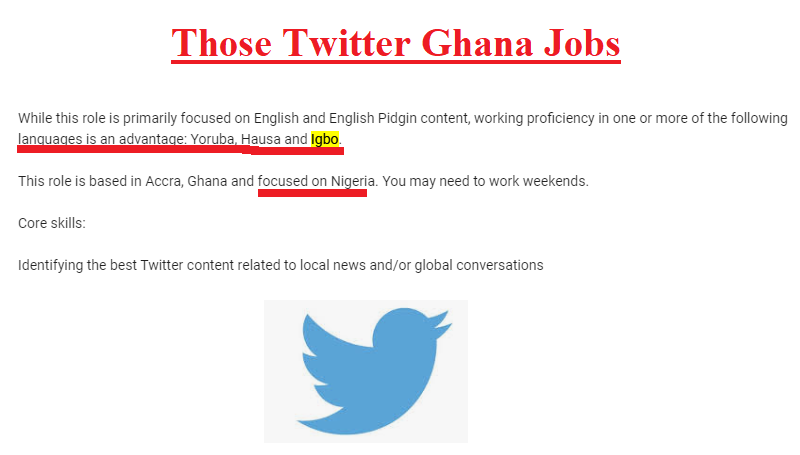
People, I glanced through some of the Twitter Africa jobs and most of them are designed around the Nigerian market. In short, the big boss for this is a Nigerian woman. They want you to understand one of Hausa, Igbo and Yoruba! Simply, I expect Twitter to open an office in Nigeria by 2024. The trajectory is evident, and there is no reason NOT.

Bloomberg tried to cover Nigeria from London but struggled – and then it began to operate from Ikeja Lagos [you will not notice as the building is nondescript]. I was among the first people it interviewed when it opened. Most consulting firms tried to cover Nigeria from South Africa until they opened shops in Lagos. If Lagos is a country, it would be the 5th or 6th largest economy in Africa.

Go and improve your Igbo, Hausa or Yoruba as Twitter needs those languages for some jobs. You will be positioned in Ghana but note that you may be required to have extended stay in Lagos, So, keep your Lagos apartment as Twitter will reimburse for rents, not hotel bills, in Lagos! You get the idea.

Ghana WINS Twitter

SEC circular on the trading of foreign securities by investment platforms in Nigeria

0
SEC Nigeria

By Ibrahim Moshood, Associate, Centurion Law Group (https://CenturionLG.com)

The apex regulator of securities in Nigeria, the Securities and Exchange Commission (“SEC”) has issued a circular, with respect to technology investment platforms providing the Nigerian public with access to foreign securities. The circular dated 8 April 2021, issues a strong warning to these investment platforms and Capital Market Operators (“CMOs”) in partnership with them to provide brokerage services. Both categories of players in the financial space were warned to desist from providing the Nigerian public, with access to foreign securities. This is pivoted on the grounds that these securities are neither registered with the SEC nor listed on the Nigerian Stock Exchange (“NSE”).

From 2018, technology start-ups have pioneered major disruptions of the financial space in Nigeria. These disruptions have been lauded by Nigerians, particularly at a time when there has been a persistent devaluation of the Naira.  Savvy and upwardly mobile Nigerians have then opted to use these technology platforms, to save in foreign currencies and also purchase foreign stocks that are being offered. Some of these technology investment platforms include Trove, RiseVest, Chaka and Bamboo etc. They typically partner with CMOs in Nigeria for their expertise and already-procured brokerage licence.

As a background, recall that in December 2019, the SEC had published a statement to notify the Nigerian public of its interim orders to restrain an investment platform called Chaka Technologies Limited (“Chaka”). This order came about as a result of the advertisement and sale of foreign securities of companies such as Google, Alibaba, Facebook, Tesla etc. in Nigeria by Chaka. The SEC had informed the Investment Securities Tribunal (“IST”) that Chaka had offered securities for sale “outside the regulatory purview of the Commission and without requisite registration as stipulated by the Investment and Securities Act (“ISA”).

Chaka responded to the allegations above by releasing a press statement, denying the wrongdoing entirely.  However, in March, Chaka announced that it had obtained a newly created licence from the SEC which allows it to offer the services above i.e. advertising and sale of foreign securities to the Nigerian public.

Notwithstanding the development above, the SEC had kept quiet for months on this issue until this recent circular, which Nigerians have reacted to as a deliberate attempt to stifle innovation by the regulators, create a multiple licensing regime, an inordinate drive for revenue and a shoddy attempt at stabilizing exchange rate of the Naira.

Currently, two major questions should be addressed by the SEC.

  1. Is the sale of foreign securities by these platforms prohibited in Nigeria?
  2. Is there a licence issued by the SEC or some other regulatory agency that would allow these investment platforms carry on the business of selling foreign securities in Nigeria?

Hopefully, the SEC will release a more informative circular or press statement clarifying what investment firms should do to continue offering these foreign securities. In the meantime, investors and investment firms alike are enjoined to consult professionals for more clarity.

Huawei to Invest $1bn on Car Tech, Signaling Attempt to Find Alternative to Telecom Business

0
Most parts of the world have been pushing to cage Huwaei

As US sanctions push Huawei to the wall, the embattled Chinese telecom vendor is beginning to weigh other choices to stay in business.

Bloomberg reported that Huawei will invest $1 billion on researching self-driving and electric-car technologies, accelerating plans to compete with Tesla Inc. and Xiaomi Corp. in the world’s biggest vehicle arena.

The Chinese telecom giant was leading the global 5G roll out before the United States, based on security concerns, blacklisted the phonemaker on many fronts.

According to the report, the Chinese telecom giant will partner with three automakers initially to make self-driving cars that carry the Huawei name as a sub-brand, said Xu, one of three executives who take turns to fill the post. It will keep its circle of partners small and get its logo onto cars — not unlike how Intel Corp. calls attention to its microprocessors on PCs — that adopt its autonomous driving technology, he added. The mobile giant has so far agreed to team up with BAIC Group, Chongqing Changan Automobile Co. and Guangzhou Automobile Group Co.

“The smart car business unit receives one of the heaviest investments from Huawei. We will invest more than $1 billion in car component development this year,” Xu said. “China adds 30 million cars each year and the number is growing. Even if we don’t tap the market outside of China, if we can earn an average 10,000 yuan from each car sold in China, that’s already a very big business for Huawei.”

China is the biggest market for electric vehicles, and divestment to carmaking will protect Huawei from the effects of US sanctions.

The United States has succeeded in rallying its allies against allowing Huawei to lead or involve in deployment of their 5G infrastructure, leaving the Chinese telecom company nearly crippled.

The teleco’s hope to use openings allowed by the sanctions to keep its telecom business alive was dashed by further sanctions.

In August, the US Bureau of Industry and Security (BIS) in the Department of Commerce announced that Huawei and its non-US affiliates on the Entity List have been restricted access to items produced domestically and abroad from US technology and software.

The BIS restrictions, which added another 38 Huawei affiliates to the Entity List, prevent Huawei’s attempts to circumvent U.S. export controls to obtain electronic components developed or produced using U.S. technology.

The pandemic-induced global chip shortage compounded Huawei’s woes, throwing its smartphone and gadget production into jeopardy.

To stay alive, the Chinese company is learning to ply its trade in other sectors. Huawei’s billionaire founder Ren Zhengfei is directing the firm toward new growth areas such as smart agriculture, health care and electric cars.

It hopes for a seat at the table with tech giants vying to define the rapidly evolving fields of connected vehicles, homes and workplaces, Bloomberg said.

These new areas of interest have the potential to win the US’ friendship. The pro-green Biden’s administration is welcoming plans geared toward green energy as it pushes to implement the Paris Climate Accord. Huawei stepping into the EV industry may well paint it in a good light before Biden’s administration that has shown few signs of taking a different approach from Trump.

However, Huawei’s new choice of business in an industry already dominated by Tesla, Nio, Xpeng Inc. and other EV makers in the China market, will face a mammoth of competition challenge.

Last month, Xiaomi, Huawei’s rival in smartphone and gadget making, unveiled plans to invest about $10 billion over the next decade on manufacturing electric cars. Search giant Baidu Inc. and Geely Automobile Holdings Ltd. are also said to be teaming up to build vehicles.

Research firm Canalys estimates that EV sales in China may climb more than 50% this year alone as consumers embrace cleaner automobiles and costs tumble, but it takes more than high demand and lower cost to win market shares.

The Huawei team believes they have what it takes to compete in the crowded Chinese EV market.

“I don’t know if they were bragging, but my team said they can have cars driving on their own without human intervention for 1,000 kilometers. That’s way better than Tesla,” Xu said Monday.